


Can Globalization Cause Wars?
Globalization has become the buzzword that you get to hear everywhere in this modern age ????. It bridged the gap between us, shrank the world, and facilitated cross-border idea and resource flow. But with all the benefits it brought in its wake, is it also going to raise wars? Let us plunge into this intriguing yet complex subject step by step!
Introduction
Defining Globalization
What is globalization? It is a process where the world is being tied together through trade, technology, culture, and politics. From the internet, which connected far-flung communities to companies outsourcing work to other countries, globalization affects all aspects of life. Brethren,
Historical Background
Did you know it wasn't just a 21st-century thing? It all began on the Silk Road, where goods and ideas flowed across continents; further supercharged by the Industrial Revolution and modern technology, which has made our world more interdependent than ever.
Role of Technology
Technology has been the backbone of globalization: the Internet, smartphones, and transportation systems. While these do make information, goods, and services more accessible, they also have become part of new vulnerabilities and tensions.
Overview of Globalization and Conflict
A Brief History of Globalization-Induced Conflicts Conflicts often emerge from the roots of globalization. From colonial struggles over resources to modern cyber conflicts, the fact is that globalization and peace do not always go hand in glove.
Why This Topic Matters Today
In today's interdependent world, conflicts in one region send ripples across the globe ????. For example, the Russia Ukraine war has driven energy prices up the world over. Showing these links will, in turn, help us to understand how to avoid any more crises.
Purpose and Scope of the Article
We are going to discuss:
The tenuous relationship between globalization and war ????️????.
The causes behind the conflicts fostered by globalization.
Potential solutions toward a more harmonious world.
Understanding Globalization
Economic Globalization
Trade and commerce are the heart of globalization ????. But is it all roses?
Trade Liberalization: While opening their markets to each other does create interdependence among nations, there is a price to pay in terms of competition.
Global Markets: International trade, dominated by corporations, sometimes at the expense of small economies, causes tension.
Cultural Globalization
The cultures of the world keep on merging ???????, but not everyone is pleased with it.
Spread of Cultural Norms: Whether it be Hollywood, K pop, or fast food-all these have become omnipresent; does this dilute local traditions?
Tensions: Many societies resist the process of cultural homogenization; hence frictions arise and even conflicts.
Political Globalization
Global governance is another key aspect.
Global Organizations: The UN, WTO, and others mediate disputes but are often accused of biased or ineffective practices.
National Sovereignty: Many countries believe that they are losing control to global powers.
Technological Globalization: Technology has connected humans in ways never imagined ????, but it is also a double-edged sword.
Internet: Facilitates communication and collaboration, yet at the same time, it is the hub where cyberattacks are born.
Cybersecurity: More connectivity brings more causes for digital warfare ????️⚔️.
Environmental Globalization
Climate change is a mutual problem but at the same time one of conflict ????????.
Conflicts: Nations often disagree over how to deal with environmental problems.
Climate Security: Scarcity in such resources as water and arable land may serve as a cause of wars.
Can Globalization Give Rise to Wars?
Economic Disparities and Conflicts
Money is power, and disparity is an invitation to resentment.
North-South Divide: Richer countries get their way at the expense of poorer ones.
Resource Competition: They fight over oil, gas, and minerals ????.
Cultural Clashes: Not everyone embraces cultural globalization.
Resistance to Homogenization: The more resist in order to preserve their distinctive identities.
Identity Crises: Erosion of culture brings unrest, and even rebellion. Geopolitical Rivalries Power dynamics are a big problem.
These are the emerging powers, such as China and India, leading the new kids on the global block and making ripples in politics. Territorial Disputes: With increased globalization, disputes over land ????????️ also tend to escalate.
Cyber Conflicts and Warfare
Enter the digital battlefield ????⚔️.
Cyberattacks: Nations are victimized by hackers who steal data and disrupt systems.
Case Studies: Examples include alleged Russian interference in elections and Chinese cyber espionage.
Ecological Resource Wars
Natural resources are in demand.
Water Wars: Countries like India and Pakistan have disagreements over shared rivers.
Energy Conflicts: Fossil fuels and rare earth minerals are the sources of conflicts.
What Happened: Britain imposed opium on China, leading to wars and deep-seated bitterness.
Lessons Learnt: Trade, if not handled in a responsible manner, can ignite conflicts. World War I and Economic Interdependence Global trade didn't prevent WWI—it exacerbated it.
Pre War Tensions: Interdependence of economies couldn't check rivalries.
Key Takeaway: Dependency is not necessarily a deterrent. The Cold War A global
ideological battle between capitalism and communism.
Proxy Wars: From Vietnam to Afghanistan, globalization stoked these wars.
Impact: Developing nations suffered most during the Cold War.
The War on Terror
Globalization has spread terrorism.
Networks: Terrorist groups use global technology and funding.
Countermeasures: Nations globally work in unity to counter terrorism. Russia Ukraine Conflict A contemporary consequence of globalization's negative consequences.
Energy Dependence: Europe's reliance on Russian gas complicated responses.
Global Ripple Effects: Sanctions and energy crises affected everybody.
Arguments entaronationelor Against Globalization Causing Wars
The Peace Through Trade Hypothesis
Can trade foster peace? ????????
Economic Interdependence: Countries with close trade relations are less likely to go to war.
Examples: The EU is an excellent model of trade-borne peace. Global Institutions as Mediators Organisations like the UN form a critical element.
Conflict Resolution: Mediation prevents wars before they start.
Success Stories: Countless disputes have been peacefully resolved with the help of such institutions.
Cultural Exchange - Binding Force
Exposure to culture opens communication lines ????????.
Mutual Understanding: The more one learns about another, the less suspicion.
Success Examples: Cultural festivals and global events bring people together.
Technology Fostering Dialogue
The internet brings us ????.
Cross Cultural Communication: Social media facilitates friends all over the world.
Global Projects: Sites like Wikipedia and TED Talks promote knowledge and peace.The Global Movement for Climate Action Climate challenges make us one.
Cooperation: Agreements like the Paris Accord show that we can cooperate.
Common Interests: Combating climate change is in all of our best interests.
The Future of Globalization and Conflict
Emerging Powers and Shifting Alliances
The dynamics are global, and shifting.
Predictions: New Alliances and New Rivalries will reshape the world ????. Artificial Intelligence and Warfare AI is the next big challenge.
Risks: Autonomous weapons could spark conflicts. Opportunities: AI can also be a tool for peace.
Economic Decoupling and Fragmentation
Are we moving toward deglobalization?
Implications: Economic fragmentation may stabilize or destabilize the world. The Role of Youth in Shaping Globalization
Young people are the future ????.
Movements: Youth-led movements for peace and sustainability. The Responsibility of Global Institutions
The stronger the institutions, the fewer the conflicts.
Reform: The need for organizations to change and accept modern challenges.
Conclusion
Recap of Key Points
Globalization is a unifier as much as it is a divider ????. This connects people through trade and culture but also causes economic, political, and environmental tensions.
Call to Action
We have to work together so that globalization will be a force for good ????. Such work is required from governments, organizations, and individuals alike. "
Final Words
The interdependence of the world is inevitable. It is up to us whether we would allow it to let us apart or bring us together.
Some Frequently Asked Questions
1. Is globalization something new?
No, it started some centuries back but has gained tremendous momentum in recent times because of technology.
2. Does economic interdependence prevent wars?
It may, but the pages of history bear witness that it is not a certain guard against wars.
3. How does Globalization affect culture?
It spreads ideas, but simultaneously erodes local traditions.
4. Do cyber wars fall under the heading of globalization?
Yes, in as much as increased connectivity has made nations prone to cyberattacks.
5. What does the future hold for globalization?
It depends on how the challenges and opportunities that arise from it are met.
About the Creator
Saudi Arabia Biodegradable Plastic Market Size and Forecast 2025–2033
Saudi Arabia Biodegradable Plastic Market Outlook 2025–2033 Saudi Arabia’s biodegradable plastic market is entering a decisive growth phase as sustainability becomes a national priority rather than a niche initiative. According to Renub Research, the Saudi Arabia Biodegradable Plastic Market is expected to grow from US$ 78.65 million in 2024 to US$ 221.98 million by 2033, registering a strong CAGR of 12.22% during the forecast period 2025–2033.
By Marthan Sir4 days ago in Earth
Europe Wheat Market Size and Forecast 2025–2033
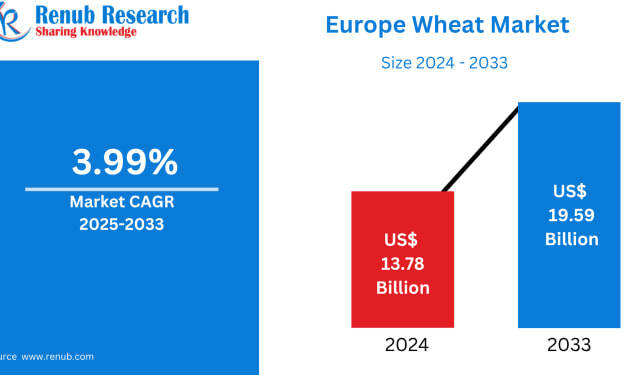
Europe Wheat Market Overview The Europe Wheat Market is projected to grow from US$ 13.78 billion in 2024 to US$ 19.59 billion by 2033, expanding at a CAGR of 3.99% during 2025–2033, according to Renub Research. This steady growth is supported by rising food consumption, strong export demand, improved yields, government-backed agricultural policies, and the rapid adoption of modern farming technologies across the region.
By Aaina Oberoi5 days ago in Earth
The Summer I Was Chosen by a Northern Mockingbird
During the long, suspended days of the pandemic, a wild mockingbird began visiting my driveway and chose me, again and again. What started as a strange encounter became a brief, meaningful connection that I still carry with me.
By Erica Roberts 3 days ago in Petlife


Comments
There are no comments for this story
Be the first to respond and start the conversation.