
Boltzmann brains and brains in tanks: do we live in reality or fantasy?
Boltzmann's brain and the brain in a tank

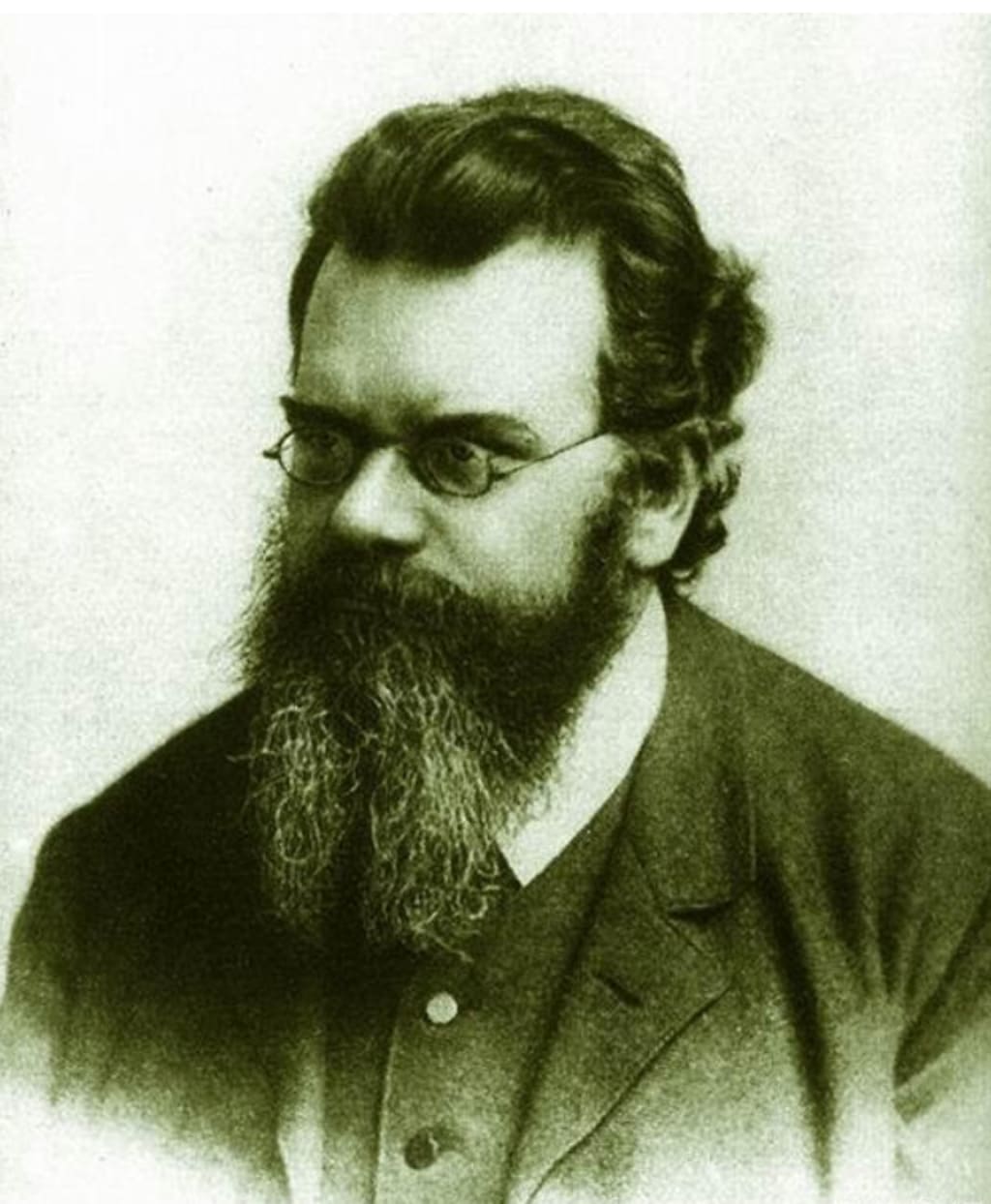
Boltzmann's brain and Schrödinger's cat are similar concepts, both belonging to the imagination of scientists. Schrödinger's cat is based on the assumption of quantum mechanics, and Boltzmann's brain is based on the assumption of entropy. My previous article just introduced what entropy is and explained how entropy increases (for those readers who do not understand entropy, please go through my previous article first to get a feel for it and to lay the foundation for understanding this article). Boltzmann's brain is a point of knowledge that unfolds in the context of entropy.
Let me first introduce Boltzmann, who conceived this brain. Boltzmann, whose full name was Ludwig Eduard Boltzmann, was an Austrian physicist and philosopher, and one of the founders of thermodynamics and statistical physics. His greatest achievement was the development of statistical mechanics, which explains and predicts the physical properties of matter through the properties of atoms, and explains the second law of thermodynamics in a statistical sense.
The second law of thermodynamics is the most countable state of the microscopic world (the most countable state) and is the macroscopic manifestation of disorder (maximum entropy). This is because the number of disordered microstates is much greater than the number of ordered microstates.
Boltzmann also concluded that an ordered state in which molecules move in the same direction at the same rate can be conceived as the most improbable state and an impossible configuration of energy. (The internet says this statement is better understood. Why I don't think so!!!)
We have said before that everything in the universe tends to increase in entropy and become chaotic. Yet the truth is that we don't feel the unusual chaos of this universe and things around us are not that chaotic. This is because everything in the universe has something that can do work, something that absorbs negative entropy to keep itself in a low entropy state. So the whole universe stays in a state where entropy is not very high between the rise and fall of entropy, and it takes a very, very long time for entropy to increase to a heat-dead state.
After all, the universe has been around for 13-14 billion years. We, humans, have only snapped our fingers in that long time, and our planet has held its shape for 4.6 billion years. How is it possible for humans to feel a change after only a few thousand years of history?
Boltzmann's brain is thought to have a lot of low-entropy self-awareness between fluctuations in entropy in a low-entropy universe. Why a brain? Because there is only one brain with lower entropy than that of a body. But if we don't have this brain that carries consciousness, then it is just consciousness, which is incomprehensible to us (which is surely a fetter on our minds, the fault of our habitual thinking).
One more question, why do you think there is such a brain (self-consciousness) in the universe? Because we humans have emerged in a universe with higher entropy, more complexity, and a lower probability of occurrence compared to a brain (self-awareness), which should have emerged in a universe with such low entropy, simplicity, and a slightly higher probability of occurrence.
Since Boltzmann's brain could exist, what is the difference between it and us humans? We have more bodies and living environments than Boltzmann's brain. To put it bluntly, it is a world where we humans have more entities than Boltzmann's brain. But if you think of it this way, self-consciousness can also build a world for itself. The imaginary world in which consciousness roams in the image does not need to be bound by the physical body. And through imagination, it can set up its own experience at will.
What if you were Boltzmann's brain? Or is everyone a Boltzmann brain? We all have a sense of self. After all, you can't prove that the so-called reality is necessarily true. You might just be setting up your own experience right now, and the world is your setting. The world now could also be the world that the Boltzmann brain clusters in the universe are interconnected to build and experience together.
There is also a brain-in-a-jar experiment that resembles a Boltzmann brain, an epistemological thought experiment. It was proposed by Hilary Putnam in 1981 in her book Reason, Truth, and History. Hilary Putnam, whose full name was Hilary Whitehall Putnam, was a leading contemporary American philosopher, logician, and philosopher of science. He is the pre-eminent British and American philosopher of the 20th century. He achieved great success in the philosophy of mind, philosophy of language, philosophy of science, philosophy of mathematics, and moral philosophy, and even contributed to the field of computing.
The mid-brain experiment is based on the idea that everything a person experience is eventually translated into neural signals in the brain. The experiment works like this. Suppose a person is removed from the human body by evil scientists and placed in a tank filled with a nutrient solution to maintain physiological activity. A supercomputer is then used to connect the nerve endings of the brain and all sorts of nerve signals are transmitted to the brain in the same way as in the human body. At the same time the same signal feedback, as usual, is given to the signals sent by the brain. Then everything the brain experiences would be an illusion provided by the supercomputer, and the supercomputer could create any experience for this brain, so would the brain still be aware of its situation?
In many science fiction films, people want to upload themselves to computers and the internet and live forever as a form of consciousness in the world. Similar in fact to Boltzmann's brain and the brain in a cylinder. Do our physical senses matter? Does matter to us?
Although we don't know what it will be like after death, we know that matter is something that we can never take with us after death, and neither is the body. Are you still you when we have only our consciousness and nobody? It doesn't matter, because nothing may matter. And with only consciousness, you may have created your universe.
These assumptions, the reason they are hypothetical, are because they are not in your head, you just don't have the means to test them. Shouldn't we think about these questions? What is the point of thinking about these questions? That is also a matter of opinion. People who want to live well, who live in the moment, even if the world is false, even if the world is about to be destroyed, will be open to it.
A personal summary of key points:
1. Boltzmann's brain is based on the assumption of entropy, a point of knowledge that unfolds under the premise of entropy.
2. Boltzmann, whose full name was Ludwig Eduard Boltzmann, was an Austrian physicist and philosopher, and one of the founders of thermodynamics and statistical physics. His greatest achievement was the development of statistical mechanics, which explains and predicts the physical properties of matter through the properties of atoms, and explains the second law of thermodynamics in a statistical sense.
3. The universe has remained in a state of rising and falling entropy, which we cannot feel because for the universe and the earth much later, we humans emerged in a snap of our fingers and we cannot visibly feel the changes involved.
4. Boltzmann's brain is thought to have a lot of low-entropy self-awareness between fluctuations in entropy in a low-entropy universe. Because a brain has lower entropy than a person with a body, it is more likely to emerge. If only self-consciousness arose, it would not be so easy for our cognition to understand, so the manifestation would be the brain.
The difference between Boltzmann's brain and a human being is that a human being has more experience in the real world. But Boltzmann's brain can create its own world, unencumbered by the physical body, free to soar in the imagination and experience it as it pleases.
6. You or every human being could be a Boltzmann brain because you cannot prove that reality is real.
7. Hilary Putnam, whose full name was Hilary Whitehall Putnam, was a leading contemporary American philosopher, logician, and philosopher of science. He is the pre-eminent British and American philosopher of the 20th century. He achieved great success in the philosophy of mind, philosophy of language, philosophy of science, philosophy of mathematics, and moral philosophy, and even contributed to the field of computing.
8. The epistemological thought experiment: the brain in a vat. Imagine putting the brain into a cylinder filled with a nutrient solution, maintaining its physiological activity, connecting the brain to a supercomputer, giving the brain the same signals as the human body, and creating a virtual world. Would the brain still be aware of its situation?
9. Although we do not know what it will be like after death, perhaps just what is left of our consciousness, we know that matter is something we cannot take with us.
10. These these hypothetical hypothesesothetical because they are not wrong, you just don't have the means to test them. Shouldn't we think about these questions? What is the point of thinking about them? This too is a matter of opinion. People who want to live well, who live in the present, even if the world is false, even if the world is about to be destroyed, they will be to it.
About the Creator
UK Exposed to ‘Serious Harm’ by Failure to Tackle AI Risks, MPs Warn
The United Kingdom is facing growing warnings from Parliament that its approach to regulating artificial intelligence (AI) could leave citizens and the financial system exposed to serious harm. A recent report by the House of Commons Treasury Select Committee criticizes the government for a “wait-and-see” attitude toward AI risks, especially in financial services.
By Aarif Lashariabout 2 hours ago in Earth
The Dryads Are Calling
Deep within the heart of ancient forests, where sunlight filters through towering canopies and the air hums with life, there exists a world few humans truly understand. It is a world of dryads, the mythical tree spirits of folklore, silently observing, nurturing, and sometimes guiding the creatures that dwell among the trees. Today, their legend continues to captivate the imagination, blending myth, nature, and a touch of magic.
By Aarif Lasharia day ago in Earth
Wild Card Weekend Recap: What Happens Now?
I think I figured out why I love Wild Card Weekend so much. It's because it's the first playoff anything of the calendar year. The NFL season starts in the fall, and once upon a time, the champion was crowned either on or slightly before New Year's. The evolution of the NFL schedule has resulted in the playoffs starting just into the New Year, and currently, the final week of the season falls on the first weekend of the New Year, with Wild Card Weekend coming a week after that. So yes, chronologically, the NFL's Wild Card Weekend serves as the first playoff anything of the calendar year.
By Clyde E. Dawkins7 days ago in Unbalanced




Comments
There are no comments for this story
Be the first to respond and start the conversation.