
Beyond the Stars: How JWST Is Redefining Cosmic Discovery
James Webb Space Telescope: Humanity’s Golden Eye Into the Universe
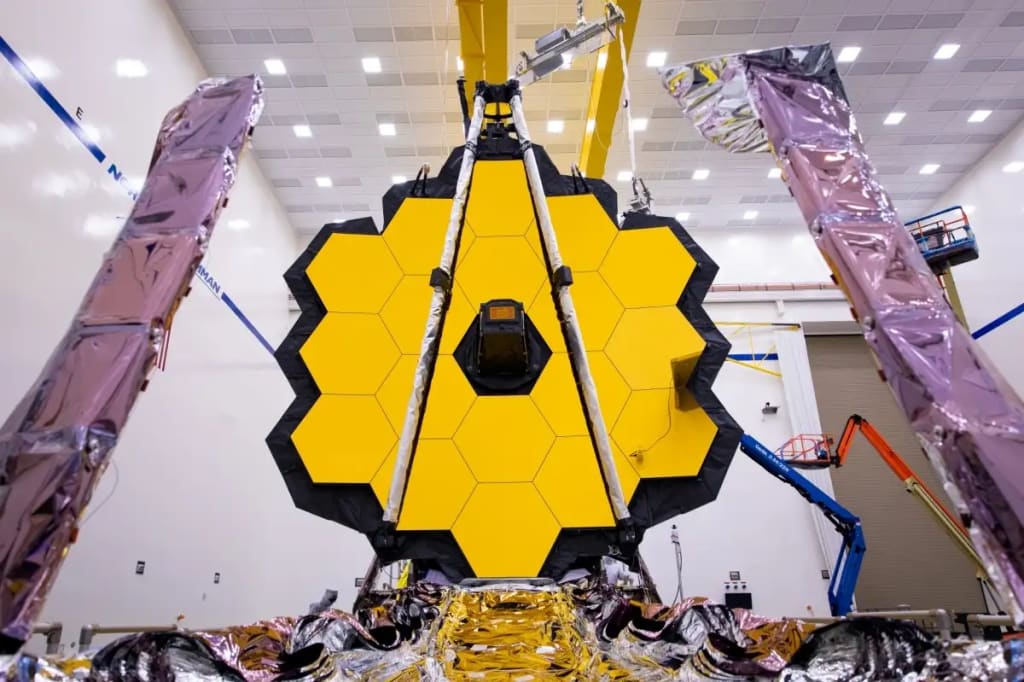
Floating more than a million miles from Earth, quietly orbiting the Sun at a gravitationally stable point called L2, the James Webb Space Telescope (JWST) is on a mission to uncover the deepest cosmic secrets. Since its deployment in 2021 and first images in 2022, JWST has not only met the world's sky-high expectations—it’s shattered them.
Combining cutting-edge infrared technology, an enormous gold-coated mirror, and decades of international engineering effort, JWST is pushing the boundaries of science, astronomy, and even philosophy. We are getting a first-hand look at how galaxies, stars, planets, and possibly even life began. Why JWST is revolutionary The JWST was designed to answer four main questions:
What caused the first galaxies to form? How do stars and planetary systems develop?
Are there habitable planets beyond Earth?
What is the origin of life in the cosmos?
JWST uses infrared light, which is ideal for peering through dust clouds and observing faint, red-shifted light from distant galaxies, to answer these questions. The light from ancient objects enters the infrared spectrum as the universe expands. JWST excels precisely in this area. 🔭 Major Features:
Primary Mirror: 6.5 meters wide (3x larger than Hubble)
Instruments: NIRCam, NIRSpec, MIRI, FGS/NIRISS
Location: Sun-Earth L2 Lagrange Point (about 1.5 million km from Earth)
The duration of the mission is 10 years, possibly more. The First Galaxies as Seen One of JWST’s most groundbreaking discoveries so far has been detecting galaxies from the first few hundred million years after the Big Bang. These observations, including galaxies like JADES-GS-z13-0, are among the oldest ever seen—dating back over 13.5 billion years.
Surprisingly, many of these early galaxies are more massive, structured, and evolved than previously thought possible. Some even exhibit evidence of heavy elements like carbon and oxygen, which ought to have formed more slowly. Cosmologists have been forced to revise their models of how quickly the universe grew and changed as a result of this discovery. Not only does it improve our comprehension, but it also alters the chronology of cosmic history. Exploring Alien Worlds
If discovering ancient galaxies wasn’t enough, JWST has also become the world’s premier exoplanet observatory.
Using a technique called transit spectroscopy, it measures the way starlight filters through a planet’s atmosphere. Because of this, it is able to pinpoint individual molecules and the chemical composition of alien skies. Recent Highlights:
WASP-39b: JWST detected carbon dioxide, water vapor, and sulfur dioxide, proving that exoplanet atmospheres can be chemically diverse.
TRAPPIST-1 System: JWST is looking into seven rocky, Earth-sized exoplanets that are orbiting in the habitable zone of the star, which is where liquid water could be found. K2-18b: JWST found possible hints of dimethyl sulfide (DMS)—a molecule that, on Earth, is primarily produced by life. While not conclusive, it opens the door to new discussions on the potential for biosignatures.
These observations are unprecedented. Scientists have never before been able to analyze the atmospheres of distant planets with such precision. JWST is laying the groundwork for perhaps the biggest question in science: Are we alone?
A New View of Starbirth and Death
Stars are born in dense clouds of gas and dust—places Hubble struggled to see. JWST, however, excels at piercing those clouds.
The Orion Nebula and the Pillars of Creation, two places where stars are currently forming, were observed by it, and their stunning, intricate structures were revealed. For the first time, astronomers can clearly witness the full life cycle of stars—from glowing cocoons of gas to violent supernova explosions.
JWST has also spotted protoplanetary disks—swirling clouds of gas and dust where planets are being born around young stars. These views are not just stunning—they're essential for understanding how planetary systems like our own come to be.
Images from the Deep Field: Seeing the Unseen JWST’s deep field images—especially the iconic SMACS 0723—are like time capsules. JWST captured thousands of galaxies in a single image, some as they appeared billions of years ago. JWST is able to look further back in time than any previous telescope by utilizing a phenomenon known as gravitational lensing, in which massive galaxy clusters bend the light of more distant objects behind them. It’s using the universe itself as a magnifying glass.
These deep fields aren’t just beautiful—they’re packed with data about the structure and evolution of galaxies across cosmic time.
Obstacles and the Way Forward Even with its successes, JWST has faced challenges. Its ultra-sensitive instruments require complex calibrations. To ensure that it continues to function throughout the entire decade—and possibly beyond—scientists must also carefully manage its fuel and thermal balance. Yet the mission’s early achievements suggest that JWST will keep producing revolutionary science for years. Already in place are plans for: a comprehensive look at the dawn of the universe and the cosmos. ongoing investigations into massive black holes. More detailed analysis of potentially habitable exoplanets.
A Global Partnership Jointly led by NASA, the European Space Agency (ESA), and the Canadian Space Agency (CSA), JWST is a triumph of international cooperation. Thousands of scientists, engineers, and technicians across 29 states and 14 countries contributed to its design, construction, and operations.
Their shared vision is now helping humanity explore the cosmos at an entirely new level.
A Universe of Wonders The James Webb Space Telescope isn’t just a tool for astronomers—it’s a beacon of human curiosity, innovation, and unity. It is more than just data; each image it sends back is a reminder of how much we have learned and how much more is still unknown. From the first stars to distant planets that may harbor life, JWST is showing us not only where we came from—but perhaps, where we’re headed.
The universe has never looked so close.
About the Creator
Keep reading
More stories from writers in Earth and other communities.
Australia Specialty Gases Market: Industrial Applications, High-Purity Demand & Technology Growth
Australia Specialty Gases Market Overview The Australia specialty gases market is developing steadily as industries increasingly require high-purity and precisely formulated gases for advanced manufacturing, healthcare, environmental monitoring and research applications. Specialty gases include ultra-high-purity gases, calibration gases and gas mixtures designed to meet strict quality and performance specifications. These products are used in applications where consistency, accuracy and contamination control are critical. The Australia specialty gases market growth reached USD 168.4 Million in 2025. Looking forward, IMARC Group expects the market to reach USD 290.2 Million by 2034, exhibiting a growth rate (CAGR) of 6.24% during 2026-2034. This growth reflects gradual expansion of technology-driven industries and rising emphasis on quality standards.
By Amyra Singhabout 17 hours ago in Earth
Dead and Wearing Green: Unpacking the Cultural and Environmental Meaning
The phrase “Dead and Wearing Green” immediately conjures images of mystery, symbolism, and questions about life, death, and environmental consciousness. While at first it may sound like a simple, perhaps eerie statement, it is layered with cultural, ecological, and metaphorical significance that resonates across literature, environmental discourse, and contemporary social commentary.
By Aarif Lashariabout 8 hours ago in Earth
After the Storm
After the storm of winter snow there sat a small bear by the name Ted, of course. He loves the snow and likes to roll around in it making all sorts of trails and whatever he has a mind to do. He wondered where all the people are, but in a way, he is hoping that they are all snug in the homes maybe drinking hot chocolate-one of his favorite drinks with mini-marshmallows and eating something homemade for he likes this winter wonderland all to himself to romp and play and maybe even catch some fish down by the river.
By Mark Graham4 days ago in Fiction




Comments
There are no comments for this story
Be the first to respond and start the conversation.