

Many microbiologists suffer from a bit of a bacterial bias. It is not by choice that bacteria have become the dominant microorganism studied in our field, but rather because of an ancient ritual all young microbiologists must endure prior to joining the graduate school house where they will learn our ancient craft. The ritual is known as the sorting and only the most talented and dedicated among the many graduates of four year microbiology degree programs, and biology majors who did not have a high enough GPA to get into medical school, and assorted philosophy and other social science majors who realized there is no money to be made in their chosen field so took a few science classes their junior and senior year and really liked them, that are invited to sit and be chosen.
The ritual begins with the passing of the sorting hat* said to once belong to Antonie van Leeuwenhoek himself, the famed dutch microscopist, and grandfather of microbiolgy. It still smells of the cheese he ate in the company of the Russian Tsar Peter the Great who once visited him to learn of his magical discoveries. As the hat is passed from each eager, young, optimistic, hopeful, soon to be graduate student to the next it calls out a name. A university name, telling you where you are going to graduate school and for some reason that ends up biasing almost all microbiologists in favor of bacteria and the prokaryotes over fungi and the eukaryotes.
The actual reasons for this bias are a bit more complicated and much less amusing. For the microbiologist, bacteria, being prokaryotes (a term slowly on its way to a well deserved and too long in coming retirement) are almost always easier to work with and thus to study, etc. than the eukaryotes. Ultimately, because of this lab discrepancy there is much more known about them overall and many more people doing both applied and basic research using bacteria as model systems. The fungi on the other hand are eukaryotes. They are more like us and the plants and animals then the bacteria with which they are sometimes compared. Compared to most bacteria, and more like plants and animals, they have a more complicated and diverse array of life cycles, mating habits, cellular structures, morphologies, etc. All of these characteristics combine to make them very difficult conceptually to wrap your head around, and just a plain pain in the butt to deal with in the lab. Also, they are far less (though still very) important in terms of agents of human disease. It makes sense that the more clinically significant organisms would see the most research effort and dollars given the human costs in pain and suffering. That is not to discount the burden caused by fungal infections and they are responsible for some pretty nasty diseases. I took a medical mycology class in graduate school and I still remember some of the pictures from the textbook. Yuck.
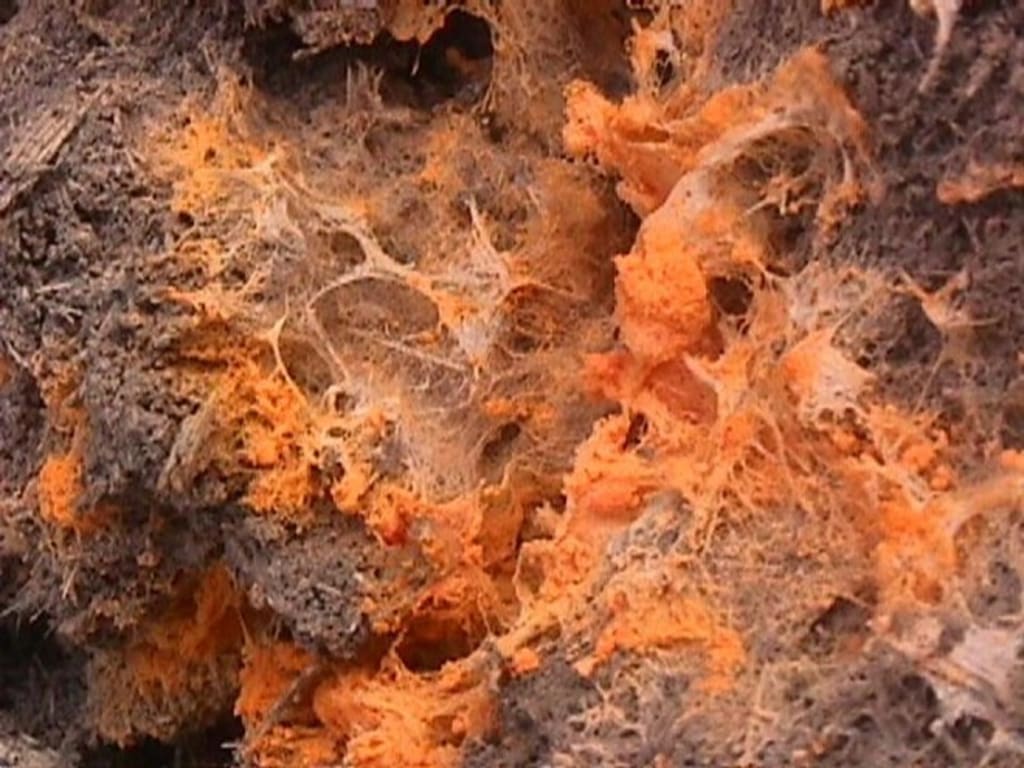
All that said there are some fungi that are considered model organisms for various fields of study. Similarly to E. coli for the bacteriologist and/or bacterial geneticist, Neurospora is the fungi of choice for the mycologist. The Genus Neurospora contains both yeasts and fungi however, the Neurospora of interest to us is a filamentous fungi commonly known as orange bread mold. It first received major attention in 1843, when there was a Neurospora infestation in French bakeries. Neurospora was domesticated for research purposes in the 1920s. Domestication is not the exact word I would select in this particular case as this particular mold has proven itself to be quite a nuisance in many microbiology testing labs, including many of the labs in which I have worked, and food manufacturing facilities for close to 100 years now. As much pain as he/she has visited upon myself I was pleasantly surprised to learn that she/he has been messing with the French for far longer. Sorry did I say that out loud or worse, write it down, what I really meant to say was Viva La France!
One of the reasons it is such a pain is how fast it can grow which it does via tip extension and branching. In fact, Neurospora fungi are one of the fastest-growing filamental fungi, with a rate of about ten centimeters per day. I actually did not know that filamental was a word until just now. Cool, and I already thought of a good application for its use, punchline for humorous joke like phrases that less than one tenth of one percent of the population would ever understand, let alone find funny, in a million years. For example, Why did they commit the mold to the insane asylum? Because it was filamental. That is pure comedy gold, 24 karat.
Some shameless lifting of material from various academic sources coming your way now. Warning, this material is not for the faint of heart, or the low of advanced degrees in the biological sciences.
“It has been shown that Neurospora have a circadian rhythm, called the sporulation rhythm. If at some point mycel is transferred from a high-light and high-nutrient environment, to a low-light, low-nutrient one, the circadian oscillator will begin. These circadian rhythms are caused by compensation mechanisms within cells. They are the physiological clocks of organisms. Neurospora often utilizes burnt plant matter as a food source. In addition, they are known to grow on bread and other food products. These organisms are heterotrophic. Neurospora reproduce sexually and asexually. Neurspora organisms spend most of their lives as haploid organisms. There are three different sexual life cycles: heterothallic, homothallic, and pseudohomothallic. In a heterothallic life cycle, Neurospora have two mating strains, A and a. Strains are determined by alternate DNA sequences at a chromosomal locus. Mating can only occur between different strains, which results in diploid cells in long sacs. Meiosis produces four haploid cells. These haploid cells undergo mitosis within the ascus, forming eight spores. N. crassa is a heterothallic species. In homothallic reproduction, an individual haploid strain can undergo sexual reproduction without pairing with another strain. To undergo meiosis, a diploid nucleus forms by the fusion of two haploid nuclei. N. galapagoensis is a homothallic species. In pseudohomothallic reproduction, a spore will grow into a dual mating type mixture of nuclei. It can then go through the sexual cycle without having to pair with anything. N. tetrasperma is a pseduohomothallic species. In the asexual cycle, spores germinate and form mycel, which produce aerial hyphae, which produce conidia.”
I told you the fungi had some complicated life cycles. Would I lie to you? Maybe a little but only if it was for your own good. Luckily there is no need to worry about getting sick or even having an allergy from Mr./Mrs. mold because it seems Neurospora is apparently incapable of causing disease in animals and has never been shown to be allergenic. Also, not a plant pathogen. Very nice fungi.
The below is from a 2000 short review article in Applied and Environmental Microbiology — Evidence for Safety of Neurospora Species for Academic and Commercial Uses. Appl Environ Microbiol. 2000 Dec; 66(12): 5107–5109. Note: I have removed all the reference citations but there were many. This was a thoroughly well documented and written short review article. It is publicly available via ncbi at the following link https://www.ncbi.nlm.nih.gov/pmc/articles/PMC92429/
“Experiments with Neurospora inspired the development of microbial genetics and initiated the molecular revolution in biology by demonstrating that genes encode enzymes. Because of its useful biological attributes, Neurospora crassa has become a favored organism for research in a variety of biological problems and a basic model organism among the filamentous fungi. A vast store of information has been acquired on the organism during 75 years of research. Over 1,000 loci have been mapped on the chromosomes………Fungi of the genus Neurospora have been known in the scientific literature since 1843. The species N. crassa has been used intensively in many laboratories since 1941. Generations of investigators in hundreds of laboratories have used the organism, with results reported in thousands of research papers. (The bibliography of reference 25, for example, contains 2,300 references.)……Never in more than a century of observation and experimentation has the genus been implicated in human disease or observed to cause disease in animals or plants……. Neurospora species are apparently incapable of causing disease in animals. ...Certain innate characteristics make it unlikely that Neurospora will have adverse effects on animals. Unlike yeasts, Neurospora species are obligate aerobes, unable to grow in the gut or bladder, in tissues, or systemically. Aside from its use in the laboratory, Neurospora has long been known to occur in close association with humans in contaminated bakeries, lumber yards, and plywood factories; on steamed logs………Despite the many opportunities for human exposure to the powdery airborne conidia, no evidence has been obtained that Neurospora is the causal agent of any disease or infection.....Despite its abundant, readily airborne conidia, Neurospora does not appear from the medical literature to be a significant allergen. Medical textbooks on allergy either fail to mention Neurospora or refer to the vegetative spores (under the anamorph name Monilia sitophila or Chrysonilia sitophila) as components of airborne spore flora, hence possible allergens………Another text reports a weak skin test reaction to Monilia sitophila, which is stated to be associated with the milling and baking trades. Two of 526 allergy patients in one study showed positive skin and nasal tests in response to Neurospora.”
All good stuff but then came this section with which I am afraid I must take issue.
"Contamination by Neurospora is readily controlled."
Say what? You sir are a captial L i a r liar, pants on out of control, massive inferno, fire.
"Because of its high growth rate (3 to 5 mm/h) and the ease with which the powdery conidia become airborne, Neurospora has gained a reputation in some quarters as a laboratory contaminant."
Well deserved thank you very much.
"This reputation is largely undeserved."
Hey did you read my mind or something? I hadn’t even read the next sentence yet when I wrote, well deserved thank you very much, and then it seemed as if you were replying directly to me, crazy.
"Cross-contamination or overgrowth of slowly growing cultures by Neurospora is not a problem in any well-ordered research laboratory."
Excuse me sir are you implying that I have not worked in well ordered laboratories, I will have you know, you are correct.
Good laboratory practice includes avoidance of drafts, attention to cleanliness, autoclaving of discarded cultures and contaminated glassware before dishes are washed, and care not to incubate cultures in closed containers in which humidity approaches 100%. Thousands of Neurospora strains are maintained in pure culture, without problems of contamination, in leading research laboratories and at the Fungal Genetics Stock Center, University of Kansas Medical Center, Kansas City.
Good for leading research laboratories and the Fungal Genetics Stock Center, aren’t they special, show-offs. Kansas is well known as a home for leading research laboratories so I guess not too surprising. If it isn't obvious that last sentence is dripping with sarcasm.
*No similarity to any other sorting hat, fictional or real, is implied or intended. This is NOT the same sorting hat from Harry Potter and it would be ludicrous to even suggest that. Please do not sue me for I am but a poor microbiologist living on the meager wages of day laborer. Yes, I do have a Ph.D., yes it took me that long to get it, and yes I realize how much “real” doctors make, geez do you have to rub it like that. I still drive my mom’s Honda Fit by choice I’ll have you know. I could afford at least a Civic or maybe even an Accord if I really wanted to and those are some pretty awesome rides, am I right? And let me ask you this Dr. McSmarty Pants, which one of us gets to wear the shirt that says “not that kind of doctor?” No price can be put on a perk that sweet. Go back to med school and call me when you get a real job.
About the Creator
Everyday Junglist
About me. You know how everyone says to be a successful writer you should focus in one or two areas. I continue to prove them correct.
Keep reading
More stories from Everyday Junglist and writers in Earth and other communities.
On the Viability of Viruses
I was taught in undergrad and graduate school that viruses are not alive as they fail several of the key tests typically required for something to qualify as being alive. There are seven main characteristics biologists like myself generally agree that living organisms must possess. They are 1. The ability to respire. 2. The ability to grow 3. The ability to excrete (waste), 4. The ability to reproduce. 5. The ability to metabolize (nutrients for energy), 6. Movement. 7. Responsiveness to the environment.
By Everyday Junglist2 years ago in Earth
Navigating the Economy of Your Inner World
Core Concept: We are applying the "Niche Earth" philosophy to Personal Finance. This piece explores how to manage the "climate" of your bank account, avoid the "tectonic shifts" of impulse spending, and build a "solid core" of financial security through evidence-based habits.
By Being Inquisitive7 days ago in Earth




Comments (1)
😳 I'm so glad I skipped science and doing PhD in Divinity, if I ever get it done. This was very interesting Dr.