
Asteroid 2024 YR4’s Collision With the Moon Could Create a Flash Visible From Earth, Study Finds
Scientists Say a Rare Lunar Impact Event Could Offer Valuable Insights Into Planetary Defense
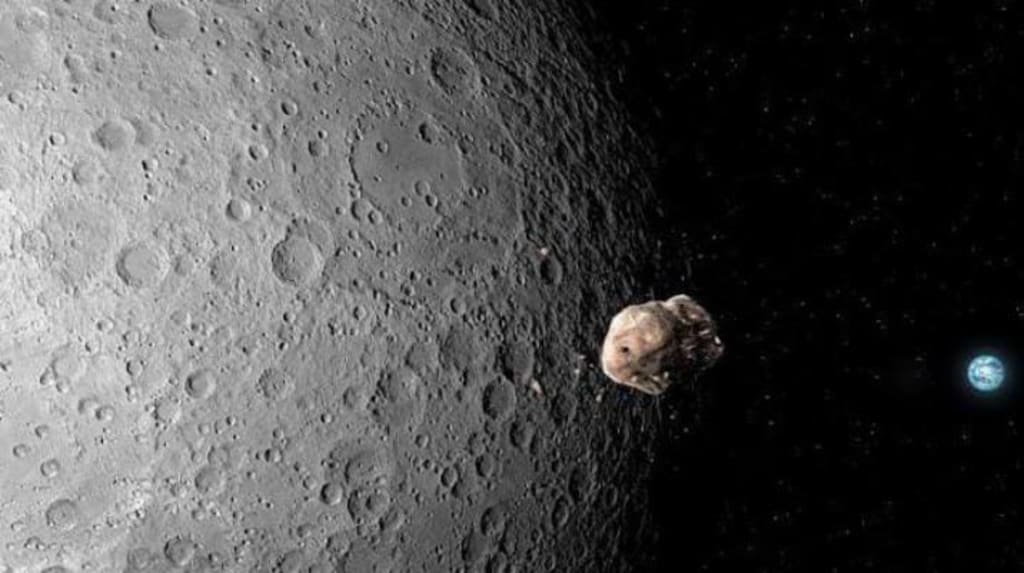
A newly published scientific study has sparked excitement across the global astronomy community by suggesting that Asteroid 2024 YR4, if it were to collide with the Moon, could generate a bright flash visible from Earth. While the event poses no threat to our planet, researchers say it could provide a rare natural experiment—offering valuable data about asteroid impacts, lunar geology, and future planetary defense strategies.
The findings have renewed public interest in near-Earth objects and highlighted how even distant cosmic events can produce observable effects from nearly 384,000 kilometers away.
What Is Asteroid 2024 YR4?
Asteroid 2024 YR4 is a relatively small near-Earth object (NEO) that was detected during routine sky surveys earlier this year. Based on preliminary observations, astronomers estimate the asteroid measures tens of meters in diameter, placing it in a category large enough to survive space travel but small enough to disintegrate upon impact without causing catastrophic damage.
While the asteroid’s current trajectory does not pose any danger to Earth, orbital simulations suggest a low-probability scenario in which it could collide with the Moon under specific gravitational conditions.
Though unlikely, such an impact has captured scientific attention because of its potential visibility and research value.
A Flash on the Lunar Surface
According to the study, if Asteroid 2024 YR4 were to strike the Moon, the collision would release a burst of energy comparable to several tons of TNT. The result would be a brief but intense flash of light—lasting anywhere from a fraction of a second to a few seconds—that could be detected by telescopes on Earth.
Under optimal conditions, including a dark lunar phase and clear skies, researchers say the flash might even be visible to amateur astronomers using standard backyard equipment.
Such flashes have been observed before, but they remain relatively rare and unpredictable.
Why Lunar Impacts Matter
Unlike Earth, the Moon lacks a thick atmosphere that burns up incoming space debris. This makes it an ideal natural laboratory for studying asteroid impacts.
“When an asteroid hits the Moon, it tells us a story that Earth often hides,” explained one planetary scientist involved in the study. “There’s no weather, no erosion, and no atmosphere to obscure the evidence.”
By analyzing the brightness and duration of an impact flash, scientists can estimate:
The asteroid’s size and speed
The energy released during impact
The characteristics of the lunar surface at the impact site
This data improves impact models used to assess asteroid threats to Earth.
Could People See It From Earth?
The idea of witnessing a cosmic collision from Earth has captivated the public imagination. According to researchers, visibility would depend on several factors:
The size and velocity of the asteroid
The angle of impact
The Moon’s phase
Light pollution and atmospheric conditions on Earth
If conditions align, the flash could appear as a brief sparkle on the Moon’s surface, detectable through telescopes and possibly captured by lunar monitoring systems.
However, scientists caution that this would be a fleeting event, requiring precise timing and observation.
No Risk to Earth
One point emphasized repeatedly by researchers is that Asteroid 2024 YR4 poses no threat to Earth. Even if the asteroid were to impact the Moon, it would not alter the Moon’s orbit or produce debris capable of reaching our planet.
“This is not a doomsday scenario,” researchers stress. “It’s an opportunity for observation, not a cause for concern.”
The study highlights how planetary defense efforts now extend beyond Earth itself, using the Moon as a reference point for understanding cosmic hazards.
A Boost for Planetary Defense Research
Planetary defense—monitoring and mitigating potential asteroid threats—has become a growing focus for space agencies worldwide. Lunar impact events like the one modeled in the study help scientists refine detection systems and response strategies.
Recent missions have already demonstrated humanity’s ability to alter asteroid trajectories under controlled conditions. Observing a natural lunar impact would complement those efforts by offering real-world data without the risks involved in an Earth-bound collision.
The Moon, in this sense, acts as a silent guardian—absorbing impacts that might otherwise go unnoticed.
Technology Watching the Moon
Modern monitoring systems constantly scan the lunar surface for sudden flashes. These systems are operated by space agencies, universities, and even citizen scientists.
High-speed cameras, infrared sensors, and automated telescopes work together to detect and analyze impact events in real time. If Asteroid 2024 YR4 were to strike the Moon, it would likely be recorded by multiple independent systems.
Such observations would allow scientists to compare predictions with actual outcomes, improving future models.
Public Fascination With Space Events
Events like this highlight the growing public fascination with space science. Social media, live streams, and online observatories have made astronomical events more accessible than ever before.
Astronomy groups have already expressed interest in monitoring the Moon during predicted observation windows, encouraging enthusiasts to participate in global observation campaigns.
For many, the possibility of witnessing a cosmic collision—even indirectly—is a reminder of humanity’s connection to the universe.
A Reminder of a Dynamic Solar System
The study underscores a broader truth: the solar system is not static. Asteroids, comets, and space debris are constantly moving, colliding, and reshaping planetary surfaces.
While Earth is largely protected by its atmosphere, the Moon bears the scars of billions of years of impacts—each crater a record of cosmic history.
Asteroid 2024 YR4, whether it collides with the Moon or simply passes by, serves as a reminder that space remains active, unpredictable, and endlessly fascinating.
Looking Ahead
Whether or not the predicted collision occurs, scientists agree that the study itself is valuable. It demonstrates how modern astronomy can anticipate rare events and prepare to observe them with unprecedented precision.
For now, Asteroid 2024 YR4 remains a distant traveler. But if it does meet the Moon, even briefly lighting up its surface, it will offer humanity a front-row seat to the forces that shape our cosmic neighborhood.
About the Creator
Keep reading
More stories from Ayesha Lashari and writers in Earth and other communities.
Hamptons Real Estate Prices Hit Record High as 2026 Summer Rentals in High Demand
The Hamptons, long synonymous with luxury, exclusivity, and summer getaways, has seen its real estate market soar to new heights in recent years. As we approach the summer of 2026, the area’s real estate prices are breaking records, and demand for vacation rentals has never been greater. While this trend is partly attributed to broader economic factors and changing work habits, it also signals an evolving landscape in the Hamptons real estate market that is shaping up to be one of the most competitive seasons in recent history.
By Ayesha Lashariabout 16 hours ago in Earth
“Painful Times in My Marriage” — Melinda French Gates Reacts to Ex-Husband in Epstein Files
Public attention has intensified after comments attributed to Melinda French Gates referenced “painful times” in her marriage while discussions surrounding documents connected to Jeffrey Epstein continue to surface in public discourse. The situation has reignited conversations about accountability, public image, and the long-lasting impact of associations with controversial figures.
By Aarif Lashari6 days ago in Earth




Comments
There are no comments for this story
Be the first to respond and start the conversation.