
Artists can do better
Reducing our creative carbon footprint


There's something hugely exciting about a newly purchased sketchbook. It seems to offer unlimited hope and potential, opportunities and exploration. But all too often the pristine white pages of a new sketchbook stay exactly that way, often for months and even years, as the unused sketchbook gets added to the ever-increasing pile of other unused art supplies. As an emerging artist, I understand the deep need for my art supplies to become my closest companion and to be employed regularly to record, interact with, and document the world around me. I know undeniably that they are my best friend and faithful ally in providing the self care, mind distraction and creative expression my heart yearns for; but more often than I would care to mention, my stacks of unused art supplies have become elements of excessive clutter and unnecessary consumerism.
.
I cannot speak for all artists, but sadly I see a similar tendency among so many fellow creatives. For artists like myself who are still discovering our unique style, as well as our individual preference for particular art materials and techniques, the world of art supplies can be not only tantalisingly enticing, but also exhaustingly overwhelming. Every art teacher - both online and in person, seems to recommend wildly different art supplies. Most art courses require a long list of the 'perfect' art equipment, and even within artist's communities, certain brands and specific art materials are favoured over others. As I am discovering, there definitely are advantages and benefits to be had by purchasing particular brands of art supplies and materials from certain manufacturers, but only if you understand those advantages and can use them to your own personal advantage in your art making. Generally in my experience, the vast array of art supplies being promoted for sale online and in-store, maximise the false belief that with exactly the right supplies it will suddenly make you into a better artist. I'm beginning to rapidly understand with startling clarity that no amount of art supplies alone can make someone into a better artist, and that sadly they are often the cause of more confusion and overwhelm than any artist needs.
.
Undoubtedly, the purchasing of art supplies is necessary and important to the ongoing practice of an artist, but if it is not monitored and managed carefully, it can easily and unnecessarily increase our carbon footprint and our impact on our precious planet. As artists we have the ability to make a powerful and profound difference, not only through the art we create and the message we champion, but also through the art materials, supplies and suppliers we choose to use. Placing further burdens on our planet and oceans due to either not being aware of our carbon footprint as creatives, or through consciously making irresponsible decisions in our art practice is certainly not a legacy any responsible artist wants to be remembered for. Thankfully, there are many ways that artists can become conscious creators. Obviously it is extremely important to intentionally try and reduce our carbon footprint in all areas of our lives, but looking at our creative practice and the decisions we make in that area is a very valuable place to start.
.
So, how can artists begin to consciously reduce their carbon footprints?
.
STASH BUST
Most artists own a huge collection of art supplies, either completely unused or partially used. Go to your stash before you buy anything new as it is likely that you will either have exactly what you need for your project, or you will have something that you can use, modify, reuse, or upcycle which will serve your purpose, cost you nothing and will not increase your carbon footprint. Your supply stash is a mighty weapon in reducing your environmental impact.

Making your own sketchbooks and art journals is an excellent way to start creating individual art in your own style. I own many pre-made sketchbooks and I am intentionally starting to use them in my work, but there are still times when I would like to use something a little different. I have found that having various different sketchbooks 'on the go' at the same time (either pre-made or handmade) means that I stay motivated and excited about the work that I am doing. Look around and see what you can find that you can make a sketchbook or journal from. You may have sheets of watercolour paper that are begging to be used which when cut up and bound can create very beautiful and useful custom size sketchbooks. Newspapers, old magazines, brown paper from packaging and even old paintings that are destined for the recycling pile can be used to create custom sketchbooks or journals. If necessary, paper can be primed with a good quality primer or acrylic paint depending on what you wish to create on the pages. Another type of paper that can be recycled and turned into a junk journal or sketchbook is used envelopes. Many companies are not completely paperless yet, and I have a steady stream of envelopes dropping through the letterbox. When hand bound - using traditional bookbinding techniques easily accessed through free online videos - a very unique journal can be created which already includes some very interesting elements and patterns on the pages - such as postmarks, addresses, stamps, labels and peep-through windows which not only add visual interest to the book but also remove the fear of not wanting to ruin the pristine white pages. Having visual elements and marks already on a page can help you begin creating more easily as the page is already started. Creating these journals is also a marvellously fun way to recycle old envelopes into something useful!


CREATIVE COLLAGE PAPERS
As a mixed-media artist, I am constantly on the hunt for interesting papers that I can use for collage work and to embellish the pages of my sketchbooks and journals. I have found many sources of interesting papers including old magazines, vintage books (that are already headed for the recycling), old envelopes and newspapers, but my real joy is creating my own custom papers using various different ecologically friendly techniques.

Collect natural objects from your garden or from local parks to use as custom stamps. Fallen leaves, seeds, twigs, bark, pinecones and feathers all provide excellent tools for creating interesting marks. They can be dipped in ink, paint, natural dyes or used with an ink pad to create unique patterns.

Binding fallen pine needles together with string can create very unusual 'brushes' that can be used with ink, dye or paint. Everything you find in nature has the potential to create a mark, but responsible harvesting of the items must be practiced in order not to cause any damage to the local environment or greater environment as a whole.
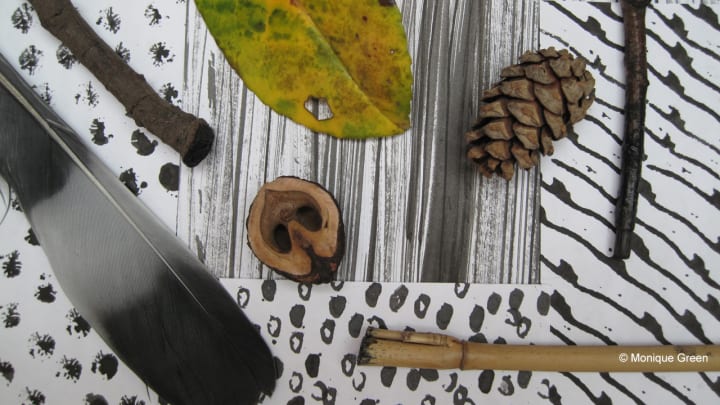
The marks made from these natural items are more exciting and unpredictable than the marks made from mass produced, commercially available, energy-rich rubber or photopolymer stamps, and have a far less damaging impact on the environment.

Other low impact items can also be used to create custom stamps for making interesting marks in your journals or sketchbooks such as toilet rolls, recycled packaging, old toothbrushes, bubble-wrap from inside envelopes, foam packaging, crumpled recycled paper, corks, foods such as potatoes, onions, cabbage or carrots and even worn-out tools or art equipment including old paintbrushes hardened with paint.


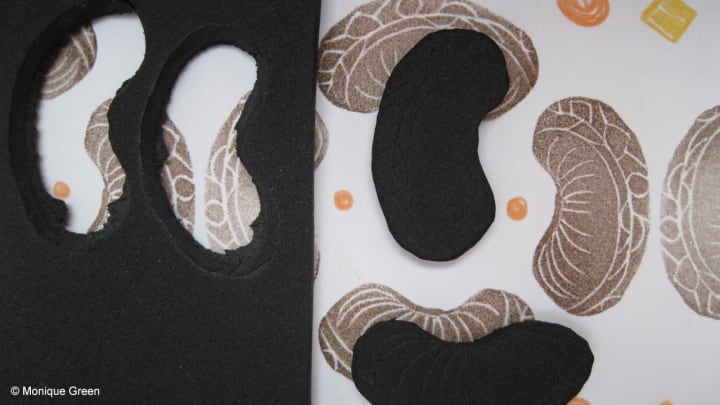

Items destined for the rubbish bin can often create the most exciting and unique marks. Start looking at everything through the lens of curiosity!
.
THINK SECOND HAND FIRST
Many people sell their unwanted (and sometimes unused) art supplies, equipment and books on online marketplaces, often for very reasonable prices. Try to source second hand items locally before looking further afield, and also visit local charity / thrift stores as many people often donate unwanted art supplies, equipment and art books there.
If you can't find a particular art book or piece of art equipment try asking artist friends first if they possess the required item that you can either borrow or buy from them if it's no longer needed.
.
BECOME A CONSCIOUS CONSUMER
Invariably, there will be art supplies and equipment that you cannot source second hand, and you will need to order from local or online suppliers. There are some considerations you can think about before you make any purchase, online or in person, that can help you to reduce your consumer carbon footprint:
- Do you really need to make that purchase? Do you have something in your stash that you could use, modify, adapt or recycle instead?
- If you do need to order the item(s), try and find a local company (if possible) that can supply all the items you need so that you are not ordering from many different companies.
- Group purchases together. Try not to order single items, but wait - if possible - until you have a number of items you need and then make just one purchase, with one delivery to you, instead of many deliveries. This helps to reduce the amount of fuel used by the company to make the deliveries, as well as the amount of packaging required as items can be packed and delivered together.
- Buy the best quality art supplies that you can afford. This reduces the amount of waste as good quality items will last longer than cheaply made items, and will need to be replaced less often. For example, good quality artists' paints contain higher concentrations of pigments meaning you need to use less, and therefore they last a lot longer than cheaper alternatives (obviously depending on how much you use them!).
- Try and find a company that is consciously working towards lowering their own carbon footprint.
.
TOOLS RATHER THAN CONSUMABLES
Think about purchasing tools and equipment that help you to reduce your carbon footprint by recycling, reusing or reducing the amount of ready made items that you buy. For example, purchasing a gelatine printing plate which repeatedly enables you to create your own unique printed scrapbook / collage papers, using paint you have in your stash, is far better than buying commercially available consumables such as printed scrapbook papers. Purchasing tools that help you to use up the supplies you already own in more inventive and intentional ways is a great way to reduce your environmental impact.

WORK SMARTER
Where possible, create a dedicated workspace in your home, shed or garage instead of renting or owning a studio 'off-site'. This reduces the amount you need to travel, makes your art practice more accessible and means that you are more likely to create more regularly. Obviously there are some creative disciplines that require a dedicated space such as pottery or metalwork, but even these could be accommodated with some careful planning and intention.
.
USE LESS TO CREATE MORE
Many artists own more supplies than they can feasibly use. Shamefully, I own far too many colours of paints, having succumbed to the lie that I need every colour of paint in every shade and hue, to create beautiful paintings. What I have since discovered through my own experimentation is that less, is most definitely, more. In regards to painting especially, using just three colours (plus black and white if required) can create the most incredible array of colours that harmonise and complement each other beautifully. Actively educating yourself about colour theory and the way that colours work with each other is essential to streamline the amount of supplies you need to create dynamic, individual and considered artwork. Choosing to work with a limited palette of colours reduces the number of supplies you need, allows you to buy better quality products and increases the chances of consistently creating artwork that you actually like that doesn't end up heading for the rubbish or recycling bin. For example, carefully choosing a warm and a cool yellow, a warm and a cool blue, and a warm and a cool red gives you the ability to create virtually any colour you can think of. Black and white can be added if you require, although neither of these colours are actually necessary to create a harmonised palette, and often dull the colours you can mix. The more you learn about colour the more effectively you can use it in your work, and the less environmental impact you will have.


DON'T WASTE YOUR SUPPLIES
Fill empty paint 'pans' with watercolour, acrylic and gouache paints from tubes and let them dry. All these paints can be easily and successfully rewetted, and letting them dry out does not affect the quality of the paint in any way. This is a much more economical and less impactful way to use your art supplies as it is all too easy to squeeze more wet paint onto your palette than you actually need and which often ends up getting wasted. Recycled bottle lids, rather than commercially produced empty pans make great mini-containers to squeeze the paint into to let it dry out.

FURTHER IDEAS TO REDUCE YOUR ENVIRONMENTAL IMPACT:
- When possible, try creating using natural daylight, and if you need to use artificial lighting opt for long-life LED Daylight bulbs that have a very long life-span compared to other types of bulbs.
- Upcycle, recycle or donate art supplies, equipment or books that you no longer need rather than buying additional storage for new supplies or equipment. Create space in the space you have.
- Take an inventory of the art supplies, equipment and books that you currently own in order to establish what you already own. I am certainly guilty of ordering certain supplies or books more than once as I've either forgotten I owned the item, or have forgotten where I have stashed it!
- Where possible, have your art supplies and books well organised in order to not only see what you own, but to encourage you to use what you have. Out of sight, out of mind certainly holds true in my experience. Make things visible and you are much more likely to use them.
Lastly, learn to use the supplies you have. Don't let markers and pens dry up and become unusable. Don't let paint dry in tubes so that it can't be squeezed out anymore. Glue dries up if it's not used. Wasting supplies through not using them contributes to environmental waste and pollution. Use what you have.
- Make conscious purchasing decisions going forward, based on what you really need, not based on whims. Use what you have and only purchase supplies when you really need them. Every intentional purchase makes a difference.
.
As artists, there are so many ways to make significant reductions to our carbon footprint and environmental impact. Every intentional decision matters; and every conscious choice to either reduce, recycle or reuse whatever we have around us helps to protect our planet, and prolong the existence of our greatest source of inspiration and joy. Small changes make big differences.
About the Creator
Monique Green
Teacher, educator, creative, rainbow unicorn chaser...
Keep reading
More stories from Monique Green and writers in Earth and other communities.
Australia Heatwave Temperatures and the Cost of Endless Summers
There was a time when summer in Australia meant long afternoons, sunburnt shoulders, and the hum of cicadas at dusk. Heat was expected, even welcomed. But something has shifted. In recent years, summer no longer arrives gently. It presses down, day after day, with a weight that feels harder to escape. Australia heatwave temperatures are no longer short bursts of discomfort. They are long, exhausting stretches that change how people live, work, and rest. This article looks beyond the numbers to explore what these heatwaves feel like on the ground. It examines how rising temperatures are reshaping daily life, the land, and the quiet routines people once took for granted.
By Muqadas khan6 days ago in Earth
How Dangerous Is Chernobyl Radiation Today
many people still ask the same question: how dangerous is chernobyl radiation today? The short answer is that the danger still exists, but it is very different from what it was in 1986. Radiation levels have dropped a lot, some areas are safer than others, and strict rules remain in place to protect people and the environment. To understand the real risk today, it is important to look at what happened, what has changed, and what dangers still remain.
By Horizon Dwellers5 days ago in Earth



Comments
There are no comments for this story
Be the first to respond and start the conversation.