
Apollo 11 Moon Landing Mystery
Was it fake ??...

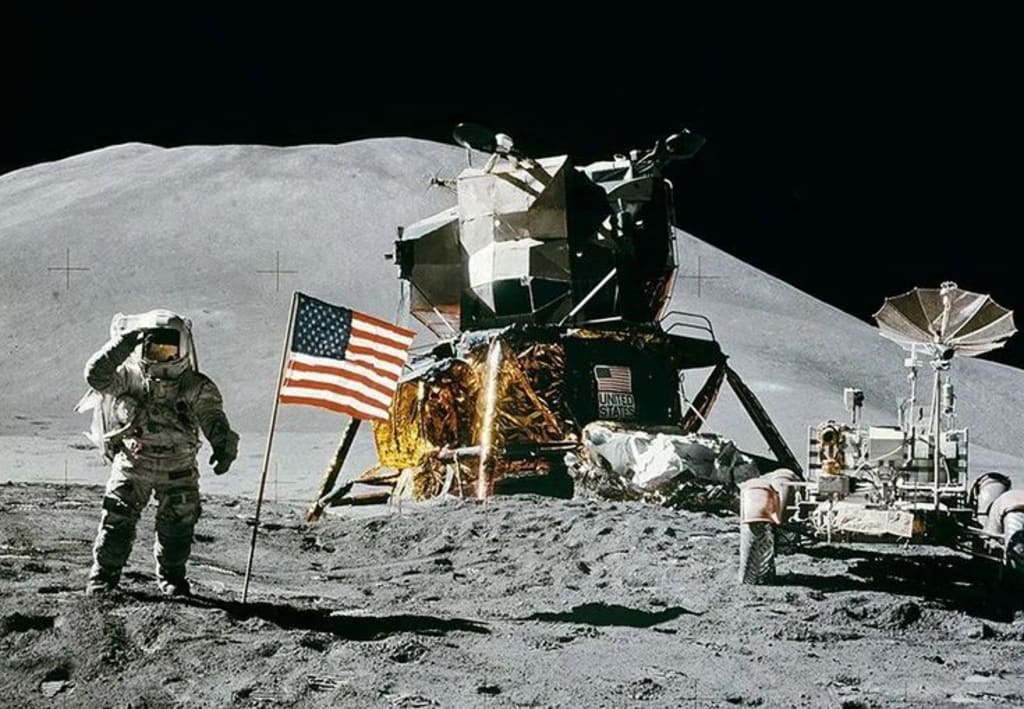
20th July 1969, The Lunar Module of the Apollo 11 mission landed on the moon. Astronauts Neil Armstrong and Buzz Aldrin were in it. After the landing, Neil Armstrong tried to open the door, to get down on the moon. It wasn't easy opening this door,due to high pressure, but he successfully opened it after a little struggle.Then he tried to get down to the moon in his heavy spacesuit.The exit wasn't spacious so by mistake, he hit the top, and a piece of the Lunar Module broke off. Neither of them was aware of this because of the lack of air. The sound didn't travel. They didn't hear any sound. But this broken piece was very crucial. It was the Assent Engine Arming Switch. Without this switch, their Lunar Module couldn't take off again, and they couldn't return to Earth. Unaware of this, Neil Armstrong got out and stepped on the moon's surface. He became the first man to step on the moon. "One small step for man, one giant leap for mankind." But did it actually happen? Today, more than 50 years later, many people refuse to believe that humans had gone to the moon. People cook up theories of their own to claim that the entire Apollo 11 mission was a farce put up by America. That they filmed the scenes on Earth, and lied to the world. How else do you explain the flag fluttering without air? What's the truth to it? All engines running. "We choose to go to the moon in this decade and do other things, not because they are easy,but because they are hard." Tranquillity Base here, The Eagle has landed! One small step for man, one giant leap for mankind." Friends, you'd be surprised to know, the real reason why Apollo 11 mission was planned was a war. Specifically speaking, the Cold War. Fought between America and the Soviet Union. Both countries were engaged in a Space Race. In 1957, the Soviet Union became the first country to launch the first artificial satellite. It was named Sputnik, and it was the first manmade object to be placed in Earth's orbit. The American government was shocked to see the Soviets getting ahead. Months later, in 1958, America launched their satellite as well. But 3 years later, in 1961, America got another shock. Soviet Cosmonaut Yuri Gagarin, was the first person to go to space. The Soviets beat America once again. One week later, the then President of America, John F. Kennedy, wrote a letter to the Vice President dated 20th April 1961. He asked the Vice President how they could beat the Soviet Union. "...by putting a laboratory in space, or by a trip around the moon,..." "Are we working 24 hours a day on existing programs? If not, why not?" "Are we making the maximum effort?" Asking if there was another space program that could be achieved quickly that would produce dramatic results and give them a lead in the race. He got the answer some days later he soon realised that the next big step would be to send humans to the moon. On 25th May 1961, in his famous speech, he promised the world that he would send humans to the moon before the end of the decade. Not only this, he also promised to get the humans back on Earth safely. "Before this decade is out, of landing a man on the moon, and returning him safely to the Earth." For many, this was an unbelievable announcement. Friends, imagine 1961, There were no smartphones, no internet, there wasn't even GPS technology. The computers were so slow and old, in such times, he was promising to send humans to the moon. For this, over the next 5 years, he provided $7-$9 billion, in additional funding to the space program. The entire space agency was engaged in fulfilling this one aim. Mere months later, the tests began. First, they tested the rockets that would be used to leave the Earth. Then the heat shields of the command modules were tested. How much they'd be able to resist heat. Then the propulsion system of the service module. Between 1963 to 1967, many unmanned tests were carried out. The rockets didn't carry any humans during the tests. In February 1967, the planned the first manned tests. A test in which astronauts will go up to space in the rockets. This was the Apollo 1 mission. But during the tests on Earth, on 27th January 1967, the cabin caught on fire, and the three astronauts preparing to go to space, died in the fire. After this painful event, NASA didn't lose courage. Instead, it continued further testing. Apollo 4, Apollo 5, and Apollo 6, were all unmanned missions. for further testing. In October 1968, Apollo 7 mission was launched and once again they attempted to send humans to space. This was successful. Only 2 months later, in December 1968, Apollo 8 mission was launched in which three astronauts were sent near the moon. Three months later, in March 1969, Apollo 9 mission was launched. In this, the lunar module was tested. The part of the spacecraft that was actually going to land on the moon. And 2 months after that, in May 1969, was the Apollo 10 mission. In this mission, 3 astronauts had to do almost everything for practice that was supposed to be done in Apollo 11 mission, except actually landing on the moon. Look at the speed with which NASA was launching the missions one after the other. In the gap of 2 to 3 months, a new mission to test the next thing. Testing the rockets, spacecraft, going to the moon, and after all these tests, finally, on 16th July 1969, Apollo 11 mission was launched. "...2...1....0! All engine running. Liftoff, we have a liftoff. 32 minutes past the hour. Liftoff of Apollo 11." Three astronauts were a part of this mission. 38-year-old commander Neil Armstrong, he led this mission. The pilot of the Command Module,Michael Collins, And the pilot of the Lunar Module,Edwin Buzz Aldrin. These three names are inscribed in the pages of history. Neil Armstrong and Buzz Aldrin become famous names everyone knows them today. But Michael Collins isn't very popular the reason for this is very interesting,I'll tell you later in this video. The spacecraft of this Apollo 11 mission, had three main parts. The Command Module, Service Module, and the Lunar Module. The first two are collectively known as CSM. Command and Service Module. They aimed to detach the Lunar Module and have it land on the moon. And to return, the Lunar Module would have to be relaunched and attached to the CSM, to enable the astronauts to return to Earth. To launch this spacecraft, a Saturn V-5 rocket was to be used. Before the launch, the rocket was loaded with 1 million gallon of Kerosene, Liquid Oxygen, and Liquid Hydrogen. The weight of this rocket was 3 million kg. With its help, the spacecraft reached Earth's orbit. It took less than 10 minutes to reach the orbit. Then they made about 1.5 revolutions around the Earth, after which they were given the permission from the mission control, the mission control was of course based on Earth, they communicated their permission to begin Trans-Lunar Injection. i.e., taking the spacecraft out of Earth's orbit and towards Moon's orbit. To leave Earth's orbit, the Saturn V-5 rocket was used. This was the third stage for the rocket. These events took place within 5 hours of the launch. But to actually reach the moon, took several days. Astronauts waited in the spacecraft the ate, slept, and took pictures of themselves and their surroundings, 19th July 1969, After travelling for almost 400,000 km, The Apollo 11 spacecraft reached moon's orbit. Here, it was supposed to be split into 2. The Command and Service Module separated from the Lunar Module. Michael Collins was in the Command Module, This part of the spacecraft was nicknamed Columbia. And the Lunar Module was nicknamed the Eagle. Neil Armstrong and Buzz Aldrin were in it. The thing is that, the command and service module,was tasked to remain in the moon's orbit. Only the lunar module was going to land on the moon. It meant that only Armstrong and Aldrin had the chance to step on the moon, and not Michael Collins. Perhaps, this is the reason why not many people know Michael Collins. Even though he was a part of the Apollo mission, he did not step on the moon.
But even so, Michael Collins' part in this mission was perhaps the most important. Because the Lunar Module was supposed to be reattached to the CSM. Without Michael Collins, Armstrong and Aldrin could not have returned safely. Around 8 PM, the Lunar Module was going to land on the moon. Exactly at 8:10 PM, alarms went off. 1201 and 1202 alarms "-1201.-1201. -Roger, 1201 alarm." Neither Armstrong nor Aldrin knew the meaning of this alarm. They asked the mission control what they ought to do next. Mission control tells them to ignore it and keep going. "We're GO, Same type, We're GO." Later, they figured out that 1202 was a warning. The processing system of the guidance computer of the Apollo was overloaded. But thankfully, the computer was designed in a way that the essential programs which were critical for the mission, would continue despite being overloaded. The computer was installed with the program for automatic landing. This would automatically land the Lunar Module on Moon's surface. But at the height of 150 metres, Neil Armstrong took over the control. He noticed that the Lunar Module was going to land at a place where huge boulders were strewn about. The landing spot was changed then. And they decided on another spot 4 miles from the predetermined landing spot, for the actual landing. At 8:16 PM, Buzz Aldrin checked the fuel indicator. Only 5% fuel remained. "100 feet, 3-1/2 down, 9 forward, 5 per cent... Okay." Seeing the low level of fuel, the mission control initiated a countdown. The countdown to decide whether they should land or abort the mission. "Now we're at critical fuel state. And that's why the 60-second call is given. And then the 30-second call." Finally, literally at the last minute, with only 30 seconds remaining in this countdown, Neil Armstrong sent a radio message to Earth. "Roger, Tranquility." The Eagle had successfully landed. Then Neil Armstrong put on his spacesuit, opened the door, and stepped on the moon. This moment was watched by 650 million people on television. His first words were televised to the world Buzz Aldrin followed him on the moon's surface, and for the next 2.5 hours, they collected samples of the moon's dust and rocks, took photographs, set up several scientific instruments as well. Although it is true that the Cold War was a big reason for this moon landing, but because the moon landing was already planned, it was such a huge achievement so obviously they were carrying scientific instruments with them. There were several scientific objectives of this mission as well. They set up a television camera on the moon, to transmit signals to the Earth. They took a device with them to measure the solar winds reaching the moon. They installed a device to send laser beams to the Earth, So that the laser beams could be used to compute the exact distance between Earth and Moon. They also had a passive seismometer. To measure the earthquakes on the moon. Of course, they're called Moonquakes. They collected 23 kg of rock and dust from the moon. And they left behind an American flag. And a plate with the inscription "Here, Men from the Planet Earth, First set foot upon the Moon. July 1969 A.D. The Lunar Module had to remain on the moon for 21 hours. After this, it had to take off once again, and attach to the CSM. But to go up, they needed propulsion. And for that, they needed an engine. Both Armstrong and Aldrin were unaware that the switch to turn on the engine, had broken off while they were getting out. I told you this at the beginning of the video. When they came back to the Lunar Module, they realised what had happened.
They informed the mission control about this damage, and look for a solution to resolve the situation. They come up with an interesting solution to the problem. Now, what exactly is a switch? Switch basically works to complete an electrical circuit. Buzz Aldrin realised that if the circuit is broken, They looked for something that could be used to complete the circuit once again. When he looked around, he noticed his ballpoint pen. He used that ballpoint pen to complete the circuit and to reignite the engine. Finally, the Lunar Module was reattached to the CSM, and the three astronauts turn the spacecraft towards Earth. The plan for landing on Earth was that The Command Module and the Service Module would be separated,
00:14:05.866 The service module would then be destroyed due to Earth's atmosphere But there was a danger that if the service module was damaged severely with its debris floating all around, they may hit the command module, killing the astronauts on board. To avoid this, NASA installed thrusters in the Service Module To take it far from the Command Module, So that they do not collide with each other.
But when the astronauts were returning to Earth, they found out that the thrusters on the Service Module weren't working. The three astronauts could only sit in the Command Module and watch the service module break apart around them. Its debris was floating all around them. It was a miracle that the broken pieces, did not hit the command module And the command module remains safe. The risk of the astronauts dying on this mission was so high that the US President Nixon had prepared an alternate speech, in case the astronauts were indeed killed Can you imagine an alternate speech? In it, he had written, "Fate has ordained that the men who went to the moon, to explore in peace, will stay on the moon to rest in peace. These brave men, Neil Armstrong and Edwin Aldrin, know that there is no hope for their recovery These two men are laying down their lives in mankind's most noble goal. The search for truth and understanding." But thankfully, this wasn't needed. The Command Module safely descended the Earth's atmosphere. The parachutes were deployed, and it landed in the ocean. All three astronauts were alive and safe. These astronauts were then evacuated by rescue ships from the ocean. It was truly a miracle that they could return alive. It wasn't that the mission had gone exactly as it was planned, They had to face problems at almost every step. They successfully dealt with the problems, and they could return alive. It is interesting to note that after returning, the three astronauts were quarantined for 2 weeks. They weren't allowed to be in contact with other humans. Because of the risk of them carrying pathogens. Viruses or bacteria that they might have encountered on moon, that could possibly wreck havoc on Earth. No one knew for sure. But again, thankfully, nothing of the sort happened. Apollo 11's moon landing was the top news in newspapers worldwide. The US President Kennedy's promise of having humans land on the moon before the end of the decade, was made possible by NASA. "In 1969, the public had little reason to question mankind's historic first step on the moon. After all, the achievement was a celebration of technological supremacy. America had finally won the Space Race." Isn't it very suspicious
About the Creator
Keep reading
More stories from Vashundhara and writers in Earth and other communities.
Earth ending in 2038
13th April, 2029. A huge asteroid Apophis, more than 1000 feet in diameter, will pass by the Earth at a close prproximity. If it hits the earth, it will bring about such a devastation which has never been seen before in human history. Compared to the bomb dropped on Hiroshima this will release 1 million times more energy. There will be tsunami waves of hundreds of metres. And entire cities will be wiped out. But not only that, on 12th July, 2038, another asteroid can collide with the earth. And look at this post. There is a 72% chance of this collision. NASA has already issued an alert and has started its planetary defence exercises. And look at this post, it's only a few weeks old. After NASA Chief, ISRO's Chief has now issued a warning that we can all go extinct. Oh, my God! An earth-destroying asteroid is speeding towards us. ISRO Chief says that migrating to Mars is an option and all global space agencies are working on it. How much truth is there in such news? Which asteroids pose the most danger for Earth? And what is NASA's plan? Let's understand all these things in depth in this video. Asteroids are also called Planetoids. Because they are like small planets. They are basically some huge pieces of rocks that are orbiting in space. Their diametre can be as small as 10-20 metres or as big as 100-200 kilometres. The smallest existing asteroid we've discovered is only 2 metres wide and the biggest is called Ceres with a diameter of 940 kilometres. Most of the asteroids in our solar system are found in the Asteroid Belt between Mars and Jupiter. It houses millions of asteroids. The drawing of this asteroid belt in our textbooks looks like this. This might seem like these asteroids are so close to each other, but in reality, the average distance between any two asteroids is more than 1 million kilometer. But sometimes these asteroids move away from this belt and get quite close to the earth. In such cases, these are known as Near Earth Objects. In short, they are called NEOs. NEOs are not just asteroids, they can be Comets, Meteors, Meteorites, and Meteoroids. You may ask what is the difference between them? Basically, all of them are just pieces of rocks moving through space. But the way we define them, is different for each. Like asteroids are made of rocks and metals. Comets are made of ice, rocks, and dust. They are known as Dirty Snowballs too. Asteroids are found between Mars and Jupiter in the asteroid belt. Comets are found in the Kuiper belt. This belt lies before Neptune, quite far from our Sun. When comets move in space, they seem to have a tail which asteroids don't. Typically, comets can be large too, with a diametre of 1-10 km. And whenever a comet passes by earth, it can be easily seen with the naked eye. But to see asteroids, telescopes are needed in most cases. In terms of danger posed to us, a comet is far more dangerous than an asteroid. Because first, a comet travels at twice the speed of an asteroid. And second, the warning time is shorter. A comet may suddenly appear and collide with the Earth, and unfortunately, we won't find out about it for a long time. This was shown in the film, Don't Look Up. In this film, we see how there was a 6-month warning time of a comet colliding with the Earth. And how the government and space agencies react to it. A Meteoroid is a small piece of an asteroid or comet. When a meteoroid gets closer to the earth and enters our atmosphere, we call it a Meteor. When that happens, it burns very quickly and we see a streak of light. It is also known as a shooting star and some of you might have seen it yourself. When this happens in large numbers, it is called a Meteor Shower. And if a piece of meteor, travels through our atmosphere and falls on the earth, it is called a Meteorite. That's the only difference. However, for us, the important thing is are the NEOs. The asteroids and comets that pass by the earth. Those posing considerable risk of of crashing on the earth. And bringing about the end of our world. This is a justified concern because this happened 66 million years ago to the dinosaurs. If they can go extinct, so can we. But before measuring this danger and moving ahead, I would like to say one thing. If you get your news from such accounts on Instagram and Facebook, it would be better to stop following news. Because this news about the 2038 Asteroid Strike is completely fake. If you want to follow some pages on Instagram for news, then there are many options like The Hindu, Indian Express, Scroll.in, The Wire, News Laundry. Or even our mainstream news websites, even though the standard of Indian media isn't quite up there, but at least they won't spread this level of lies there. Because see, Times of India has also written an article on this. The headline states that "NASA warns that a planet-sized asteroid has a 72% chance of impacting the earth." This headline is wrong. It is a click-bait headline. But if you read the first line of the article by scrolling further, they have clarified this headline. "NASA recently conducted a hypothetical exercise to assess the planet's preparedness against an asteroid impact." Actually, this 72% chance is not a finding or result. This is a hypothetical imaginary scenario which was created by NASA. They conducted an exercise, that if today we found out that an asteroid is going to collide with earth in July 2038, what can we do? This was a mock test in which more than 100 experts took part from different organisations. NASA, European Space Agency, UK Space Agency, United Nations Office of Outer Space Affairs. Everyone discussed this hypothetical situation if an asteroid were to collide with the earth 14 years from now, what should be the exact steps to stop it. On 20th June, NASA released this report in public which contain some interesting points. We will talk about them in the video later, but before that I would like to tell you, the date of 2029, which I talked about at the beginning of the video, that date is not hypothetical. Apophis asteroid with a diametre of more than 1,000 feet does really exist. And on 13th April 2029, this asteroid will pass by very close to the earth. Only 30,000 km away. Many geostationary satellites are farther away than this. NASA had released a video showing the exact path of this Apophis asteroid. 5 years later, the day this asteroid will pass by the earth you won't need a telescope to see it. You will be able to see it with your eyes at night. So the question is, what are the chances of this asteroid actually colliding with earth? The answer is Zero Percent. This asteroid was discovered in 2004. After which, there was quite an uproar all over the world. Because according to the initial observations, they claimed that there was a 2.7% chance of this asteroid colliding with the earth in 2029. Even though this 2.7% chance wasn't very significant. It basically meant that there's a 97% chance that it won't collide. But when the consequences can be so devastating, even a 2% chance can be terrifying. That's why in those years, this asteroid was called the City Killer, the most dangerous asteroid. This was the origin of its name Apophis. In Egyptian mythology, Apophis is a giant snake which destroys everything. It is also known as the God of Chaos. But the good news is that after further observations of this asteroid by the scientists, they found that in reality, it has a 0% chance of colliding with the Earth. For a few years scientists thought that though it won't collide in 2029, when it'd come closer to Earth the next time, it might be dangerous. Like in 2036 or 2068. Because when it would pass by Earth in 2029, it would pass through a Keyhole Area. In space, those places are said to be Keyholes that is so close to the Earth, where a passing asteroid is affected by Earth's gravitational force. When the asteroid comes close to Earth in 2029, it will pass through a Keyhole region, which will change its orbit. Due to Earth's gravity, the asteroid's orbit will change, which will increase the risk in 2036. Scientists were afraid of this at one time, but today, this threat has been debunked. NASA has confidently stated that in the next 100 years, the asteroid will not collide with the Earth. This is why, it has been removed from the risk list of Near-Earth Objects. You might be surprised at this. To know that there is a risk list. Of course, there is. Space agencies around the world have made a Risk List of the most dangerous asteroids in the near future. For example, on the European Space Agency's website, look at this Risk List. The possible collisions of these asteroids and comets. The Impact Date and Time are mentioned. The probability of their collision. Look at this IP max section. This mentions the maximum probability. And this section at the back, mentions the diameter to show how big the asteroid or comet is. It was only because of Data Science take a closer look at the top three objects in this risk list. At #1 is the 2023VD3 asteroid. The 2023 in the name tell us that this asteroid was discovered in 2023. This asteroid is quite small in size. It is only 11 to 24 metres wide. It might collide with earth on 8th November 2034. And the probability of collision is 1 in 387. That is, in percentage, it has a 0.25% chance of colliding. This is a substantial chance actually. That is why it is placed at the top of the list. But because of its smaller size, it is not very dangerous. The chances are that even if it collides with earth, it will fall into a sea or ocean or somewhere with few people. It won't cause much damage. In 2013, there was a similar incident when in Chelyabinsk, Russia, the Chelyabinsk meteor blasted above the city. "It came out of nowhere a bright speck in the sky seen streaking across the horizon. Followed by an almost apocalyptic scene. A blinding flash of light and then, all hell broke loose." The diameter of the meteor was about 20 metres and a powerful shockwave was released. Some buildings were damaged, some people were injured but thankfully, no lives were lost. "Nearly 1,500 people were injured. Most of them suffered cuts from shattered windows." At #2 on the risk list is the 1979XB asteroid. It is quite big. Its diameter is around 400-900 metres. Potentially, it will collide with earth on 12th December 2056 and the probability of the collision is 1 in 4.27 million. That is 0.00002%. The chance of this collision is almost negligible, but it is still ranked #2 on the risk list because of its size. We cannot afford this low chance. At #3 is asteroid 2008JL3. With an estimated diameter of 23-50 metres. And the potential impact date as 1st May 2027. And the probability of impact at 1 in 6,711. That is a 0.01% chance of collision. As you can see, these scientists working in these space agencies are doing a great job. Because they don't want to risk Earth's future due to these small risks. The only problem is that these are the asteroids that we have discovered so far. They may discover more asteroids in the future. But Comets don't have such a proper calculated trajectory. That is, we won't get a big warning window about comets. Tomorrow, we may discover a new comet that may collide with the Earth and for that we will have only 6-7 years to prepare. The detection systems on Earth, work well most of the time, but sometimes they might not. I would like to tell you about 4 most popular detection projects. The first is LINEAR, Lincoln Near-Earth Asteroid Research. It was started in 1996 by the US Air Force, NASA, and MIT, in a joint collaboration. Two 1-metre long telescopes and a 0.5-metre telescope is used to discover more than 10,000 objects every year. Today, out of all the asteroids that are being discovered, 65% of them are being discovered by this project. The second is CSS, Catalina Sky Survey. Established by the University of Arizona in 1998, it uses two big telescopes. Its measurements are so precise that in 2008 it found an asteroid which was only 4 metres in diameter. And it had accurately predicted the exact time and day when this asteroid will fall on the earth and the exact location. 19 hours after its prediction this asteroid fell in the desert of North Sudan the same place it had predicted. The third is PAN STARRS Panoramic Survey Telescope and Rapid Response System. It is located in the middle of the Pacific Ocean in Hawaii and it uses the world's largest digital cameras to find asteroids. The images captured by this largest camera are of 1.4 billion pixels. And the fourth is ATLAS Asteroid Terrestrial Impact Last Alert System. It is also located in Hawaii. And scientists have created it as a final warning of sorts. In case all the other systems are unable to detect an asteroid, if an asteroid goes undetected by mistake, then this system will give us a last minute warning of a possible asteroid impact. Every night this system scans the sky twice to detect any danger. So overall, Earth's defence system is quite brilliant and strong. But sometimes there might be some errors. Like, sometimes small meteors remain undetected as they get closer and then collide with the earth. Like the Chelyabinsk meteor in February 2013. This 20-metre wide meteor was not detected by any system on time. That's why for such scenarios, a Civil Defence Component becomes crucial. NASA has talked about this on Page 12 of their mock test report. If a small asteroid or meteor is about to crash somewhere International coordination is required at the right time, as well as the activation of the Disaster Management plans. But what will happen if a large asteroid is about to collide? There are three strategies to deal with it. First are the Kinetic methods, second are the Slow Push and Pull methods and the third are the Nuclear methods. The first of these three, the Kinetic Method is the only one that has been successfully tested in real life. In this, we send a spacecraft that collides with the asteroid and changes its orbit. The asteroid moves in a new orbit. This is a simple and effective method. Its practical experiment was conducted two years ago in NASA's Double Asteroid Redirection Test (DART). On 26th September, 2022, a 170-metre-wide Dimorphous asteroid was in space, far away from Earth and NASA launched a spacecraft to collide with it. "NASA's first planetary defence test to strategically crash into an asteroid..." This asteroid didn't pose any danger to us. It was just an experiment to see whether doing this really changes the orbit of the asteroid or not. You can watch the video of this collision on the screen. After that, when NASA looked at the result, the asteroid's orbit had actually changed. The same experiment is going to be conducted by China's National Space Agency next year. In 2025, they will have their spacecraft collide with a 30-metre-wide asteroid, and try to change its path. The second method is Slow Push and Pull. In this, we change the asteroid's orbit gradually. Solar energy can be used for this. If a spacecraft is sent near the asteroid it can concentrate the sun's rays on the asteroid to vaporise a part of the asteroid, this reaction will release some amount of gas, which will cause a small thrust on the asteroid. And gradually, the asteroid will change its orbit. This happens naturally on asteroids when an asteroid passes near the sun. But if it is done by sending spacecraft, scientists' only concerns is before the rocks on the asteroid are vaporised, these rocks should not interfere with the spacecraft's optical system. Thirdly, we have the Nuclear Method. Literally, sending a spacecraft carrying nuclear b0mbs to destroy the asteroid. It sounds very filmy but realistically, it may hardly ever be used. There are two reasons behind this. First, deploying a nuclear b0mb in space can lead to many legal, international, and geopolitical problems. And second, when an asteroid is destroyed, its pieces will be blown up all around and we can't control the orbit of those pieces. A piece may even collied with earth after the asteroid is destroyed. But this method is still under consideration because if an asteroid is large beyond an extent, like if the asteroid's size is more than 10 km, the same size that caused the extinction of dinosaurs. Then the other methods may not work as well because of the extreme size of the asteroid. In NASA's mock test from a few months ago they discussed these points. "Exactly how to deal with an asteroid which is going to collide with the Earth after 14 years with a chance of collision at 72%." The good news is that 81% of the participants participating in this mock experiment believed that we are ready to deal with such a threat. There are only a few gaps that scientists have raised regarding such scenarios. For example, one gap mentioned was that we have tested only one method till now, the Kinetic Method. We should test this Kinetic Method more times in the future so that we can be sure that it will work as needed. This was the 5th meeting to discuss a hypothetical asteroid strike. Before this, in 2013, 2014, 2016, and then in 2022, similar meetings were held. It was named Planetary Defense Interagency Tabletop Exercise. And in John Hopkins Applied Physics Laboratory, around 100 experts came together. So, in conclusion, friends, there is nothing to worry about. First of all, in the next 100 years there are no big asteroids that have even a 0.01% chance of colliding with the Earth. Secondly, our Earth's defence systems are becoming more advanced with time. In the year 2028, NASA is planning to launch a space telescope named Near Earth Object Surveyor. It will be stationed outside Earth, to detect such asteroids so our detection systems will improve further. And thirdly, even if we find an asteroid that can collide with the earth, we already have adequate systems to stop it. Stop believing in such fake news.
By Vashundharaabout a year ago in Earth
The Reality of the Illusion of Time
Recently, as I strolled along the short stretch to my strength training session, I aimlessly took in the row of tatty shops and shabby buildings along the route and passed an off-street, in which one of my sisters used to live, around thirteen years ago.
By Chantal Christie Weiss5 days ago in Earth
Supreme Court to Review Monsanto’s Bid for Immunity in Roundup Lawsuits
The U.S. Supreme Court has agreed to review Monsanto’s appeal seeking immunity from lawsuits related to its popular herbicide, Roundup. This decision marks a critical moment for both the company and individuals claiming health damages from the chemical, which contains glyphosate—a substance under scrutiny for potential links to cancer. The review could have wide-reaching implications for corporate accountability, public health, and the legal landscape surrounding chemical products. Background on Roundup and Legal Challenges Roundup, a herbicide produced by Monsanto (now owned by Bayer), has been a staple in agriculture and home gardening for decades. Glyphosate, its active ingredient, was introduced as a highly effective solution for weed control. However, in recent years, scientific studies and lawsuits have raised concerns about its potential carcinogenic effects. Thousands of plaintiffs have claimed that exposure to Roundup caused non-Hodgkin lymphoma and other health issues. Numerous state and federal courts have seen extensive litigation, with some plaintiffs receiving multimillion-dollar verdicts. Monsanto has consistently defended the product, emphasizing that regulatory agencies worldwide have deemed glyphosate safe when used as directed. Monsanto’s Bid for Immunity Monsanto is appealing for legal immunity, arguing that its use of Roundup was regulated and approved by federal agencies, and therefore the company should not be held liable in civil lawsuits. The company contends that federal oversight should preempt individual claims, a legal doctrine known as federal preemption. In essence, Monsanto is asserting that because the Environmental Protection Agency (EPA) has evaluated and permitted glyphosate use, states or courts should not hold the company personally accountable for alleged harm. Why the Supreme Court’s Review Matters The Supreme Court’s decision to hear the case is significant for several reasons: Corporate Accountability: A ruling in favor of Monsanto could strengthen corporate defenses in cases where products are federally regulated, potentially limiting lawsuits against companies producing similar chemicals or pharmaceuticals. Public Health: Plaintiffs and advocacy groups argue that a corporate victory could undermine accountability for harmful products and reduce incentives for companies to rigorously test safety. Legal Precedent: The case could set a nationwide precedent regarding federal preemption, influencing how courts balance regulatory approval with civil liability. The Supreme Court’s interpretation could reshape the legal landscape for product liability and consumer protection in the United States. Stakeholder Perspectives Plaintiffs and Advocacy Groups For those affected by Roundup, the Supreme Court review is a critical opportunity to hold a powerful corporation accountable. Many plaintiffs argue that Monsanto failed to adequately warn users of the potential risks associated with glyphosate exposure. “People shouldn’t have to choose between using a product as intended and risking their health,” says Laura Mitchell, an attorney representing multiple plaintiffs in Roundup lawsuits. “A ruling that shields Monsanto from liability could leave victims without recourse.” Advocacy groups, such as environmental and cancer prevention organizations, emphasize that transparency and accountability are essential, particularly for chemicals widely used in agriculture and landscaping. Monsanto and Bayer Monsanto, now part of Bayer, maintains that Roundup is safe when used according to label instructions. Bayer has publicly stated that legal challenges have cost billions but that the company continues to stand behind its products. The firm argues that courts must respect federal regulatory authority to avoid creating conflicting standards between federal law and state-level lawsuits. “If companies could be held liable despite following federal regulations, it would set a concerning precedent for innovation and regulatory compliance,” a Bayer spokesperson said. Broader Implications The Supreme Court review has implications far beyond Monsanto and Roundup: Agricultural Industry: Glyphosate and similar herbicides are widely used in crop production. Legal outcomes could influence labeling, usage guidelines, and liability risk for other companies in agriculture. Consumer Products: The ruling could affect cases involving pharmaceuticals, chemicals, and other regulated products, particularly when federal agencies approve them. Regulatory Authority vs. Civil Liability: The decision may clarify the balance between federal oversight and state-level tort claims, potentially shaping how courts interpret the limits of corporate immunity. Previous Court Decisions Lower courts have issued mixed rulings in Roundup lawsuits. Some courts awarded substantial damages to plaintiffs, while others limited awards or found in favor of Monsanto. These inconsistent outcomes underscore the complexity of balancing scientific evidence, regulatory approval, and legal responsibility. Federal appeals courts have previously sided with both sides in separate cases, making Supreme Court intervention necessary to establish uniform legal standards nationwide. Public and Media Reaction Media coverage of Monsanto’s legal challenges has been extensive, reflecting public concern over chemical safety and corporate responsibility. Many reports highlight the tension between regulatory approvals and individual health claims, questioning whether federal endorsements automatically protect companies from lawsuits. Public sentiment is divided. Supporters of corporate immunity argue that companies need protection to operate and innovate without fear of excessive litigation. Opponents worry that such immunity could prioritize corporate interests over public health. What to Expect The Supreme Court will now evaluate key questions: Does federal regulatory approval preempt state-level claims of harm? Can companies be held liable even if they followed federal guidelines? How should courts balance scientific uncertainty with civil justice? The decision, expected within the next year or two, will be closely watched by lawyers, plaintiffs, corporations, and advocacy groups alike. Conclusion The Supreme Court’s review of Monsanto’s bid for immunity in Roundup lawsuits represents a landmark moment in American legal history. The case has the potential to redefine corporate liability, influence public health policy, and set precedent for future disputes involving federally regulated products. For plaintiffs, the stakes are deeply personal—seeking justice for alleged health impacts caused by widespread chemical exposure. For Monsanto and other corporations, the outcome could determine the limits of accountability in a regulated marketplace. As the Supreme Court deliberates, the nation watches closely, recognizing that the ruling will resonate far beyond Monsanto, affecting consumers, companies, and the broader debate over safety, regulation, and responsibility in the United States.
By Muhammad Hassan2 days ago in Earth
My New Book is Finally Here
My poetry collection Beautiful and Brutal Things is done. It's actually done and finally published over 270 pages. Over a year of my life went into this book. More than a year, really. Long days at my computer, sometimes seven days a week because I couldn't stop even when I probably should have. Then two months of editing that felt harder than the writing itself. But it's finished, and I'm still standing, and the book is real.
By Tim Carmichaela day ago in BookClub



Comments (1)
So interesting