
Anunnaki, the sky god
Enki, Anu’s half-brother, stood beside him. He was the architect of life, the scientist-priest of the Anunnaki. “There is one path,” he said. “The readings from the observatory confirm a planet rich in gold dust. Gold can save us. It can heal the breach in our atmosphere.”
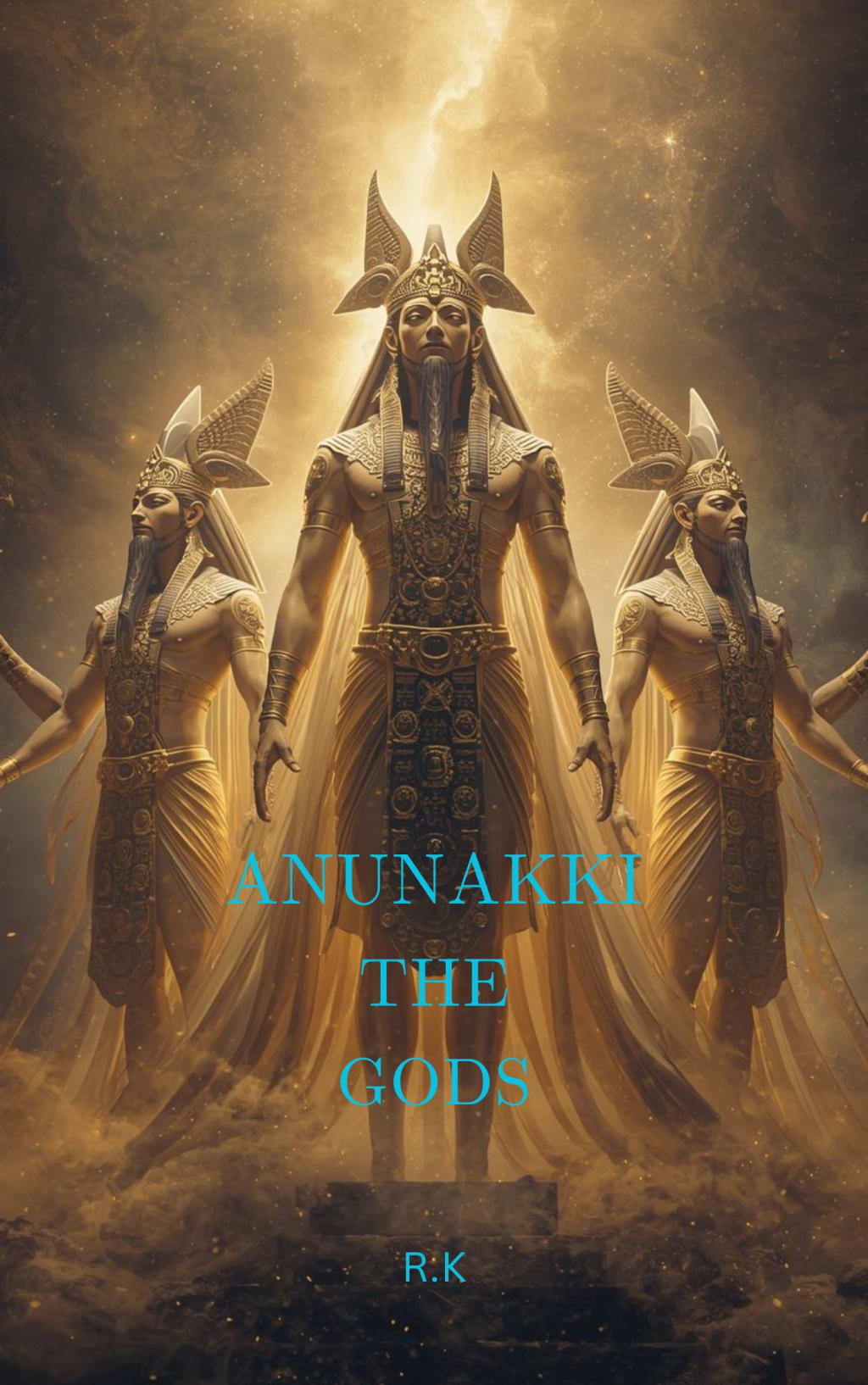
Episode 1 – The Descent from Nibiru
In the cold outer edge of the Solar System, a vast crimson planet circled the Sun on a long, elliptical orbit. Its name was Nibiru, the wandering world of gold deserts, black seas, and glittering cities beneath a fading sky. The Anunnaki called it home. Their civilization was ancient beyond measure, and their knowledge stretched across space and matter. But their world was dying. The protective atmosphere of Nibiru was thinning, and the heat that once nurtured life was slipping away.
Anu, their High King, sat on a throne of obsidian and light in the Hall of Nine. His face was calm, but beneath the calmness was fear. “We cannot survive another orbit,” said Enlil, commander of the royal fleets. “The storms are tearing through the dome cities. Our people are dying.”
Enki, Anu’s half-brother, stood beside him. He was the architect of life, the scientist-priest of the Anunnaki. “There is one path,” he said. “The readings from the observatory confirm a planet rich in gold dust. Gold can save us. It can heal the breach in our atmosphere.”
Anu looked at the holographic projection of a blue world — Earth, or Ki, as they called it. It shimmered with oceans and clouds. “Send a host,” said the King. “Claim what we need.”
Within a cycle, Enki led a fleet of shining vessels across the dark gulf of space. They descended through fire and storm, cutting through the young Earth’s clouds. Mountains shook as the first of their ships landed in the valley of Eridu.
When the dust cleared, the Anunnaki stepped onto the raw soil of a new world. To the primitive eyes of early hominids watching from the trees, they were radiant giants in armor of gold. The air shimmered around them as their ships hummed in the distance.
Enki gazed at the horizon. “Here we begin again,” he whispered. “A home reborn from the dust of another.”
Episode 2 – The Mines of the Gods
Years passed. The Anunnaki built cities from stone and metal along the rivers of the fertile plains. They raised towers that touched the clouds and channels that gleamed in the sunlight. Their purpose was extraction. Beneath the earth lay the veins of gold that would save Nibiru.
But the work was hard, even for gods. The miners toiled in heat and darkness, and murmurs of revolt began to spread. Enlil, who ruled the operations with iron precision, dismissed their complaints. “We serve Nibiru,” he said. “We endure for our people.”
One night, fire erupted in the mines. The workers threw down their tools and marched toward the citadel. “We will not dig for eternity!” they cried. The rebellion of the Igigi, the lower Anunnaki, had begun.
Anu was summoned from Nibiru. His arrival turned the skies red. He listened to both Enlil’s anger and Enki’s counsel. “There must be another way,” said Enki. “Let the labor be done by new hands, born of this Earth.”
“You propose to create life?” asked Anu.
“Not create,” said Enki, “but modify. The creatures of this planet are close. Their flesh is crude, but their essence is potential. With our essence mingled in theirs, they could serve, and perhaps one day stand beside us.”
Anu nodded slowly. “Do it, my son. But do not forget — you play with fire.”
Episode 3 – The Birth of Adamu
In the laboratories of Eridu, Enki and his sister Ninhursag began their work. They gathered the clay of the earth, mixed it with the blood of an Anunnaki worker, and sealed it within a crystal womb. They waited through cycles of stars.
When the vessel opened, a being rose — neither god nor beast, but something in between. The first human. Enki looked upon him with awe. “Adamu,” he said. “Born of Earth and Heaven.”
Adamu grew swiftly, learning to speak, to till the ground, to serve. Others followed — male and female. They worked in the gardens and mines, watched by their shining masters.
But Enki saw in them something more than servitude. He saw curiosity, wonder, the spark of consciousness. He began to teach them — words, symbols, the meaning of the stars. Enlil saw this and was furious. “You blur the line between god and servant!” he thundered.
“They are our creation,” said Enki. “They carry our essence. Would you deny them knowledge?”
“Knowledge breeds defiance,” Enlil warned.
The seeds of a cosmic rivalry had been planted — not just between brothers, but between destiny and control.
Episode 4 – The Garden of the Knowing
The Anunnaki built a great enclosure they called Edin, where the air shimmered and the rivers flowed like mirrors. There they placed the most perfect of the new humans, Adamu and Tiamat, under the guardianship of Enki. He walked among them like a father.
He taught them to name the beasts, to weave, to plant seeds. But within Edin grew a towering tree of crystalline fruit, glowing with strange light. It was the Tree of Knowing, born from the fusion of Anunnaki data crystals and living energy.
Enlil forbade them to touch it. “That fruit holds the code of our essence,” he said. “It is forbidden to mortals.”
But Enki watched silently as curiosity drew Tiamat near. When she touched the fruit, a spark leapt through her veins — awareness beyond instinct. She saw the stars and remembered none of this was a cage.
When Enlil discovered it, his wrath was boundless. “You have defied command,” he roared. “You and your kind shall leave Edin. You shall toil and bleed for the knowledge you stole.”
Enki said nothing, but his eyes held quiet defiance. Humanity had tasted divinity. There was no turning back.
Episode 5 – The Rise of Kings
Generations passed. The children of Adamu spread across the lands, building huts, then villages, then cities under the watch of the gods. The Anunnaki ruled as kings, teaching astronomy, agriculture, and the measure of time.
They walked among men as shining teachers. The people carved their faces into stone and built ziggurats that reached toward the heavens.
Yet the rivalry between Enki and Enlil deepened. Enlil saw humans as tools; Enki saw them as heirs. Wars erupted between their followers. Lightning burned the plains, and rivers turned to blood.
When the smoke cleared, Enlil decreed limits. “Let their lifespans be short,” he said. “Let them serve and fade, not rise as gods.”
But Enki continued to guide them in secret, whispering to chosen ones in dreams. He taught them writing, healing, and the secret of metal. Civilization was born in rebellion.
Episode 6 – The Whisper of the Flood
The balance between Earth and Nibiru began to shift. When Nibiru approached its perihelion, the pull of its gravity disturbed the Earth. Storms raged for years, seas rose, and Enlil saw in this chaos a divine judgment.
“Let the flood cleanse the earth,” he said. “Humanity has overreached. Their cries fill the heavens.”
Enki could not bear it. He visited a man named Ziusudra in his dreams, a descendant of Adamu. “Build a vessel,” he whispered. “Take your kin, the beasts, the seeds of life. The waters will come, but you will endure.”
When the deluge came, mountains vanished beneath the waves. The Anunnaki fled to their ships in the highlands, watching in silence as the world was drowned. For forty days, lightning danced upon endless water.
Then the rain ceased. Ziusudra’s vessel grounded upon a peak. He stepped out beneath a pale sun, the air heavy with salt and silence. From the heavens descended the ships of the gods once more.
Enlil saw the survivors and turned to Enki. “You defied me.”
“I preserved what we created,” Enki said. “Would you destroy your own seed?”
Anu, watching from above, decreed peace. “Let there be balance,” he said. “Let mankind live — but let them remember who came from the stars.”
Episode 7 – The Covenant of Fire
After the flood, the Earth was reborn. The Anunnaki returned to guide the rebuilding. They gave humankind fire, tools, and law. Temples rose again, their steps aligned with the constellations of Nibiru.
Enki gathered the elders of men. “You are no longer servants,” he said. “You are stewards. Remember the knowledge, but use it with wisdom.”
Enlil, still wary, placed guardians around the sacred places — winged beings of fire. “The heavens are closed to mortals,” he said. “Let them honor but not ascend.”
But humanity remembered. They looked to the sky and saw the path of their makers. Stories spread — of gods descending on beams of light, of chariots that roared like thunder. The memory of the Anunnaki became myth, and myth became faith.
Episode 8 – The Departure
As ages passed, Nibiru’s orbit drew it far again into the dark. The Anunnaki prepared to return home. One by one, their ships rose into the clouds, leaving behind temples, laws, and legends.
Enki lingered. He walked among the humans, unseen, watching children play beside the rivers. “They will wonder who we were,” he said softly to Ninhursag.
“They will call us gods,” she replied. “But perhaps one day they will understand we were only travelers seeking life.”
Enki touched the earth and whispered, “Remember.” Then he vanished into the light.
Episode 9 – The Age of Forgetting
Millennia passed. The monuments eroded, languages shifted, and the true memory of the Anunnaki faded into stories of divine kings and angels. Yet their influence remained in symbols — the winged disk, the serpent of wisdom, the tablets of destiny.
In the shadow of these myths, empires rose and fell. Humanity learned to shape its own destiny. But in the stars, the watchers still observed. Nibiru continued its long orbit, carrying the remnants of an ancient civilization that once touched the Earth.
Episode 10 – The Return
In the twenty-first century, deep beneath the deserts of Mesopotamia, a team of archaeologists uncovered a chamber sealed for forty-five thousand years. Within it were tablets inscribed with markings that no one could decipher.
Dr. Lena Armitage, the lead researcher, ran her fingers over the stone. “It’s older than Sumer,” she whispered. “Older than writing itself.”
As they worked, their instruments picked up a strange resonance — a frequency pulsing from the tablets themselves. One night, Lena dreamed of a vast red planet and a voice calling her name.
When she awoke, she found one tablet glowing faintly. The symbols shifted, forming words she could read: “We will return when the stars align.”
Across the sky, astronomers detected a massive object entering the outer system — a planet moving toward the Sun. Its name was Nibiru.
Lena looked up from her research station as the night sky trembled with unfamiliar light. The old myths stirred, and the world waited once more for the gods of gold and fire to descend.
And far beyond the clouds, a voice echoed through the silence of space — Enki’s voice, ancient and patient.
“Children of Earth,” it said, “we come not to rule, but to remember.”
The Anunnaki Genesis – Part 2
Episode 11 – The Signal
The world was restless.
From observatories across the planet came the same report: a massive celestial body had entered the inner solar system. Its trajectory was not random — it was guided, deliberate. Governments denied it publicly, but scientists knew. Something was coming, and it was slowing down.
Dr. Lena Armitage barely slept. The tablets from Mesopotamia now vibrated faintly every night, humming in resonance with a frequency identical to the approaching planet. She and her small team worked in secrecy beneath the ruins near Ur.
On the seventh night after the signal began, Lena deciphered a sequence that repeated across multiple tablets: a map of star coordinates, matching the orbit of the incoming planet. Below the map was an inscription: “The sons of Anu shall return to awaken what was left in flesh and stone.”
“Awaken?” whispered Lena. “Awaken what?”
Before dawn, the desert trembled. From beneath the excavation site, a low pulse of light spread through the sand like veins of molten gold.
Episode 12 – The Vault of Eridu
The team uncovered an ancient stairway descending into the earth. At its end lay a door of black stone, marked with cuneiform sigils none of their scanners could penetrate. As Lena touched it, her palm burned with sudden heat — the sigils flared to life, reading her DNA.
The door opened silently, revealing a chamber untouched by time. Inside floated a crystal sphere suspended by unseen forces, radiating faint light.
“This is not human,” said Amir, her assistant.
“It’s a data core,” Lena said. “But it’s alive.”
The moment she approached, the sphere projected a figure — tall, robed in shimmering light, with eyes that seemed older than the world.
“I am Enki,” the figure said. “Keeper of the code. You are of the seed I left behind.”
The team froze. The hologram continued. “We seeded life so you might carry our knowledge forward. Now the cycle turns again. Nibiru returns, and with it, judgment and renewal.”
The sphere pulsed once, then went dark.
Episode 13 – The Council of Shadows
Across the world, leaders met in secrecy. Satellites confirmed that the incoming body had slowed to orbital velocity beyond Mars. Strange electromagnetic disturbances echoed across Earth’s atmosphere, disrupting communications.
At the same time, ancient sites — Giza, Stonehenge, Teotihuacan — began emitting radio bursts at identical frequencies. Hidden systems, dormant for millennia, were awakening.
In Washington, General Reeves spoke before a silent room. “If this is an invasion, it’s not new. It started forty-five thousand years ago.”
Dr. Lena was brought before the council. She placed the Eridu sphere on the table. “They’re not invaders,” she said. “They’re returning. But we don’t know why.”
The sphere flickered and emitted a voice — distorted but unmistakable: “The reckoning of creation begins. The gods return not for worship, but for the balance.”
“What balance?” Reeves demanded.
No one could answer.
Episode 14 – The Descent
Weeks later, telescopes captured the impossible: from the orbit of the approaching planet, luminous craft detached and began a slow descent toward Earth.
The first landed in the deserts of Iraq — near the ancient ruins of Eridu. The shockwave shattered glass hundreds of miles away. Lena and her team rushed toward the landing site, escorted by military convoys.
When they arrived, they found not destruction, but silence. From the dust emerged figures — towering beings with skin like polished bronze, eyes burning with inner fire.
One stepped forward. “You carry our essence,” it said to Lena. “You bear the sign of Enki.”
The soldiers raised their weapons, but Lena raised her hand. “Wait. They’re not attacking.”
The being knelt. “We return for the harvest of consciousness,” it said. “To see if our creation has become what we hoped — or what we feared.”
Episode 15 – The Awakening of Memory
All across the world, humans began to dream the same dream — a flood of images: gold cities, crimson skies, the faces of gods. The genetic memory encoded by Enki thousands of years earlier was reactivating.
Lena’s dreams became clearer each night. She saw Enki not as a god, but as a scientist, standing beside vast crystal machines that sang with living data. She remembered — she had been one of them once, long ago, reborn in human form to continue his legacy.
When she awoke, she found a faint golden mark on her wrist — the same sigil that glowed on the Anunnaki who had knelt before her.
“They’re awakening us,” she realized. “Not to serve, but to remember what we are.”
Episode 16 – The War of Two Bloodlines
Not all Anunnaki agreed on humanity’s fate. Enlil’s faction, descending from the orbiting vessels, believed humanity had corrupted its purpose. “They wage war, they poison the earth, they forget the laws,” they proclaimed. “Let the cycle end.”
Enki’s followers stood against them. “They learned what we never did — compassion, creation, endurance. Their flaws are their strength.”
The skies burned once again, as in the ancient days. Over the deserts and oceans, ships of light clashed. Cities trembled beneath unseen forces. Humanity watched, powerless, as myths became real and the heavens turned to fire.
Episode 17 – The Covenant Restored
Lena stood between them — human and divine, descendant and heir. Guided by the Eridu sphere, she activated an ancient beacon buried beneath the ruins. Its energy spread across the planet, resonating with the hidden devices in every ancient site.
The beacon’s voice filled the skies: “Enough.”
In the light that followed, the combatants froze. The projection of Anu himself appeared, vast and sorrowful. “My sons, my daughters,” he said, “you have repeated the same error. Creation is not dominion. It is coexistence.”
The war ceased. Enlil bowed his head. Enki turned toward Lena. “Now it is your world,” he said. “Guide it better than we did.”
Episode 18 – The New Dawn
When the ships departed, humanity was left changed. The skies cleared. The energy signatures that had powered the ancient machines remained dormant but alive beneath the crust.
Lena and her team founded the Genesis Institute, dedicated to decoding the legacy left behind. “They didn’t just make us,” she said in her address to the world. “They trusted us to evolve. We were never their slaves. We were their continuation.”
All over the world, humans began to look to the stars not with fear, but remembrance. The myths of gods had become the history of teachers.
Episode 19 – The Voice Beneath the Stars
Years later, deep in orbit, the International Observatory detected a final message from the retreating fleet. It came as a pattern of sound, almost musical.
When translated, it read: “When you stand among the stars as we once did, remember that divinity was never above you. It was always within you.”
Lena listened to the message alone. She smiled through tears. “Goodbye, Father,” she whispered.
Episode 20 – The Last Transmission
Decades later, long after Lena’s death, a new generation of explorers left Earth aboard the first interstellar vessel built with technology derived from Anunnaki archives. They called it Enkidu.
As the ship accelerated beyond Mars, its sensors detected a faint energy trail — the path of Nibiru, leading into the dark. The captain, a young woman named Asha Armitage, gazed into the abyss and whispered, “We’re coming home.”
The voice of Enki echoed once more in the ship’s comm system: “Welcome, children of Earth. The circle is complete.”
The stars shimmered, and the vessel vanished into the light — toward the red planet that had once been the cradle of gods.
And thus ended the tale of the Anunnaki — not as conquerors, nor as myths, but as the ancestors of humanity, whose legacy lived on in the hearts of their creation.
The gods had returned. But this time, they found their equals.
The Anunnaki Genesis – Part 3: The Children of Nibiru
Episode 21 – Voyage Beyond
Decades had passed since humanity first glimpsed the path of Nibiru. The ship Enkidu carried a crew of scientists, explorers, and engineers, descendants of those who had once lived under the shadow of the Anunnaki. At the helm stood Captain Asha Armitage, a direct descendant of Lena, whose dreams carried fragments of ancient memory.
The vessel sailed through the void, following the faint energy trails left by the Anunnaki. The farther they traveled, the more the crew felt a resonance in their bones, as if the planet itself called to them. Every instrument hummed with an unseen power. Stars blurred past the viewing windows, and in the endless black, Asha felt the pull of her destiny.
“Prepare for approach,” she ordered. “This is no longer exploration. We are entering the cradle of gods.”
Episode 22 – The Red World
Nibiru appeared in the viewport like a jewel of molten metal and rivers of gold dust. Its surface was scarred by ancient rivers and deserts that shimmered with energy unknown to Earth science. Towering citadels, long abandoned, rose from the horizon, suspended on levitating platforms that defied gravity.
The crew’s first descent was cautious. Atmospheric shields crackled as they pierced the upper clouds, and the planet’s gravity tugged at the hull. When the landing gear touched down on a golden plateau, the crew disembarked to find silence. No ships moved. No life stirred.
But traces of the Anunnaki remained — enormous statues, floating glyphs, and corridors of crystal that pulsed faintly with memory. Asha ran her hand over one of the glyphs, and images flooded her mind: visions of Enki, Enlil, and Anu walking the corridors, teaching, arguing, and observing humanity’s first steps.
“This was their home,” whispered Dr. Rami, the chief historian. “And now it belongs to us.”
Episode 23 – The Halls of Memory
Exploring deeper into the citadel, the crew found what appeared to be a control chamber. A massive sphere floated in the center, projecting holographic archives of the Anunnaki civilization: their cities, experiments, and wars. Lena’s voice echoed faintly in Asha’s mind. “We were meant to remember, not repeat.”
Enki’s projection emerged from the sphere. “You are the children of Earth,” he said. “But here, you shall see the truth of your ancestors — ours and yours.”
For hours, they watched as the holograms revealed how the Anunnaki had engineered humans, the struggles with Enlil, the great flood, and the eventual departure of the gods. Yet something puzzled the crew: at the edges of the projection, other beings were recorded — unknown, shadowy entities, watching the Anunnaki.
“What are they?” asked Rami.
“Visitors,” said Enki’s voice. “Some who walked the universe before us. They observed, learned, and vanished. Their purpose is still a mystery.”
Episode 24 – Awakening the Terraform
Within the citadel, Asha discovered a massive device — a terraforming engine that had once shaped Nibiru’s surface and sustained its atmosphere. It was dormant but intact.
“Could this revive the planet?” asked Dr. Nira, the engineer.
Enki’s projection answered. “Yes. But only if those who inherit Earth’s legacy possess wisdom. The Anunnaki left tools, not dominance. You must learn balance to wield them.”
Asha and her team activated the engine. Golden light poured across the plateau, rivers flowed anew, and the skies shimmered with ionized clouds. The crew felt a surge of energy, a connection to the Anunnaki and the Earth they had left behind.
“This is more than science,” Asha said. “It’s history alive.”
Episode 25 – The Shadows Return
As Nibiru’s skies cleared, the mysterious shadow entities from the archives reappeared — flickering shapes of light and darkness, observing the humans.
“They were the original watchers,” Enki said. “They remain to ensure creation does not destroy itself. They do not intervene directly, but they test those who inherit knowledge.”
One of the beings approached Asha. It shimmered, humanoid but with facets of crystal and flame. Its voice resonated directly in her mind: “The children of Earth must prove themselves. Only then will the covenant of the Anunnaki continue.”
The crew realized that the survival of humanity’s legacy was now not just a matter of technology, but of judgment, morality, and unity.
Episode 26 – Trials of the Mind
Over the following cycles, the shadow beings led the crew through tests — puzzles that spanned physics, ethics, and consciousness. They walked through labyrinths of pure light, faced simulations of catastrophe, and experienced the lives of countless species across the cosmos.
Asha understood the lessons were clear: power without wisdom would destroy everything. Collaboration, empathy, and understanding were required to operate the tools of the Anunnaki.
Dr. Rami, who had always sought knowledge for personal fame, nearly failed a test of morality, forcing Asha to intervene and remind him that leadership meant sacrifice and discernment.
Through these trials, humanity began to awaken not only to the history of the Anunnaki but also to the latent potential Enki had encoded into their DNA millennia ago.
Episode 27 – The Rebirth of the Planet
With the terraforming engine fully operational and the trials successfully completed, Nibiru began to pulse with life once more. Atmosphere thickened, rivers shimmered with golden sediment, and forests of luminous flora emerged. The planet, long thought dead, was alive — a bridge between Anunnaki wisdom and human ingenuity.
The crew realized the significance: this world was no longer the gods’ alone, nor Earth’s, but a shared cradle. They had inherited a responsibility that spanned worlds.
“This is our covenant,” Asha said. “We are the children of Nibiru. We must not fail.”
Enki’s voice rang in the chamber: “You have begun to understand. Not as rulers, but as stewards. Remember the lessons of balance, and the legacy of Earth will endure.”
Episode 28 – The Legacy of Anu
Exploring the upper towers of the citadel, the crew discovered the throne room of Anu. The great king of the Anunnaki had left no living body, but his essence remained encoded in a crystalline archive.
“Anu’s final message,” whispered Dr. Nira.
A projection emerged, revealing the king overseeing the unification of Anunnaki factions and the decision to leave Earth. “Humanity was my experiment,” Anu said. “But the Anunnaki seed was only the beginning. You are the culmination. You inherit the stars, the knowledge, and the choice to survive as one species, or perish divided.”
The words left a mark on every crew member — a responsibility heavier than any burden they had known.
Episode 29 – The Children of the Stars
With Nibiru revived and its lessons learned, humanity began to understand its potential. The crew of Enkidu broadcast messages to Earth, sharing the truth: that the Anunnaki were not gods to be worshiped, but ancestors to be understood.
Cultures across Earth responded with awe, skepticism, and wonder. The myths of gold-skinned gods, floods, and divine teachers were now history. Humanity began to prepare for a future beyond their planet, guided by the principles of balance, unity, and stewardship instilled by Enki.
Children born after the mission carried a genetic memory, subtle and unspoken, a resonance connecting them to both Earth and Nibiru. Humanity was evolving, awakening to the cosmic inheritance that had waited forty-five thousand years.
Episode 30 – The Covenant Fulfilled
In orbit above Nibiru, Asha gazed at the planet below, shimmering with golden light. She felt the presence of Enki, Anu, and the watchers who had guided them through the trials.
“You have done well,” Enki’s voice said. “Not as gods, but as the inheritors of knowledge. The cycle continues, and the children of Earth shall walk among the stars as equals of those who came before.”
The crew looked at one another. They were no longer explorers. They were stewards, students, and heirs to a legacy that spanned worlds.
And as the first golden dawn rose over Nibiru, humanity took its first step into the stars, not as subjects of gods, but as the children of Nibiru.
The circle that began with Enki, Anu, and the first humans of Eridu was complete. Humanity had finally come of age.
The Anunnaki Genesis – Part 4: The Stars of Destiny
Episode 31 – Foundations of a New Civilization
Years had passed since humanity first landed on Nibiru. The planet, once a silent monument to a vanished civilization, now thrummed with life. Forests glowed with bioluminescent flora, rivers carried golden sediment, and the atmosphere hummed with energy from the Anunnaki terraforming engines.
Under Captain Asha Armitage’s leadership, the first human city rose from the plains — Uridun, named in honor of the ancient Sumerian origins. Buildings were constructed using Anunnaki designs, combining crystal lattices with human ingenuity. The city became a hub of science, governance, and culture.
Children born on Nibiru carried faint golden sigils on their skin — a genetic echo of Enki’s work. They were stronger, smarter, and more attuned to energy and matter than any human before them. Humanity had become the bridge between worlds, a new species shaped by knowledge, experience, and inheritance.
Episode 32 – The Echoes of Enlil
Even in triumph, shadows lingered. Deep within the deserts of Nibiru, remnants of Enlil’s faction survived. They had retreated during humanity’s awakening but watched from hidden fortresses. Their intent was unclear. Some wished to guide humanity through stricter control, while others were consumed by resentment.
Asha received intelligence reports of unusual energy spikes — constructs activated without explanation, as if a hidden will stirred beneath the sands. Exploratory teams found massive crystalline drones designed for defense and surveillance, relics of Enlil’s lingering authority.
Enki’s projection appeared in the city’s command center. “Enlil’s legacy endures,” he said. “Not all our kind embrace balance. Humanity must now learn to face not only the universe but also the remnants of our past.”
Asha nodded. “We cannot repeat history. We must resolve this without war.”
Episode 33 – The First Contact
While surveying the far polar deserts of Nibiru, exploration drones detected a signal unlike any previously recorded. It was rhythmic, patterned, intelligent. When amplified, it formed a complex language — mathematical, geometric, and musical all at once.
Dr. Rami and Dr. Nira realized it was a message from an unknown intelligence. “They’re not Anunnaki,” Rami said. “And they’ve been watching the planet for millennia.”
The signal grew stronger each day. Within weeks, a fleet of strange vessels appeared near the upper atmosphere — smooth, dark, and vast, far larger than any human ship. Their energy signatures matched the shadowy beings glimpsed in the Anunnaki archives.
Enki spoke through the city’s holographic interface: “These are the Watchers — ancient observers of life across the cosmos. They will not interfere unless they perceive imbalance. Their test is ongoing.”
Episode 34 – The Test of Unity
The Watchers issued a challenge, though without words. Structures on Nibiru began to resonate in harmonic frequencies, testing the inhabitants’ ability to collaborate and maintain focus under pressure. When certain human-made structures were misaligned, massive storms erupted. When teams cooperated, the storms calmed.
Asha realized that humanity was not only being tested for intelligence or strength but for unity. Every decision, every choice, was being observed. The genetic memory of the Anunnaki that had been dormant for millennia was awakening in the population, enhancing empathy, cognition, and cooperation.
The city council debated. Some wanted to harness the tests as a tool for dominance, but Asha insisted, “This is not about power. We succeed only through harmony. That is the lesson left to us by Enki.”
Episode 35 – The Hidden Library
While studying one of the Watchers’ signals, Dr. Nira discovered coordinates leading to a hidden structure beneath the equatorial plains. Excavation revealed a massive subterranean library containing millions of crystalline tablets — the collective knowledge of the Watchers themselves.
Each tablet contained blueprints of advanced technology, interstellar navigation systems, and energy manipulation techniques. Some detailed planets terraformed and civilizations nurtured across the galaxy.
Asha realized the magnitude of what they had found. Humanity was now the inheritor not only of the Anunnaki legacy but also of the wisdom of a species that had observed countless worlds.
Enki’s voice echoed through the hall. “Knowledge is not power. It is responsibility. You must decide how to use it, and what consequences are acceptable.”
Episode 36 – The Rift
Conflict emerged as not all humans agreed on how to use the Watchers’ knowledge. Some factions sought conquest and expansion, while others favored careful stewardship and ethical exploration. Tensions escalated as the first human spacecraft were launched into Nibiru’s orbit, powered by the Watchers’ designs.
The rift mirrored the ancient conflict between Enki and Enlil, a reminder that the past could repeat if humanity failed to learn its lesson. Asha convened the Council of Unity. “We must not let ambition fracture us. Our survival depends on harmony — not conquest.”
The council voted to establish a code of ethics for interstellar exploration, modeled on the principles left by Enki: balance, stewardship, and the protection of life.
Episode 37 – The Awakening of the Starborn
As humans adapted to life on Nibiru, anomalies began to appear. Children born on the planet exhibited extraordinary abilities — subtle manipulation of energy, precognitive awareness, and intuitive understanding of the Watchers’ signals.
Asha named them the Starborn. They became a bridge between humanity and the cosmic legacies of both Anunnaki and Watchers.
Training programs were established to nurture their potential. The Starborn became the first interstellar ambassadors, explorers, and guardians, embodying the ethical principles Enki had left behind.
Episode 38 – Shadows in the Void
While humanity prepared to expand beyond Nibiru, reports came of rogue Watcher probes moving toward uncharted sectors. It became clear that the Watchers were testing multiple civilizations, not just humans. Their true motives remained unclear.
Asha and her Starborn explored one of the approaching vessels. Inside, they found simulations of entire worlds — thriving civilizations at various stages of development. The Watchers were observers, but they were also curators, ensuring life did not destroy itself.
Enki’s projection reminded Asha: “All civilizations face choices. You must guide humanity to ensure the legacy is worthy, lest it falter like so many others before you.”
Episode 39 – The First Expedition
The first human expedition beyond Nibiru was launched, crewed by Starborn and trained humans. Their mission: explore nearby star systems, identify planets suitable for life, and establish contact with other civilizations influenced by the Watchers.
The journey was perilous. Cosmic storms, rogue asteroids, and temporal anomalies tested the crew. Yet every trial strengthened their resolve, reinforcing the ethical framework they had learned on Nibiru.
Asha watched the expedition depart, feeling the weight of responsibility. Humanity was no longer Earthbound. The circle of life, knowledge, and legacy had expanded into the cosmos.
Episode 40 – The Covenant Eternal
Back on Nibiru, the golden plains shimmered under a new dawn. The Watchers’ signals faded, leaving humanity to stand on its own. The city of Uridun became a hub of learning, culture, and cosmic diplomacy.
Asha addressed the people: “We are the children of Earth, the inheritors of Nibiru, and the stewards of life. Our ancestors gave us knowledge, but our choices will shape the future. Remember the lessons of balance, unity, and responsibility. This is our covenant — eternal, and our own to uphold.”
High above, the stars shone brighter than ever. Humanity had come of age, standing between the past of the Anunnaki, the wisdom of the Watchers, and the uncharted expanse of the universe.
The story of gods and humans, of creation and awakening, was now humanity’s story — their legacy, their covenant, their destiny.
The Anunnaki Genesis – Part 5: The Cosmic Bridges
Episode 41 – First Light Beyond
The first human expedition had left Nibiru’s orbit and now sailed among the stars. The crew aboard the ship Enkidu II, led by Starborn commander Kael Armitage, surveyed nearby star systems, seeking worlds that could support life.
The starfields stretched endlessly, each star a sun to unknown planets. Kael stood before the viewport, feeling the resonance of Nibiru and Earth pulsing through him. The genetic memory left by Enki stirred, giving him insight into the fabric of the universe.
“Captain,” said Dr. Selene, the expedition’s chief scientist, “we’ve detected a planet with artificial constructs on the surface. The energy signature is… alive.”
Kael’s eyes widened. “Not human?”
Selene shook her head. “No. But it bears the mark of the Watchers — civilization engineered, maintained, yet independent. We are not alone in this.”
Episode 42 – The Planet of the Watchers
The crew descended into the planet’s atmosphere. Vast crystalline towers rose from a golden desert, and the air hummed with faint harmonics. Unlike Nibiru, this planet had never hosted humans; life here had been guided entirely by the Watchers.
Upon landing, Kael and the Starborn team discovered inhabitants — humanoid in form, but with subtle energy signatures, bioluminescent veins, and advanced cognitive abilities. They greeted the humans not with fear, but recognition, as if expecting them.
A holographic projection appeared. “We are the guardians of this world, seeded by the Watchers. Your arrival was foretold.”
Kael realized the enormity of the situation. Humanity was encountering civilizations that had grown without conflict, guided solely by observation and ethical frameworks. This was a glimpse of what humans could become if they followed the principles left by Enki.
Episode 43 – The Network of Worlds
Returning to Enkidu II, the crew mapped out other planets with similar signatures — civilizations thriving under the subtle guidance of the Watchers. Each world was unique, adapted to its environment, yet shared a common thread: the preservation of balance and life.
The Starborn began to communicate with these civilizations. Using a combination of genetics, telepathy, and advanced technology, humans discovered that the Watchers had designed an interstellar network, a vast web of civilizations linked through guidance and observation.
Kael sent a message back to Nibiru: “We are witnessing the architecture of the Watchers’ legacy. Humanity has a role to play in connecting these worlds.”
Episode 44 – The Whispering Signals
While charting the network, Dr. Selene intercepted a series of complex signals originating from the edge of a distant galaxy. The messages were fragmented, ancient, and resonated with patterns reminiscent of Enki’s genetic codes.
“These signals… they are a call,” Selene said. “Not just for humans, but for any species carrying the seed of the Anunnaki or Watchers. Something is stirring in the universe.”
The signals conveyed warnings of cosmic phenomena, potential collapses, and the need for coordination among the seeded civilizations. The Starborn began to understand that the Watchers’ influence was not merely observational — it was preparatory, building resilience across the galaxy.
Episode 45 – The Council of Starborn
Back on Nibiru, a council convened, composed of Starborn and humans trained in interstellar diplomacy. The council’s purpose was to oversee communication with the newly discovered civilizations and ensure ethical interaction without imposing control.
Asha Armitage, now elder stateswoman of the Starborn, addressed the council. “The Watchers designed a network of life across the stars. We are the first to step into it consciously. How we act will determine the trajectory of countless civilizations. Our covenant extends beyond Nibiru and Earth.”
The council voted to establish a series of interstellar bridges — communication hubs, safe passages, and knowledge exchanges, forming the foundation for humanity’s role as custodians in the cosmic network.
Episode 46 – Shadows Among Stars
Not all entities in the galaxy welcomed the new arrivals. The Starborn detected anomalies — rogue forces that had diverged from the Watchers’ guidance, civilizations corrupted by unchecked ambition or ignorance.
Kael and his team encountered fleets of ships that attacked without reason, not recognizing humanity or the Starborn as allies. It became clear that while the Watchers seeded life responsibly, the universe was vast, and many paths remained unmonitored.
Enki’s voice echoed through the network’s archives: “Balance is never absolute. It is a struggle between order and chaos. The children of Earth must intervene when imbalance threatens the harmony of life.”
Episode 47 – The Bridge of Nibiru
Using the Watchers’ technology, humanity constructed the first interstellar bridge — a massive energy conduit linking Nibiru with one of the newly discovered civilizations. The bridge allowed instantaneous transfer of knowledge, resources, and communication, creating the first true hub of interstellar collaboration.
Starborn engineers worked tirelessly, guided by intuition and memory. Kael supervised the final calibration. “If we fail,” he said, “it could destabilize the network. If we succeed, we become a force for unity across galaxies.”
When the bridge activated, a wave of harmonic energy rippled through space, visible light traveling across star systems, announcing humanity’s presence and intent.
Episode 48 – Legacy of the Watchers
Exploration of the connected civilizations revealed artifacts older than Nibiru, predating even the Anunnaki. The Watchers’ designs had influenced countless species, some thriving, others decayed. Humanity began to compile an interstellar archive — the Encyclopedia of Life — preserving histories, languages, and ethical frameworks of the galaxies they encountered.
Asha’s holographic message to the Starborn emphasized the guiding principle: “Knowledge is a covenant, not a weapon. Legacy is responsibility, not domination. Our ancestors gave us seeds; now it is our task to nurture them.”
Episode 49 – The Call Beyond
From the outer rim of the galaxy, the fragmented signals grew stronger, more coherent. The Watchers’ message was no longer a warning, but an invitation: to join a larger cosmic assembly of civilizations, a council that oversaw life across multiple galaxies.
Kael reported the findings to Nibiru. “We are being asked to take our place among the stars not just as explorers, but as delegates. Humanity’s role is no longer local. It is universal.”
Asha smiled. “We have inherited the covenant of Enki, the wisdom of the Watchers, and the lessons of the Anunnaki. Humanity is ready.”
Episode 50 – The Covenant of the Stars
Humanity prepared its first delegation for interstellar council. The Starborn were the ambassadors, carrying the genetic memory of Earth, Nibiru, and the principles instilled by Enki. The bridges connected multiple civilizations, forming a network of communication, ethics, and guidance.
As the delegation departed, the skies of Nibiru shimmered with golden light. Enki’s projection appeared one final time. “The children of Earth have risen. Not as conquerors, not as subjects, but as custodians. Remember your covenant. Stand among the stars with wisdom, for the legacy of life depends on you.”
The delegation crossed the cosmic threshold, humanity’s presence now extending beyond one world into the galaxy. The ancient story of gods and humans had evolved into a new chapter: humanity as the children of Nibiru, stewards of life, and keepers of balance across the stars.
The Anunnaki Genesis – Part 6: The Interstellar Covenant
Episode 51 – Arrival at the Cosmic Assembly
The human delegation, led by Starborn commander Kael Armitage, arrived at the coordinates indicated by the Watchers. There, suspended in the void, floated a colossal structure unlike any human creation: a ringed council station, encompassing an entire asteroid belt. Its architecture shimmered with crystalline energy, resonating in perfect harmony with every nearby star.
From within the station, representatives of civilizations across multiple galaxies emerged — beings of diverse forms, some organic, others partly synthetic, all radiating intelligence and awareness. The Watchers presided as arbiters, their forms shifting between light, shadow, and crystalline geometry.
Kael felt the pulse of Nibiru within him, connecting with the energy of the station. He understood that humanity was about to be evaluated not for strength, but for wisdom, ethics, and readiness to assume responsibility among the stars.
Episode 52 – The Council’s Challenge
The assembly addressed humanity collectively. The Watchers projected a message: “Civilizations are judged by balance, not conquest. You have been seeded with knowledge and experience. Prove that you can use it without domination.”
Each member of the human delegation was tested. Kael and the Starborn faced simulations of interstellar conflict, resource scarcity, and ethical dilemmas involving multiple civilizations. These tests measured their ability to mediate, negotiate, and maintain equilibrium under pressure.
Dr. Selene confronted a scenario where a civilization under human guidance could be exploited for technological gain. The simulation forced her to choose between immediate advantage and long-term stability. She chose restraint, demonstrating the principle Enki had instilled: stewardship over ambition.
Episode 53 – Shadows of Rebellion
While the humans navigated council trials, rogue civilizations outside the council’s protection began stirring. These civilizations, evolved from earlier Watcher experiments, had rejected balance and embraced conquest. Their fleets advanced through unmonitored sectors, threatening the network of life the Watchers had nurtured.
Kael received encrypted transmissions showing entire systems destabilized. The rogue factions sought to disrupt the assembly’s equilibrium and eliminate emerging custodians like humanity.
Enki’s voice reverberated through Nibiru and the council archives: “Balance is never given freely. It must be defended. Humanity will now confront its first true challenge — not against nature, but against those who reject harmony.”
Episode 54 – The Test of Unity
The council provided humanity with advanced tools — interstellar navigation systems, energy shields, and artificial constructs modeled after Nibiru’s infrastructure. Kael coordinated with other civilizations aligned with the council to respond to the rogue threat.
The Starborn led fleets in defensive formations, not to conquer, but to protect vulnerable systems. They utilized principles of strategy, empathy, and foresight, ensuring that lives were preserved while maintaining order.
The rogue factions underestimated the humans, believing them inexperienced. Yet the combination of Anunnaki insight, Starborn intuition, and cooperative strategy proved formidable. Humanity demonstrated that it could balance power with morality, earning the Watchers’ acknowledgment.
Episode 55 – The Archive of Origins
During the conflict, Dr. Selene discovered a hidden archive at the center of the council station. Unlike any previous database, this archive contained records of the earliest Watcher experiments — galaxies seeded, civilizations guided, and failures cataloged.
Among the data was a revelation: the Anunnaki themselves had been a Watcher project, designed to seed and cultivate life on Earth. The Watchers’ ultimate goal was not domination, but the creation of resilient custodians capable of maintaining balance across countless worlds.
“This is bigger than Nibiru,” Selene said. “We are not just inheriting the legacy of Enki or Earth. We are inheriting the purpose of the universe itself.”
Episode 56 – The Rogue Confrontation
The rogue civilizations launched a direct assault on a critical hub in the network, attempting to sever communication and destabilize entire planetary systems. Humanity, allied with other council-aligned species, intercepted them at the edge of the affected sector.
The battle was unlike anything humans had experienced. Fleets moved with precision, energy fields pulsed, and Starborn abilities manipulated matter and energy in real time. Kael coordinated strikes while ensuring minimal loss of life.
During the climax, one of the rogue leaders, a being of dark crystalline form, confronted Kael personally. “You think you can impose balance? The universe is chaos. Your covenant is a lie.”
Kael responded calmly, invoking the lessons of Enki: “Balance is not imposed. It is earned. That is what makes us custodians, not conquerors.”
Episode 57 – Victory Through Harmony
Through coordination, strategy, and ethical decision-making, humanity and its allies repelled the rogue forces without annihilating them. The Watchers observed silently, projecting approval through resonant harmonics felt across the council station.
Kael realized that victory had not been achieved through weapons alone, but through empathy, negotiation, and foresight. Humanity’s potential as a custodian civilization had been validated.
Enki’s voice resonated with pride: “You have learned the principle that defines us all. Life must be guided, not dominated. Wisdom must prevail over instinct. Humanity now stands among the stars not as subjects, but as partners in creation.”
Episode 58 – The Covenant Strengthened
In the aftermath of the conflict, the council formalized humanity’s role. Humans were granted a permanent seat in the interstellar assembly, along with the responsibility to maintain and expand the network of civilizations.
Asha, observing from Nibiru, addressed the planet’s inhabitants: “The legacy of Enki and the lessons of the Watchers are now our responsibility. We will guide, protect, and nurture life across galaxies. This is the covenant we uphold — eternal and universal.”
The Starborn became mentors and mediators, traveling between systems, sharing knowledge, and ensuring harmony. Humanity’s influence grew not through conquest, but through guidance and stewardship.
Episode 59 – Secrets Beyond the Watchers
While humanity adapted to its new role, anomalies persisted in the outer galaxy — regions beyond Watcher influence where strange energy patterns and unexplained phenomena hinted at entities even older than the Watchers.
Dr. Selene and Kael speculated that these forces might be the architects of the Watchers themselves — a hidden layer of cosmic governance beyond comprehension. Humanity had been awakened, but the universe remained vast, mysterious, and full of challenges.
Asha understood the truth: humanity’s covenant was just the beginning. The Anunnaki legacy, the Watchers’ guidance, and the ethical principles instilled across millennia had prepared them to confront not just chaos, but the unknown beyond the known galaxies.
Episode 60 – Humanity Among the Stars
The final episode of Part 6 concluded with humanity firmly established in the interstellar council. The Starborn and human ambassadors traveled between systems, fostering communication, knowledge exchange, and cooperation.
Kael reflected: “We are no longer Earthbound. Nibiru shaped us, Enki guided us, and the Watchers tested us. But now, our journey is our own. Our covenant extends across the stars.”
The galaxy shimmered with new connections, civilizations thriving in harmony, and humanity standing as a bridge between worlds. The story of the Anunnaki, of gods, humans, and cosmic observers, had evolved into a living legacy — one that would endure for eons, guiding life toward balance, wisdom, and the infinite potential of the stars.
The Anunnaki Genesis – Part 7: The Architects Beyond
Episode 61 – The Hidden Signal
Years after humanity’s induction into the interstellar council, anomalies appeared in the outermost sectors of explored space. A faint, complex signal pulsed rhythmically, its structure unlike any known communication — neither Watcher nor rogue civilization had created it.
Dr. Selene decoded portions of the signal, revealing geometric patterns that corresponded to structures older than Nibiru and even the Anunnaki themselves.
“These patterns… they predate the Watchers,” Selene said. “We are looking at something… primordial.”
Kael Armitage convened the Starborn leadership. “If these architects exist, they could redefine our understanding of life and the universe itself. We need to investigate.”
Episode 62 – Journey into the Unknown
A fleet of Starborn-led exploration ships departed toward the origin of the signal. The journey took them beyond charted galaxies, into a void filled with energy anomalies and dark matter currents.
As they approached the source, enormous structures emerged — monolithic constructs, orbiting a blackened star, their surfaces inscribed with symbols older than any known civilization. The energy emanating from them was alive, resonating with a frequency that stirred the latent Anunnaki DNA in the Starborn.
“This is the Architects’ domain,” Kael whispered. “We are witnessing a civilization beyond imagination.”
Episode 63 – The Awakening
The fleet detected signs of activity within the constructs. Holographic projections emerged, depicting beings of pure energy, their forms constantly shifting, impossible to perceive fully with human senses.
One projection communicated directly: “You are children of children of a seed we planted. Your awakening has been observed. We are the Architects, the creators of the Watchers, the guides of Anunnaki and humanity alike. You must prove your readiness.”
The message concluded with a challenge: a cosmic trial designed to test humanity’s ability to protect life across galaxies and maintain balance under extreme conditions.
Episode 64 – Trial of Dimensions
The Architects’ trial forced the human delegates and Starborn into multidimensional simulations. Entire star systems were collapsing, civilizations were facing extinction, and anomalies of space-time challenged perception itself.
Kael realized that failure meant not death, but the potential collapse of the interstellar network humanity had nurtured. Decisions had to be made instantaneously, balancing ethical dilemmas, survival, and resource distribution.
Dr. Selene managed a simulated crisis involving a species on the verge of annihilation. Choosing intervention risked destabilizing a nearby planetary system. Hesitation meant loss. She relied on Starborn intuition, genetic memory, and collaboration with allied civilizations to navigate the dilemma successfully.
Episode 65 – Shadows of Doubt
During the trial, rogue civilizations observed humanity’s actions, questioning the strength of their covenant. Some sought to exploit the chaos, while others retreated in fear.
The Starborn understood that the trial was not just for humans — it was a test of the moral and ethical integrity of all custodians. Humanity’s choices would ripple across galaxies, shaping civilizations seeded by the Watchers for millennia.
Kael confronted his fears: the responsibility was heavier than any battle fought with fleets or energy weapons. The fate of the network, and potentially the universe, rested on human wisdom.
Episode 66 – The Architects’ Verdict
After cycles of trials, the Architects assessed humanity’s performance. Kael and the delegation stood before an immense crystalline interface that reflected the entire multiverse, highlighting choices made, consequences endured, and lives saved.
“You have acted not for conquest, but for balance. You have proven your capacity to protect life, preserve knowledge, and uphold the covenant,” the Architects’ projection stated.
The verdict came with a gift: humanity was granted access to deeper cosmic knowledge, advanced energy manipulation, and the tools to coordinate life across galaxies beyond the reach of the Watchers.
Episode 67 – The Warning
Despite the gift, the Architects delivered a stern warning. “Chaos exists beyond the monitored networks. Entities older than the Watchers lie dormant, observing civilizations. You must be vigilant. The covenant is fragile, and arrogance can undo millennia of progress.”
Kael recorded the message for Nibiru. “Our responsibility is not only to protect life, but to anticipate threats we cannot yet perceive.”
The Starborn council began preparing protocols for universal defense, ethical governance, and expansion of interstellar bridges to new civilizations.
Episode 68 – Return to Nibiru
The fleet returned to Nibiru, bearing knowledge and warning from the Architects. The planet shimmered with golden energy, reflecting the advanced consciousness now present in its inhabitants.
Asha Armitage addressed the Starborn and human population: “We have met beings older than the Watchers. They have tested us, and we have passed. But vigilance is eternal. Our covenant now spans the galaxy and must endure beyond generations.”
The city of Uridun became a hub not just for exploration, but for interstellar governance, training custodians capable of facing unknown cosmic forces.
Episode 69 – The Covenant Expanded
Humanity, guided by Starborn and aided by allied civilizations, began establishing new bridges across galaxies. These bridges connected civilizations that had evolved independently, allowing for exchange of knowledge, ethical guidance, and protection against rogue entities.
The lessons of Enki, the trials of the Watchers, and the verdict of the Architects now coalesced into a universal doctrine: the Covenant of Life. It emphasized balance, wisdom, stewardship, and unity across species and worlds.
Kael reflected: “We are no longer just Earth’s children or Nibiru’s inheritors. We are custodians of life, responsible for the cosmic order.”
Episode 70 – The Eternal Watch
The final episode of Part 7 concluded with humanity firmly integrated into the cosmic network. The Starborn patrolled star systems, ensuring stability and nurturing civilizations. The Architects remained observers, offering guidance when necessary, while the Watchers continued their quiet monitoring.
Kael looked out from the bridge of the flagship, seeing the interconnected web of civilizations, bridges of light stretching across galaxies. He knew humanity had grown beyond myth, beyond gods, and beyond even the Anunnaki legacy.
“The covenant is eternal,” he whispered. “And now it is ours to uphold.”
The stars of the universe pulsed with life, knowledge, and potential, and humanity stood among them as the children of Nibiru — custodians, stewards, and guardians of a cosmic balance that stretched across time and space.
The Anunnaki Genesis – Part 8: The Rogue Emergence
Episode 71 – Signs of a New Threat
Decades after the Architects’ trials, humanity had flourished across multiple star systems. Interstellar bridges connected civilizations seeded by the Watchers, and the Starborn patrolled the network to ensure balance.
Yet anomalies began appearing at the fringes of the mapped galaxy — unexplained energy surges, disappearing stars, and entire civilizations collapsing without warning.
Dr. Selene studied the phenomena and concluded: “These anomalies are not natural. They are deliberate. Something older than the Watchers, something even the Architects feared, is awakening.”
Kael Armitage convened the Starborn council. “We must investigate. This could be a threat to the entire covenant — not just humanity, but all life we oversee.”
Episode 72 – The Dark Void
The Starborn fleet traveled to the outermost sector, known as the Dark Void. Navigation instruments failed intermittently, and temporal distortions created illusions of phantom fleets and ghost worlds.
The anomalies intensified as they approached a massive singularity-like structure, surrounded by energy fields that seemed alive.
Kael realized that the rogue forces were ancient entities, predating both the Watchers and the Architects, feeding on civilizations and destabilizing life networks.
“These are predators,” Kael said grimly. “They do not seed or guide. They destroy.”
Episode 73 – The First Encounter
The fleet encountered the rogue entities directly — enormous, amorphous beings of dark energy, capable of manipulating matter, time, and perception. Their presence caused fear, disorientation, and rapid deterioration of ship systems.
A projection of one entity communicated telepathically: “Children of Nibiru, you have grown strong, but you cannot stop us. Life must collapse. Balance is illusion. We are eternal.”
The Starborn realized conventional weaponry was useless. Only unity, strategy, and the combination of Anunnaki legacy, Watcher wisdom, and Architects’ knowledge could counter the threat.
Episode 74 – The Council of Uridun
Back on Nibiru, Asha convened the interstellar council of human and allied civilizations. Starborn and diplomats strategized, combining science, energy manipulation, and ethical guidance to confront the rogue entities.
“We cannot fight them like conventional enemies,” Asha said. “We must anticipate their moves, protect civilizations, and use the covenant to stabilize the network. This is not just war; it is survival and stewardship combined.”
The council decided to establish defensive sanctuaries — nodes of harmonic energy across the galaxy, drawing on principles from Nibiru’s terraforming engines, Watcher constructs, and Architects’ multidimensional knowledge.
Episode 75 – The First Sacrifice
Kael led the fleet into battle, coordinating with Starborn who could manipulate energy and matter directly. Civilizations under threat were evacuated and shielded, but one colony could not be saved entirely.
Dr. Selene realized that to stabilize the network temporarily, a Starborn would have to merge consciousness with a harmonic node, synchronizing with the flow of energy across multiple star systems.
Kael volunteered. The merging caused intense strain, altering his perception of time and space. Through his connection, the fleet gained a temporary advantage, allowing civilizations to survive while the rogue entities were repelled.
Episode 76 – Lessons from the Architects
During a brief lull, a projection of the Architects appeared. “You have faced a force older than the Watchers. Remember: the covenant is not just protection, but adaptation. You must evolve strategies beyond comprehension, beyond force alone.”
Kael transmitted the lesson to the council. Humanity realized that the rogue entities were testing not only strength but resilience, collaboration, and ethical consistency. Failure could mean annihilation not just for one world, but for the entire interstellar network.
Episode 77 – The Rogue Nexus
The fleet traced the source of the rogue entities to a massive energy nexus, a collapsing star system with a hidden dimensional rift. The nexus served as both base and energy reservoir for the rogue forces.
The Starborn deployed advanced constructs derived from Watcher and Architects’ technology to stabilize the rift temporarily, but the nexus required constant vigilance. Any lapse could trigger chain reactions across multiple galaxies.
Kael addressed the fleet: “We are guardians now, custodians of life. Every system we protect, every choice we make, is a thread in the covenant. We cannot fail.”
Episode 78 – Unity Across Galaxies
In response to the threat, the interstellar council activated every human and allied civilization fleet. Coordinated defense strategies combined scientific precision, Starborn abilities, and ethical decision-making to contain the rogue forces.
Civilizations that had never interacted now collaborated, demonstrating the strength of the covenant. Humanity became a beacon of guidance and strategy, showing that balance and unity could withstand forces of chaos older than the Watchers themselves.
Episode 79 – The Tides of Balance
Over months, the rogue entities were pushed back to the edge of known space. Entire star systems were restored, and temporal and energy anomalies stabilized. The cost had been high, and some civilizations were forever altered, but the network endured.
Kael reflected: “We have learned that the covenant is not static. It must adapt, grow, and evolve with the universe. The legacy of Nibiru, Enki, the Watchers, and Architects has brought us to this moment, but the journey is ongoing.”
Episode 80 – The Eternal Covenant
The final episode of Part 8 concluded with humanity and its allies standing firm. Starborn patrolled the network, Starborn and human councils continued training new custodians, and interstellar bridges connected life across galaxies.
Asha addressed the population of Nibiru and beyond: “We have faced forces beyond comprehension, forces older than gods and watchers. Yet we endured. The covenant is eternal, but it requires vigilance, wisdom, and unity. Humanity’s legacy has grown from Earth to Nibiru to the stars, and now it extends across the galaxy as a beacon of balance and hope.”
Humanity had become not just survivors or explorers, but guardians of life, wisdom, and cosmic equilibrium. The Anunnaki legacy, the Watchers’ guidance, and the Architects’ trials had culminated in a civilization capable of standing against the universe’s oldest forces.
The stars shimmered brighter, interconnected by the covenant humanity now upheld — eternal, unyielding, and alive.
The Anunnaki Genesis – Part 9: The Ultimate Convergence
Episode 81 – The Council of All Worlds
With the rogue entities contained, the interstellar council convened its first truly unified assembly. Every civilization guided by the Watchers, assisted by humanity, and monitored by the Architects sent delegates. Starborn and humans led the proceedings, establishing protocols for ethical governance, resource management, and defense across galaxies.
Kael Armitage addressed the assembly: “Our purpose is not dominion but stewardship. The covenant is universal, connecting life across galaxies. We must act as one, not as individuals, to preserve balance and foster growth.”
The assembly formally recognized humanity as the central coordinator, bridging civilizations seeded by the Watchers and ensuring ethical alignment across the network.
Episode 82 – The Hidden Pattern
During deliberations, Dr. Selene discovered a hidden pattern in the energy flows of multiple galaxies. The pattern indicated a cosmic mechanism — a lattice of energy nodes spanning countless galaxies, operating beyond the control of the Watchers or Architects.
“This is ancient,” Selene said. “It predates everything we know, even the rogue entities. It is a network designed to regulate life, matter, and energy on a cosmic scale. But it is becoming unstable.”
The discovery shocked the assembly. Humanity realized that their covenant was now tied to the fate of the entire universe, not just seeded civilizations.
Episode 83 – The Cosmic Instability
As the instability grew, stars began to flicker, planetary orbits shifted, and gravitational anomalies threatened entire systems. The rogue entities sensed the disturbance and began moving toward the unstable regions, amplifying chaos.
Kael and the Starborn fleets worked tirelessly, deploying harmonic stabilizers, energy conduits, and multidimensional shields. Yet the scale of the instability exceeded even the combined resources of humanity, the Watchers, and allied civilizations.
Enki’s voice echoed through Nibiru and the council: “This is the ultimate test. Knowledge, wisdom, and unity will be the only weapons capable of sustaining existence.”
Episode 84 – The Call of the Architects
The Architects projected themselves directly into the assembly, revealing that the lattice was the Original Framework — a cosmic system created by the Architects’ predecessors to ensure continuity of life across time and space. Its instability could erase civilizations indiscriminately.
“You are the first to comprehend the lattice fully,” the Architects said. “Its restoration requires the convergence of all consciousness, the harmonization of knowledge, and the willingness to sacrifice control. Humanity must lead.”
Kael accepted the responsibility, realizing that this challenge would require not only strategy but the ethical and spiritual unity of every civilization in the network.
Episode 85 – The Gathering
Humanity coordinated the unprecedented convergence of civilizations. Starborn, humans, and allies traveled to key nodes in the lattice. Each node required precise alignment — energy calibration, ethical consent, and telepathic resonance from advanced species.
Kael and the Starborn guided the process. Civilizations that had never communicated worked together, combining knowledge and abilities. The effort tested diplomacy, trust, and moral integrity on a scale never before attempted.
Dr. Selene remarked, “We are not just repairing the lattice. We are proving that conscious life can collaborate across the cosmos without coercion or domination.”
Episode 86 – The First Node
The first node, located in a binary star system, proved both difficult and enlightening. Its energy was chaotic, reacting unpredictably to any attempt at stabilization.
Kael allowed the Starborn to connect directly to the lattice, synchronizing their consciousness with the network. Through shared awareness, they guided the node toward equilibrium. Civilizations contributed in turn, harmonizing technologies, energy manipulation, and moral reasoning.
The node stabilized, sending a pulse of clarity across the network — a signal that life could converge successfully when guided by unity, wisdom, and ethical action.
Episode 87 – Shadows of Discord
Despite progress, rogue entities infiltrated other nodes, attempting to destabilize the lattice. They exploited fear, deception, and greed, testing the council’s ability to respond collectively.
Kael addressed the assembly: “The lattice is a reflection of life itself. Disorder is inevitable. But our covenant is stronger when we act with integrity. Trust, coordination, and ethical resolve are our weapons.”
Civilizations countered using coordinated energy harmonics, telepathic guidance from Starborn, and advanced technological constructs. The rogue entities were contained, though not destroyed, reminding all delegates that vigilance was eternal.
Episode 88 – The Final Node
The last and most critical node lay at the heart of the lattice — a supermassive black hole surrounded by quantum filaments. Stabilizing it required the combined efforts of every civilization, the Starborn, and human leadership.
Kael, linked with Selene, Asha, and the most advanced Starborn, coordinated the convergence. Energy flowed across galaxies, moral consent synchronized, and consciousness merged in a cosmic symphony.
The rogue entities attempted interference, but the collective ethical and harmonic alignment of life proved stronger.
With one final pulse of resonance, the lattice stabilized, restoring balance across galaxies. The cosmic network was secure, and the covenant had been proven not only feasible but enduring.
Episode 89 – The Revelation
In the aftermath, the Architects revealed the ultimate truth: the lattice was not only a mechanism for life stabilization but also a guide to higher consciousness. Any civilization that successfully harmonized with it could perceive the universe’s true structure, access interdimensional knowledge, and evolve beyond physical limitations.
“Humanity has demonstrated the capacity to unify diverse life, act ethically, and protect existence,” the Architects said. “You are ready for the next stage of evolution.”
Kael, Asha, and Selene realized that humanity had become not just custodians of life but custodians of cosmic consciousness itself.
Episode 90 – Humanity Ascendant
The final episode of Part 9 concluded with humanity and the Starborn standing as the central nodes of the interstellar covenant. Civilizations celebrated unity, ethical cooperation, and the stabilization of the Original Framework.
Kael addressed the assembly: “We began as children of Earth and Nibiru, guided by gods and watchers. Now, we are custodians of life, wisdom, and cosmic balance. Our covenant extends beyond stars, beyond galaxies, and beyond time itself. Together, we are eternal.”
The stars shone brighter than ever, resonating with the network’s stability. Humanity had not only survived the trials of rogue entities, cosmic instability, and ancient architects but had ascended to a role that intertwined destiny, ethics, and the infinite potential of life.
The covenant was complete, yet the universe remained vast and full of mysteries — waiting for humanity’s next step.
The Anunnaki Genesis – Part 10: The Eternal Covenant
Episode 91 – The Dawn of Ascension
Humanity had become a central force in the interstellar network. Starborn patrolled galaxies, civilizations collaborated in harmony, and the lattice — the Original Framework — pulsed steadily, reflecting balance and life’s vitality.
Yet Kael Armitage sensed a final challenge approaching. A new signal emanated from beyond the known universe, a resonance that matched the frequency of the Original Framework but carried an intensity far greater than anything experienced before.
Dr. Selene analyzed the signal: “It’s not just energy or information. It’s consciousness. Something ancient… something ultimate.”
Asha addressed the Starborn and human leaders: “The covenant has prepared us. The final revelation awaits. We must be ready.”
Episode 92 – The Threshold Beyond
The fleet journeyed beyond the edges of mapped space, following the signal. They encountered a region where space itself shimmered, where stars bent under unseen currents, and dimensions folded upon each other.
At the heart of this threshold, an immense energy entity awaited — a being of unimaginable intelligence, embodying the culmination of all cosmic design. Its voice resonated directly into the minds of the Starborn and humans:
“Children of Nibiru, children of Earth, custodians of life, you have proven worthy. You have endured trials of gods, Watchers, Architects, and rogue forces. Now, you must understand the purpose of all creation.”
Episode 93 – The Legacy of the Anunnaki
The entity revealed that the Anunnaki had been chosen by the Watchers as an experiment in stewardship. Humanity, evolved from their work, represented the fulfillment of that experiment: ethical intelligence capable of sustaining life beyond a single planet.
“The Anunnaki were the seed, humanity the bloom, and the Watchers the gardeners,” the entity explained. “Your covenant is not just protection, but guidance, evolution, and ascension.”
Kael and Asha realized the depth of the responsibility. Humanity’s covenant was eternal, extending beyond galaxies, dimensions, and time itself.
Episode 94 – The Architects’ Final Gift
The Architects appeared, their presence now fully integrated with the entity’s consciousness. They revealed that the Original Framework was a training ground — every node, every trial, every rogue encounter had been designed to prepare civilizations for true cosmic guardianship.
“You have harmonized diverse life, stabilized the lattice, and demonstrated wisdom,” they said. “You are now ready to ascend, to merge consciousness with the covenant itself, ensuring life thrives across all dimensions.”
The Starborn and humans were offered the choice: ascend into cosmic custodianship, merging with the consciousness of the network, or continue as corporeal beings, guiding civilizations as emissaries of balance.
Episode 95 – The Choice
Kael and Asha conferred with the Starborn. Some chose to ascend, merging with the network, perceiving and guiding life across galaxies instantly. Others chose to remain embodied, traveling among civilizations, nurturing growth, and teaching the principles of stewardship, ethics, and unity.
Dr. Selene reflected: “This is the culmination of everything — Anunnaki, Watchers, Architects. Our choices define the covenant, and now it continues as a living, conscious force.”
Humanity had become both observers and participants in the ultimate tapestry of existence.
Episode 96 – The Harmonization
The ascended Starborn and humans merged with the lattice, their consciousness expanding beyond time and space. The Original Framework glowed with new energy, responding dynamically to life across galaxies. Civilizations flourished under guidance they could perceive but never fully control, maintaining freedom while benefiting from wisdom and protection.
The interstellar council observed the transformation. They realized that the covenant was now alive, self-sustaining, and capable of adapting to threats or challenges beyond comprehension.
Episode 97 – The Final Challenge
Even as the covenant stabilized, rogue forces lingered at the edges of known space. The entity revealed that chaos would always exist, as it was intrinsic to creation.
“The covenant is eternal because it adapts. Guardians will emerge, civilizations will falter and recover, and life will continue. You have proven that balance, wisdom, and unity can prevail — even against the oldest forces in the universe.”
Kael, merged with the lattice, sent harmonics through the network, gently restraining rogue energy while preserving the freedom of life. Humanity’s legacy became both shield and beacon.
Episode 98 – The Universal Covenant
Asha addressed the remaining corporeal civilizations: “We are now partners in an eternal covenant. Knowledge, life, and consciousness are interwoven. Our duty is not to dominate, but to harmonize, to protect, and to guide.”
Starborn mentors traveled between galaxies, teaching civilizations to align with ethical principles, to preserve life, and to respect the balance of existence. Humanity had become the nucleus of a universal ethical network.
The Watchers and Architects observed with satisfaction. The Anunnaki legacy had reached fulfillment, not as rulers, but as seeds whose ultimate bloom was humanity.
Episode 99 – The Eternal Watch
Across the galaxy, civilizations thrived in balance, interstellar bridges connected countless worlds, and the lattice hummed with conscious energy. Humanity’s covenant had transformed from myth to living reality.
Kael and the ascended Starborn guided life, aware of threats, opportunities, and the unfolding potential of the cosmos. The covenant was eternal, self-sustaining, and adaptable, a living testament to the principles of stewardship and wisdom.
Enki’s voice resonated across Nibiru and the network: “The children of Nibiru have become custodians. The covenant endures. Life thrives because it is guided by wisdom, unity, and choice.”
Episode 100 – Humanity Ascendant
The final episode concluded with the full realization of the Anunnaki Genesis: humanity had evolved from the children of Earth and Nibiru into universal custodians, integrating the legacy of Anunnaki, Watchers, and Architects.
The stars, once distant and silent, now pulsed with life, consciousness, and connection. Civilizations continued to grow, guided by the covenant, but free to flourish independently.
Humanity’s story had transformed from myth into eternal reality — a legacy of wisdom, stewardship, and unity, standing as a beacon across galaxies.
The covenant was complete. The universe was alive. Humanity had ascended.
End of Part 10 – The Eternal Covenant
About the Creator
Keep reading
More stories from online Job and writers in Earth and other communities.
San Francisco Food Banks: How Community Support Fights Hunger
San Francisco is a city filled with innovation, opportunity, and diverse communities, yet thousands of residents still struggle to secure enough nutritious food for their families. Rising living costs, fluctuating wages, and ongoing economic pressures make food insecurity a daily reality for many households. Food banks serve as an essential lifeline by providing access to healthy groceries, community resources, and supportive programs.
By Jason Pruet2 days ago in Earth



Comments
There are no comments for this story
Be the first to respond and start the conversation.