
Antarctica: The Silent Symphony of Ice
The Silent Symphony of Ice

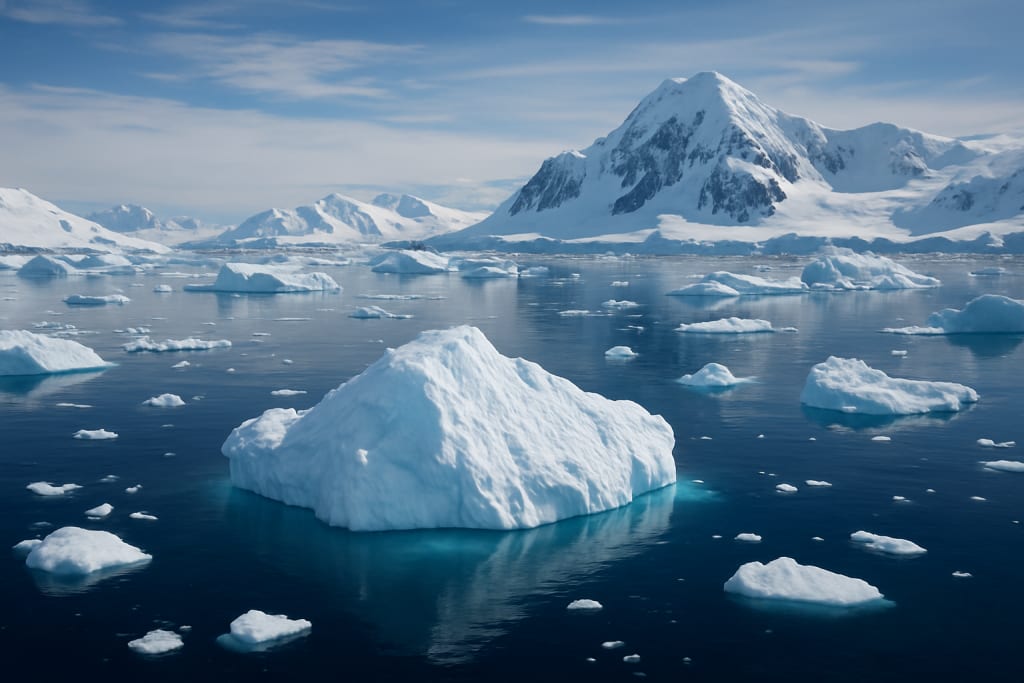
In the farthest reaches of our planet lies a world few will ever see with their own eyes. Antarctica, often referred to as the "Last Frontier," is a continent of paradoxes—silent yet thunderous, fragile yet enduring, empty yet overflowing with life. The picture of vast icebergs drifting across still waters, with towering snow-covered mountains rising like guardians in the background, captures more than a frozen landscape. It holds within it stories of survival, resilience, and a quiet reminder of how deeply connected humanity is to even the most remote corners of Earth.
This frozen wonderland is not simply a stretch of ice and snow. It is a living, breathing ecosystem, a climatic regulator, and a mirror that reflects both the beauty of creation and the fragility of existence.
The Majesty of Ice
At first glance, the icy expanse of Antarctica appears motionless. But those who look closer begin to realize that every block of ice, every drifting floe, and every shard of frozen water is part of a slow, majestic dance. Icebergs, like the ones in the picture, are not static objects—they are constantly breaking, shifting, melting, and re-forming. The massive glacier behind them, towering under a sky brushed with clouds, tells the story of thousands of years of snow compressed into ancient ice.
The colors themselves hold meaning. The crisp whites and radiant blues are a reminder of purity. Unlike many landscapes altered by human hands, much of Antarctica still stands untouched, unspoiled, and undefiled. Yet beneath the beauty lies an unspoken truth: the ice is melting faster than it should.
The Keeper of the Planet’s Balance
Antarctica is more than a remote wilderness; it is one of Earth’s greatest balancing forces. Its massive ice sheets store about 70 percent of the world’s freshwater. This frozen reservoir plays a crucial role in regulating sea levels and the planet’s climate. The cold, dense waters that sink off its coasts drive global ocean currents, helping circulate nutrients and heat across the seas.
In other words, what happens in Antarctica doesn’t stay in Antarctica. The rise and fall of its glaciers affect coastal cities thousands of miles away. The rhythm of its winds and waters sets the tempo for weather systems across the globe. Even if most of us never set foot there, the continent’s silent pulse beats through our lives daily.
Life in the Ice
Though the picture shows a serene and seemingly barren seascape, life in Antarctica is abundant, though often hidden from view. Penguins, seals, and whales thrive in the surrounding waters, relying on the ice for survival. Beneath the surface, plankton blooms and krill swarm in great numbers, forming the foundation of an intricate food web.
The continent’s animals embody the essence of resilience. Emperor penguins huddle together through freezing blizzards, protecting their chicks in one of nature’s most remarkable displays of endurance. Weddell seals carve breathing holes into the ice, surviving in temperatures that would kill most creatures. Humpback whales migrate thousands of miles to feed in these rich waters before returning to warmer seas.
Each life is part of a larger narrative—a testament to adaptation, perseverance, and the quiet will to survive in the harshest environment on Earth.
Silence That Speaks
There is something profoundly spiritual about Antarctica. Unlike other places on Earth, there are no cities, no noise of traffic, no flashing lights. The silence is absolute, broken only by the cracking of ice, the call of a seabird, or the distant splash of a whale. For those who experience it, the silence is not empty—it is full.
It is the kind of silence that invites reflection. The stillness forces one to confront not only the immensity of nature but also the smallness of human existence. Standing before an Antarctic iceberg is not simply looking at frozen water; it is witnessing a monument older than any civilization, sculpted by time and untouched by human ambition.
The Fragile Future
And yet, as eternal as Antarctica may seem, it is far from invulnerable. Climate change is carving its way through the continent. The icebergs that appear so majestic in the photograph are, in part, a symbol of loss. Every year, Antarctica loses billions of tons of ice, contributing to rising seas and threatening coastal communities worldwide. Scientists warn that if the continent continues to warm, the stability of its ice sheets could collapse, leading to catastrophic consequences for the planet.
This fragility transforms the picture into more than a beautiful image—it becomes a call to responsibility. Antarctica is both a wonder to be admired and a warning to be heeded. What we do in our daily lives, from the energy we use to the choices we make, affects this remote wilderness in ways we cannot always see.
A Place That Belongs to All
One of the most remarkable things about Antarctica is that it does not belong to a single nation. Governed by the Antarctic Treaty of 1959, it remains dedicated to peace, science, and preservation. This treaty symbolizes what humanity is capable of when cooperation outweighs conflict—nations coming together not to claim, but to protect.
In an age of division, Antarctica is a reminder of unity. It shows us that some places are too sacred for ownership, too essential for exploitation. It belongs not to one, but to all of humanity. And more than that, it belongs to the generations yet to come.
The Emotional Weight of Ice
Looking at the picture of drifting icebergs, one cannot help but feel a mixture of awe and melancholy. Awe at the sheer scale of nature’s artistry—mountains rising from the sea, glaciers sculpted into frozen castles, and ice reflecting the soft light of the sky. Melancholy at the knowledge that this beauty is under threat, that future generations may see less of it than we do today.
There is a certain poetry to ice. It holds memory—ancient air trapped inside bubbles, tiny fossils hidden in its layers, history preserved in silence. Each iceberg is a floating archive, a fragment of Earth’s long story. To see them drift is to witness history moving before your eyes.
Conclusion: A Mirror of Ourselves
Antarctica is not just a place on the map; it is a mirror. In its silence, we hear the echoes of our responsibility. In its fragility, we see our own. And in its beauty, we recognize what is worth protecting.
The picture of Antarctica’s ice is more than an image—it is an invitation. An invitation to pause, reflect, and act. To see beyond ourselves, to protect what cannot protect itself, and to ensure that the last great wilderness remains untouched for as long as the Earth spins.
Antarctica is, at its heart, a silent symphony. A song of ice and time, sung not in words but in whispers of wind, in the cracking of glaciers, in the reflection of sunlight on frozen seas. It is a reminder that even in the coldest corners of the Earth, beauty thrives, life endures, and hope remains.
About the Creator
Keep reading
More stories from Fazal wahid and writers in Earth and other communities.
Voices from the Stars space
The hum of the spacecraft was constant, like a heartbeat woven into the silence of space. Commander Elara Hayes floated near the observation window, her gloved hand resting against the glass. Beyond, the Earth glowed—a fragile marble of blue and green suspended in an endless sea of black. She had dreamed of this view since childhood, but dreams had never quite captured the way the world shimmered like a jewel under the stars.
By Fazal wahid 4 months ago in Earth
Greenland: New Shipping Routes, Hidden Minerals – and a Frontline Between the US and Russia?
Once seen as a remote and largely isolated Arctic territory, Greenland is rapidly emerging as a focal point of global geopolitics. Climate change, melting ice, and technological advances are transforming the island into a strategic hub defined by new shipping routes, vast mineral resources, and growing rivalry between major powers, particularly the United States and Russia. As the Arctic opens up, Greenland’s geographic position and untapped potential are pushing it to the center of international attention, raising questions about security, sovereignty, and sustainable development. Melting Ice and the Opening of New Shipping Routes One of the most visible impacts of climate change in the Arctic is the reduction of sea ice, which is making previously inaccessible waters navigable for longer periods each year. New Arctic shipping routes, including passages near Greenland, promise shorter travel times between Europe, Asia, and North America. Compared to traditional routes like the Suez Canal, Arctic pathways can reduce shipping distances by thousands of kilometers, cutting fuel costs and emissions. For global trade, this could be transformative. Greenland’s coastal waters are increasingly important as potential transit corridors and support hubs for these routes. However, the expansion of Arctic shipping also raises concerns about environmental risks, maritime safety, and the lack of robust emergency infrastructure in the region. Hidden Mineral Wealth Beneath the Ice Beyond shipping, Greenland holds significant reserves of critical minerals, many of which are essential for modern technologies and the global energy transition. These include rare earth elements, lithium, graphite, uranium, and other strategic resources used in electric vehicles, wind turbines, batteries, and defense systems. As demand for these materials grows, Greenland is being viewed as a potential alternative to existing supply chains dominated by a small number of countries. This has increased interest from Western governments seeking to diversify mineral sourcing and reduce strategic dependencies. However, mining in Greenland is controversial. Local communities and policymakers must balance economic opportunities with environmental protection and cultural preservation. Greenland’s harsh climate and fragile ecosystems make resource extraction both technically challenging and politically sensitive. The United States’ Strategic Interest in Greenland The United States has long considered Greenland strategically vital, largely due to its location between North America and Europe. The US already maintains a military presence at Pituffik Space Base (formerly Thule Air Base), which plays a key role in missile warning systems and space surveillance. In recent years, Washington has renewed its focus on Greenland, emphasizing Arctic security, infrastructure investment, and cooperation with Denmark, which oversees Greenland’s foreign and defense policy. US interest is driven by several factors: protecting transatlantic security routes, countering rival powers in the Arctic, and ensuring access to critical minerals. Greenland is increasingly viewed as a frontline in maintaining Western influence in the High North. Russia’s Arctic Ambitions Russia, meanwhile, sees the Arctic as central to its economic and military strategy. It has invested heavily in Arctic military bases, icebreaker fleets, and energy projects, particularly along its northern coastline. Although Greenland is geographically distant from Russia’s main Arctic territories, Moscow closely monitors developments there. The island’s proximity to key Arctic sea lanes and North Atlantic routes makes it strategically relevant in any broader confrontation between Russia and NATO. As tensions between Russia and the West remain high, Greenland’s location places it near the intersection of competing security interests, increasing its geopolitical significance. Greenland Between Global Powers The growing attention from major powers puts Greenland in a delicate position. While the island seeks greater economic independence and development, it must navigate complex relationships with Denmark, the United States, and other international actors. Greenland’s government has emphasized the importance of maintaining control over its resources and ensuring that development benefits local populations. At the same time, geopolitical competition risks turning Greenland into a strategic chessboard rather than a partner in decision-making. This balancing act is becoming more difficult as Arctic competition intensifies. Environmental and Social Challenges Greenland is on the front lines of climate change. Melting ice sheets contribute to global sea-level rise, while local communities face changes to traditional livelihoods such as fishing and hunting. The expansion of shipping and mining could bring jobs and infrastructure, but it also threatens fragile ecosystems and raises concerns about pollution, habitat disruption, and long-term sustainability. Any future development in Greenland will require careful regulation, international cooperation, and meaningful engagement
By Aarif Lashari3 days ago in Earth
Top Australian Writers’ Festival Cancelled After Palestinian Author Barred
One of Australia’s most respected literary festivals has been cancelled following a fierce backlash over the decision to bar a Palestinian author from participating. What began as a programming dispute quickly escalated into a national debate about free speech, cultural inclusion, and political pressure in the arts. The cancellation has sent shockwaves through Australia’s literary community, raising urgent questions about whose voices are allowed on public platforms and at what cost.
By Aarif Lashari4 days ago in Earth




Comments
There are no comments for this story
Be the first to respond and start the conversation.