
An Introduction to Napoleon Bonaparte: His Life, Legacy, and Impact on History
From Military Commander to Emperor of France and Beyond - Exploring the Complexities of Napoleon's Reign and Influence on Europe

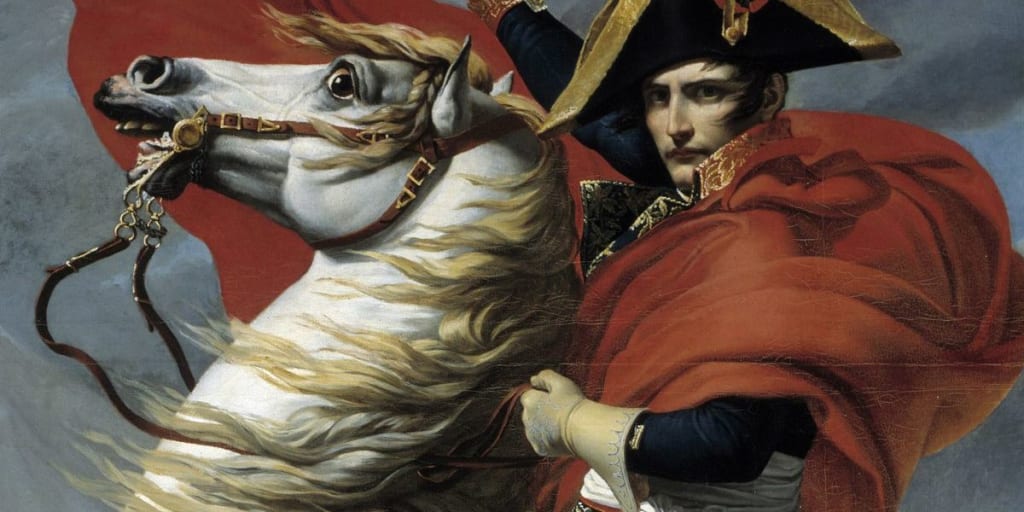
Napoleon Bonaparte was a military and political leader of France who lived from 1769 to 1821. He rose to prominence during the French Revolution, becoming a general in the French army and leading several successful military campaigns.
Napoleon became First Consul of France in 1799 and then declared himself Emperor in 1804. He implemented many reforms and modernized France's legal and educational systems, and he also expanded the French Empire through military conquests in Europe.
However, Napoleon's ambition led him to make some costly mistakes, including the disastrous invasion of Russia in 1812. He was defeated in 1815 at the Battle of Waterloo and exiled to the island of Saint Helena, where he died six years later.
Napoleon is often remembered as one of the greatest military commanders in history, and his legacy continues to be debated to this day.
Napoleon was born on the island of Corsica, which was under French control at the time, on August 15, 1769. He received a military education and quickly rose through the ranks of the French army, displaying a natural talent for strategy and leadership.
During the French Revolution, Napoleon played a key role in several military campaigns, including the Italian campaign of 1796-97 and the Egyptian campaign of 1798-99. He also helped to overthrow the Directory and establish the Consulate, with himself as First Consul.
As Emperor, Napoleon continued to expand the French Empire, conquering territories in Europe and beyond. He also implemented many domestic reforms, such as the Napoleonic Code, which established a uniform legal system throughout France and has had a lasting impact on the legal systems of many other countries.
Despite his military successes, Napoleon's empire eventually became overextended, and he suffered major defeats, including the disastrous Russian campaign and the Battle of Leipzig. He was ultimately defeated by the Seventh Coalition at the Battle of Waterloo in 1815 and exiled to Saint Helena, where he spent the rest of his life in confinement.
Napoleon's impact on history is still debated. He is often seen as a great military leader and innovator who modernized France and helped to spread the ideas of the French Revolution throughout Europe. However, he also has been criticized for his autocratic tendencies and the human cost of his conquests.
Napoleon's legacy extends far beyond his military conquests and political reforms. He is also remembered for his contributions to the arts and sciences.
During his reign, Napoleon supported the development of science and technology, including the establishment of the French Academy of Sciences and the creation of the Metric System. He also founded the University of France, which was intended to provide a comprehensive education to all French citizens.
Napoleon was also a patron of the arts, commissioning many works of art and architecture and supporting the development of the Romantic movement. He famously commissioned Jacques-Louis David to paint his portrait, which has become an iconic image of the emperor.
Napoleon's impact on world history can still be felt today. His military tactics and strategies are studied by military historians, and his reforms have had lasting impacts on legal systems, education, and governance in many countries around the world. Despite his controversial legacy, Napoleon remains a fascinating figure and one of the most important political and military leaders in European history.
Napoleon's impact on Europe was not limited to France. His military campaigns and conquests led to the spread of French culture and ideas throughout Europe, particularly in areas that were under French control.
Napoleon's rule also had a significant impact on the development of nationalism in Europe. The idea of a unified national identity and a centralized state became increasingly important in the aftermath of the Napoleonic era, as many European countries sought to establish their own independent states.
Napoleon's legacy also continues to be debated in France today. While he is still widely regarded as a key figure in French history, his rule is often criticized for its autocratic tendencies and the human cost of his wars and conquests.
In recent years, there has been renewed interest in Napoleon, with numerous books, films, and TV shows exploring his life and legacy. The bicentennial of his death in 2021 was marked with events and exhibitions across France and around the world, highlighting the ongoing fascination with one of history's most controversial and enigmatic figures.
About the Creator
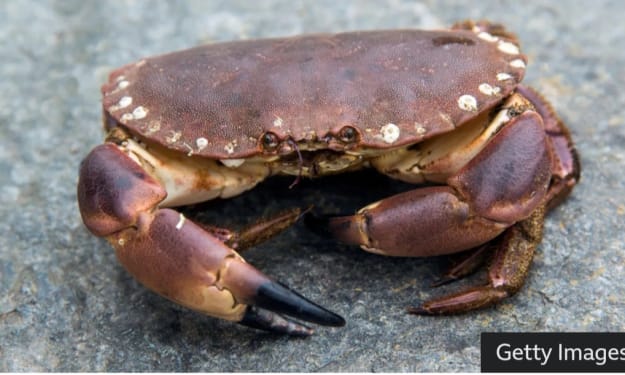
Workers Recover 15,000 Crabs After Lorry Crashes Into Field
An extraordinary scene unfolded when a lorry carrying an estimated 15,000 live crabs crashed into a field, spilling its cargo across farmland and prompting a large-scale recovery effort. The unusual accident quickly drew attention from local residents, emergency services, and animal welfare groups, as workers scrambled to rescue as many crabs as possible before they succumbed to exposure.
By Aarif Lashari7 days ago in Earth
FPS: Roots and Branches Challenge Winners
The FPS: Roots and Branches Challenge has wrapped up, and gaming enthusiasts around the world are celebrating the winners of this exciting and competitive event. From showcasing incredible skill to creative problem-solving, participants pushed their limits, making the challenge a true testament to the evolving world of first-person shooter (FPS) games.
By Aarif Lasharia day ago in Earth


Comments
There are no comments for this story
Be the first to respond and start the conversation.