
Addressing Climate Change: A Global Imperative for a Sustainable Future
Climate change

1) Introduction
Climate change is one of the most pressing issues of our time, affecting every corner of the globe. It poses significant challenges to our environment, economy, and social well-being. As the world's population continues to grow and industrialization expands, the need to take immediate and decisive action to combat climate change becomes increasingly urgent. This article explores the causes, impacts, and potential solutions to address climate change, emphasizing the collective responsibility we bear as global citizens.
2) Understanding Climate Change
Climate change refers to long-term shifts in temperature patterns and weather conditions, primarily caused by human activities that release greenhouse gases (GHGs) into the atmosphere. The burning of fossil fuels for energy, deforestation, and industrial processes are the primary contributors to rising GHG levels. These gases trap heat within the Earth's atmosphere, leading to a gradual increase in global temperatures, commonly known as global warming.
3) Impacts of Climate Change
The impacts of climate change are far-reaching and diverse, affecting various aspects of our lives. Rising sea levels threaten coastal communities, increasing the risk of flooding and erosion. Changing weather patterns contribute to more frequent and intense natural disasters, such as hurricanes, droughts, and wildfires. Shifts in rainfall patterns can lead to water scarcity and food insecurity, impacting agricultural productivity and exacerbating hunger and poverty. Moreover, climate change poses risks to human health, biodiversity, and ecosystems, disrupting delicate natural balances that support life on Earth.
4) Solutions and Mitigation Strategies
1. Addressing climate change requires a multifaceted approach involving individuals, governments, businesses, and international cooperation. Here are some key strategies for mitigating climate change:
2. Transition to Renewable Energy: Shifting away from fossil fuels and embracing renewable energy sources like solar, wind, and hydroelectric power is essential. Governments should incentivize the adoption of clean energy technologies while investing in research and development to make them more accessible and affordable.
3. Energy Efficiency: Enhancing energy efficiency across all sectors, including transportation, buildings, and industries, can significantly reduce GHG emissions. This includes promoting energy-efficient appliances, improving insulation, and implementing stricter energy efficiency standards.
4. Sustainable Agriculture and Land Use: Implementing sustainable agricultural practices, such as organic farming and precision agriculture, can reduce emissions from the agriculture sector. Protecting and restoring forests and other natural habitats can also help sequester carbon dioxide.
5. Circular Economy: Moving towards a circular economy, where resources are used efficiently and waste is minimized, can significantly reduce emissions and resource depletion. Recycling, reusing, and adopting eco-friendly production methods are key components of a circular economy.
6. Climate Policy and International Cooperation: Governments must establish robust climate policies, setting ambitious emission reduction targets and implementing regulations to incentivize sustainable practices. International cooperation and agreements, such as the Paris Agreement, are crucial for coordinating global efforts and providing support to developing countries.
5) Individual Actions
While systemic changes are crucial, individual actions can also make a difference. Adopting a more sustainable lifestyle by reducing energy consumption, practicing responsible consumption, and advocating for climate action can contribute to the collective effort against climate change.
6) Conclusion
Climate change is an existential threat that demands immediate action at all levels. The consequences of inaction are dire, but the opportunity to mitigate and adapt to climate change is within our grasp. By embracing renewable energy, promoting sustainable practices, and fostering international cooperation, we can build a more resilient and sustainable future for generations to come. The time to act is now, and the responsibility rests on all of us to address climate change head-on.
About the Creator
Keep reading
More stories from Chris G.T.S and writers in Earth and other communities.
The Rise of Robots: Exploring the Replacement of Humans in the Workplace
Introduction Advancements in technology, particularly in the field of robotics and automation, have led to significant transformations in various industries. As artificial intelligence and robotics continue to evolve, the potential for replacing humans in certain areas of work has become a topic of considerable discussion. This article delves into the concept of human-robot substitution, examining its implications, benefits, and challenges. While the integration of robots in the workforce offers undeniable advantages, we must also address the ethical, social, and economic aspects associated with this transition.
By Chris G.T.S3 years ago in Humans
Magnetic Magma earth
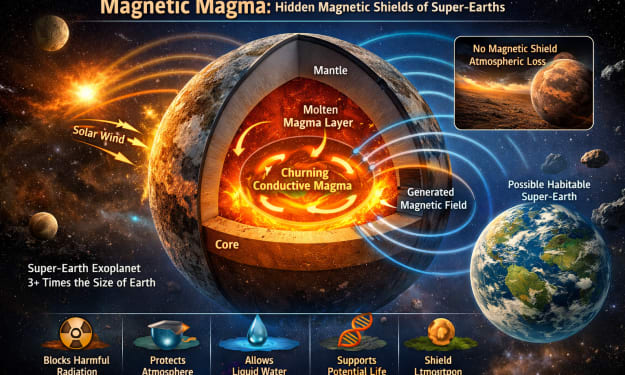
Super-Earths are rocky exoplanets more than three times the size of our planet, with far greater internal pressures and temperatures. For years, scientists assumed that if these worlds had magnetic fields, they would form the same way Earth’s does — through movement in a molten iron core. However, new laboratory experiments suggest something very different may be happening deep inside these massive planets. Under extreme pressure, certain molten rocks become electrically conductive. When these materials churn and circulate between the core and the mantle, they can generate magnetic fields on their own. This means a super-Earth might not rely solely on its core for protection. Instead, a thick, dynamic layer of magma could act as a natural magnetic shield, powered by internal heat and motion.
By USA daily update 5 days ago in Earth
Media: The Amplifier of Injustice
Media does not report reality. It selects, compresses, and amplifies fragments of it according to incentives largely unrelated to truth. What reaches the public is not an account of events; it is an engineered sequence designed to capture attention, provoke reaction, and sustain engagement.
By Meridian Vox2 days ago in Earth



Comments
There are no comments for this story
Be the first to respond and start the conversation.