
A Comprehensive Farming Guide for Growing Ginger
Ginger a High Value Crop for Framers
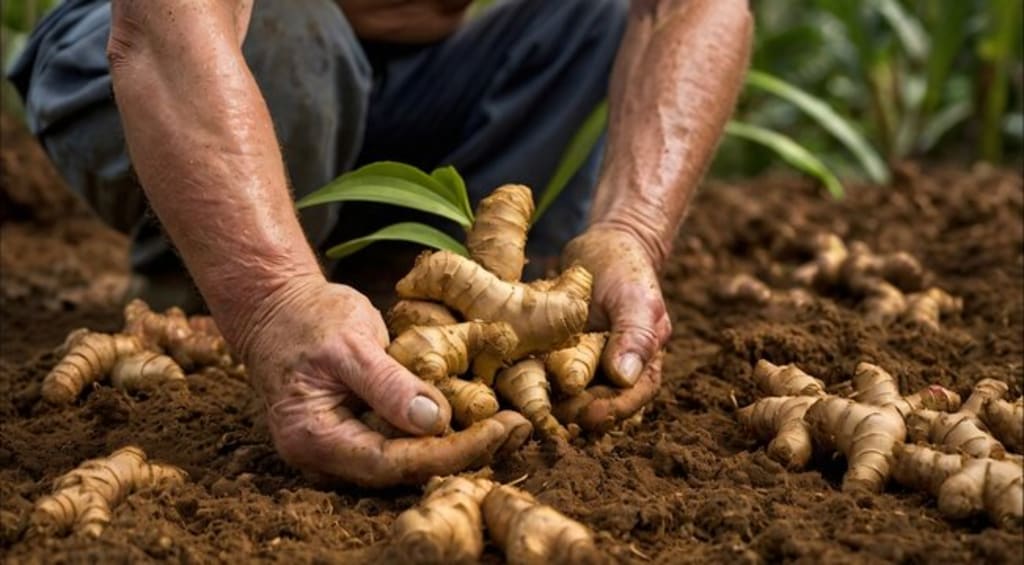
Ginger is a cool perennial plant that grows at 2 to 4 feet. It has little dark green leaves and big bunches of small white flowers. So, if you want to be a ginger-growing pro, stick around for this article.
Ginger is a tropical climatic plant in Karnataka, Orissa, Assam, and Meghalaya. Mostly, it needs hot temperatures except for a few varieties of ginger. You can plant ginger seeds outdoors, but growing them directly into the ground is the most reliable method. Ginger needs little care other than deadheading flowers and weeding. Let’s dive into this article to understand everything in detail.
Soil Requirement For Ginger Farming:
The ideal soil requirement for ginger farming is loose, well-drained soil with a slightly acidic pH. It is tolerant of most soils but needs loam that is rich in organic matter. A good manure mix will help to promote growth.
● Ginger prefers well-drained soil but can tolerate various soil conditions. It may also be grown in multiple soil types in India, including clay, sand, rocky soils, and heavy clays.
● To thrive, the Ginger plant needs nitrogen, phosphate, and potassium. Organic materials, such as compost or old manure, can improve garden soil. According to some gardeners, planting Ginger on raised beds can enhance harvests.
Land Preparation for Ginger Farming:
The field should be ploughed 4 to 5 times or dug completely after receiving early summer rainfall to bring the soil to a fine tilth. Beds are about 1 m in width, 30 cm in height, and convenient in length, with a 50 cm inter-gap between beds. For ginger farming, farmers often rely on the efficiency and convenience of the Shaktiman Rotavator to prepare the land for optimal ginger cultivation.
Planting Season of Ginger:
Ginger is best planted on the West Coast of India during the first two weeks of May, when pre-monsoon showers arrive, and in the North Eastern states during April. In irrigated circumstances, it may be planted well in advance in the middle of February or early March.
Mulching for Ginger:
The initial mulching is done with green leaves at 10-12 tonnes/ha at the planting time. For efficient weed control, use dry coconut leaves after removing the petiole or paddy straw (2-3 kg/bed) as mulch in ginger.
Harvesting Month for Ginger Farming:
Ginger is suitable for harvesting after 8-9 months of seeding (around December) when the leaves begin to yellow and dry. The average ginger rhizome production is estimated to be between 7 and 12 tonnes per acre.
Varieties Of Ginger

Ginger varieties are grown in different ginger-growing areas in India and are generally named after the localities where they are grown. Some prominent indigenous cultivars are Maran, Kuruppampadi, Ernad, Wayanad, Himachal and Nadia.
a) Common Ginger -
Features
● Asian ginger is a versatile ingredient in stews, soups, and cookies across the globe.
● Also known as Indian or Chinese ginger
Uses
● It helps treat nausea, indigestion, muscle pain, cold, and flu and reduces inflammation.
b) Galangal -
Features
● Also known as Thai ginger, Finger root, and Tropical ginger
● It has a milder and sweeter taste.
Uses
● Used to treat stomach ache, muscle pain, gout, fever, and flatulence.
c) Turmeric
Features
● Turmeric, like galangal, is a type of ginger used for centuries in Southern India and Indonesia.
● Its orange flesh turns yellow when dried or boiled.
Uses
● You can take it as a supplement due to the presence of rich antioxidants
d) Peacock Ginger-
Features
● has purple flowers and serves both medicinal and cosmetic purposes.
Uses
● Relief in curing throat infections and stimulating new cell growth.
e) White Ginger-
Features
● Peacock ginger, also known as butterfly flower or ginger lily.
● Mostly found in Nigeria, parts of the US, Nepal, and eastern India.
Uses
● They were used against indigestion, constipation, anorexia, and stomach pain.
How Much Farmers Can Earn From Ginger Farming?
On the West Coast of India, ginger thrives when planted in the first half of May, coinciding with the initial pre-monsoon showers. However, it can be produced even earlier, around February or March, under irrigated conditions.
Ginger cultivation costs around Rs 7-8 lakh per hectare and can generate profits of up to Rs 9 lakh with current market prices at around Rs 60-80 per kg.
Conclusion
In Indian agriculture, ginger farming emerges as a beacon of promise and profitability. Its ability to thrive in diverse climates makes it an appealing choice for farmers nationwide, offering a bountiful source of income.
Ginger cultivators can foster a sustainable and flourishing industry by adopting sound agricultural methods, staying attuned to market dynamics, and embracing contemporary farming practices. Suppose you aspire to become a successful ginger farmer and wish to boost your productivity. In that case, you can reckon on Shaktiman Rotavator which makes tilling work easy by prepping soil for planting. With Shaktiman Rotavator Price 7 feet's smooth operation and reliable performance, you can achieve optimal soil preparation with minimal stress.
As the demand for ginger escalates, a harmonious blend of innovation and eco-consciousness will undoubtedly secure a prosperous future for this revered spice in India's farming heritage.
About the Creator
Mahira Kaur
Hello! I'm Mahira and I have a deep passion for agriculture & farming. My interest lies in exploring innovative agricultural techniques and sustainable farming practices that can enhance productivity and ensure environmental stewardship.
Keep reading
More stories from Mahira Kaur and writers in Earth and other communities.
A Comprehensive Guide to Millets Farming
Out of all the cereal crops, millet is considered to be one of those that favour the farmer the most. Indeed, in many regions, millet is referred to as the lazy man’s crop, which is implicative of their ease of cultivation. All you need to do is pay a visit to the field to plant seeds and then come after three months to collect the grains.
By Mahira Kaur2 years ago in Earth
Super Intelligent Aliens
For centuries, humanity has gazed at the night sky with a mixture of wonder and curiosity. The question of whether we are alone in the universe has fascinated philosophers, scientists, and storytellers alike. With recent advancements in astronomy, artificial intelligence, and space exploration, the possibility of extraterrestrial life no longer belongs solely to science fiction. Among the many hypotheses about alien life, one of the most unsettling is the existence of super intelligent aliens—beings whose intellectual, technological, and strategic capabilities far surpass those of humans. While the idea may seem speculative, the potential threat posed by such entities raises serious concerns about human survival, autonomy, and the future of civilization.
By Ibrahim Shah 7 days ago in Earth



Comments
There are no comments for this story
Be the first to respond and start the conversation.