
9 Eco-Solutions for the Bathroom
Do you use eco-friendly products?

Today you will find out how you can help the planet by reviewing your bathroom products.
Bamboo toothbrush
One of the basic principles of an ecological lifestyle is to give up products that cannot be recycled.
Plastic toothbrushes are very difficult or even impossible to recycle. They are made of a combination of plastic, rubber (for the handle), and nylon (the actual brush). None of these materials are biodegradable, so brushes will remain a waste forever.
National Geographic reports that more than 448 million tons of plastic are produced annually, which does not decompose and cannot be recycled.
Replace the plastic brush with a bamboo one, its base will turn into compost in 2–3 years, while the decomposition time of the plastic toothbrush is 500–1000 years.
Toothpaste in tablets or toothpaste
According to the production standard, the most common toothpaste is packed in plastic and aluminum tubes, which are practically not recycled and can decompose in the landfill for up to 450 years.
While toothpaste in tablets and toothpaste more often (but not always) are packed in recyclable plastic bottles or cardboard boxes.
Wooden or bamboo comb
Most plastic combs also do not recycle, so replace them with bamboo or wood. This will be useful not only for the planet but also for you - after using the natural comb for a long time, the quality of the hair will improve, because during the combing you massage and stimulate the blood circulation of the scalp.
T-shaped metal shaver
All disposable razors and litter boxes alike end up in the landfill without going through the recycling process. Use a harmless razor, the so-called two-blade razor, so you can reduce the amount of waste and save on the blades.
Reusable sponges for the face
Most commonly, make-up removal discs are made from raw materials. This means that you could save resources if you find an environmentally reusable substitute.
You have several options: order cloth sponges online, which can be machine washed or made by yourself. There are also cellulose sponges (wood) - they will not last you long, but at least they disintegrate in the natural environment and are not disposable. The cellulose sponge can be used to remove makeup or face masks, but it is too harsh to clean the eyes.
Loofah sponge
You will often find synthetic and foam sponges on store shelves, but synthetic sponges may cause allergies, and foam sponges may accumulate germs. The most environmentally friendly substitute for synthetic sponges is a loofah product.
Lufa is a plant whose fruit resembles large cucumbers. People in ancient times learned to process and use them as sponges - the first to use the plant for this purpose were Portuguese sailors.
This plant sponge cleanses the skin and massages well, dries quickly so that bacteria do not grow in its fibers. And, of course, it decomposes in the natural environment.
Cotton swabs
Ordinary ear sticks with cocktail straw are one of the main pollutants in the environment. On the list of the most common wastes on the beach, they have a sixth place. Plastic chopsticks are not recyclable, so you may need to replace them with wood and cardboard items or replace them completely. Many studies confirm that it is not good to clean your ears with chopsticks.
Solid soap, shampoo, and conditioner
The rule is simple: it's good when they're not in plastic containers. Solid cosmetics are often not sold in packaging or are sometimes wrapped in paper. You can keep them in metal boxes at home.
There are benefits for you too - in solid variations of products, sulfates, and other harmful chemicals are less common.
Deodorant crystals
Deodorant crystals are the most environmentally friendly for several reasons. First of all, they are made entirely of natural ingredients - they do not clog pores and do not cause inflammation even on freshly shaved skin.
Second, they are sold in recyclable plastic packaging. Crystals are not sold as aerosols (many waste operators do not risk recycling aerosols due to the danger of explosion). Third, crystals are economical, which means you will consume fewer resources.
Together we can save the planet.
About the Creator
Keep reading
More stories from Paul Wilks and writers in Earth and other communities.
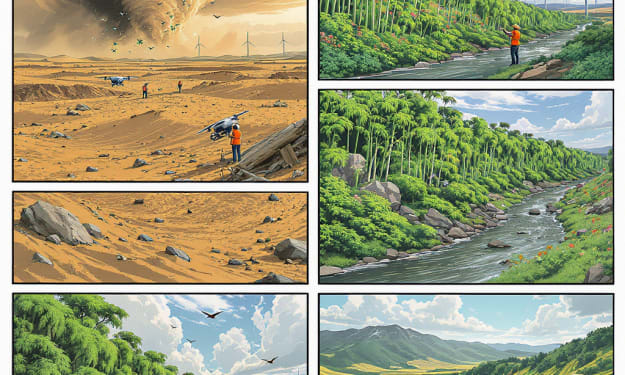
Chinese Planetary Engineering: The Great Green Wall and the Reclamation of Climate
There are junctures in history where a civilization no longer chooses between comfort and progress, but between adaptation and extinction. At the dawn of the new millennium, China hit one of those silent thresholds where geography ceases to be a backdrop and becomes an adversary. The desert was advancing, not as a metaphor for decay, but as a physical, methodical, and relentless force. Sand was devouring the horizon, winds grew heavy with dust, and the soil lost its fertile memory, taking with it the promise of social stability.
By Laurenceau Porte4 days ago in Earth
US Warns Airlines About Military Activity in Parts of Latin America
Commercial aviation is built on predictability—clearly defined airspace, coordinated air traffic control, and shared international rules. When that predictability is disrupted, even subtly, the ripple effects can stretch far beyond the cockpit. That is exactly why a recent warning from the United States has caught the attention of airlines, governments, and travelers alike. In early 2026, US aviation authorities issued an advisory warning airlines about military activity in parts of Latin America, urging pilots to exercise heightened caution when flying over certain regions. While no immediate restrictions or flight bans were imposed, the message itself was clear: something in the skies has changed, and the risks—however limited—can no longer be ignored. This development is not just about aviation safety. It reflects a growing intersection between geopolitics, military operations, and civilian infrastructure in a region that has long balanced cooperation with tension. What Exactly Did the US Warn About? The advisory, released through official aviation safety channels, highlighted concerns over potential military activity affecting airspace across parts of Mexico, Central America, South America, and nearby oceanic regions. Airlines were advised to remain vigilant during all phases of flight, including cruising at high altitudes, takeoff, and landing. Unlike routine notices related to weather systems or airport congestion, this warning explicitly referenced security-related risks. These include the possibility of unexpected military movements, temporary airspace disruptions, and interference with navigation systems that modern aircraft rely on for safe operations. Importantly, the warning did not accuse any specific country of wrongdoing, nor did it suggest an immediate danger to passengers. Instead, it served as a precaution—one designed to ensure airlines adjust flight planning, monitoring, and communication protocols accordingly. Why Military Activity Matters to Civil Aviation To the average traveler, military exercises or operations may seem distant from the experience of flying on a commercial jet. In reality, the two worlds often share the same skies. Civilian aircraft depend heavily on satellite navigation, coordinated air traffic control, and stable airspace rules. Military operations—especially those involving fast-moving aircraft, surveillance systems, or electronic equipment—can introduce uncertainty into that environment. Some of the key risks aviation authorities monitor include: Unplanned military aircraft movements that may not follow civilian flight patterns Temporary airspace closures or restrictions that require last-minute rerouting Navigation signal disruptions, whether accidental or intentional Increased congestion in strategic corridors used by both civilian and military flights While these risks are typically managed through coordination and communication, heightened military activity raises the stakes. The FAA’s advisory suggests that such activity has reached a level where additional caution is warranted. The Geopolitical Context Behind the Warning The timing of the advisory is not accidental. Latin America has seen a noticeable rise in security operations and military coordination involving the United States over the past year. These efforts are largely focused on counter-narcotics missions, maritime security, and regional stability, particularly in areas with strategic shipping routes or ongoing political tension. At the same time, broader global dynamics—ranging from great-power competition to shifting alliances—have increased the strategic importance of air and sea routes across the Western Hemisphere. From Washington’s perspective, issuing an aviation warning is not about alarmism. It is about acknowledging that military and security activities in the region may temporarily affect civilian systems, including aviation. How Airlines Are Responding For airlines, advisories like this are not unusual—but they are taken seriously. Most major carriers already operate with layered safety systems that allow them to respond quickly to changing conditions. In practical terms, this warning may lead to: Slight route adjustments to avoid specific airspace Enhanced pilot briefings before flights Increased coordination with air traffic controllers Closer monitoring of navigation and communication systems So far, there have been no widespread flight cancellations or suspensions linked directly to the warning. That suggests airlines view the risk as manageable, provided proper precautions are followed. Reactions from Latin American Governments Some governments in the region have been quick to reassure the public. Officials have emphasized that their national airspace remains safe and fully operational, and that civilian flights continue without disruption. This response highlights an important tension: while the US warning is precautionary, it can still affect public perception. Tourism, business travel, and investor confidence are all sensitive to suggestions of instability—even when no immediate danger exists. As a result, many countries are walking a careful line between cooperating on aviation safety and defending their reputation for stability. What This Means for Passengers For travelers, the key takeaway is simple: commercial aviation remains safe. Warnings like this are designed to prevent incidents, not predict them. Passengers flying through or over affected regions may experience slightly longer flight times or minor schedule adjustments, but there is no indication of increased danger to civilian aircraft. In fact, the existence of such advisories demonstrates how seriously aviation authorities take even low-probability risks. A Sign of a More Complex World The US warning to airlines is a reminder that modern air travel does not exist in a vacuum. As military operations, security concerns, and geopolitical rivalries evolve, civilian systems—from shipping lanes to flight paths—are increasingly affected. This moment underscores a broader reality: the skies are becoming more crowded, more contested, and more interconnected with global politics. Managing that complexity will require continued transparency, cooperation, and vigilance from governments, regulators, and airlines alike. For now, planes continue to fly, passengers continue to travel, and the system continues to work. But behind the scenes, aviation authorities are quietly adjusting to a world where safety is shaped not just by weather and mechanics—but by geopolitics as well.
By Muhammad Hassanabout 14 hours ago in Earth



Comments
There are no comments for this story
Be the first to respond and start the conversation.