
183 cases, the number of global conflicts in 2023 "hit a 30-year high"
World peace needs everyone

The US Bloomberg News website recently published an article titled "It's Not Just Ukraine and Gaza: Wars Are Increasing Around the World," written by Max Hastings. An excerpt from the article is as follows:
Recently, the London-based International Institute for Strategic Studies released the latest edition of its authoritative annual report, the Armed Conflict Survey. This survey predicts we won't have a very peaceful holiday season. It paints a grim picture: violence is increasing in many places, and war is hindering the achievement of peace in the long term. The survey focuses on regional conflicts rather than great-power rivalry between China, Russia, the United States and their allies. The survey recorded 183 conflicts in 2023, the most in 30 years.
The survey emphasized: "The difficulty of resolving conflicts is the biggest feature of the contemporary global conflict situation." Non-state armed organizations (Hamas in Gaza is just one of the most visible organizations) pose a huge threat.
Although the threat of world wars like those of 1914-1918 and 1939-1945 was not yet imminent, tensions were growing.
After Hamas's horrific atrocities on October 7, Israel launched an attack on Gaza. The risk that the operation could spark a larger conflict in the Middle East remains.
There are border conflicts around the world, and the Russia-Ukraine conflict is but one of the most destructive. Azerbaijan has seized the Nagorno-Karabakh region, prompting more than 100,000 Armenian residents to flee. Tensions between Russia and Georgia persist. Tensions between Algeria and Morocco are at their highest since the modern era. In Pakistan, domestic terrorism has escalated and relations with the Indian government are dangerously tense.
Meanwhile, the IISS report said: “In fragile states, the growing climate crisis continues to amplify the root causes of conflict and institutional weaknesses.”
The intensity of the conflict increases year by year.
In the latest survey, deaths increased by 14% and violence by 28%. In the description of the authors of the survey report, the world is "dominated by increasingly intractable conflicts and armed violence, with a proliferation of actors, complex and conflicting motivations, global impacts, and accelerated climate change."
The ICRC lists 459 armed groups whose activities raise humanitarian concerns, with 195 million people living under their full or partial control. Four-fifths of these groups have sufficient local or regional dominance to collect taxes and provide some level of public services.
In the Americas, most conflicts are caused by rival criminals, especially those related to the drug trade. In many countries in South and Central America, criminal groups wield increasing power relative to governments. For decades, many governments have waged so-called wars on drugs with little impact on production or supply chains. In many places, these operations have instead prompted criminal groups to arm themselves with increasingly lethal weapons, the International Institute for Strategic Studies said. Most of these weapons are smuggled from the United States, where they are easily available.
In Eurasia, many conflicts are triggered by territorial disputes left over from the collapse of the Soviet Union.
It’s no surprise that Ukraine remains the most conflict-ridden place on earth, but Syria, Brazil, Myanmar, Mexico and Iraq are also torn apart by violence. In Nigeria, more than 10,000 people have died violently, most of them at the hands of "jihadist" elements. In Somalia, more than 9,000 people have died violently. The number of refugees displaced by war is staggering: more than 6 million in Syria, 5 million in Afghanistan and 1 million in Myanmar.
About the Creator
xx x
Hello everyone, I am a new all-around writer. I will share with you what is happening every day about the earth, country, environment, food, health, etc. Thank you for watching.
Microbiota, microbiome or microflora: how to speak correctly and why it is for health.
You've probably heard the phrase, "We are what we eat." But modern science says more precisely: we are also those who live in us. Until 2016, it was believed that there are many times more bacteria in our body than our own cells. The latest calculations by mathematicians show that we divide the body with our microorganisms by about 50/50: about 30 trillion of our cells versus 38 trillion bacterial ones.
By Yaroslav Gorohov4 days ago in Earth
Chinese EVs Closing In on America After Canadian Tariffs Deal
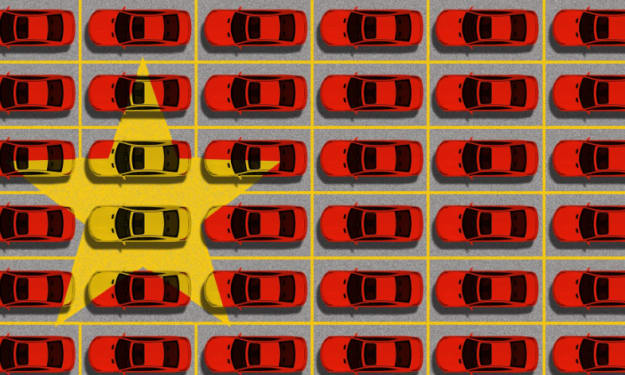
The electric vehicle race is no longer just about climate goals or consumer choice — it has become a geopolitical contest. And in early 2026, a subtle but powerful move by Canada may have tilted the board. By agreeing to sharply reduce tariffs on Chinese electric vehicles, Canada has opened a door that the United States has worked hard to keep shut. While Chinese EVs are still largely barred from the American market, they are now edging closer than ever — not by crossing the border directly, but by entering through Canada. This development raises a pressing question: Are Chinese EVs closing in on America, and what does that mean for the future of North American auto markets? The Deal That Changed the Game Canada’s new agreement with China allows up to 49,000 Chinese-made electric vehicles per year to enter the Canadian market at a tariff rate of just over 6%, a dramatic drop from the previous 100% tariff that effectively blocked them. On paper, the quota seems small. In reality, it carries enormous symbolic and strategic weight. For years, both Canada and the United States aligned closely on keeping Chinese EVs out, citing concerns over unfair subsidies, national security, and the protection of domestic auto industries. This new deal marks a clear shift — and a divergence from U.S. policy. Canada didn’t make the decision in isolation. The EV tariff reduction was part of a broader trade reset with China, tied to agricultural exports such as canola and efforts to stabilize a strained economic relationship. Why Chinese EVs Matter So Much China is the undisputed leader of the global electric vehicle industry. Its manufacturers produce EVs at scale, often at prices Western automakers struggle to match. Brands like BYD, Nio, and Xpeng have already expanded aggressively into Europe, Southeast Asia, and parts of the Middle East. North America has remained one of the final fortified markets — until now. Chinese EVs are appealing not just because they’re cheaper, but because they’ve rapidly improved in quality, range, and technology. For consumers priced out of North American and European EV models, Chinese vehicles offer something rare: affordability without sacrificing features. Canada’s decision gives Chinese automakers their first legitimate foothold in North America — and footholds tend to grow. Why the U.S. Is Nervous The United States still enforces a 100% tariff on Chinese EV imports, making them effectively unsellable in the American market. But Canada’s move has triggered concern in Washington. U.S. officials argue that Chinese EVs entering Canada could indirectly pressure American markets, influence supply chains, and weaken Washington’s leverage in future trade negotiations. There’s also a political dimension. Both major U.S. parties have framed Chinese dominance in EVs as a strategic threat — not just to auto jobs, but to technological leadership. Modern EVs collect vast amounts of data, and lawmakers have raised concerns about cybersecurity and foreign data access. While Chinese EVs aren’t rolling onto American roads yet, their presence just across the border changes the conversation. Canada’s Risk — and Opportunity Inside Canada, the reaction has been mixed. Automotive hubs like Ontario worry that opening the market could undermine domestic manufacturing and strain relations with the U.S., Canada’s largest trading partner. Some leaders have called the deal “lopsided,” warning it could cost jobs if American retaliation follows. Others see opportunity. A more competitive EV market could lower prices for Canadian consumers and accelerate EV adoption. It may also attract Chinese investment into Canada itself — including factories, battery plants, and supply chain partnerships. If Chinese automakers choose to build in Canada rather than simply export to it, the country could position itself as a bridge between Chinese EV innovation and North American demand. That balancing act — between economic opportunity and political risk — defines Canada’s strategy. Are Chinese EVs Really ‘Closing In’ on America? For now, the answer is: not directly — but strategically, yes. Chinese EVs sold in Canada won’t automatically flood the U.S. market. Regulations, trade rules, and tariffs still stand in the way. But proximity matters. Supply chains overlap. Consumer awareness spreads. Manufacturing footprints expand. There’s also the possibility of a workaround: Chinese companies could eventually build EVs in North America to bypass tariffs altogether. This idea has already been floated — but it faces fierce resistance from U.S. lawmakers and unions. Still, history shows that once a global industry leader gains regional access, momentum often follows. What This Means for Consumers For Canadian buyers, the impact could be immediate: more choice and lower prices in an EV market that has long been criticized for being expensive and limited. For American consumers, the effect will be indirect — at least at first. But increased competition could eventually pressure U.S. automakers to reduce prices, improve features, and accelerate innovation. The larger question is whether North America wants competition or insulation — and how long insulation can realistically last in a globalized EV economy. The Bigger Picture: A Global EV Power Shift Canada’s tariff deal reflects a broader reality: China’s dominance in electric vehicles is reshaping global trade, whether governments like it or not. Europe is already grappling with an influx of Chinese EVs. Emerging markets are embracing them. And now, North America has its first real crack in the wall. This isn’t just about cars. It’s about who controls the future of clean transportation, supply chains, and industrial policy. Final Thoughts Chinese EVs aren’t driving down American highways yet — but after Canada’s tariff deal, they’re closer than ever. This move doesn’t spell immediate disruption, but it does signal a shift. One country has decided that economic pragmatism outweighs political alignment. And in doing so, Canada may have opened the door to a new phase of EV competition in North America. Whether that door swings wider — or slams shut — will depend on how the U.S., automakers, and consumers respond. One thing is certain: the EV race just entered a new chapter.
By Muhammad Hassan2 days ago in Earth
Ludacris and Nelly draw backlash over bookings at MAGA-coded music festival
Ludacris and Nelly headlining a mostly right-wing event is good for them. It’s also great for the genre of hip hop. The two rap veterans have showcased their talents on other stages. Why can’t they perform for mostly MAGA folks and grab that bag?
By Skyler Saunders4 days ago in Beat



Comments
There are no comments for this story
Be the first to respond and start the conversation.