
War in the Age of Globalization
From Battlefields to Broadband: Causes, Consequences, and New Frontiers of Conflict

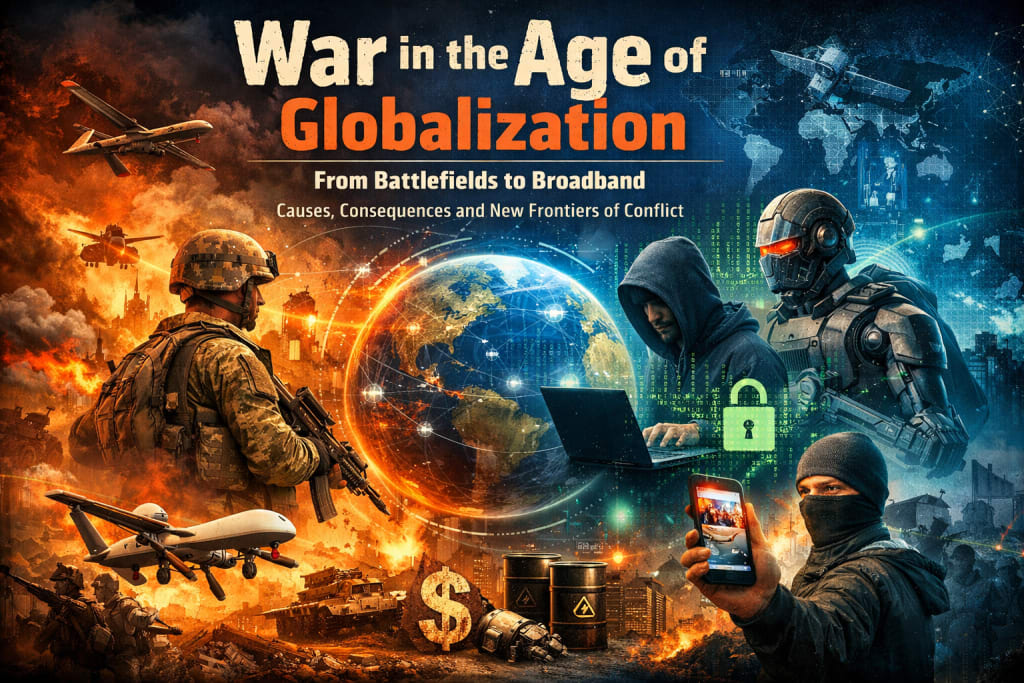
War has accompanied humanity since the earliest civilizations, evolving in form but never disappearing in substance. In the twenty-first century, despite unprecedented economic interdependence and technological progress, armed conflicts continue to erupt across the globe. Globalization was once expected to reduce violence by binding nations together through trade, diplomacy, and communication. Yet paradoxically, this interconnected world has generated new causes of war and transformed its nature. Today, war is no longer confined to physical battlefields; it extends into cyberspace, media platforms, and economic systems. Understanding the causes and consequences of war in this era requires examining both traditional motivations and emerging dimensions shaped by information technology.
The Causes of War in a Globalized World
The fundamental causes of war remain rooted in political ambition, economic interests, and ideological differences. States continue to pursue power, territory, and influence. Nationalism, ethnic tensions, and religious extremism still fuel violent conflicts. Competition over natural resources—such as oil, gas, water, and rare minerals—has intensified as global demand increases. In some regions, fragile governance and political instability create conditions where violence becomes a tool for seizing or maintaining control.
However, globalization has introduced additional dynamics. Economic interdependence can both discourage and provoke conflict. While trade partnerships may foster cooperation, economic inequalities between nations can breed resentment and social unrest. Wealth disparities, perceived exploitation, and unfair trade practices may contribute to instability within and between states. Moreover, global supply chains have turned certain strategic resources into geopolitical flashpoints.
Another significant factor is the rapid spread of information. Social media and digital communication platforms can amplify ideological divisions and facilitate the mobilization of extremist groups. Online propaganda allows radical movements to recruit supporters across borders. Disinformation campaigns can manipulate public opinion, undermine trust in institutions, and inflame tensions. In this sense, technology does not merely report conflicts—it can actively shape and intensify them.
The Consequences of War
The consequences of war are profound and far-reaching. At the most immediate level, war results in loss of life, physical destruction, and humanitarian crises. Civilians often bear the brunt of modern conflicts, suffering displacement, poverty, and psychological trauma. Refugee flows destabilize neighboring countries and create long-term challenges for international organizations.
Economically, war disrupts trade, damages infrastructure, and diverts national resources toward military spending. In a globalized economy, such disruptions rarely remain localized. Conflicts can affect international markets, energy prices, and supply chains worldwide. For example, wars in resource-rich regions can trigger global inflation and economic uncertainty.
Socially, war leaves deep scars. It can fracture communities, intensify divisions, and erode trust. Post-conflict societies often struggle with reconstruction, reconciliation, and the restoration of democratic institutions. Generations may grow up in environments marked by violence and instability, perpetuating cycles of conflict.
Environmentally, war also carries significant consequences. Bombings, chemical weapons, and the destruction of industrial facilities can contaminate land and water. Military operations contribute to carbon emissions and ecological damage. These effects compound existing global environmental challenges, linking warfare to climate insecurity.
War and the Revolution in Information Technologies
Perhaps the most striking transformation of war in the current era lies in the development of new information technologies. The digital revolution has reshaped how wars are fought, perceived, and remembered.
Cyber warfare has emerged as a powerful new dimension of conflict. States and non-state actors can now attack critical infrastructure—such as power grids, financial systems, and communication networks—without deploying traditional weapons. Cyberattacks can paralyze entire societies, disrupt elections, and compromise national security. Unlike conventional warfare, cyber operations are often covert and difficult to attribute, blurring the boundaries between war and peace.
Information warfare is another defining feature of contemporary conflict. Governments and organizations use digital platforms to spread propaganda, manipulate narratives, and influence public opinion. Deepfakes, artificial intelligence, and automated bots can distort reality, making it increasingly difficult to distinguish truth from falsehood. In this environment, perception becomes a battlefield.
Drone technology and remote warfare further illustrate the changing nature of armed conflict. Unmanned aerial vehicles allow military forces to conduct operations with reduced risk to their own soldiers. While this may limit casualties among combatants, it raises ethical questions about accountability, civilian harm, and the psychological distance between decision-makers and the consequences of their actions.
Moreover, globalization ensures that modern wars are instantly visible worldwide. News spreads in real time through social media, often accompanied by graphic images and emotional commentary. Public opinion can shift rapidly, influencing political decisions. At the same time, constant exposure to distant conflicts may lead to desensitization, reducing empathy and engagement.
Beyond Traditional Warfare
In today’s interconnected world, war also takes non-military forms. Economic warfare—through sanctions, trade restrictions, and financial manipulation—has become a strategic instrument. Nations can weaken adversaries by targeting their economies rather than their armies. Similarly, hybrid warfare combines conventional military action with cyber operations, disinformation, and economic pressure.
Terrorism, insurgency, and transnational criminal networks further complicate the landscape. These actors exploit global communication systems and financial networks to coordinate activities across borders. The line between domestic security and international conflict grows increasingly blurred.
Finally, the rise of artificial intelligence introduces new possibilities and risks. Autonomous weapons systems may alter the speed and scale of warfare. Decisions once made by human commanders could increasingly depend on algorithms, raising profound ethical and legal concerns.
Conclusion
War in the era of globalization is both familiar and transformed. Its traditional causes—power, resources, ideology, and identity—remain deeply embedded in human societies. Yet globalization and information technologies have reshaped the terrain of conflict. Today, wars are fought not only with guns and tanks but also with data, algorithms, and narratives.
The interconnectedness of our world means that no conflict is truly isolated. Economic, environmental, and social consequences ripple across continents. As technology continues to evolve, humanity faces a critical challenge: ensuring that innovation serves peace rather than destruction.
Ultimately, preventing war requires more than military deterrence. It demands international cooperation, equitable development, digital responsibility, and a renewed commitment to dialogue. In a world connected by broadband and bound by shared vulnerabilities, peace is no longer a local aspiration—it is a global necessity.
About the Creator
Rachid Zidine
French teacher in Morocco, BA in French Literature | Essays on language, society, culture, philosophy & anthropology.
Keep reading
More stories from Rachid Zidine and writers in Critique and other communities.
Capitalism as a Social and Ecological Crisis: Why Profit Is Destroying the Planet and Deepening Inequality
Introduction: Capitalism as a Sociological Problem In sociological inquiry, capitalism is not merely an economic system but a total social structure that shapes institutions, social relations, cultural norms, and individual subjectivities. While often defended for its capacity to generate wealth and innovation, capitalism has also produced profound social and ecological crises. From widening class inequalities to environmental collapse and the commodification of everyday life, its consequences raise fundamental questions about social justice, sustainability, and human well-being.
By Rachid Zidine7 days ago in Critique
Pastor Jamal Bryant calls for the arrest of protestors who recently interrupted his church service
Churches on private property should be protected. No matter if it’s a white supremacist or a black supremacist. It’s about the right for the leader and parishioners to enjoy the service in peace.
By Skyler Saunders7 days ago in Critique




Comments
There are no comments for this story
Be the first to respond and start the conversation.