

Kashmir – A Heaven or a Hell on Earth?
Since childhood, we’ve heard Kashmir being referred to as a piece of heaven on Earth. Perhaps that’s why Mughal Emperor Jahangir once visited Kashmir and exclaimed, "If there is paradise on Earth, it is this, it is this, it is this." Standing before such breathtaking beauty, one cannot deny his words. However, the question remains—can a place where its inhabitants regularly face oppression, murder, rape, abduction, and arson truly be called a paradise? Rather, it seems more appropriate to describe it as a piece of hell within heaven.
The separatist movement for autonomy is not exclusive to Kashmir. Several parts of India's vast northeastern region, such as Assam, Mizoram, and Nagaland, have also witnessed similar separatist uprisings. In the late 1980s, we saw the Khalistan movement in Punjab, which even led to the assassination of a former Indian Prime Minister. However, these movements never seriously threatened India's territorial integrity.
But Kashmir, nestled between two hostile neighbors—India and Pakistan—has become a ticking time bomb for the entire subcontinent. On multiple occasions, it has come dangerously close to explosion but has been spared, perhaps by divine grace. Since the partition of the subcontinent in 1947, both domestic and international politics in this region have largely revolved around Kashmir. Especially in the power-centric politics of Delhi and Islamabad, Kashmir remains a crucial tool. Time and again, we have seen how Indian or Pakistani governments, when failing to tackle internal crises and losing public confidence, have used the Kashmir issue to divert attention. In this regard, India’s current Hindutva-driven Modi government has outpaced all its predecessors during its more than decade-long rule.
We clearly remember how, in 2019, Modi’s government exploited the Pulwama suicide bombing by blaming Pakistan entirely and reaping massive political gains. At that time, India was facing one of the worst unemployment crises in recent memory—over 12 million Indians lost their jobs in an uncertain economy. But former Pakistani Prime Minister Imran Khan's diplomatic intervention prevented the Kashmir time bomb from exploding and saved the region from a nuclear catastrophe. Modi, who was cornered by this situation, resorted to state propaganda to save face. India claimed to have killed over 300 militants in a retaliatory surgical strike inside Balakot, Pakistan—an assertion later debunked by an Al Jazeera investigation.
In 2021, India witnessed an average of 30 farmer suicides per day. Even during this time of crisis, the Modi government did not hesitate to use the Kashmir issue to spread Islamophobia. Now, following the Pahalgam terrorist attack that killed 26 people, it's crucial to see how far the water of the Indus River will flow. India has already suspended the 1960 Indus Waters Treaty with Pakistan, potentially depriving the latter of its rightful share of the river’s water. In response, Pakistan has announced the suspension of the Simla Agreement.
India has always claimed Kashmir as an integral part of its territory, but there is no written proof or international recognition supporting this. In 1948, India forcibly occupied Kashmir, violating Prime Minister Jawaharlal Nehru's promise of a plebiscite. This betrayal sparked the Kashmiris’ struggle for independence, which soon turned into an armed rebellion. Indian governments have continuously branded this uprising as terrorism to consolidate state power. Given Kashmir's Muslim majority and its cultural, culinary, and other similarities with Pakistan, India has repeatedly tried to exploit the religious card.
India’s attitude toward Kashmir today mirrors Israel’s approach to Palestine. Whenever a terrorist attack occurs in India, innocent Kashmiris are the first to bear the brunt of state repression. Under the flimsy pretext of cross-border involvement, the Indian army often engages in brutal actions against them.
The Kashmir crisis cannot be viewed solely through the lens of India and Pakistan. The international community cannot evade its responsibility. Global powers fishing in troubled waters are equally to blame for turning Kashmir into a festering wound in the subcontinent. The way they have exploited other freedom movements around the world, they’ve done the same in Kashmir. If Kashmir were to become independent, capitalist powers would lose a massive arms market. And if somehow India and Pakistan were to establish stability, the geopolitical importance of South Asia to those powers would diminish.
The liberation of Kashmir’s freedom-seeking people will happen—if not today, then tomorrow. The ongoing destruction of mosques, madrasas, and Muslim heritage sites in the name of building a Hindu-only India has intensified the call for a second Pakistan—uniting not only Kashmiris but also other Muslim communities in India. Although Muslims are a minority in India, their population exceeds that of any Muslim-majority country. The real question is, how long can India keep labeling their defensive Jihadi spirit as terrorism and get away with it?
About the Creator
Keep reading
More stories from Mubasshir Haque and writers in Critique and other communities.
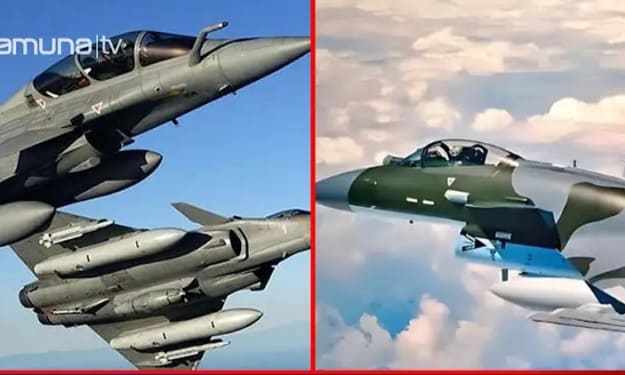
Indian Jet Retreats After Aerial Confrontation with Pakistani Forces: Tensions Flare
"date": "2025-04-29r", { "heading": "Tensions Flare Near Border", "paragraph": "In a dramatic turn of events, an Indian Air Force fighter jet was reportedly forced to retreat after being chased by Pakistani military aircraft near the Line of Control (LoC) on Tuesday morning. The incident, which lasted a few minutes, has once again raised tensions between the two nuclear-armed neighbors."
By Mubasshir Haque 10 months ago in Critique
Completed Draft
When is a piece of writing finished? It’s a question with as many different answers as writers. For me, a work is finished when it can’t be improved anymore. Almost everything I have posted here is still in drafting (not draft; they’re posted). Even when I think a work is finished, I read it again, usually finding something I can improve or tighten.
By Harper Lewis4 days ago in Critique



Comments (1)
This article brings up some complex issues. It's hard to ignore the beauty of Kashmir, but the human rights abuses described are terrible. It's concerning how politics in the region use Kashmir as a pawn. I remember the Pulwama incident well. It seems like both countries need to find a way to address the root causes of these tensions. How can we ensure that Kashmiris can live in peace without being caught in the middle of political games?