
Wait… Am I The Horse?
Part 1 of BoJack Horseman, Season 1: A Review!


If I had a nickel for every time someone recommended BoJack Horseman to me… well, I’d have three or four nickels. Which isn’t a ton and couldn’t buy me anything—but man, I’m sure glad I listened and watched it anyway.
Before jumping into season one in our year 2024, which is now over a decade after the first season aired on Netflix, I didn’t know much about the show at all. I knew two things: that many people love it very much, and many people also find it immensely depressing. And after coming out on the other side, I definitely understand both of these generalizations.
So let’s jump into the world of BoJack Horseman, shall we?
Episode 1: BoJack Horseman: The BoJack Horseman Story, Chapter One
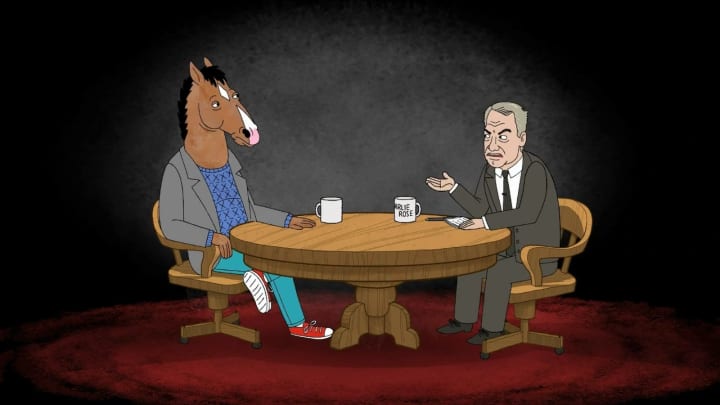
The first episode introduces us to our main character, a washed-up sitcom actor from the 90s. Yes, he’s a humanoid horse; he’s also an alcoholic. You know, a normal TV main character.
Right off the bat, we can observe that BoJack already isn’t the greatest guy on the planet. He’s arrogant, bitter, cynical, and incapable of not throwing himself a pity party every time the immense weight of his narcissism fades for a singular moment. He also always seeks sympathy and compassion from other people without ever really deserving it or earning it, either because he feels like he doesn’t/shouldn’t have to, or—even more depressingly—because he doesn’t know how.
Because there’s something else to BoJack, something painful. There’s a sadness there, a desperation for other people’s love and approval. Even from the opening scene, where he’s being interviewed about his very successful role in the family sitcom Horsin’ Around twenty years ago, we can see that behind the alcohol and the overt overconfidence, there is an intensive, insecure despondency that pervades BoJack at all times, and this will certainly stay the case throughout the season.
During this interview in the first scene, BoJack talks about the significance of sitcoms for the people who watch them. Sitcoms allow us to tune out and feel okay for half an hour, and he speaks about how important it is to see “good, likable people loving each other” on our screens.
It’s a greatly ironic scene. While I believe a part of him means what he says here, he is also very clearly talking as if trying to persuade himself to believe his own words. It’s a great moment that foreshadows the rest of the season as well, as BoJack Horseman proves itself to be quite the anti-sitcom.
We’re introduced to a good amount of characters in this first episode. There’s BoJack, in all of his mopey, self-destructive, blame-dodging glory. There’s Princess Carolyn, BoJack’s crafty, cunning talent agent as well as his ex-girlfriend. There’s also Todd, a young, optimistic stoner who freeloads off of BoJack and lives in his house after going to one of his parties and never leaving. All of these characters are compelling, humorous, and likable without necessarily being “good” people, which I found very impressive.
A big premise of the first episode is BoJack finally agreeing to hire a ghostwriter to write his memoir for him; a while ago, he promised a publishing company a draft of it, but he was never struck by inspiration and couldn’t even start. The company is Penguin Publishers—run by actual penguins, of course, because if there’s one thing BoJack Horseman loves, it’s an animal pun. There’s a series of semi-dark jokes throughout this season about how broke the publishing company is, which I quite enjoyed; they are very reliant on BoJack’s upcoming book to do well.
The ghostwriter’s name is Diane, and she is dating BoJack’s bubbly, effortlessly confident acting rival Mr. Peanutbutter—much to BoJack’s dismay.
The show does a good job already establishing all of these characters in a short period of time, and the pacing is near perfect. You never feel lost, and you never feel like things are moving too slowly. It’s a solid first episode—with a great title too, poking fun at BoJack’s immediately obvious, almost humorous sense of narcissism and self-importance put in place at the forefront to conceal his crippling insecurities.
Episode 2: BoJack Hates the Troops

Moving onto the second episode, we get this super realistic/unrealistic celebrity scandal where BoJack comes under fire for stealing a guy’s muffins.
Yeah, that’s the entire episode.
It sounds stupid, and it is stupid, but it’s also great.
A pack of muffins was placed in the fruit section by a customer who had just left them there momentarily to go and use the supermarket bathroom. BoJack comes across the muffins and picks them up to buy just as the customer comes back out of the bathroom, and the two argue until BoJack purchases the muffins and leaves. Unfortunately for BoJack, the customer also happens to be a Navy seal. And yes, he is literally a seal.
Furious over getting his muffins stolen, the seal goes to the press to complain about BoJack being a jerk and a troop-disrespecting loser for stealing his muffins, and a super dramatic, chaotic paparazzi blowout ensues.
There’s a very funny live television debate between the Navy seal and BoJack who, of course, protests his full innocence and moral superiority in the situation. There’s serious talk about the sanctity of having dibs, which was hilarious. But even behind the humor, we get some intriguing commentary from BoJack about the military, albeit being important, not being inherently heroic or moral, which I thought was respectfully and cleverly handled.
There’s also a very funny joke where BoJack, high on the adrenaline of the debate, is being grilled about how many of the stolen muffins he ate in one sitting. He vehemently responds that there were twelve in the pack and that he ate them all at once because he hates himself; he then hangs up the phone and enthusiastically asks Diane and others how they think he performed, because he feels like he did great. It’s a very funny moment, and it succeeds in further cementing BoJack as a delusional character.
The first episode was funny, but here is definitely where you start to see the creativity of the humor in the show and how effortlessly it blends with social commentary and character building. It’s a great episode overall and probably one of my personal favorites from the season’s first half.
Episode 3: Prickly-Muffin
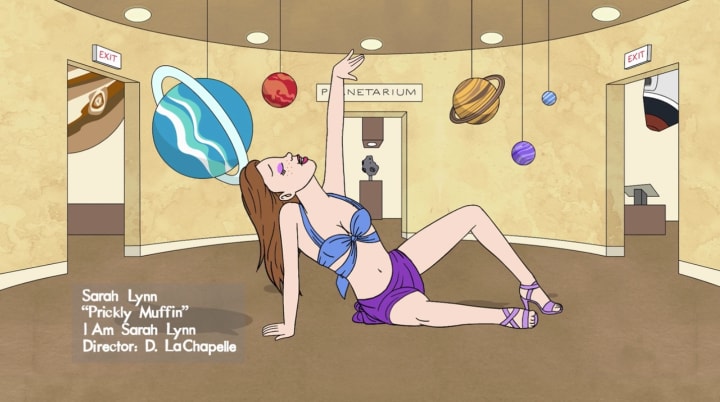
This is a weird one.
The third episode introduces us to Sarah Lynn, one of the stars from BoJack’s sitcom Horsin’ Around. Once a child actor, then a young, overly sexualized pop star, and now in her thirties, she has since turned into a wild, mildly jaded drug addict.
Seeing that she’s going through a rough time in her life with substances, relationships, and identity issues, amongst other things, BoJack offers up his house for her to stay, and Sarah Lynn basically does whatever she wants—drinks, does drugs, has sex, and parties like crazy—until BoJack threatens her with rehab and she leaves.
It’s a solid episode. It has some really good moments: Diane’s commentary on BoJack’s attachment issues was very poignant, and BoJack sleeping with Sarah Lynn, his once on-screen child, was effectively disgusting and a gross power play that cements BoJack’s moral flaws significantly, even this early in the show.
There’s also a detail that’s important for later where Sarah Lynn mentions to BoJack that Herb Kazzaz, the writer of Horsin’ Around and BoJack’s old friend who gave him the starring role, has, as Sarah so gracefully puts it, “ass cancer” and is dying; we’ll circle back to him later in the season.
Sarah was an interesting character, displaying selfish traits due to clear trauma from her past of being used and then dumped by the industry when she wasn’t young or pretty enough anymore.
That being said, it’s not my favorite of the episodes, just because it’s such a gut punch and a downer in how realistically it depicts child stardom and the sexualization of young stars in the industry. It makes some of the jokes feel sort of icky.
Episode 4: Zoes and Zeldas
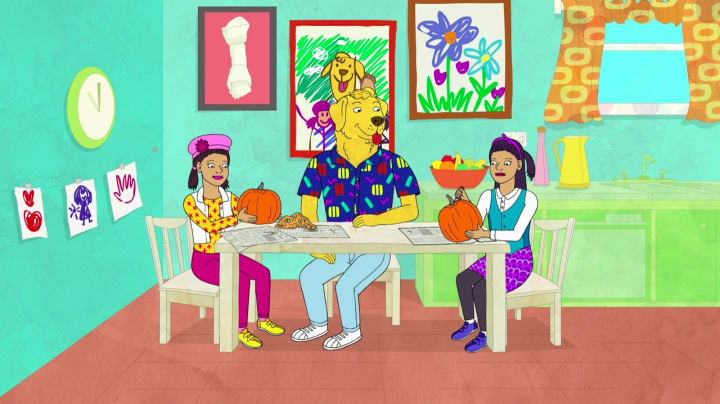
The title comes from the lore of our boy Mr. Peanutbutter, BoJack’s ghostwriter’s boyfriend. He also starred in a sitcom back in the day at the same time as BoJack’s Horsin’ Around, and he was also the parent of two foster kids. One of them was named Zelda, the outgoing and optimistic one. The other was Zoe, the down-to-earth, introverted pessimist. Due to the show’s popularity, the two names became used to describe the two distinct personality types. BoJack is deemed a Zoe, which he irritably disregards.
Todd is working on a rock opera, and when he performs it for everyone, BoJack horrendously insults it. Todd continuously tries to get advice from BoJack, who constantly disrespects him and shuts him down. Diane tells him he should work on encouraging Todd instead of always bringing him down, and because he likes Diane, he reluctantly agrees.
Together, Todd and BoJack work on the rock opera until they are both proud of it. Diane expresses her surprise to BoJack that he is being such a good friend, and she tells him she is impressed—which makes him happy, because he definitely doesn’t have a crush on her. She’s his ghostwriter, and she’s dating his rival. So that would be really bad if he did.
Todd even gets the opportunity to show it off to an investor of significance. He excitedly tells BoJack that if his play succeeds, he’ll finally be able to move out and stop being such an annoyance to BoJack.
Horrified at the idea of Todd moving out due to his terrible attachment issues, BoJack does what he does best: sabotage. He hires a character actress to present Todd with the newest installment of the addictive video game that he knows ruined Todd’s life at the store, and Todd ends up “relapsing” and playing it all night. When he shows up to perform, he does terribly. BoJack yells at the investors for insulting his friend’s performance, trying to come off as supportive and protective of Todd while really severing any ties Todd can have with them again, and they both go home.
For an episode with a rather silly concept, it gets pretty dark. It shows us how far BoJack is willing to go to get the things he wants. He is willing to lie, pay off, steal, cheat, and manipulate people to stay as content as he can be. He is addicted to this terrible cycle of dishonesty and self-sabotage, and it’s painful and heart-wrenching to watch. You feel for him, but you also despise him.
There was also a side plot that wasn’t super important where Wayne, Diane’s ex-boyfriend, is there the whole time working on a Buzzfeed article on Mr. Peanutbutter. Diane sees his notes and realizes he’s twisting the article into an opportunity to berate Mr. Peanutbutter, deeming him a has-been and an embarrassment. When she angrily confronts him about it, her ex tells her it’s just his job as a writer. He tells Diane both he and her are Zeldas and they always will be, and Diane dating the cheery Mr. Peanutbutter can’t change who she truly is at her core: a dark, deeply pessimistic person who is trying to be something she’s not.
Episode 5: Live Fast, Diane Nyugen

The fifth episode was probably my least favorite overall. It wasn’t bad; it was just probably the least entertaining.
There’s a largely insignificant, mildly funny B-plot where Todd and Princess Carolyn pass of BoJack’s house as David Boreanaz’s house, and it results in Todd going to jail at the end of the episode for fraud. It’s dumb and quite silly.
I really think that with this being my least favorite episode, it speaks to how good the show is, because the episode is still super solid. It’s only rough because Diane’s family is awful. Like, unwatchably awful. And they’re supposed to be. You really sympathize with her frustrations over their vapid, shallow lives and having to be the responsibility-heaving director of it all, only to be blamed for everything in the end anyway. The episode really did a good job making us understand Diane more as a character, someone who left her unhappy life behind for dreams to be someone more, someone important, someone that would prove to her family they were wrong about her.
It’s also my least favorite because the BoJack development isn’t super strong this episode. At first, BoJack plays along with Diane’s brothers’ careless, abusive nature. He didn’t grow up with a supportive family or with any siblings, so he wants to put himself into the shoes of being a brother. It does make sense, but the way it’s portrayed in the show comes across a little silly and immature on BoJack’s part to the point where it’s sort of out of character. It just feels like it’s there to be a gag instead of actually being what BoJack would act like and do, in my opinion.
Episode 6: Our A-Story Is a “D” Story
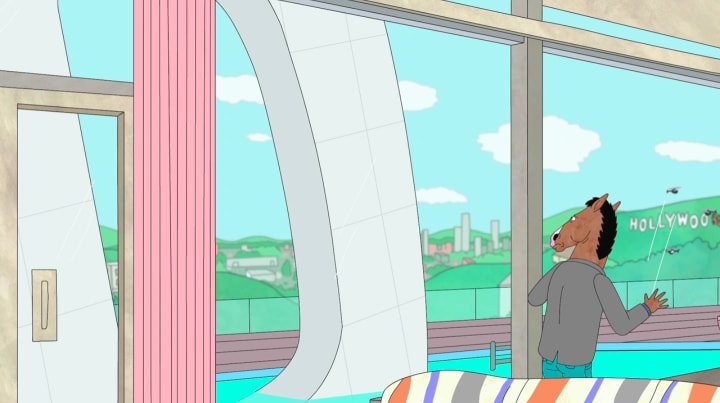
This episode, something that viewers had begun to suspect was happening is confirmed for us: BoJack is jealous of Mr. Peanutbutter’s relationship with Diane. After spending so much time with Diane and admiring her humor and cleverness, as well as getting to know her on a personal level, BoJack has developed a bit of a crush on Diane. He’s setting himself up for self-sabotage here—shocker.
The episode starts with a scene where Mr. Peanutbutter and BoJack fight to one-up each other in a restaurant with Diane in order to impress her. It’s a very funny moment that encapsulates toxic masculinity and how immature and futile it can be, as they bicker and fight and do all these competitive activities until Diane falls asleep.
When she wakes up, they’re still competing doing push-ups and arm wrestling. But Mr. Peanutbutter wins the final round of their competition by making a show of the fact that he is in the relationship with Diane and he gets to take her home, which sends BoJack into a depressed spiral. He drinks heavily before he falls asleep.
When BoJack wakes up the next morning, he is deeply horrified to find that he, in his drunken, love-drunk madness, has stolen the D from the Hollywood sign for Diane. How’s that for a one-up? Unfortunately, the police are searching for the culprit who did this, and the giant D is right outside BoJack’s mansion.
Mr. Peanutbutter visits and sees the D outside BoJack’s house, which confirms to him for sure that BoJack has feelings for Diane. He makes BoJack promise he will not romantically pursue Diane anymore if he helps him get rid of the D, and BoJack agrees. They get drunk and high and drink a ton of coffee and cause a big public disturbance while the D is (allegedly) put onto the sign by helicopter in a super bizarre, amusing set of events.
However, Mr. Peanutbutter actually has the D delivered to his own house as a gesture for Diane. BoJack calls Princess Carolyn to complain that, just like in their past sitcoms, Mr. Peanutbutter is ripping him off again. She tells him Mr. Peanutbutter is better at expanding BoJack’s ideas in execution, which makes BoJack realize he hasn’t told Diane about his feelings for her.
We get this scene where Mr. Peanutbutter is telling Diane how much he loves her and how perfect they are together, despite their immensely differing personalities, while BoJack leaves her a rather intimate voicemail about how important she is to him and how good and happy he feels around her. It all culminates into Mr. Peanutbutter proposing to Diane, and when she says yes, a paparazzi crew pops out to reveal they’ve caught her reaction. Diane is rather uncomfortable and looks down at her ring doubtfully.
She calls BoJack and tells him that she’s engaged, and she asks him what his latest voicemail said, as she hasn’t had the time to listen to it. BoJack, shocked and dismayed, tells her to delete the confession voicemail he left her, as it was just another drunken one left by mistake.
The D is taken back to the sign and, on the way, slams into the jail Todd is in from the last episode, the jailbreak saving him from getting curb-stomped by the Neo Nazi and Latin King prison gangs, who he in yet another side plot has been going between to be a part of both of them.
This episode is both very funny and very heavy. BoJack’s feelings for Diane feel uncomfortable to witness, both because he can’t have her and because he is clearly not emotionally ready for a real relationship with anybody, but they are strong nevertheless. You do really feel for BoJack when he learns she is engaged.
—
All together, this show is great, even from the first half of the season.
The characters, from off the bat, are super solid. BoJack is equally funny and disturbing, as he is supposed to be. Todd is a sweetheart. Diane serves as a great voice of reason, and she only gets better later in the reason. Mr. Peanutbutter, the foil to Bojack, is overly bubbly and confident in this perfectly annoying way. He’s hilarious, and his relationship with Diane is intense and funny and interesting. It doesn’t make sense that they would be together, and yet it does.
Reflecting back on the first half of the first season of Bojack Horseman as a whole, something comes to mind for me:
In the anime community—the kingdom of weebs, if you will—there is a little thing we call the three episode test. This is exactly what it sounds like: it’s common to give a show around three episodes to see if you appreciate what it has to offer. If you liked the content within those three episodes, you know you will continue to watch and most likely finish the show, hoping it continues in the direction it’s heading. If you did not necessarily love the three episodes, it doesn’t mean the show is bad, or that it won’t get better, but it can be indicative that it might not be for you.
It’s not a perfect test, but I’ve found it quite efficient over the years. Three episodes is usually enough to give watchers a basic idea of what to expect from the show they are watching.
BoJack Horseman, for what it is at its core, kind of fails the three episode test with this first half of the season. And let me explain why.
It’s not that these first six episodes aren’t good—they’re actually quite good, and I very much enjoyed them. But they’re not what I would call representative of the show as a whole and how emotionally crushing it can be. We do get glimpses of sadness and desolation in some of the themes of these episodes, but as of right now, it’s mostly a Family Guy adjacent show about a washed-up horse, and while that’s really unique and interesting as a concept, it’s not why I and so many other people fell in love with this show. We’ll get to the real emotional impact of the show in the second half of the season, which I’ll delve into in the next part.
All in all, I was thoroughly impressed by these first season episodes thus far. The humor is solid, the writing is creative, and the nuance and character development are superb.
Until the next part! ♥️
About the Creator
angela hepworth
Hello! I’m Angela and I enjoy writing fiction, poetry, reviews, and more. I delve into the dark, the sad, the silly, the sexy, and the stupid. Come check me out!
Keep reading
More stories from angela hepworth and writers in Critique and other communities.
Cassie and Johnny
I’m the kind of dame you notice. I’m no femme fatale, but you can’t ignore me, at least not until I warn you about what’s coming, then everybody ignores me. Hell, they usually blame me afterwards and give Johnny all the credit for saving the day, but my Johnny couldn’t save a seat at the movies without my help. Sure, he’s brawny, but brainy? Not so much. Like that time I asked him to spot me five bucks, and he said he didn’t see it anywhere on me, and believe you me, he looked but good.
By Harper Lewis10 days ago in Critique
Doechii Will Not Apologize For Disliking Cats
I don’t like cats. I like the idea of them; they’re independent, agile, and selfish. All traits that a human being should hold. However, as domesticated animals, they’re nasty, overbearing, and insolent despite their furry (sometimes), cuddly demeanor.
By Skyler Saunders3 days ago in Critique



Comments (5)
I haven't watched BoJack in so long. This is such a thorough critique episode by episode. Very cool to see how you feel about the show so far!
This really ain't my cup of tea but I enjoyed your review. Oh and Mr Peanutbutter sounds delicious hahahaha
A solid and thorough review, Angela. I can think of 2 sitcoms I've actually enjoyed and they're long gone. I'm also not a real fan of anime, so it's a pretty good bet I won't watch the show, but you did a good job with the review.
Lemme know when you finish the show we gotta talk and have some tea 🍵
Ohhh I love ❤️ this show! It’s so amazing you liked it! I hope you enjoy the rest. I left in tears when the show was over because it meant so much to me.