
Unlocking Africa’s Potential: The Path to Industrialisation, Innovation, and Global Leadership - By godInk
Addressing the Leadership Crisis, Harnessing Intellectual Capital, and Leveraging Natural Resources to Propel Africa into a New Era of Sustainable Development

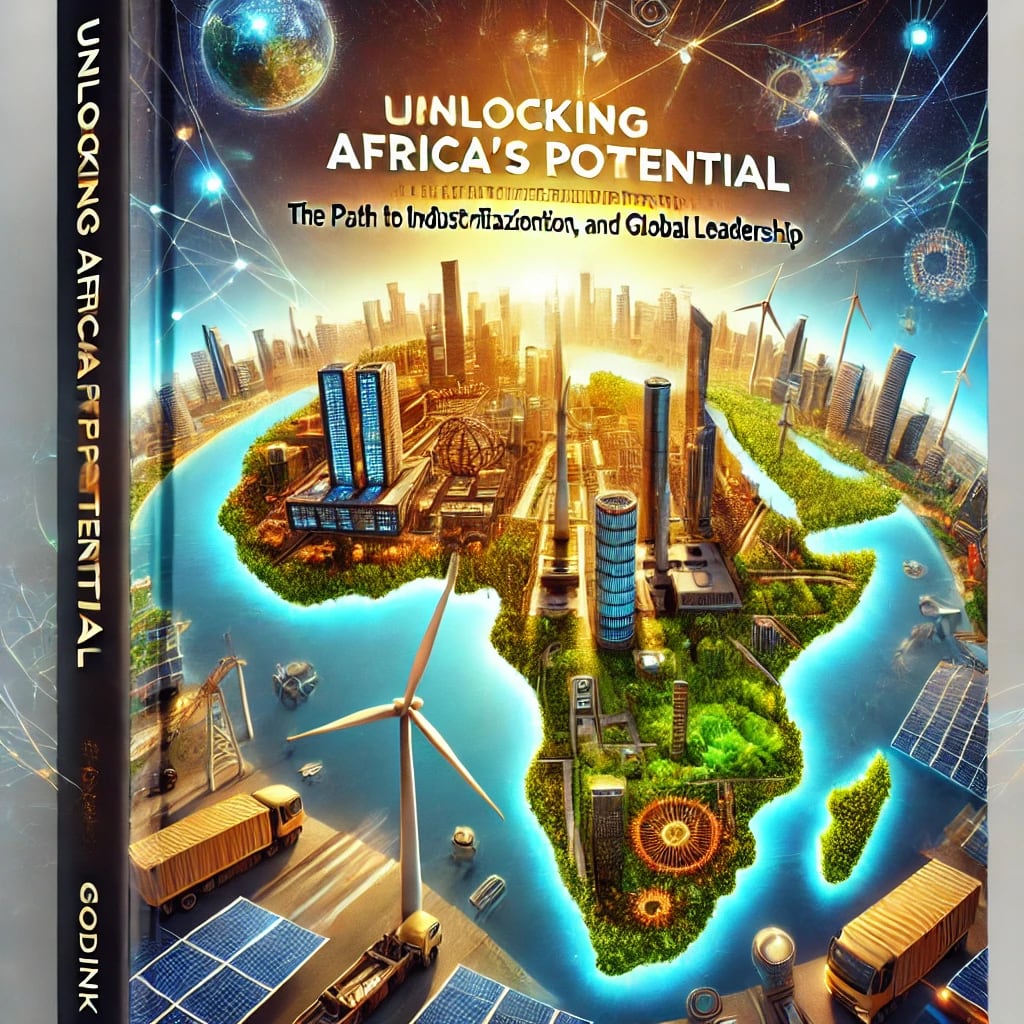
Unlocking Africa’s Potential: The Path to Industrialization, Innovation, and Global Leadership - By godInk
Addressing the Leadership Crisis, Harnessing Intellectual Capital, and Leveraging Natural Resources to Propel Africa into a New Era of Sustainable Development
Africa stands at the crossroads of a historic transformation, with the potential to become a global powerhouse. However, unlocking this potential requires addressing key challenges, including leadership failures, mismanagement of resources, and a lack of investment in critical sectors like education, innovation, and infrastructure. This book proposes a bold vision for Africa’s future—one rooted in industrialization, technological advancement, and strategic investments. By harnessing its intellectual capital and leveraging its abundant natural resources, Africa can embark on a path toward sustainable development and global leadership.
Chapter 1: The Prime Cause of Africa’s Underdevelopment
Examining the Structural Deficits and Mismanagement of Resources Holding Back Africa’s Growth
The primary cause of Africa’s underdevelopment lies in its failure to embrace industrialization, mechanization, and intellectual pursuits as fundamental drivers of societal transformation. While Africa is endowed with abundant natural resources and human potential, these assets remain largely underutilized. The mismanagement of these resources, coupled with the undervaluing of education, research, and long-term infrastructural development, has resulted in a continent that is still reliant on external aid for basic needs. The lack of strategic investment in crucial sectors has left Africa vulnerable to exploitation and dependency.
Africa’s leaders have often mismanaged resources, diverted funds to unproductive ventures, and failed to invest in essential areas such as education and research. This deficit has entrenched a cycle of poverty and stagnation, preventing the continent from leveraging its vast potential.
Chapter 2: Critique of African Leadership
The Role of Leadership Failures in Perpetuating Dependency and Stagnation
African leaders bear significant responsibility for the continent’s underdevelopment. Despite the abundance of natural resources, many governments have failed to allocate funds to critical sectors such as education, research, and innovation. Instead, resources have been diverted to corruption, mismanagement, and short-term political gains. This failure to invest in intellectual and technological growth has hindered Africa’s progress and kept it reliant on external powers.
The lack of a strategic vision for the future has left Africa vulnerable to exploitation. Developed nations, such as the U.S., China, and European countries, have capitalized on Africa’s resource wealth while offering little in return. These countries have been able to process Africa’s raw materials into finished goods, which they then sell back at high prices, leaving African nations with little control over their own resources.
Chapter 3: Comparison with Developed Nations
Lessons from the U.S., Europe, China, and Japan on Innovation, Industrialisation, and Strategic Investments
To understand the potential solutions for Africa’s development, it’s essential to look at the examples of nations that have successfully harnessed innovation and industrialization. The United States, Europe, China, and Japan provide critical lessons on how targeted investments in research, technology, and industrialisation can yield global leadership.
3.1 United States and Europe
How Research and Development Shaped Global Industries in Aviation, Medicine, and Renewable Energy
The success of the U.S. and European nations can be traced back to their commitment to research and development (R&D). This focus has birthed major advancements in industries like aviation, medicine, telecommunications, and renewable energy. For example, the Wright brothers’ invention of the airplane revolutionized global transportation, while Europe’s contributions to renewable energy have positioned it as a leader in the fight against climate change.
3.2 China
The Power of Strategic Investment in R&D for Global Leadership in Technology and Manufacturing
China’s meteoric rise to global prominence is a testament to the power of strategic investment in R&D. By prioritizing education, technological development, and manufacturing, China has established itself as a leader in robotics, smartphones, electric vehicles, and infrastructure. Initiatives like “Made in China 2025” emphasize China’s commitment to self-reliance in cutting-edge technologies such as AI and aerospace.
3.3 Japan
Turning Limited Resources into Global Industrial Dominance through Innovation
Japan’s success is particularly remarkable given its lack of natural resources. Through focused efforts on electronics, robotics, and precision manufacturing, Japan has become an industrial powerhouse. By turning constraints into opportunities, Japan has produced globally recognized products like hybrid vehicles, medical robots, and advanced consumer electronics.
Chapter 4: What If These Solutions Were Implemented in Africa?
The Transformative Potential of Industrialisation, Technological Advancements, and Global Competitiveness
Had Africa adopted similar strategies decades ago, the continent would likely be on par with global industrial and technological leaders today. The implementation of these solutions would have transformed Africa into a vibrant industrial economy, a hub for technological innovation, and a global competitor in markets across the world.
4.1 Industrial Cities
African nations would have developed thriving industrial cities, producing automobiles, electronics, medical equipment, and other essential goods locally, thereby creating jobs and boosting economic growth.
4.2 Technological Advancements
Locally developed technologies in areas like AI, robotics, and renewable energy would have helped African nations reduce their dependence on foreign imports and drive economic growth.
4.3 Global Influence
Instead of exporting only raw materials, Africa would be exporting finished goods and competing with developed nations in global markets. The continent would have carved a strong position in the global economy.
4.4 Quality of Life
Improved infrastructure, modern healthcare, and access to world-class education would have significantly elevated living standards across Africa, helping to eradicate poverty and improve global perceptions of the continent.
Chapter 5: Ultimate Solutions for Africa’s Transformation
This chapter presents key strategies for unlocking Africa’s full potential and positioning it as a global leader in innovation and industrialization. These solutions are designed to propel the continent into a new era of development.
5.1 Strategic Investment in R&D
Prioritizing Research and Development to Drive Innovation and Sustainability
To foster innovation, African nations must allocate 5-10% of their national budgets to R&D. This investment should focus on critical areas like renewable energy, advanced manufacturing, healthcare, and agriculture. Collaborations with global universities and research centers can help accelerate progress.
5.2 Industrialisation and Mechanisation
Developing Local Industries and Advancing Agricultural Mechanisation
Africa must build industries that process raw materials locally, transforming natural resources into finished products. The continent must also invest in mechanized agriculture to improve food security, increase productivity, and enhance its export capacity.
5.3 Reform Education Systems
Building a STEM-Driven Educational Framework to Foster Innovation
Educational systems across Africa need to place a stronger emphasis on science, technology, engineering, and mathematics (STEM) education. Establishing technical institutes focused on training youth in manufacturing, engineering, and robotics will ensure a workforce equipped for the future.
5.4 Incentivize Innovation
Supporting Local Entrepreneurs and Startups through Grants and Incentives
African governments should provide grants, tax incentives, and other support for startups and innovators. These measures would encourage entrepreneurship and foster a culture of innovation.
5.5 Leverage Diaspora Talent
Harnessing the Expertise of African Professionals Abroad for Nation-Building
The African diaspora is a critical asset. Engaging African professionals abroad to mentor, collaborate, and invest in local initiatives would bring valuable knowledge, experience, and resources back to the continent.
5.6 Strengthen Governance and Accountability
Eliminating Corruption and Ensuring Transparent Governance Systems
Effective governance is essential for Africa’s transformation. Corruption must be eliminated, and transparent systems for managing public funds must be implemented to ensure resources are allocated to development projects that benefit the public.
5.7 Promote Public Awareness
Fostering a Culture of Intellectual Pursuits and Critical Thinking
Media and public campaigns should be used to inspire a culture of intellectual curiosity and critical thinking. By prioritizing research and innovation in the public consciousness, Africa can foster a new generation of problem-solvers and leaders.
Chapter 6: Vision for the Future
Envisioning an Africa Powered by Innovation, Prosperity, and Global Leadership
The future of Africa holds immense promise. By implementing the solutions outlined in this book, Africa has the potential to become a global leader in innovation, sustainability, and economic growth. Picture a continent where towering skyscrapers symbolize thriving economies, electric vehicles travel efficiently along modern highways, and renewable energy powers industries and homes. Imagine African-made satellites orbiting Earth, enhancing communications and meteorology, while African innovations drive technological advancement worldwide.
Africa can become a beacon of prosperity, innovation, and resilience—standing proudly alongside global powers like the U.S., China, and Japan. This is the future that Africa can achieve by harnessing its vast resources, human potential, and intellectual capital.
With Love
- godInk
About the Creator
JaygodInk
Born in Africa godInk grew up influenced by rich cultures. Their journey into self-discovery began in South Africa. A trailblazer in positive self-image psychology, godInk’s insights aim to unlock human potential. Contact: [email protected]
The Quantum Shift: Rewriting Reality with the Power of Words - By godInk
The Quantum Shift: Rewriting Reality with the Power of Words Harnessing the Power of Words to Redefine Your Reality In the heart of a bustling, unruly African city, a young man named Jonathan Osei, gifted but restless, found himself caught in the chaos of his surroundings. Life in his community was harsh—a society where aggression and hopelessness ruled. People believed life was a gamble, an uncontrollable force that one could not influence. Yet, Jonathan stood out. He had a strange gift: his words often became reality, whether good or bad.
By JaygodInk about a year ago in Motivation
Who Is Clavicular? The Looksmaxxing Streamer Who Ran Over A Stalker In His Cybertruck
What is so damaging to this current culture is the ant-intellectualism which pervades nearly every element of it. Clavicular, real name, Braden Peters equivocates physical form with getting women, making money, and overall being a strong “man.”
By Skyler Saunders23 days ago in Critique
Center Stage with Paul Stewart
*** I'm keen to republish the interviews I did for my series with Vocal creators. It's been a few years and I thought it might be nice to revisit these wonderful conversations. I'll be releasing them one at a time for a few weeks/months.
By Heather Hubler4 days ago in Interview



Comments
There are no comments for this story
Be the first to respond and start the conversation.