
The Unreal of Preservation
In the Abbot Library

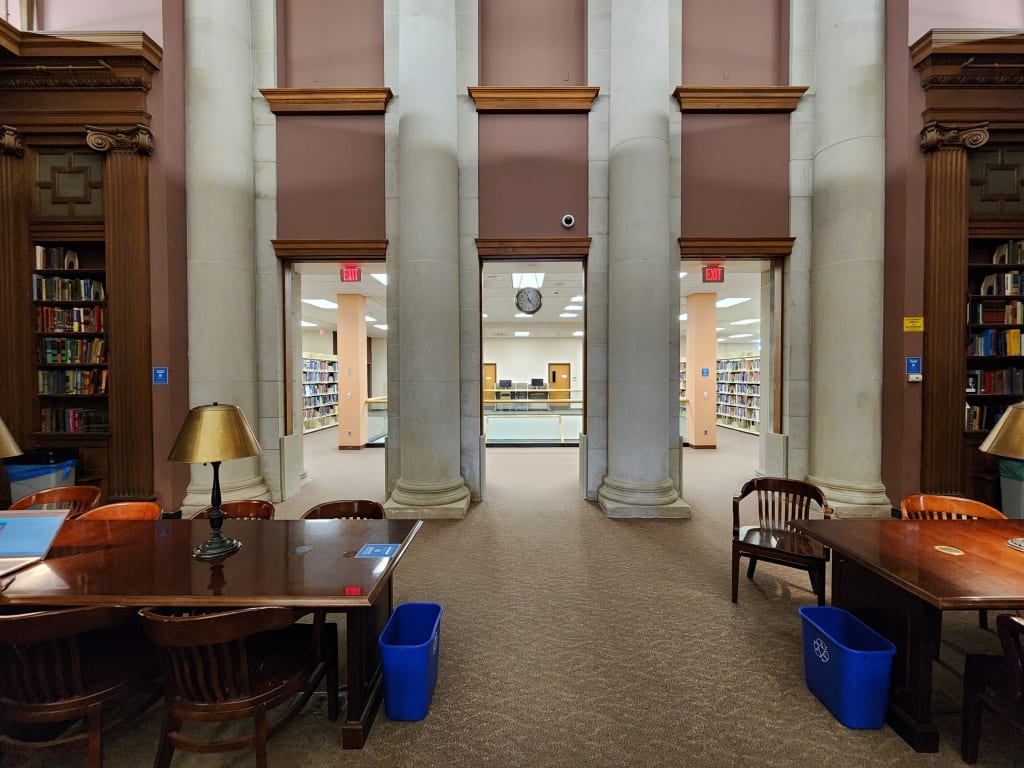
How can one think of preservation in terms of what is real? I think this while sitting in the main reading room of the Abbot Library at the University at Buffalo. I had been meaning to come to this library for some time after seeing a picture of it. Books are a passion of mine and thus so are the repositories of knowledge that we simply call libraries. Gone, it seems however, are the days of the beautiful library. Filled with grandeur and craftsmanship to be an edifice of thought itself imbued in structure. A space in which one can think, connected to the history of Mankind. A space that could anthropologically be called a place; that is, imbued with history, emotion, tradition. I could just as easily now be writing of the strangeness I experienced walking through the very modern, yet not all unpleasant, 39th Street Stavros Niarchos Public Library in New York City that felt the need to display photographs of the world’s most beautiful libraries on their walls. A strange display of the past in a space in which the past is abandoned, if only preserved within the books themselves, and yet, how real is the copy of Flaubert’s Madame Bovary or Joyce’s Ulysses that is printed in 1994, covered in its protective plastic laminate? In fact, the main 5th Avenue library that is imbued with history and beauty has lost its practical purpose and has become a museum that is its own relic.
Here, in this library, there is a similar affect that is being produced to these two other libraries. In the main reading room one is enveloped by the vastness of space under the vaulted ceiling, from which hang baroque chandeliers that harken back to the time of Descartes, Voltaire, and Montesquieu, surrounded by the dark wood of the high bookshelves and long tables, the brass lamps reminiscent of the great places of study and pursuit of academic enlightenment of 19th century Northern Europe and the Americas, the colonial fireplace as the centrepiece, accompanied on either side by oil portraits of college founders, and the entrance marked by the doric pillars of Plato and Aristotle. This is a place imbued with history. However, this same entrance also marks the precipice of something else. Much like the strangeness of the pictures on the wall at the Stavros Library, here the unnerving amalgamation of the old and the new becomes even more manifest. For just beyond these pillars, lies the aesthetically blank, rationally functional non-place of modernity. This is the term the French Anthropologist Marc Augé used to describe the transitory places of super modernity such as airports and train stations that lack connection, history, or culture.
Beyond the pillars, lies the world of recessed lighting, low, tiled foam ceilings, off-white plaster walls, lightly stained pine doors without ornamentation, plastic cubicles, and dusty computers. This is the realm of the cheaply mass-produced, made by automated machine, lacking in humanity. Marcel Duchamp coined the term the infrathin to describe the imprint left by a person on an object. A word described by its creator as defying definition but preferring to be understood through examples such as the warmth you feel on a seat that tells you someone else was just sitting there, or the smell of cigarettes in an empty room. Objects themselves can also contain the imprint of Man within their very structure, whether by creation or contact. What primordial infrathin of humanity can exist within an object made by machine?
What happens here is that the pillared entrance of the library becomes a kind of portal between one world and the next, producing an unusual mental vertigo, as if standing on the fault lines of time. It is as if being in one time and looking out to another removes us from either and we become Vonnegut’s Billy Pilgrim, unstuck from time.
It does not take long, however, for one to realize that this portal between worlds is not as sealed as initially thought, but that the new is seeping into the old. The brass lamps are lit by LEDs, there is an outlet on every wall, in fact, there are outlets built into the oak table on which I write betraying that these are certainly reproductions. The wood in the fireplace is fibreglass and the fireplace is sealed. Even the atmosphere teems with the modern as vents silently pump in air conditioning. A security camera adorns the entrance. What is most telling, however, is that between these two worlds of time, the carpet remains the same, so that the barrier is ultimately broken, and one comes to realize that they are not in another time at all, but merely a preservation. This inhabiting of a relic, a museum display, produces the quality of the unreal, what Freud may have called the uncanny. Something out of place, inhabiting the space between dreams and reality.
Karl Marx once said that through Capitalism, “all things solid melts into the air”. What is meant by this is that everything becomes transactional, our daily lives and connections and our institutions become rationalized to produce function over beauty and connection. Perhaps there is some truth to this. Perhaps, what has happened, is that our places that at one time coupled us to our own history, our traditions, our culture, have become merely preservations. And now, for those that wish to live in the physical world, the world of real connection, connection to others, to the Earth, to humanity, are exiled to live in preservations.
About the Creator
Daniel J. Guercio
Is it true, or the illusion of truth?
Keep reading
More stories from Daniel J. Guercio and writers in Critique and other communities.
Sociological Imagination
This place is odd. I am at a café in Allentown. I like the loft area. I am Phantom of the Opera here. Hiding in the shadows of a dead and vacant café. There are no people here; just as there were none on the street. The things around me that feel most alive are, ironically, the things that are most dead. To my left is some sort of wooden crank machine. To my right, an old, ornate full-size mirror. Up here, closer to the ceiling, one is better able to appreciate the ghosts of this building. Often the ceiling is the last thing to change through all the iterations of businesses and residences. These things feel more alive than the phone by my side, the clothes that are on me, the bag that I carry, but not the books that are within that bag. Marcel Duchamp coined the term the “infrathin” to give a word to the phenomenon of the residue left by humans on objects. It is the marks left behind, such as the warmth on a seat after someone has left, or the smell of tobacco in a room. These objects around me relate, but they are a more permanent version. They have taken in the marks of history and the dead. There is a possession to them. The phone, my clothes, my bag have touched no one but me. Save for the passing brush or the hug of family and partner. But this is not imprintation. Some of my books have not known the touch of another reader, but not most. I love used books. This possession of books is intensified by the marks of prior human contact. It is a connection with a separate mind that is thinking and interpreting the same words as you. In a way, this is a comradery. It cuts through the loneliness of thought. It adds life to thinking with the dead. Roland Barthes discusses in his essay “The Death of the Author” that the author should be one that disappears into the work. Ultimately, the reader becomes the author. It is the reader that is the end interpreter of the work, and it is the reader that gives meaning to the work. Without the reader, there is no author, and there is no author if they are not themselves a reader. Even without used books, there is an aliveness that comes from books that is ultimately unalive. It is this uncanny paradox that makes books the quintessential source of intelligence. Freud discussed this element in his essay on the uncanny by stating that the uncanny arose from “doubts whether an apparently animate being is really alive; or conversely, whether a lifeless object might not be in fact animate”. In this understanding, it can be argued that books generally hold this uncanny quality. They are both alive and dead and also neither. However, it should be accepted that the uncanny stems more from the doubt than the paradox. This aliveness is the continuation of life through ideas. Discussing, and somewhat opposing, Michel Foucault and Roland Barthes, Kate Zambreno, in her To Write as if Already Dead, speaks of the desire to write with the solitude and peace of someone dead, and yet to place oneself within the work in order to be seen, respected, acknowledged. Although the reader may give the ultimate meaning to the work, the words themselves are a certain continuation of the self. The words matter, but maybe so also the importance of its generality, which Hamlet may well have implied with his epizeuxis, Words, words, words. More than the café in which I now sit, with its wooden crank machine, ornate mirror, and historical ceiling, books contain the history and space in which one can think.
By Daniel J. Guercio8 months ago in Critique
Cassie and Johnny
I’m the kind of dame you notice. I’m no femme fatale, but you can’t ignore me, at least not until I warn you about what’s coming, then everybody ignores me. Hell, they usually blame me afterwards and give Johnny all the credit for saving the day, but my Johnny couldn’t save a seat at the movies without my help. Sure, he’s brawny, but brainy? Not so much. Like that time I asked him to spot me five bucks, and he said he didn’t see it anywhere on me, and believe you me, he looked but good.
By Harper Lewis14 days ago in Critique
Doechii Will Not Apologize For Disliking Cats
I don’t like cats. I like the idea of them; they’re independent, agile, and selfish. All traits that a human being should hold. However, as domesticated animals, they’re nasty, overbearing, and insolent despite their furry (sometimes), cuddly demeanor.
By Skyler Saunders6 days ago in Critique




Comments
There are no comments for this story
Be the first to respond and start the conversation.