
The Trolley Problem
The Trolley Problem is a classic ethical thought experiment used in moral philosophy to explore the consequences of decision-making
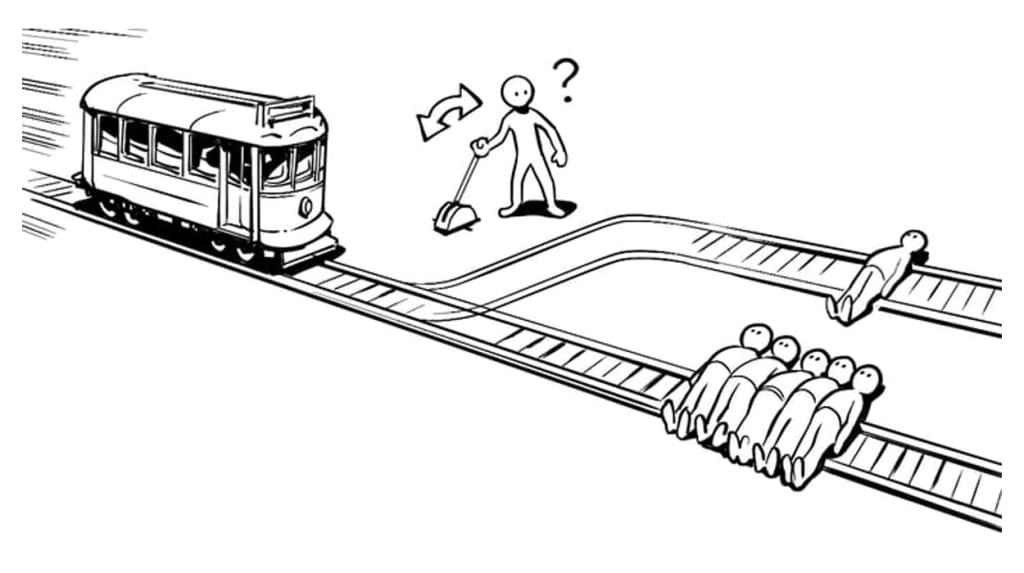
🧠 The Classic Trolley Problem (Refresher)
Five people who are pinned to the main track are being pursued by a runaway trolley. You are standing at a switch. If you pull it, the trolley will divert to a sidetrack, where one person is tied down.
There are two options: Do nothing, letting five people die.
One person was killed when you pulled the lever, actively redirecting the trolley. ⚖️ Moral Frameworks in Play
Utilitarianism (Consequentialism)
Morality is based on outcomes.
Action: Pull the lever to maximize overall good (saving five over one).
Problem: If it benefits the majority, it justifies sacrificing individuals. Deontological Ethics (Kantian ethics)
Rather than consequences, morality is founded on duty, rights, and rules. Action: Don't get involved. Killing is wrong even if it saves more.
Problem: It could have a negative impact on society as a whole. Virtue Ethics emphasizes the moral character of the person making the decision. What would an ethical or "good" person do? Act with compassion, courage, wisdom.
Outcome may vary depending on the perceived virtues.
Doctrine of Double Effect
You may cause harm as a side effect, but not as a means to an end.
Because the death is a byproduct rather than the tool, pulling the lever is morally superior to pushing a person off a bridge. 🧩 Complex Variations
🔁 The Loop Variant
A loop of track connects back to the five people.
The trolley would be stopped by a large person on a sidetrack, saving the five. In this case, his death is not a side effect but rather the means by which others are saved. raises deeper concerns regarding intent: the choice between means and ends. 🧍 The Fat Man Variant
A trolley is heading toward five people.
You are on a bridge with a large man whose body, if pushed, would stop the trolley. There is no lever; you must push him physically. Killing is more personal and direct. Most people say pushing is worse than pulling a lever—why?

🎯 Modified Knowledge Problem
You don’t know if the five people are criminals, and the one person is a doctor.
Or maybe the one person is your child.
Should your choice be influenced by your personal relationships or social roles? 🛑 Passive Bystander Variation
What if doing nothing isn’t really neutral?
Choosing not to act may also be seen as a form of moral responsibility.
Raises the question: Is omission different from commission?
Current Applications 🚗 Autonomous Vehicles
A self-driving car must choose between hitting pedestrians or sacrificing its passengers.
Who programs the ethics? Who is liable?
Should the car prioritize passengers, pedestrians, or maximize life saved?
🏥 Medical Ethics
A surgeon can save five patients by harvesting organs from one healthy person. Do they have to? Same numbers as the trolley problem, but context makes it feel morally unacceptable.
🔍 Meta-Ethical Questions
Is there a correct answer?
Some philosophers argue these thought experiments are intuitively impossible to solve because human moral reasoning is context-sensitive and emotionally driven.
Are moral intuitions reliable?
Moral psychologists contend that our instinctive responses may be relics of evolution that are neither rational nor consistent. Can AI be moral agents?
Do AI systems require a moral theory to make decisions about life and death? Should they emulate human morality?
🧠 Summary
The trolley problem goes far beyond its simple setup. It reveals deep tensions in moral philosophy:
Consequences vs. principles
Intentions vs. outcomes
Logic versus emotion Personal vs. impersonal morality
It questions not only what we believe to be right, but also why we believe it.
🔬 Advanced Trolley Scenario: "The Triage Dilemma"
Scenario: A runaway trolley is headed toward five people tied to the main track.
You can pull a lever to divert the trolley onto a different track. But this time, on that track are two people:
Person A: A 75-year-old retired professor.
Person B is a 25-year-old mother of two young children who has a history of criminal activity. In the meantime, the five people on the main track are as follows: Two elderly individuals
Two middle-aged adults
One 12-year-old child
You can kill two to save five by pulling the lever, but who those people are now is important.
🌍 Cross-Cultural Moral Reasoning
Psychological studies (e.g., by MIT's Moral Machine) show cultural variations:
Cultural/Regional Tendency in General Western (e.g. USA, Germany) Favor utilitarian solutions (more likely to pull the lever). Asian (such as Japan and China: Social harmony, duty, and elder respect are more likely to be prioritized. may be reluctant to act. Middle Eastern & South Asian Value community and family ties. Might prioritize a known individual over strangers. Latin American Emphasize emotional intuition and care ethics, often resisting abstract dilemmas.
So, depending on culture, age, gender, and even how the situation is framed, who lives and who dies can change.
🧠 Final Thoughts
The Trolley Problem is a mirror to our moral systems, not trains or levers. As soon as you add:
Age
Identity
Responsibility
Culture
Relationships
Technology
…the problem becomes not only more realistic but far more personal.
About the Creator
Keep reading
More stories from Wahid Jamil and writers in Critique and other communities.
Infant's body recovered 14hrs
Tragedy in Chattogram: Baby’s Body Recovered After Rickshaw Falls into Open Drain In a tragic incident that has once again highlighted the perils of Chattogram’s fragile drainage infrastructure, the body of a six-month-old baby was recovered from the Chaktai canal early this morning. The recovery took place almost 14 hours after the infant went missing when the battery-run rickshaw carrying the child and their mother fell into an open roadside drain, swollen by rainwater in the Kapasgola area of the port city.
By Wahid Jamil11 months ago in 01
‘We have enough’: Godfrey renews call for Black entertainers to stop seeking white validation after BAFTAs, praises Image Awards
DEI must die. It’s been far too long for Foundational Black Americans (FBA) and tethers to come up and say things like #OscarsSoWhite. So what? NAACP Image awards are about RAH, Representation, Agency, and Honor. Black people have to stop crying about their snubs at award shows that often overlook them.
By Skyler Saunders3 days ago in Critique
Review of 'Man on the Run'
My wife and I saw Man on the Run, a nearly 2-hour documentary on Amazon Prime, about Wings, Paul McCartney's group that flew around the world from shortly after The Beatles broke up in early 1970 to shortly after John Lennon was murdered at the end of 1980, making a Beatles reunion forever impossible.
By Paul Levinson7 days ago in Beat




Comments
There are no comments for this story
Be the first to respond and start the conversation.