
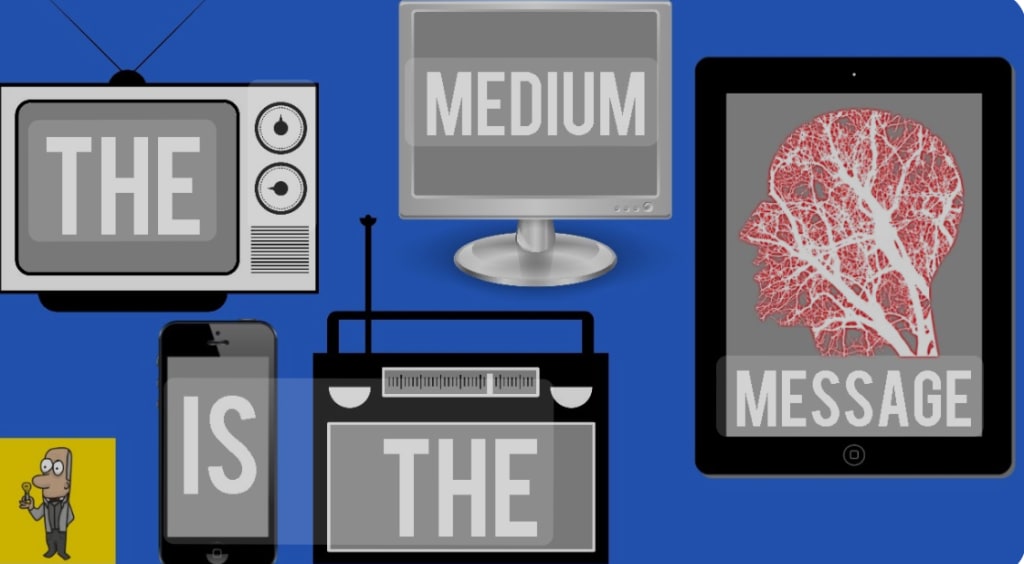
The Message or The Medium?
This article examined the longstanding debate on whether the medium or the message holds more importance. It traced the historical evolution of communication mediums and their messages, analyzing their impact on contemporary society and referencing scholarly doctrines on media and communication.
The prehistoric era marks the beginning of the information cycle when gestures were used to transmit data, gradually paving the way for spoken language. As society evolved and interactions became more complex, it became difficult to spread stories and information through oral communication alone. Consequently, collective memory introduced new forms of interaction to facilitate the transmission of knowledge.
"In this way, the growth of ‘communication’ led to the development of ‘communications,’ that is, media to store and reuse the growing volume of information." (Crowley - Heyer, 1995).
In ancient times, specific symbols were used to record news on natural elements, a kind of equivalent to a weather report carved into the landscape. Between 12,000 and 4,000 B.C., during the Egyptian, Sumerian, and Babylonian civilizations, many scholars identified the beginning of writing, based on the interpretation of discoveries regarding communication.
Early societies already recognized the importance of terracotta blocks for trade and economic development. These blocks, often referred to as "bricks," are actually ideograms, conventional signs with no iconic connection to their meaning. These artifacts are considered a primitive form of three-dimensional writing which, due to social and economic changes, evolved into a more efficient two-dimensional script. Writing developed across all cultures throughout history, adapting to the specific needs of space, distance, and sectors of society. Egyptians adopted papyrus, the Incas developed quipus, while the Mayans and Aztecs created their own writing methods.
However, the creation of the Phoenician alphabet in 1500 B.C. marked a new beginning, giving equal importance to both the message and the medium: one could not exist without the other. The invention of writing had a significant impact on memory and cognitive processes, especially during the Middle Ages. James Burke (1985) emphasizes the fundamental role that memory and mnemonic mechanisms played in medieval communication systems. This role would change with the arrival of powerful technological revolutions like movable type printing.
The introduction of paper, discovered in China around the 1st century A.D., made the printing process cheaper, making books accessible even to the poorest. This innovation reached Europe in the 12th century. Thomas Carter (1882-1925) recalls China as a literary civilization devoted to research and development, employing ideographic writing. Europe experienced a revolutionary phase thanks to this new medium of communication, and with the spread of the press, the production of manuscripts shifted from scribes to print shops.
Contemporary historian Elizabeth Eisenstein (1983) raised a fascinating question: imagining the world of scribes before the invention of printing is challenging, due to the differences in the mental processes of today compared to the past.
“Undoubtedly, the press created a new class of intellectuals (men of letters).” (Elizabeth Eisenstein, 1983).
The printing revolution lasted over two centuries, transforming society and the field of knowledge. Walter Ong (1982) observes that the press completed the shift from an oral culture to a visual one, which had already begun with writing. During the Enlightenment, prose became a real profession, pursued by thinkers, intellectuals, and scientists.
The introduction of the telegraph, on the other hand, allowed information to travel faster than couriers, eliminating the need for physical transportation. Both the telegraph and the telephone represented new revolutions in communication systems. In 1840, it became possible to convert words into electrical impulses (Morse code), which could be transmitted across a network of cables between America and Europe.
Although the telegraph followed the expansion of railways, the medium itself became more important than the message for its innovation and practicality. The 'wired world,' as defined by Daniel Czitrom (1982), highlights the importance of the device. Czitrom describes how the telegraph industrialized communication in the United States, while James Carey emphasizes the impact of the telegraph on journalism, which then divided into two forms: one focused on politics and economics, and the other on entertainment and everyday life.
Many limitations of the telegraph were overcome by the invention of the telephone, which allowed voice transmission, no longer limited to written documents. This new medium introduced a sense of novelty and accelerated technological growth. Early experiments in ‘proto broadcasting’ involved using the telephone to transmit information to multiple subscribers simultaneously.
The invention of photography (1839) and its subsequent application contributed to a new understanding of distant people, places, and things. However, photography only began to be used as a mass medium towards the end of the 19th century, thanks to the 'half-color plate' technique, which allowed photographs to be reproduced in books, newspapers, and magazines.
The desire to read and learn more increased as people observed images of disasters, much like today’s filmed news reports. This led to an increase in television news viewers. The very nature of journalism changed, making it more similar to contemporary journalism. From that moment, the medium was simply a tool to convey or distribute a message, but the way it was used determined its effectiveness. Well, that is another story. The message now gained more importance.
In the years between the two World Wars, radio became a popular medium, following a trend primarily controlled by private individuals in the USA, while Europe opted for civic organizational models of a public nature. Wireless communication was already spreading before World War I, and many experienced the uniqueness of a technology that allowed real-time remote messaging. People preferred to stay at home near the radio instead of going out to listen to live music.
According to scholar Marshall McLuhan (1964), the auditory power of radio had a quasi-tribal effect, recalling primitive emotions. Although historians and theorists criticized this idea, it remains true that Hitler’s powerful speeches broadcast on the radio had a significant impact on the German public. McLuhan's theory may not be entirely incorrect. This shows that the medium can carry a message capable of guiding the masses, making the message more important than the medium itself.
With the emergence of television, radio's role as a mass medium was seriously questioned. In the 1950s, people were eager to switch to television; the same people who had been enthusiastic about radio in the 1930s. Communication theorist George Gerbner (1971) believed that cultural forms mediated by television held the same authority and influence as schools, peer groups, and families.
“Television actually replaces everything in everyday life. Children receive information and knowledge on how the world works and how to navigate it. The emotional life of the younger generation is largely shaped by television, which offers specific models and lifestyles; the impact of this new communication medium is felt by adults as well.” (George Gerbner, 1971).
In the Modern Age, the circulation of knowledge in society was profoundly affected by the press’s democratization of culture, freeing it from the monopoly of scribes. Recently, all other communication technologies have been overwhelmingly influenced by the evolution of computers. Today, electronic interaction contributes to the decline of books as sources of information and culture, while simultaneously expanding services in new ways. Furthermore, today’s computers, with their immense data management capacity, enhance this change, just as printing enabled a different use of memory.
In the 21st century, the computer has become a highly effective medium; it is also a writing tool accessible to anyone, including journalists, writers, scientists, engineers, poets, and artists. Moreover, it has significantly influenced the nature of newspapers as cultural products, enabling millions of people to exchange messages without the limitations of time and space. These changes, however, do not always lead to positive outcomes. In fact, with easy access to the internet and email, many forms of personal interaction have become 'virtual.' Additionally, the explosion of digital technology, with its countless features, generates anxiety about the risk of an excessive gap between 'rich' and 'poor' computer scientists. This affects not only individuals but entire nations. Many scholars have described this era as tainted by what is called ‘media syndrome.’
One of them is award-winning sociologist David L. Altheide, who has shed light on how media systems and media logic influence our perception of social issues, political decision-making, and interpersonal relationships, providing a detailed description of media syndrome and its impact on daily life. Altheide offers a compelling and detailed account of how 21st-century mediated reality works.
Both the medium and the message can have what is termed ‘strong effects.’ Indeed, in the 1930s and 1940s, political science and social psychology researchers developed the 'strong effects' model, which assumed that the media could have any effect on their passive audience. However, research such as Paul Lazarsfeld’s *The People's Choice* confirmed that media messages actually reinforce pre-existing opinions. Since the late 1960s, mass communication scholars have shifted their focus from changing attitudes and opinions to understanding how individuals socialize through the media; for instance, how shared values, behavior patterns, and perceptions of social reality emerge through information and media images (the message). McLuhan argues that:
“The media does not dictate what or when we should think, but rather how we should think.” (Marshall McLuhan, 1978).
McLuhan’s innovative and sometimes controversial ideas have made him one of the most influential figures in media studies. His famous aphorism, ‘The medium is the message,’ is one of the most widely known concepts among intellectuals. This suggests that the medium used has a more significant impact on society than the content conveyed. One of McLuhan’s important contributions is the identification of ‘hot media’ and ‘cool media’; the former offer an intense and engaging sensory experience, like cinema and radio, while the latter are less immersive and require more audience participation, like television and the telephone.
Thus, every method of communication shapes and influences our perception of reality and affects the organization and interaction of society. Beyond the transmitted content, the medium used to convey information has an intrinsic and reflective impact on humanity.
About the Creator
Reader insights
Outstanding
Excellent work. Looking forward to reading more!
Top insights
Compelling and original writing
Creative use of language & vocab
Easy to read and follow
Well-structured & engaging content
Expert insights and opinions
Arguments were carefully researched and presented
Eye opening
Niche topic & fresh perspectives
Heartfelt and relatable
The story invoked strong personal emotions
On-point and relevant
Writing reflected the title & theme
Keep reading
More stories from Simone Nunziata and writers in Critique and other communities.
Do social media platforms offer a new way of connecting, or are they just narcissistic?
Social media platforms are unquestionably a modern track to connect and communicate with others in real time with a wide audience. Nonetheless, exactly like other tools, how they are used diverges from person to person. When individuals use platforms to promote themselves, trying to seek approval, or interacting with others sharing interests, it can lead to ambiguous or narcissistic behavior.
By Simone Nunziata2 years ago in Critique
Cassie and Johnny
I’m the kind of dame you notice. I’m no femme fatale, but you can’t ignore me, at least not until I warn you about what’s coming, then everybody ignores me. Hell, they usually blame me afterwards and give Johnny all the credit for saving the day, but my Johnny couldn’t save a seat at the movies without my help. Sure, he’s brawny, but brainy? Not so much. Like that time I asked him to spot me five bucks, and he said he didn’t see it anywhere on me, and believe you me, he looked but good.
By Harper Lewis4 days ago in Critique
On The Accessibility of US Political Systems & A Crisis of Legitimacy
California prides itself on 'expanding the voting franchise' by delivering a ballot to each doorstep, but a single vote does not even guarantee lobby entry into a private club where the membership access and dues stay unchanged. Moreover, mail-in ballots are fake paper thin luxuries when you lack the stable home, living wage, and benefits (medical, dental, and retirement) needed for a future. While California postures as a sanctuary for voting rights under the Voter’s Choice Act (VCA), an incumbent, self reinforcing status quo undermines free and fair elections in a lot of places - which I suspect has been the case for many generations but observe it with increasing clarity. Most folks do not understand this status quo for their relative class at birth - so they vote along party lines according to what is popular which means exposed most.
By James Royer5 days ago in Critique
A Historic Declaration
We the People of the Husbands of the United States of America, in Order to form a more perfect Union, and I mean you...with me...establish Justice, insure domestic Tranquility, provide for the common defence, promote the general Welfare, and secure the Blessings of Liberty to ourselves, after Puberty, do ordain and establish this Declaration of Co-Dependence.
By Gerard DiLeo5 days ago in Humans

Comments
There are no comments for this story
Be the first to respond and start the conversation.