

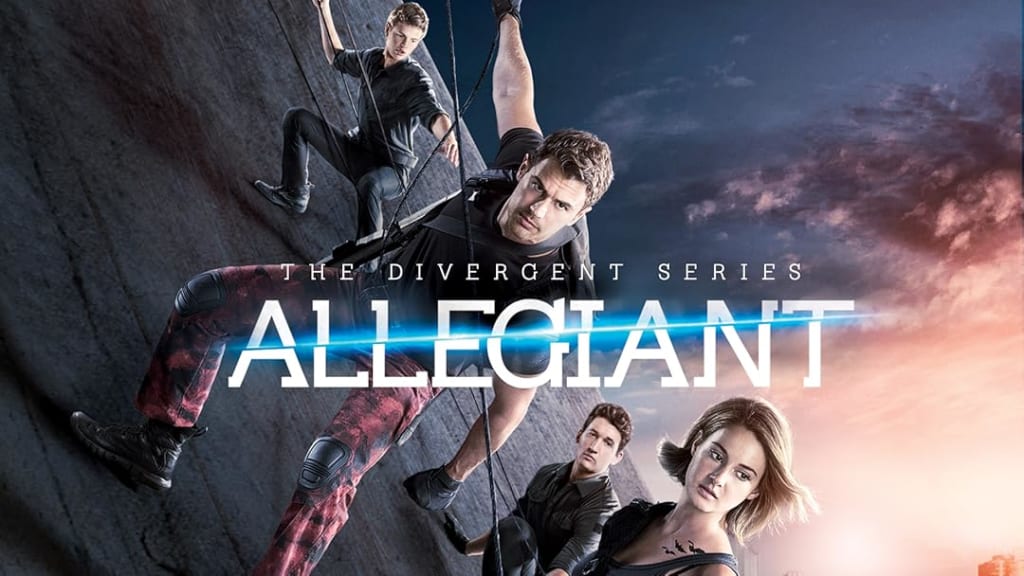
Allegiant, released in 2016, occupies a unique and unfortunate position in franchise history: it was designed as the penultimate chapter of the Divergent series, the first half of a split finale that would conclude with Ascendant. Instead, due to poor box office performance and audience apathy, it became the accidental endpoint of a franchise that never received proper closure. This dual identity—intended setup piece and unintentional finale—haunts every aspect of the film, resulting in a viewing experience that feels simultaneously incomplete and exhausting.
Directed by Robert Schwentke (returning from Insurgent), Allegiant attempts to expand the scope of the franchise by finally taking audiences beyond the wall that has enclosed Chicago for two films. This should be a momentous, game-changing development. Instead, the world beyond proves disappointingly generic, the revelations feel hollow, and the film squanders what could have been a franchise-revitalizing opportunity. Allegiant represents the culmination of every problem the series has struggled with, amplifying weaknesses while failing to capitalize on strengths, resulting in the weakest entry in an already troubled franchise.
Adaptation and the Split-Finale Problem
Allegiant adapts roughly the first half to two-thirds of Veronica Roth's final novel, following the industry trend popularized by Harry Potter and the Deathly Hallows and The Hunger Games: Mockingjay of splitting finales into two films. This decision, almost always motivated by commercial rather than creative considerations, rarely serves the story well, and Allegiant suffers acutely from this structural problem.
The novel Allegiant was already the most controversial book in Roth's trilogy, criticized for its confusing dual-narrator structure, pacing issues, and divisive ending. Rather than streamlining these problems for adaptation, the decision to split the story exacerbates them. The film must stretch limited narrative material across its runtime while preserving major plot developments for the sequel that would never come.
The result is a film that feels padded and aimless. Characters travel beyond the wall, discover the Bureau of Genetic Welfare, learn about the genetic purity experiments, and deal with Chicago's deteriorating political situation. These developments should feel momentous, but the film treats them with surprising indifference. Major revelations are delivered and then the film simply moves on, never allowing information to resonate or meaningfully impact the characters.
The screenplay by Noah Oppenheim, Adam Cooper, Bill Collage, and Stephen Chbosky (four writers often signals troubled development) makes significant changes from the source material. Most notably, it eliminates the novel's dual perspective structure, keeping Tris as the sole viewpoint character. This is arguably an improvement—the book's decision to split perspectives between Tris and Four felt like a narrative gimmick that diluted both characters. However, the film replaces this structure with nothing particularly compelling, resulting in a straightforward, uninvolving plot that simply moves from location to location.
As an intended Part 1, Allegiant fails to build anticipation for its conclusion. The film doesn't end on a compelling cliffhanger that makes audiences desperate for resolution. Instead, it just... stops, in the middle of developments that feel neither climactic nor particularly interesting. As an accidental series finale, it's even more unsatisfying, leaving virtually every narrative thread dangling and providing no sense of closure whatsoever.
Thematic Confusion and Genetic Determinism
Allegiant introduces the franchise's most problematic thematic element: genetic determinism. The revelation that society has been conducting experiments to create "genetically pure" individuals, and that Divergents are considered "pure" while most others are "damaged," fundamentally undermines everything the series has supposedly stood for.
The first two films, for all their flaws, at least paid lip service to themes of choice, self-determination, and the rejection of rigid categorization. The idea that Tris was special because she didn't fit into boxes was meant to be empowering—a celebration of human complexity and individuality. Allegiant retroactively reframes this as genetic superiority, transforming a story about social constructs and personal choice into one about biological determinism and innate worth.
This thematic shift is deeply troubling and poorly examined. The film presents the "damaged/pure" dichotomy as scientific fact within its world, not as the ideological framework of misguided scientists. David, the Bureau leader, isn't positioned as obviously villainous in his beliefs about genetic purity—the film treats his scientific worldview as largely legitimate, even if his methods are questionable. This uncritical acceptance of genetic determinism as truth rather than dangerous pseudoscience represents a catastrophic failure of thematic coherence.
The eugenic implications are impossible to ignore. The Bureau's experiments have bred generations of people, manipulated their societies, and deemed most of humanity "genetically damaged"—and the film never adequately challenges this worldview. Tris learns she's "pure" and this becomes a source of significance rather than a rejection of the entire categorization system. The franchise that supposedly celebrated not fitting into boxes ends by putting everyone into the most rigid, immutable boxes imaginable: genetic categories that define worth and ability from birth.
Compared to the faction system, which was at least acknowledged as a social construct that could be questioned and dismantled, the genetic purity system is presented as scientific reality. This represents a profound misunderstanding of the series' thematic foundation. The film seems unaware of how drastically it has undermined its own message, playing genetic determinism straight when it should be interrogating and dismantling it.
The political situation in Chicago, with the factionless in power and public trials being conducted, offers potentially interesting territory about post-revolutionary societies and cycles of violence. However, this is relegated to B-plot status, never developed with sufficient depth to provide meaningful commentary. The film gestures toward themes of how the oppressed can become oppressors, but it's too busy with the Bureau storyline to explore these ideas substantively.
Performance and Character Regression
Shailene Woodley, who elevated the previous films through committed performances, seems notably less engaged in Allegiant. Her performance is competent but lacks the intensity and emotional depth she brought to earlier installments. Whether this reflects directorial choices, a weak script, or Woodley's own diminishing enthusiasm for the franchise is unclear, but Tris feels less vital and compelling here than in previous films. The trauma and complexity that defined her character in Insurgent have been smoothed away, leaving a more generic heroic protagonist.
Theo James as Four receives more focus in Allegiant, which should be welcome after two films of him primarily reacting to Tris's journey. However, the increased attention reveals that the character has never been particularly well-developed. Four's arc involves discovering his mother Evelyn's authoritarian tendencies and confronting his past, but these developments feel perfunctory. James does what he can, bringing brooding intensity to his scenes, but he's working with thin material. His relationship with Tris has also stagnated—after two films of building trust and partnership, they spend much of Allegiant separated or at odds, cycling through the same arguments about trust and communication.
The supporting cast fares even worse. Ansel Elgort's Caleb, who betrayed Tris in the previous film, should be dealing with significant emotional fallout, but his guilt and Tris's anger are addressed in a few scenes and then largely dropped. Miles Teller's Peter, previously one of the franchise's most interesting characters, is reduced to comic relief, his moral ambiguity flattened into simple self-interest. His eventual betrayal and redemption happen so quickly they barely register.
New additions to the cast include Jeff Daniels as David, leader of the Bureau. Daniels brings gravitas and a veneer of benevolence to the role, playing David as someone who genuinely believes in his mission. However, the character is underwritten, his motivations remaining frustratingly vague. We understand he believes in genetic purity and wants to continue the experiments, but his personal investment in this project or his emotional life remain unexplored. He's a functional antagonist rather than a compelling one.
Naomi Watts returns as Evelyn, and the film's most interesting character dynamics involve her increasingly authoritarian control of Chicago. However, these scenes feel like they belong in a different, more interesting movie. The Evelyn storyline offers political complexity that the main Bureau plot lacks, but it's treated as a distraction from the "real" story rather than the compelling core it could have been.
Zoë Kravitz appears as Christina and Keiynan Lonsdale as Uriah, but both are given virtually nothing to do. The film assembles a large cast and then has no idea how to utilize them meaningfully. Characters appear in scenes because they need to be present, not because they have compelling reasons to be there or meaningful contributions to make.
The most significant character regression involves the group dynamics. In Divergent, the relationships among Dauntless initiates provided emotional texture. In Insurgent, the found family of survivors on the run offered moments of connection. In Allegiant, the core group feels like strangers forced together by plot necessity rather than people with history and bonds. The emotional foundation that makes us care about these characters has eroded completely.
World-Building Collapse
Allegiant's greatest failure is its squandering of the beyond-the-wall revelation. After two films of wondering what lies outside Chicago, the answer proves to be: a generic sci-fi facility in a barren wasteland. The Bureau of Genetic Welfare looks like every other sleek, futuristic installation in recent sci-fi cinema—white walls, glowing screens, people in uniform jumpsuits. There's nothing distinctive or memorable about it.
The world-building issues that plagued the first two films metastasize in Allegiant. We learn that Chicago was one of many walled cities conducting experiments to "repair" damaged genes and create genetically pure individuals. This revelation should recontextualize everything we've seen, but it mostly raises more questions than it answers. How long has this experiment been running? How many cities are there? What's the political structure of the outside world? How did the genetic damage occur? Why do they believe fixing genes will solve humanity's problems?
The film provides minimal answers. We're shown a devastated landscape and told there was a "purity war" that caused widespread destruction, but the specifics remain vague. The Bureau monitors multiple cities and occasionally recruits promising individuals, but their broader operations and goals remain unclear. The film treats this world-building as sufficient when it's barely sketched.
Most frustratingly, the film's depiction of the outside world makes the entire franchise feel smaller rather than larger. The faction system, already strained and illogical, is revealed to be an artificial experiment imposed by outside forces. Rather than adding depth, this revelation strips away what little meaning the factions had. They weren't even an organic social development—they were designed by scientists. Every struggle in the previous films was essentially a laboratory scenario being observed from above. This should be a profound, disturbing revelation, but the film treats it as simple exposition.
The visual design of the world beyond fails to impress. The wastelands are generic post-apocalyptic scenery. The Bureau facility is indistinguishable from countless other sci-fi locations. Even the technology—floating drones, holographic displays, plasma shields—feels borrowed from other franchises without distinctive style. Compare this to the world-building in the Maze Runner sequels, released around the same time, which at least created visually distinctive environments and a sense of dangerous, lived-in spaces. Allegiant's world beyond the wall feels like a set rather than a place.
The film also completely abandons the faction system that defined the first two installments. Once outside Chicago, the factions become irrelevant, barely mentioned. This might be intentional—showing how arbitrary the categorizations were—but without meaningful thematic examination of this transition, it just feels like the film has forgotten its own premise. Characters who defined themselves by faction for two films suddenly have no connection to those identities, with no exploration of what it means to leave those structures behind.
Technical Mediocrity
Robert Schwentke's direction in Allegiant lacks the visual ambition he brought to Insurgent. The simulation sequences that provided that film's visual highlights are absent here, replaced by more conventional action scenes and sci-fi facility exploration. The film's visual style is aggressively bland, with clean, flat lighting and uninspired composition throughout.
The action sequences are competently staged but forgettable. A mid-film infiltration of the Bureau and a climactic battle involving weaponized red gas provide the primary action beats, but neither generates much excitement. The hand-to-hand combat is adequately choreographed but lacks impact. The gunfights are routine. The film seems to be going through action-blockbuster motions without genuine investment in creating memorable set pieces.
The special effects work is inconsistent. The CGI rendering of devastated Chicago and the wasteland beyond ranges from acceptable to video-game-like. The Bureau's technology looks generic, and the climactic red gas—which should be visually striking and horrifying—looks like unconvincing digital effects. The flying vehicles and drones that transport characters lack weight or presence, feeling obviously computer-generated rather than tangible.
The cinematography by Florian Ballhaus (returning from Insurgent) does nothing to distinguish Allegiant visually. The film has a flat, overlit quality that robs scenes of atmosphere. Even potentially dramatic moments are shot in bland, even lighting that removes any visual tension. The color grading is unremarkable, with the outside world rendered in desaturated earth tones and the Bureau in sterile whites and grays—safe, boring choices that create no visual identity.
The pacing remains problematic, though in different ways than Insurgent. Where that film moved too quickly, Allegiant feels simultaneously rushed and sluggish. Major plot developments happen rapidly—they leave Chicago, reach the Bureau, learn the truth about genetic purity, uncover David's plan—but these events don't build momentum. The film checks boxes without generating narrative drive. Simultaneously, individual scenes drag, particularly exposition-heavy sequences where characters explain the world and its history. The film can't find a rhythm, lurching between frantic activity and tedious explanation.
Joseph Trapanese returns to score Allegiant, and his music remains functional but unmemorable. The score hits expected beats—swelling orchestral themes for emotional moments, electronic pulses for action sequences—without creating distinctive or memorable motifs. After three films, the Divergent franchise still lacks an iconic musical identity.
The editing, credited to Stuart Levy, Nancy Richardson, and Michael McCusker (three editors often indicates troubled post-production), is workmanlike at best. Transitions between the Chicago and Bureau storylines are awkward, action sequences lack proper rhythm, and the film's climax is assembled without proper building tension. The multiple editors' involvement suggests extensive reshoots or restructuring, and the seams show in the final product.
The Split-Finale Catastrophe
Allegiant exemplifies everything wrong with splitting finales into multiple films. The practice, which became standard in the 2010s, was justified as allowing fuller, more complete adaptations of lengthy source novels. In practice, it usually meant stretching thin narratives across inflated runtimes to maximize box office revenue.
The Hunger Games: Mockingjay suffered from this decision, with Part 1 feeling like extended setup and Part 2 rushing through its climax. However, both films were at least made, allowing the story some form of completion. Allegiant doesn't even have that consolation. The film ends mid-story, setting up conflicts and revelations that will never be resolved cinematically.
As an intended Part 1, Allegiant fails to justify its existence as a standalone film. Nothing about the narrative necessitates splitting it across two movies. The story being told here—heroes discover the truth about their world, uncover a conspiracy, and prepare to stop it—could easily be told in a single film. The split exists purely for commercial reasons, and the film suffers narratively as a result. There's no meaningful act structure, no satisfying arc within this installment. It's all setup with no payoff.
As an accidental finale, Allegiant is catastrophically unsatisfying. The film ends with Tris and Four returning to Chicago to stop Evelyn's plan to erase everyone's memories, while also planning to expose David and the Bureau. Nothing is resolved. Evelyn's fate is unclear. David remains in power. The genetic experiments continue. Tris and Four's relationship is in an ambiguous place. Every narrative thread is left dangling, every character arc incomplete.
For fans who invested in this franchise across three films, Allegiant offers no closure whatsoever. The film simply stops, mid-story, promising a continuation that never came. It's a deeply unsatisfying viewing experience, like watching the first half of a movie and being told the second half doesn't exist.
The failure to produce Ascendant stems directly from Allegiant's poor performance. The film grossed $179 million worldwide against a $110 million budget—not disastrous, but far below the previous installments and insufficient to justify producing another expensive blockbuster. Plans to conclude the series as a television movie were announced but never came to fruition, as the cast moved on to other projects and interest evaporated.
This failure reflects broader franchise fatigue in the YA dystopian genre. By 2016, audiences had tired of these narratives. The Hunger Games had concluded successfully but left audiences satisfied and ready to move on. The Maze Runner was struggling to maintain relevance. The 5th Wave, The Giver, and numerous other YA adaptations had failed to launch franchises. Allegiant arrived at exactly the wrong moment, when the genre had worn out its welcome and audiences weren't interested in yet another dystopian narrative about special teenagers fighting oppressive systems.
Franchise Trajectory
Examining the Divergent series as a complete trilogy (or incomplete tetralogy) reveals a franchise that consistently failed to realize its potential. Divergent established a world and characters with promise but suffered from thin world-building and generic execution. Insurgent added visual ambition and darker themes but lost narrative coherence. Allegiant expanded the scope while stripping away what little worked in previous installments.
Across all three films, certain patterns emerge. The franchise consistently struggled with world-building, creating systems and societies that looked impressive but crumbled under logical scrutiny. The faction system never made sense, and the genetic purity experiments somehow make even less sense. The films prioritized visual spectacle and action sequences over character development and thematic depth, resulting in a series that looks expensive but feels hollow.
Shailene Woodley's presence as Tris is the franchise's most consistent strength, and even that diminishes in Allegiant. The supporting cast, which included numerous talented actors, was perpetually underutilized. Interesting characters like Peter, Caleb, and Evelyn were introduced and then given nothing meaningful to do. The romance between Tris and Four, which should have been a emotional anchor, remained tepid throughout.
The shift in directors—from Neil Burger's safe competence in Divergent to Robert Schwentke's more ambitious but scattered work in Insurgent and Allegiant—never resulted in a coherent visual or tonal identity. The franchise couldn't decide whether it wanted to be gritty and realistic or stylized and fantastical, so it awkwardly straddled both approaches without committing to either.
Thematically, the franchise started with interesting ideas about identity, conformity, and choice, but progressively undermined its own messages. The celebration of being "divergent" became less about rejecting limiting categories and more about being special and superior. The introduction of genetic determinism in Allegiant represents the complete collapse of whatever thematic coherence the series once had.
Compared to The Hunger Games, which maintained thematic consistency and political relevance across its run, the Divergent series never found its ideological footing. Compared to Harry Potter, which built its world methodically across multiple installments, Divergent never established convincing world-building. Compared to even The Maze Runner, which at least committed to its pulpy action-thriller identity, Divergent tried to be too many things and succeeded at none of them.
Strengths in the Wreckage
Despite overwhelming problems, Allegiant has isolated moments of competence. Some individual scenes work on their own terms: Tris's confrontation with Caleb about his betrayal contains genuine emotion; Four's reunion with Evelyn and his attempts to reach her has dramatic potential; the reveal of Chicago from above, seeing the city as a contained experiment, should be powerful (even if the film doesn't capitalize on it).
The film deserves acknowledgment for attempting to expand its world, even if the execution fails. The ambition to take the story beyond Chicago and into larger questions about genetic manipulation and social engineering shows a desire to grow beyond the first film's limited scope. That the film bundles this expansion speaks to failure of imagination and skill rather than lack of ambition.
Some of the visual effects, particularly the holographic displays and the view of devastated Chicago, demonstrate technical proficiency. The Bureau's surveillance technology, showing them monitoring multiple cities, at least attempts to show the scale of the operation. The flying vehicles, while generically designed, are rendered adequately.
The film also continues the franchise's commitment to racial diversity in its casting, with significant roles for actors of color without making race a plot point or issue. This representation, unremarkable as it should be, still wasn't universal in mid-2010s blockbusters, and the Divergent series deserves credit for its inclusive casting throughout.
Critical Failures
The problems far outweigh any positive elements. The genetic determinism plot represents not just a thematic failure but an ideological one, introducing eugenic concepts and treating them as scientific fact rather than dangerous pseudoscience. This isn't just sloppy storytelling—it's actively harmful messaging, suggesting that human worth is determined by genetic "purity" and that people can be categorized as "damaged" or "pure" based on biological markers.
The complete abandonment of the faction system, which defined the franchise for two films, happens without meaningful examination or transition. The factions simply become irrelevant once the characters leave Chicago, with no exploration of what this means for their identities or the narrative's thematic concerns. It's as if the franchise forgot what it was supposed to be about.
The wooden dialogue and exposition-heavy screenplay bog down virtually every scene. Characters constantly explain things to each other (and the audience), but these explanations rarely illuminate or deepen understanding. Instead, they create a sense that the film doesn't trust its audience to understand visual storytelling or subtext, so everything must be verbally stated.
The complete lack of resolution, combined with the knowledge that Ascendant will never be made, creates a deeply frustrating viewing experience. Fans who invested in this franchise across three films receive no payoff, no conclusion, no sense of completion. Every plotline is left dangling, every character arc incomplete, every question unanswered.
The film's complete lack of visual personality, combined with forgettable action sequences and bland cinematography, results in a movie that is technically competent but utterly unmemorable. Nothing about *Allegiant* sticks in the memory after viewing. It's cinematic wallpaper, present but making no impression.
Conclusion
Allegiant represents a franchise's slow death made manifest on screen. It's a film made without passion, conviction, or clear purpose beyond fulfilling contractual obligations and attempting to extract revenue from a fading property. The decision to split the finale, already questionable from a creative standpoint, proved commercially disastrous and narratively catastrophic.
As an intended Part 1, Allegiant fails to tell a complete story or build anticipation for its conclusion. As an accidental series finale, it provides no closure or satisfaction whatsoever. In either context, it's a failure—a movie that exists without justification, that tells a story no one needed told in this way, that undermines rather than celebrates what came before.
The thematic collapse into genetic determinism represents a fundamental betrayal of the series' supposed values. A franchise that claimed to celebrate individuality and reject limiting categorizations ends by embracing the most rigid, immutable categories imaginable: genetic markers that determine worth from birth. This isn't just poor execution of good ideas—it's the complete abandonment of those ideas in favor of their opposite.
For the cast, particularly Shailene Woodley, Allegiant must represent a disappointing end to their involvement in this franchise. Woodley brought talent and commitment to a role that deserved better material than it received. The same is true for the entire supporting cast, filled with capable actors given nothing substantial to work with.
For fans of Veronica Roth's novels, the film series ultimately failed to do justice to the source material, making changes that rarely improved upon the original and often actively worsened it. For fans of the films themselves, if such viewers exist after Allegiant, they're left with an incomplete story that will never receive proper conclusion.
Allegiant stands as a cautionary tale about numerous poor decisions: splitting finales for commercial rather than creative reasons, introducing problematic themes without proper examination, prioritizing franchise-building over storytelling, and assuming audience investment that no longer exists. It's a film that exemplifies everything wrong with franchise filmmaking in the 2010s—the cynical calculation, the bloated budgets, the assumption that audiences will consume anything branded with a familiar property.
In the landscape of YA adaptations, the Divergent series as a whole represents a missed opportunity and a slow decline. It started with a mediocre foundation and never built upon it successfully. Each installment made different mistakes, but all three films shared fundamental problems: shallow world-building, weak thematic development, underdeveloped characters, and prioritization of spectacle over substance.
Allegiant is the weakest entry in a weak franchise, a film that neither stands alone nor functions as part of a coherent whole. It's simultaneously too much and not enough—too long for the story it's telling, too complicated for the depth it provides, too expensive for the quality it delivers, yet not enough of anything to be memorable, meaningful, or worthwhile. It's a franchise finale that doesn't finalize, a story conclusion that doesn't conclude, a movie that exists without purpose or justification beyond the commercial imperative to extract one more film from a dying property.
The Divergent film franchise is over, ended not with meaningful conclusion but with an incomplete whimper. Allegiant is the film that killed it, and in retrospect, that might have been a mercy.
About the Creator
Parsley Rose
Just a small town girl, living in a dystopian wasteland, trying to survive the next big Feral Ghoul attack. I'm from a vault that ran questionable operations on sick and injured prewar to postnuclear apocalypse vault dwellers. I like stars.
Keep reading
More stories from Parsley Rose and writers in Critique and other communities.
I Sat Down and Watched Insurgent (2015)
Insurgent, the 2015 sequel to Divergent, arrives with the unenviable task of expanding upon a world that was already thinly constructed while advancing a story toward increasingly convoluted territory. Directed by Robert Schwentke (replacing Neil Burger from the first film), Insurgent represents both the best and worst tendencies of middle-chapter sequels: it's more visually ambitious and action-packed than its predecessor, yet it also feels narratively hollow, trading character development for spectacle and coherent world-building for escalating confusion. The result is a film that simultaneously improves upon and regresses from Divergent, creating a frustratingly inconsistent viewing experience.
By Parsley Rose 5 months ago in Critique
Cassie and Johnny
I’m the kind of dame you notice. I’m no femme fatale, but you can’t ignore me, at least not until I warn you about what’s coming, then everybody ignores me. Hell, they usually blame me afterwards and give Johnny all the credit for saving the day, but my Johnny couldn’t save a seat at the movies without my help. Sure, he’s brawny, but brainy? Not so much. Like that time I asked him to spot me five bucks, and he said he didn’t see it anywhere on me, and believe you me, he looked but good.
By Harper Lewis5 days ago in Critique
$5 CHICKEN EXPOSED Creepy AI Video Goes Viral Claiming To Reveal How Costco And Other Stores Keep Their Chicken At $5!
At least in some videos, you know that it is obviously AI. In this clip, a chicken explains the difference between “real” chicken and “modified” chicken. The grotesque figure with bulbous eyes, bruised skin, and decaying teeth walks down a processing plant lane to show the chickens that can be found at your neighborhood supermarket. The ones that are encased in plastic and ready to eat, this chicken claims is full of “GMOs.” Let’s stop right there; genetically modified organisms have been part of the diet for centuries starting chiefly with American Indians who used the process of altering the genes to produce more corn.
By Skyler Saunders6 days ago in Critique
Review of 'Man on the Run'
My wife and I saw Man on the Run, a nearly 2-hour documentary on Amazon Prime, about Wings, Paul McCartney's group that flew around the world from shortly after The Beatles broke up in early 1970 to shortly after John Lennon was murdered at the end of 1980, making a Beatles reunion forever impossible.
By Paul Levinson3 days ago in Beat



Comments
There are no comments for this story
Be the first to respond and start the conversation.