
On a fateful November night
The challenges of gently bringing to light the dark family histories of a nation

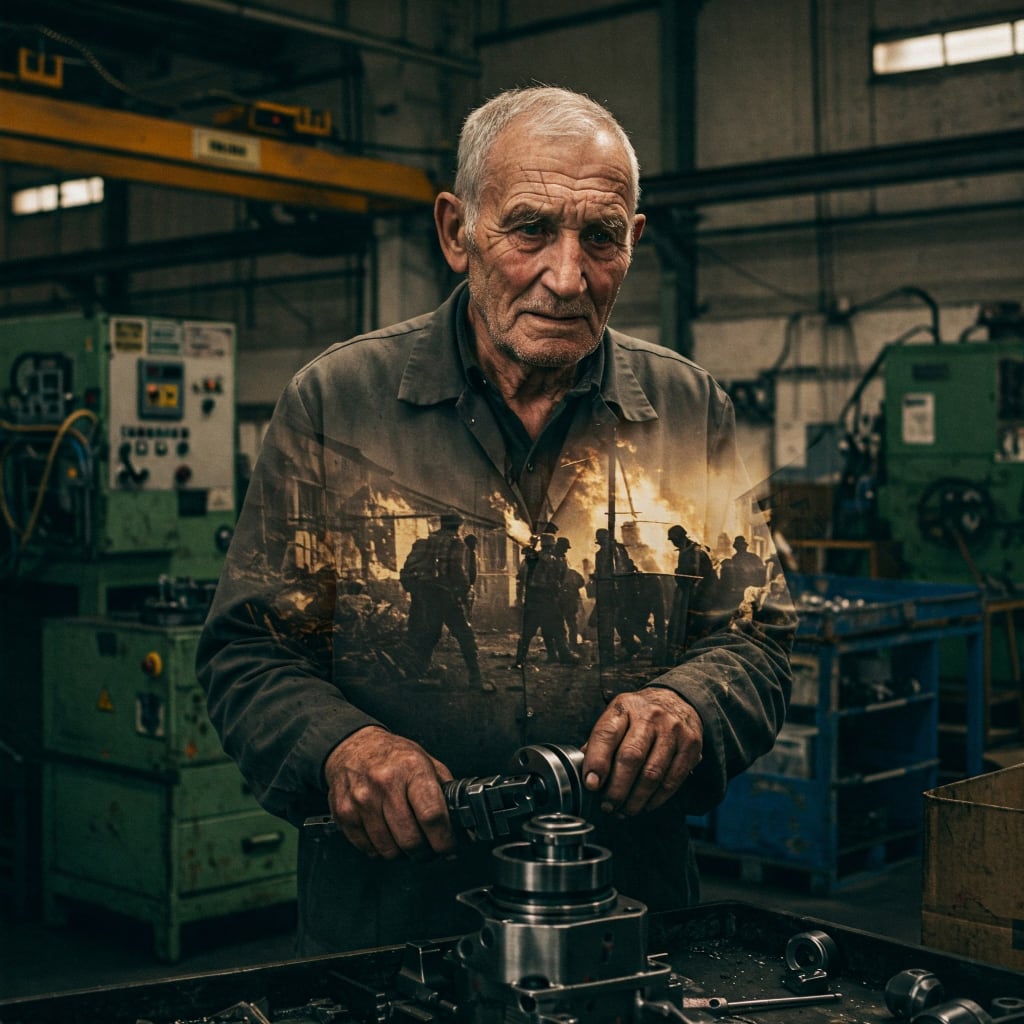
(I was writing this for the "Self-Editing Epiphany"-Challenge, only to in the end realize in the end that there was a 1.500 words limit to it, and this has more like 3.800 words. Since today is my birthday and I won't have time to shorten it, I'll just publish it anyway now. I hope you like it!)
A while ago, I had discovered a Toastmasters club close to where I live. After visiting, I was surprised by just how much I enjoy talking in front of people. When they told me there would be a speech competition coming up soon, I was thrilled.
Since the topic was free to choose, I figured I’d speak about something that had been on my mind on and off for at least a year by then. It had a lot to do with my own family history, but it also connected far beyond that, to the history of my country.
So I imagined a grand event, me sharing those revelations on stage to an awed audience, ensuring me a clear win at the contest, while somehow heroically liberating my whole country from its past sins.
He sure must have read a lot of books to imagine that, you might think. Which is true. I have read a lot of books for all my life, about pretty much anything I could find. I figured I should be capable of producing language akin to that of the books I’ve read. Think Martin Luther King. Ghandi. Powerful language. Speeches that change the course of history. That's what I wanted to do.
For how hard could it be?
Well...
The first (finished) draft
I decided I would start the speech with an ominous historic event which most in the audience wouldn’t instantly recognize. It would set the mood, while also raising some curiosity, like in a great book opening:
On a fateful November night in 1943, a company of gentlemen meet in Moscow to sign a declaration on the future of a country. It said:
- The future of the country shall be independent again
- It was to be further known as the first victim of Hitler’s Germany
- It had its own responsibility in the matter, but would have to atone for its sins later
I didn’t tell them which country yet, which would work quite well to hook the audiences attention.
Then I would continue with a few more facts, building up the suspense. Which country could I be talking about?
In April ’45 the country had achieved its independence from Germany, but was still occupied by the allied forces.
Surprisingly, even one year after the allied occupation there were still roughly 500.000 official Nazi party members in the country.
By 1948 the government had granted a general amnesty to those 500.000 people.
And in '55 Leopold Figl, chancellor of said country, even managed to remove the critical line of the 1943 declaration that gave co-responsibility to the country for the Nazi crimes. It allowed the country to save billions on war reparation payments.
Next I would move on to the first powerful punch, revealing that the country I was speaking about was the country we were living in right now:
And thus, Austria was free again!
As for the past: They decided to “start anew with a clean slate”.
Some context here: You have to know that here in Austria where I live, there is this grand myth that Austria has been the first helpless victim of Hitler’s Germany. Which is true in a sense, but there were also Hundreds of Thousands Austrians who were enthusiastically awaiting and supporting him back then. Who have gladly helped in numerous crimes in this country and abroad. But nobody here ever talks about it. You don’t learn about this in school. Your family will be silent about it. So most people have no idea, and of course mostly still believe in the victim myth.
Next I needed a transition from historical facts to the personal, focusing not on the victims, but the perpetrators and their future family histories:
And restart they did. Austria has been an economical powerhouse for decades.
It has even begun to acknowledge at least part of its responsibility to its victims.
But what about the ones who committed those crimes? A few have been taken to court, yes, and very select few have been judged guilty. Most, though, came away unharmed by the law.
At first, that must have felt like a true blessing to some.
But what do you do if you do feel guilty for what you did, and then, after the war, your government tells you that it needs you to forget all that was, and all you did, for good?
Worked nice as a cliffhanger. Well, what would happen then? The audience was definitely listening by now.
If you are not a psychopath, you’ll probably struggle with that. The guilt you feel, without any way to come to light neither to justice nor mercy, will stay within you. It will fester there, in the darkness of your soul, and grow.
And once in a while, it will surface in unexpected places.
It makes you ...
[Removed a few paragraphs of the original from this post for reasons I will go into later]
... Your other granddaughter will marry a man she never loves, but until you die you will not know, because she as well has learned to keep silent. She dies at the age of 44, desperate but to the end unable to understand how on earth she couldn’t have found a life worth living for.
She bore three children to the man she never loved. One of those children stands here before you today.
Boom! The next emotional punchline, which worked quite well. Bringing the message home that it wasn’t just back then, long ago. The consequences are still felt. By us. Today. To empathize the point, I had started my speech at the back of the stage, and for every generation that had been affected again, I would take one step forward. The last step would bring me to the present:
And I am here to break the silence of almost a century. A silence that allowed our country to achieve independence from foreign occupation. Yes, I give you that! It allowed us to prosper economically. Yes, that as well! But it cost us so dearly as humans.
So next I wanted to make the personal side of the story relatable to my audience, while showing how the truth has been denied successfully from later generations:
And yet I didn’t learn any of this in school. If I didn’t dig deeper on my own, I would have no way to understand why my mother staid for so long with a man she never loved. [Again omitted 2-3 sentences here. I'll explain why in a minute]. Nobody ever talked about these things.
It is often said that those who do not know their history are bound to repeat it.
And in my family, they all did. Makes you wonder what that silence did to other families. Perhaps even to yours, as well.
Again I was physically moving back and forth “between generations”, to bring home the message of how the effects of that silence travel throughout history. That it's not just one family history, but the history of many families. That perhaps some in the audience have felt the effects of this silence. And most shockingly, they might not even realize it, because the cover-up had been done so successfully after the war.
But I didn’t just want to leave the audience feeling sad and powerless, like it was a tragedy we might never overcome. I wanted to lift them up, pull them through. First, though, I figured I’d add another punch to really bring home the effects of the generational silence (imagine the next part to be delivered quite theatralical, followed by an effectful pause):
So I say we need to uncover the ghosts of the past still haunting so many Austrian family histories. Because in my own family, I can see that this war was catastrophic. And for some, it never ended in ‘45. They kept fighting. In their nightmares. In those moments when they had nothing to do to keep their unspoken panic at bay. And when the wound surfaced again and made them do things they would later regret, but couldn’t stop or even understand.
Now, back to the beginning, closing the circle to the fateful November night theme. Slowly growing the original, ominous meaning into a powerful message of hope and liberation:
And yes, it sure was a fateful November night, when the ’43 Moscow declaration was signed by the allied powers.
But that was back then, and today, we ought to be in power of our destinies.
So I invite you to let this 1st of March be an equally fateful day, when we all ally to speak up. To bring to light those dark family secrets. To ask for forgiveness where we can and justice where necessary. Let the past rest, yes! But not by dissociating and hiding away our traumas, but by healing them instead.
Ending now with a hopeful note, a strong call to action, one last time empathizing the generational connection by stepping back and then moving forward with each “again” and “again” and “again”:
Because there can be no “Never again” without true healing.
There will just be again and again and again.
So please: Do speak up!
And thus, after four long generations of suffering in silence, finally:
Let the healing begin.
Well, that was the first “finished” version of the speech, after probably Hundreds of revisions, trying it out for practice and edits. I was damn proud of it and figured I should win the speaking contest.
The feedback from contest level 1
In the end I did make it to the next level. But I also got some very important feedback.
First, it was slightly too long. In a Toastmasters competition, you have 5-7 minutes for each speech, with a 30 seconds grace period. But if you go over 7 minutes and 30 seconds, you are disqualified. I must have practiced it a Hundred times before the contest, but the time I needed to do the speech varied wildly from 6-8 minutes. At the first level of the contest itself it took me 6 minutes and 45 seconds, so safely inside the zone. But I figured that for the next level I had better shorten it, because my fear of going over the time limit would otherwise make me so nervous that my speaking suffered.
Secondly, I really didn’t expect my own strong emotional reaction while giving this speech. When practicing at home, it was fine, but when I went up there on stage, my adrenaline levels went through the roof, even though I normally feel quite confident speaking in front of audiences. I'm guessing that since the topic is deeply connected to my own family history plus it's kind of a taboo topic, my body felt like it could be under attack any moment - probably the effects of daring to publically break a silence that hasn't been broken in 80 years.
Third, my girlfriend (rightfully) told me that I should better remove the all too clear connections to my family (that's the reason for the omissions above). Yes, these were very powerful lines. But some of those family members I was talking about are still living. Are still traumatized. And it should be their choice when or if they are willing to openly speak about these things, not mine. I have to admit I was a bit reluctant at first about having to let go of these powerful parts. But at the same time, I knew that she was right.
Fourth, I was told that the topic was a very sensitive one, and that I could expect to not win the contest because of that. To put it in context for non-Austrians reading this: In the last general election last year, roughly 29% voted for the political party FPÖ, which is sort of a successor of the old Nazi parties in Austria.
Fifth, they told me that although my language was beautifully crafted, this produced several problems. First, the whole speech was much harder to remember if each sentence I wanted to say was pre-written in a specific way. Second, the beautiful language potentially moved the attention away from my main points. And third, those who were not as good in English (it’s Austria, we speak German after all) might have a harder time following what I wanted to convey.
What I changed, and why
So now I had roughly 4 weeks to prepare a better version for the next level speech contest. Since I hadn’t been a Toastmasters member for long enough, I couldn’t compete in the English contest at the next level. But the German contest was open to me. Which is why I changed the whole speech to German - first a nuisance, then a blessing in disguise, because it forced me to rethink much of what I had written before.
So here’s (roughly) what I changed:
I removed the all-too-clear connections to my family, because my girlfriend was correct: It was the right thing to do. The hints were still there, but one who didn’t know me well could only guess if it was true. The only obvious one I left in was my great-grandfather. He’s already dead, so I figured that should be ok. After all, he really did what he did, so why lie about it?
I then spent about a week lingering on the “great” idea to talk (in hindsight) way too much about “healing” and how important it was. But it began to sound too much like preaching, so reluctantly I cut it back again.
In the middle part, I added a musing question to shake it up a bit.
I trimmed the text multiple times sentence by sentence, word by word, to lessen the chance that I would go overtime at the contest. I knew that originally I had started out with a speech of about 12 minutes, and to leave some room for effectful pauses during the speech, I would have to cut it down to about 6 minutes. So a lot of my "beautiful" sentences would have to go, or be cut down to the most efficient way possible.
Also, I completely reinvented the ending. The old English one worked, but translated to German it just sounded stupid and lame. In addition, I wanted everyone in the audience to know that the ending was approaching, and then know exactly that this was the end, without having to say "Thank you" or something.
So here’s my English translation of the final version (the original finished version was in German language of course, but I translated it back to English for you since vocal.media only allows English posts so far):
Final English version of the speech
While in Stalingrad the fighting still rages, a thousand kilometers away, in Moscow, a declaration on the future of a country is signed. It says:
- The future of this country will be independent again
- It will further be known as the first official victim of a Hitlerite Germany
- It has its own responsibility in the matter, but will atone for its sins later
Two years later, in ’45, the country is liberated from Germany, but still occupied by the allied forces.
Surprisingly, even though occupied by the Allies, there are still 500.000 official Nazi party members in said country. That’s roughly 7% of the population.
In ’48 the country grants a general amnesty for ‘minor crimes’ committed during the Nazi era. Those affected are allowed to vote again.
By ’55 then foreign minister Leopold Figl even manages to remove the 3rd paragraph of the Moscow declaration that gives the country co-responsibility for the Nazi crimes. This will help to save billions on war reparation payments.
And thus soon after he can proudly pronounce from a balcony: “Austria is free!”
They shall start again with a clean slate.
Away with the uncomfortable past!
But.. does the world truly work like this? If nobody talks about something, then it never existed? If nobody finds a murder victim, then there cannot have been a murder?
If you’re not a psychopath, your conscience might want to differ.
And you may keep silent, for your fatherland and its independence. You may think you have safely buried everything you have done in the cemetery of history. But the feeling of guilt will still haunt you. Fester within you. Grow.
And once in a while, it will surface again, and make you… do things.
Then you will hit your granddaughter if she asks too many innocent questions.
You will cover for your daughter’s husband, no matter what he does for money. Because didn’t you yourself do unspeakable things back then?
Your other granddaughter will marry a man she will never love, only silently endure. Before she dies young, she will bear him 3 children. Your grand-children, who have also learned to endure silently. But never, perhaps, will they ever learn why.
Because 4 generations later they still learn only how Austria has been the first official victim of a Nazi Germany. Do their ancestors still insist they knew nothing, nor have they ever been involved in any way.
But something must be amiss here.
Because out of 500.000 official Nazi party members even after the Allied occoupation, not to mention countless opportunists, this country sentenced only 43 of them to death, 23 to life-long imprisonment, and roughly 300 more to other considerable punishments.
Which leads us to 2 possible explanations:
- In Austria there really were close to zero true Nazis. And those who were there didn’t do much harm. Otherwise they should have found many more during the so-called “de-nazification” years, right?
- The low number of sentences were meant to support a politically useful story, a myth
Which is more likely?
It’s often said that those who do not know their history are bound to repeat it.
As someone who values freedom very much, I wanted to know the truth. So I began to dig deep into my own family history.
And since last summer I now finally know that my great-grandfather, who I always remembered as friendly and peace-loving as a kid, had been serving as a sergeant in the 7. SS division “Prinz Eugen”. It’s an internationally famous one, because it was mentioned in the Nuremberg trials by name as the war crime division.
But did he go there of his own free will? Or was he forced to go?
Turns out that no, he wasn't forced to go. And not only him: His whole village enthusiastically joined the SS as soon as they could.
But perhaps after the war they were disillusioned, regretting all they did back then, changed men from all they've seen?
They were not. By pure luck I met a few survivors and their descendants last summer. And to this day, they are still regretting that their Hitler couldn’t force the last few meters towards Moscow back then. It would have been “so much better” if he did, they told me.
Nothing of this, though, I’ve learned through my own family. For this wall remains surprisingly durable to this day. As it probably still stands strong in so many other Austrian families.
But if knowledge is power, then ignorance becomes an impotence to act. If we keep silent, often without even knowing that there would be something to say, or why we still keep silent, we remain unfree. But not only us. If we cannot break that cycle, we also damn our children to the same fate. And their children.
But there's more: It makes us perpretators.
For in my search for answers I often stumbled on this one sentence that stuck with me: “Those who have been hurt, will hurt others”. And looking back on my family history, I would say that sadly, it seems to be true.
But luckily, there are 2 antidotes: Knowledge, and Healing.
Our generation should finally know that the victim myth of Austria was but a myth, albeit a very useful one. And if you do not believe me yet: Wonderful! Feel free to check the facts yourself! Find your own answers!
What I unfortunately cannot relieve you of here and now is the need for healing. Healing can be a long and strenuous process, usually taking much longer than my 7 minutes here. It takes endurance and an admirable strand of bravery. Yet I can promise you: Finding true healing will always be worth your while.
But because ignorance means powerlessness. Because those who are wounded will continue to wound others. And four generations behind walls of silence have really endured enough by now:
Bring down that wall now. Just.. bring it down.
And if we then not stop there, starting to build the very next walls from the rubble -
Well then, friends:
We can probably call that “progress” then.
How it was received
Well, I didn't win. I placed third.
Afterwards I was told again that the topic wasn't very likely to win to start with. It's too.. heavy, too polarizing to win such a competition. If you want to win, you have to prepare a speech on a topic that's... safe.
But that's not what I'm aiming at if I'm raising my voice to speak. Why waste your words, your energy on that?
The very interesting thing for me though was that after my speech, multiple people I've never met before came to me and a) thanked me for speaking up about such a difficult topic, b) told me they have a similar family history and c) asked me how I figured things out and whether I was willing to share some of my information with them.
That didn't seem to happen after any other speech at the contest.
So, in some way, I feel like I kind of "won" some very different prize for my efforts. One I might not be able to hang on a wall like my 3rd place certificate. But the speech I was working on for months might actually have changed something. Made a few people really listen, really think, really wonder.
And isn't that what we all yearn for in the end?
About the Creator
Niklas Baumgärtler
I'm a speaker, musician, writer and teacher. Although interested in many things, I am most fascinated by the human condition and how humans and their social systems are born, change and fall apart.
Keep reading
More stories from Niklas Baumgärtler and writers in Critique and other communities.
When your facebook ad account gets hacked: Why it happens, and how to deal with it
A while ago I got a rather confusing Email by Facebook: They were not sure whether I was old enough to actually be a user. Which is quite weird, since I had been using it for 7 years, and I was 31 years by then. Did they increase their minimum age to 35 now, or what the hell happened?
By Niklas Baumgärtler12 months ago in Geeks
Cassie and Johnny
I’m the kind of dame you notice. I’m no femme fatale, but you can’t ignore me, at least not until I warn you about what’s coming, then everybody ignores me. Hell, they usually blame me afterwards and give Johnny all the credit for saving the day, but my Johnny couldn’t save a seat at the movies without my help. Sure, he’s brawny, but brainy? Not so much. Like that time I asked him to spot me five bucks, and he said he didn’t see it anywhere on me, and believe you me, he looked but good.
By Harper Lewis12 days ago in Critique


Comments
There are no comments for this story
Be the first to respond and start the conversation.