
Israel Attacks Iran
Israel Strikes Iran: Massive Airstrikes Hit Nuclear & Military Sites | Middle East on Edge

Israel Attacks Iran – June 2025
Overview
In the early morning hours of June 13, 2025, Israel launched a massive, coordinated military operation—codenamed Operation Rising Lion—targeting Iran’s nuclear facilities, military leadership, and strategic infrastructure. The assault marks the largest Israeli attack on Iran since the Iran–Iraq War and represents a dramatic escalation in Middle East tensions, with the world now bracing for further retaliation and regional instability.
Israel Strikes Iran: Massive Airstrikes Hit Nuclear & Military Sites | Middle East on Edge
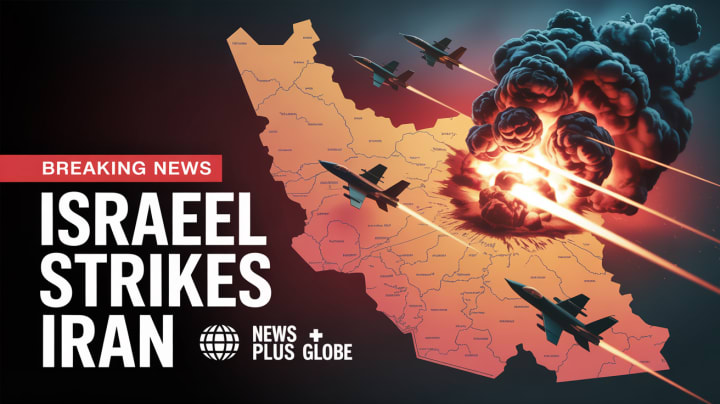
Israel has launched its largest-ever airstrike campaign against Iran, targeting nuclear facilities and top military leaders in a dramatic escalation. Over 200 Israeli jets struck more than 100 sites, including Tehran and Natanz. Iran has vowed harsh retaliation, launching drones toward Israel as the world braces for further conflict. Get the latest updates and analysis with News Plus Globe.
The Strikes: Scope and Targets
According to Israeli and international sources, over 200 Israeli fighter jets participated in the operation, striking more than 100 targets across Iran. The Israeli Defense Forces (IDF) confirmed that the attacks specifically targeted:
Nuclear sites: Including the Natanz Enrichment Complex in Isfahan Province, Khondab, Khorramabad, and other facilities critical to Iran’s uranium enrichment and nuclear weapons development.
Military leadership: The strikes killed several of Iran’s top military commanders, including:
Maj. Gen. Mohammad Bagheri (Chief of Staff of Iran’s Armed Forces)
Gen. Hossein Salami (Commander-in-Chief, Islamic Revolutionary Guard Corps)
Gen. Gholamali Rashid (Deputy Commander-in-Chief of the Armed Forces)
Nuclear scientists: Fereydoun Abbasi (former head of Iran’s Atomic Energy Organization) and Mohammad Mehdi Tehranchi (president of Islamic Azad University, Tehran) were also killed.
Residential and military infrastructure: Explosions were reported in Tehran, Isfahan, Natanz, and several neighborhoods housing senior Iranian commanders.
Background: Why Now?

The attack follows months of rising tensions and failed nuclear negotiations between Iran and the United States. In the days leading up to the strikes, the International Atomic Energy Agency (IAEA) declared Iran in breach of its nuclear obligations for the first time in two decades. Iran has been enriching uranium to 60% purity, a technical step away from weapons-grade, and installing advanced centrifuges at a rapid pace.
Israel’s leadership, including Prime Minister Benjamin Netanyahu and Defense Minister Israel Katz, described the operation as a “preemptive strike” to prevent Iran from acquiring nuclear weapons, citing the existential threat posed by a nuclear-armed Iran.
Immediate Aftermath and Global Reaction
Iranian Response: Iran’s Supreme Leader Ayatollah Ali Khamenei and other officials vowed “harsh and decisive” retaliation. Within hours, Iran launched more than 100 drones toward Israel, with both countries bracing for further escalation.
Regional Impact: Neighboring countries, including Jordan and Iraq, closed their airspace. Air traffic was halted at Tehran’s main airport, and Israel declared a state of emergency, warning of imminent missile and drone attacks.
International Reaction: The United States, while informed, did not participate in the strikes and urged restraint. Saudi Arabia, China, Australia, and other countries condemned the escalation and called for dialogue. Oil prices surged, and global markets reacted nervously.
Casualties and Damage: The full extent of casualties and damage remains unclear, but the loss of Iran’s top military leadership and nuclear scientists is a significant blow to Tehran’s command structure and nuclear ambitions.
Strategic and Historical Context

This operation represents a significant escalation beyond previous tit-for-tat exchanges between Israel and Iran. Unlike earlier, more limited strikes, the June 2025 attack was broad, unannounced, and targeted Iran’s core military and nuclear infrastructure. The scale and surprise of the operation have pushed the psychological and strategic boundaries of the conflict.
What’s Next?

Retaliation Expected: Iran has declared its right to respond under Article 51 of the UN Charter and is expected to retaliate with missile and drone attacks, raising fears of a broader regional war.
Nuclear Talks in Jeopardy: Scheduled nuclear negotiations between the U.S. and Iran are now uncertain, with diplomatic solutions appearing increasingly remote.
Global Security Concerns: The United Nations, the U.S., and regional powers are urging restraint, warning that further escalation could destabilize the entire Middle East and threaten global security.
Israel has launched a massive airstrike campaign against Iran, targeting nuclear and military sites in a dramatic escalation. With top Iranian generals killed and both nations bracing for retaliation, the Middle East faces a dangerous new chapter. Follow News Plus Globe for all the latest updates on this breaking story. #IsraelIran #BreakingNews
About the Creator
Keep reading
More stories from M Irfan Zafar and writers in Critique and other communities.
US Open Golf Championship 2025
The US Open (Golf) Championship 2025 Introduction The US Open Golf Championship stands as one of the most prestigious and challenging events in the world of sports. In 2025, the 125th edition returns to the legendary Oakmont Country Club in Pennsylvania, a venue synonymous with golf’s ultimate test. From June 12–15, the world’s best golfers—spanning the PGA Tour and LIV Golf—will battle for the coveted trophy, a record-breaking purse, and a place in history.
By M Irfan Zafar9 months ago in Cleats
On The Accessibility of US Political Systems & A Crisis of Legitimacy
California prides itself on 'expanding the voting franchise' by delivering a ballot to each doorstep, but a single vote does not even guarantee lobby entry into a private club where the membership access and dues stay unchanged. Moreover, mail-in ballots are fake paper thin luxuries when you lack the stable home, living wage, and benefits (medical, dental, and retirement) needed for a future. While California postures as a sanctuary for voting rights under the Voter’s Choice Act (VCA), an incumbent, self reinforcing status quo undermines free and fair elections in a lot of places - which I suspect has been the case for many generations but observe it with increasing clarity. Most folks do not understand this status quo for their relative class at birth - so they vote along party lines according to what is popular which means exposed most.
By James Royer3 days ago in Critique



Comments
There are no comments for this story
Be the first to respond and start the conversation.