
Donald Trump’s Role in the Iran-Israel Conflict
Strategic Alliances, Maximum Pressure, and Lasting Impacts on Middle East Tensions

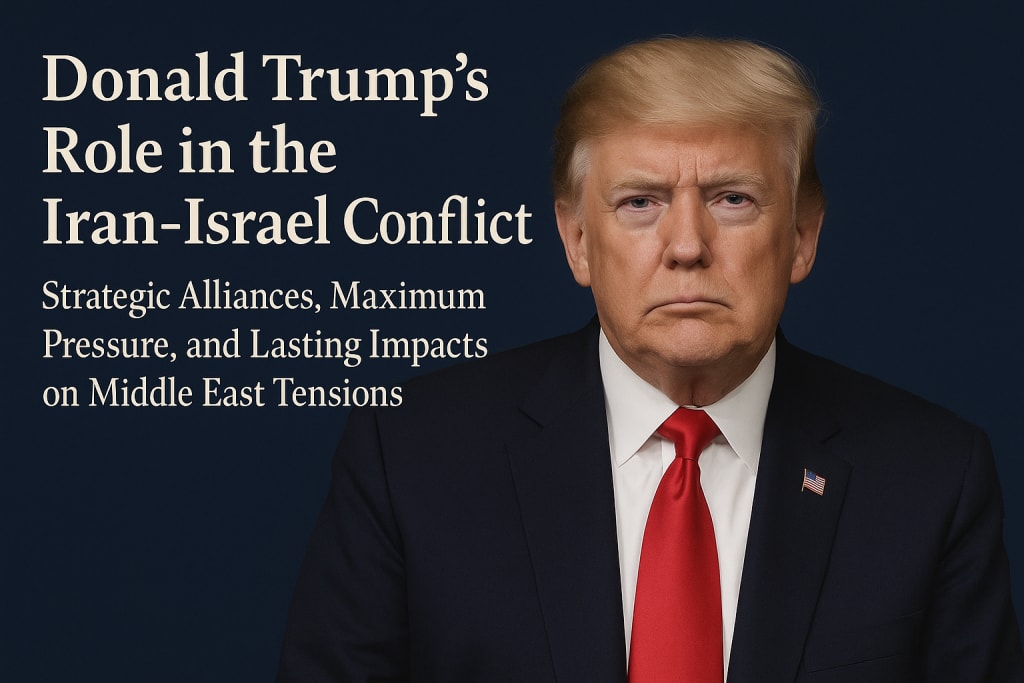
The Iran-Israel conflict is one of the most volatile and enduring rivalries in modern geopolitics, shaped by ideological, religious, and strategic opposition. While the seeds of this conflict were sown decades ago, the role of U.S. presidents—particularly Donald Trump—has been pivotal in influencing its trajectory. Trump’s presidency (2017–2021) marked a period of significant policy shifts in the Middle East, with direct implications for the Iran-Israel dynamic. His administration's bold decisions, especially the withdrawal from the Iran nuclear deal and the strengthening of U.S.-Israel ties, intensified regional tensions and reshaped alliances across the region.
Withdrawal from the Iran Nuclear Deall
One of Trump’s most consequential moves in foreign policy was his unilateral withdrawal from the Joint Comprehensive Plan of Action (JCPOA) in May 2018. The JCPOA, commonly known as the Iran nuclear deal, was a multilateral agreement reached in 2015 between Iran and six world powers (U.S., UK, France, Germany, Russia, and China), which aimed to limit Iran’s nuclear capabilities in exchange for sanctions relief.
Trump denounced the deal as “the worst ever,” arguing it was too lenient and failed to address Iran’s ballistic missile program and regional influence. His administration reinstated harsh sanctions on Iran under a policy dubbed “maximum pressure,” aiming to force Tehran back to the negotiating table under more U.S.-favorable terms.
This move had significant implications for Israel and its adversarial stance toward Iran. Israeli Prime Minister Benjamin Netanyahu was one of the deal’s fiercest critics and a vocal supporter of Trump’s decision to withdraw. The re-imposition of U.S. sanctions strained Iran’s economy and heightened its hostility toward both the United States and Israel, escalating proxy confrontations in Syria, Iraq, and Lebanon.
Strengthening U.S.-Israel Ties
Trump’s presidency marked an unprecedented deepening of U.S.-Israel relations. His administration recognized Jerusalem as Israel’s capital in December 2017 and moved the U.S. embassy there from Tel Aviv in May 2018. This decision broke with decades of U.S. policy and was widely condemned by Palestinians and much of the international community, who viewed East Jerusalem as the capital of a future Palestinian state.
While the move was not directly about Iran, it symbolized Washington’s clear siding with Israel in regional disputes, including the Iranian threat. Iran and its allies saw the embassy relocation as further evidence of U.S.-Israeli collusion against Muslim interests in the region.
Moreover, under Trump, the United States recognized Israeli sovereignty over the Golan Heights in 2019, another diplomatic win for Netanyahu and a strategic setback for Iran and Syria, both of whom reject Israel’s control over the area.
Abraham Accords and Strategic Isolation of Iran
Another cornerstone of Trump’s Middle East policy was brokering the Abraham Accords, a series of normalization agreements between Israel and several Arab countries, including the United Arab Emirates, Bahrain, Sudan, and Morocco. These deals were significant not only for their historic nature—breaking the decades-long Arab consensus to withhold recognition of Israel until a Palestinian state is established—but also for their strategic implications vis-à-vis Iran.
Trump’s team framed these accords as part of a broader regional coalition to counter Iranian influence. By bringing together Israel and Gulf Arab states, many of whom see Iran as a major threat, the United States sought to isolate Tehran further. This effectively created a soft alliance against Iran, shifting the regional balance of power.
Iran reacted to the Abraham Accords with fierce condemnation, accusing the signatory Arab states of betrayal and warning of increased instability. The accords deepened Tehran’s sense of encirclement and heightened its reliance on asymmetric warfare through proxy groups such as Hezbollah in Lebanon, the Houthis in Yemen, and various Shiite militias in Iraq.
Covert Operations and Escalations
During Trump’s tenure, there were a number of covert and overt operations that escalated tensions between Iran and Israel, often with U.S. backing or coordination. Notably, in January 2020, the Trump administration authorized the assassination of Iranian General Qassem Soleimani in Baghdad. Soleimani was the head of the Quds Force, a branch of Iran’s Islamic Revolutionary Guard Corps (IRGC), and a key figure in Iran’s regional strategy.
The killing of Soleimani was a watershed moment. While it weakened Iran’s regional command structure, it also fueled anti-American sentiment and increased Iran’s resolve to retaliate. Israel, which had long viewed Soleimani as a major threat, welcomed the operation.
Additionally, during Trump’s presidency, Israeli intelligence and security agencies were reportedly involved in a series of sabotage operations and assassinations targeting Iran’s nuclear program and military personnel. While Israel officially remained silent, these actions aligned with Trump’s hardline approach and contributed to the broader strategy of weakening Iran’s capabilities without open war.
Long-Term Implications
Trump’s Iran policy left a mixed legacy. On the one hand, it strengthened U.S.-Israel ties and aligned key Arab nations with Israel in opposing Iran. On the other hand, it increased regional polarization, led to greater Iranian belligerence, and pushed Tehran to ramp up its nuclear activities following the collapse of the JCPOA framework.
Moreover, the Biden administration has struggled to revive the nuclear deal, in part due to the trust deficit created by Trump’s withdrawal. Iran now insists on stronger guarantees, while Israel and its allies remain skeptical of any deal that doesn’t severely restrict Iran’s regional ambitions.
In sum, Donald Trump’s role in the Iran-Israel conflict was transformative. By abandoning diplomatic engagement with Iran and doubling down on support for Israel, Trump altered the strategic landscape of the Middle East. His policies emboldened Israel, cornered Iran, and cemented new regional alliances—but also paved the way for a more dangerous and uncertain future.
About the Creator
Keep reading
More stories from Intresting Stories and writers in Critique and other communities.
The Great Banana Heist
In the heart of the lush, green Junglewood Forest, there lived a monkey named Bongo and a cat named Whiskers. Bongo was mischievous, chatty, and had a tail longer than your average jungle vine. Whiskers, on the other hand, was sleek, sassy, and convinced she was royalty—even though her throne was just an upside-down tortoise shell.
By Intresting Stories8 months ago in Humor
On The Accessibility of US Political Systems & A Crisis of Legitimacy
California prides itself on 'expanding the voting franchise' by delivering a ballot to each doorstep, but a single vote does not even guarantee lobby entry into a private club where the membership access and dues stay unchanged. Moreover, mail-in ballots are fake paper thin luxuries when you lack the stable home, living wage, and benefits (medical, dental, and retirement) needed for a future. While California postures as a sanctuary for voting rights under the Voter’s Choice Act (VCA), an incumbent, self reinforcing status quo undermines free and fair elections in a lot of places - which I suspect has been the case for many generations but observe it with increasing clarity. Most folks do not understand this status quo for their relative class at birth - so they vote along party lines according to what is popular which means exposed most.
By James Royer2 days ago in Critique



Comments (1)
Waw