
Young Indigenous Mother Vanishes After Making Distressing 911 Call
Alyssa McLemore said she’d be home soon to see her dying mother. Instead, police showed up after an alarming call was made from her phone.

Alyssa Angelique McLemore was a 21-year-old biracial (African American and Native American) woman from Kent, Washington. She lived with her grandmother Barbara and mother Gracie.
She did not finish high school or have a job. Instead, Alyssa spent her time raising her 3-year-old daughter Nevaeh Walker and taking care of her mother, who had scleroderma (an autoimmune disease).
Alyssa was a cheerful young woman who enjoyed dancing and roller-skating.
It was 6:30 PM on April 9, 2009, when Barbara called her granddaughter to tell her that her mother was not doing well. Alyssa, who was about six miles away, promised she would catch a bus and be home as soon as possible. But when an hour went by, and she still hadn’t arrived, her family began to worry.
A few hours later, the police knocked on the family’s door. They wanted to know if Alyssa was okay.
At 9:15 PM, someone had called 911 from Alyssa’s phone. The dispatcher heard a woman scream for help but couldn’t get any information as the line went dead after 10 seconds.
Alyssa’s Blackberry phone did not have a GPS making it impossible for authorities to trace the exact location from where the call was made. They do, however, know the call pinged off a tower in Kent.
Because she was an adult, her family was not allowed to report her missing for at least 24 hours. The investigation into Alyssa’s disappearance officially opened four days after she last spoke to her grandmother.
Alyssa has not been heard from again. It is uncertain who placed the call to 911. Her phone went out of service a few days later. The family has not been allowed to listen to the recording as it is still an open case.
There is a witness who believes they saw Alyssa the day she went missing. A green 1990s model pickup truck (possibly with Oregon license plates) approached Alyssa near Kent Des Moines Road and Pacific Highway South.
This area is a known hotspot for prostitution and drugs. Alyssa had been arrested for prostitution four times between September 2008 and February 2009.
Another witness reported having seen Alyssa on an unspecified date before she went missing. She was with a Caucasian male in his 50s or 60s. He was about 5 feet 8 inches tall and 175 to 185 pounds. Notably, he drove a green pickup truck.
It is unknown if this unidentified man is involved in Alyssa’s disappearance.
Gracie died three days after her daughter went missing. She was just 35-years-old.
Alyssa’s aunt, Tina Russell, has been at the forefront of the search for her niece. In the last decade, the family has organized searches, distributed flyers, and submitted DNA samples in the eventuality that remains are discovered.
In 2019, the Washington State Patrol Missing and Unidentified Persons Unit unveiled a semi-trailer featuring Alyssa’s pictures in hopes of increasing exposure to her disappearance.
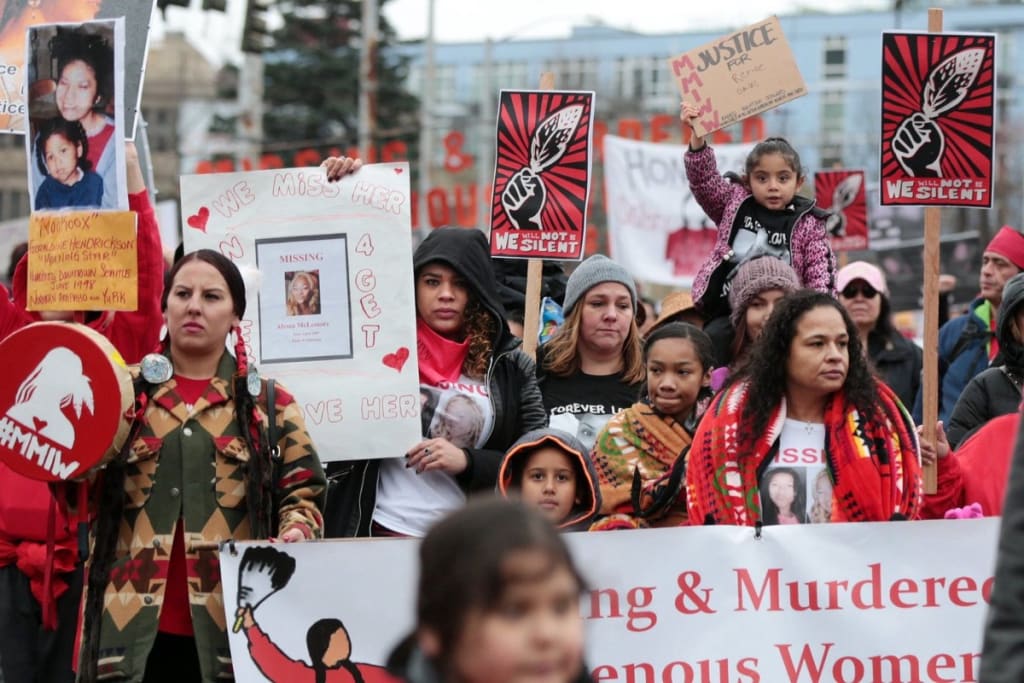
Alyssa belongs to the Aleut tribe. Although a small percentage of the population, Native Americans have a disproportionally high number of murders and missing persons cases. This is especially true for Indigenous women and girls.
As Native Hope explains,
Not only is the murder rate ten times higher than the national average for women living on reservations but murder is the third leading cause of death for Native women.
This is startling as Native people only make up 2% of the US overall population.
Furthermore, a shocking amount of Indigenous women and girls are not included in the national missing persons database,
“The National Crime Information Center reports that, in 2016, there were 5,712 reports of missing American Indian and Alaska Native women and girls, though the US Department of Justice’s federal missing person database, NamUs, only logged 116 cases.”
Red dresses memorialize missing and murdered Indigenous women. This dress hung in Kent includes Alyssa’s name:
Tina spoke to PRI’s The World about the toll Alyssa’s disappearance has had on the family and how it will continue to affect future generations,
“We don’t know what happened so we can’t begin to heal. Life goes on, but like I said, we’re just putting a Band-Aid over something that is really a stitcher’s job.
You know, until we find Alyssa and bring her home, it’s going to cause generational trauma.”
Alyssa’s family is desperate to find her. Tina stated in an interview for The Seattle Times,
“Dead or alive, my family needs to bring her home”.
About the Creator
Cat Leigh
Visit my publication on Medium for more true crime cases.
❤️ You can support my work on Ko-fi.
El Infernito: Inside the Notorious Prison Where Crocodiles, Chickens, and Refrigerators Were Found in Inmates’ Cells
Deep inside **Guatemala**, a prison once nicknamed **“El Infernito”**—Spanish for *“The Little Hell”*—became a global symbol of how prisons can spiral out of control. Officially known as **Pavón Prison**, the facility gained its terrifying reputation after authorities discovered that inmates were not only running the prison but also living with luxuries—and even wild animals—inside their cells.
By Irshad Abbasi 6 days ago in Criminal




Comments
There are no comments for this story
Be the first to respond and start the conversation.