
Why Ordinary People Kill
The Milgram Shock Experiment

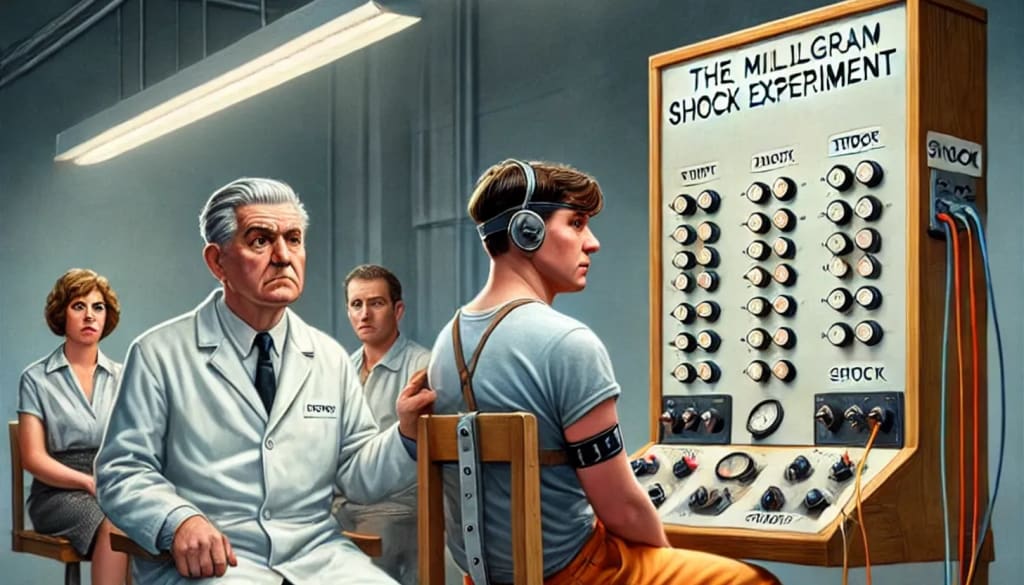
Several weeks ago, we looked at mob mentality. After this article, I came across the Milgram Shock Experiment, which further shows how ordinary people can kill.
The experiment's background starts with a psychologist named Stanley Milgram at Yale University. He carried out what has become known as one of the most famous studies in obedience.
Looking at his results shows us not only why people kill but also how cults attract members who blindly follow their leader.
Milgram also stated that his experiment justified the acts of genocide caused during World War II. Many of the officers were put on trial, and Nuremberg cited obedience as their defence. They were following orders.
Many of us will state that we would never do this. History has proved that only a few of us are telling the truth. When faced with authority demands, many of us will fall into line.
Our Obedience to Authority
Milgram conducted a simple experiment that showed how many people obediently follow authority without regard to their personal conscience.
The experiments started in July 1961, one year after the trial of Adolf Eichmann in Jerusalem. Milgram devised the experiment to answer the question:
Could it be that Eichmann and his million accomplices in the Holocaust were just following orders? Could we call them all accomplices? - Milgram, 1974
The study was designed to measure how far participants would go in obeying an authority figure who instructed them to perform acts that conflicted with their conscience.
Participants were asked to give an electric shock to those taking part. An authority figure instructed them to take this shock to a level that was considered dangerous to humans. When the members got an answer wrong, a shock was administered, and this shock was increased on the instructions of the person carrying out the experiment, the authority figure.
In truth, the shock was never increased; however, the participants did not know this.
Experiment Group
The group consisted of 40 male participants between the ages of twenty and fifty. They were recruited through newspaper advertisements. All participants believed they were participating in an experiment studying memory and learning.
The participants came from New Haven and the surrounding communities. They held a wide range of occupations, including teachers, engineers and labourers. The group's education level was also diverse, ranging from professional degrees to high school diplomas.
The roles were assigned through a rigged draw. Every slip assigned the participant as the shock giver. Those receiving the shocks were part of the experiment.
The actor was taken into a room and strapped into an electric chair apparatus. The participant and the authority figure entered a separate room with the stock generator.
The ‘Learning Task’
The participant was given a preliminary series of 10 words to read to the fake student, with seven predetermined wrong answers, reaching 105 volts.
After the practice round, a second list was given, and the participant was told to repeat the procedure until all word pairs were learned correctly.
The participant read a second list of word pairs to the student. The participant then read one word from each pair and was provided with four options for matching words.
The student had to indicate which word had been paired initially with the first word by pressing one of four switches.
Each incorrect answer resulted in a shock, while a correct answer moved the process to the next word. Milgram watched through a one-way mirror.
When the 300v shock is administered, the learner pounds on the room’s wall, which the participant hears.
The learner stops responding to the questions after receiving the 300v shock.
Authority figure
Another actor provided by Milgram was the authority figure, dressed in a lab coat and with a stern manner. This experimenter instructed the participant to administer the electric shock, gradually increasing the level with each mistake.
He also told the shock givers that if a learner did not answer within ten seconds, they should count this as a wrong answer.
At any point when the participant refused to administer the shock, the experimenter would verbally prod. The tone was firm but not impolite. The prods were repeated if the participant showed reluctance to continue.
- Prod 1 - Please continue / please go on.
- Prod 2 - The experiment requires you to continue.
- Prod 3 - It is absolutely essential that you continue.
- Prod 4 - You have no other choice but to continue.
If the participant held firm, the next participant would be placed in the room.
Results
So the question is, would you have kept pressing the button? Two-thirds of the participants continued to a level of 450 volts, and all participants went as high as 300 volts. Milgram carried out this experiment eighteen times, and each time, it yielded the same results.
Participants showed tension, including sweating and biting their lips, but did not stop the experiment. Some were even heard hysterically laughing.
Milgram proved that people appeared to be more obedient to authority figures than anyone thought possible. Ordinary individuals followed orders to a level where they knew they were causing harm to innocent human beings. They were willing to harm others, believing that someone else had taken away their guilt.
This is why ordinary people kill.
Read more of my articles on Crime & History
About the Creator
Sam H Arnold
Fiction and parenting writer exploring the dynamics of family life, supporting children with additional needs. I also delve into the darker narratives that shape our world, specialising in history and crime.
Keep reading
More stories from Sam H Arnold and writers in Criminal and other communities.
Push To Prevent Catapults Being Bought By Children
MP’s have been warned to put new legislation in place that will help to close a loophole in the law which allows people including children to legally buy weapons which is capable of killing wildlife. The alert was issued during a briefing in parliament which set out growing evidence that catapults were being misused against animals and to damage other people’s private property. The Naturewatch Foundation who hosted the session expanded on their message that at the moment there is a completely unregulated system where people of any age can buy weapons and there are no meaningful controls on sale or power.
By Ashish Prabhu4 days ago in Criminal


Comments
There are no comments for this story
Be the first to respond and start the conversation.