
Who Put Bella in the Wych Elm?
Still unsolved after almost eight decades

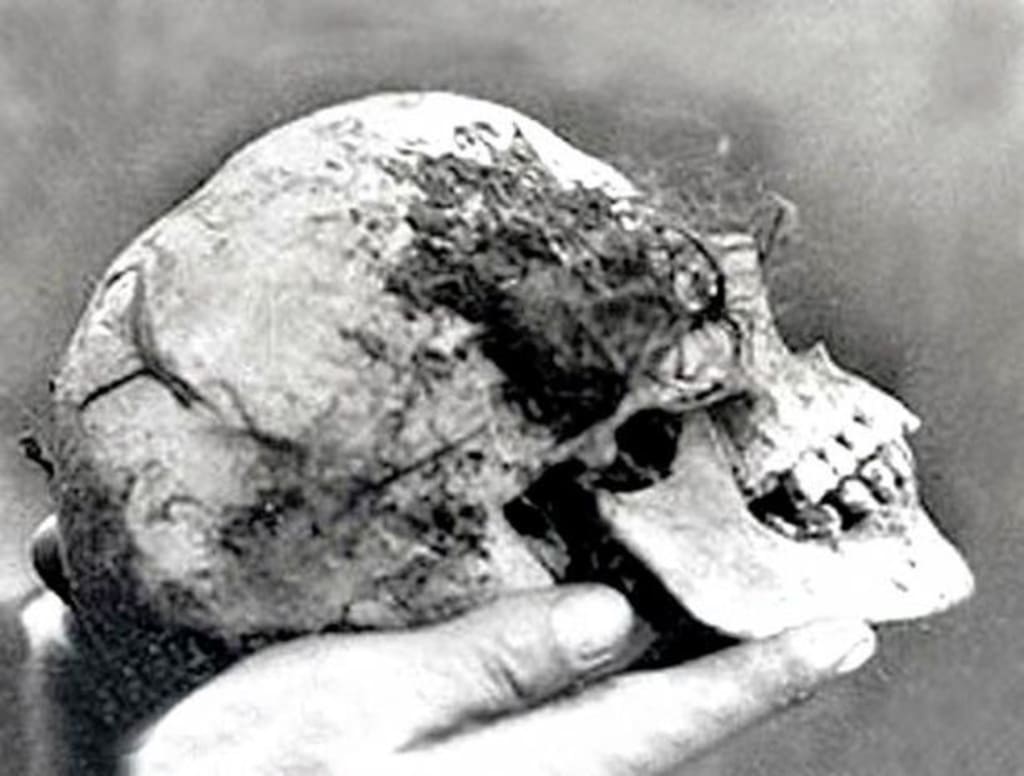
Over four years before America became engrossed in the mystery of The Black Dahlia, England found fascination with the bizarre case of “Bella” — the skeletal remains of a woman discovered by local boys named Robert Hart, Thomas Willetts, Bob Farmer, and Fred Payne while out on a hunt for bird eggs.
On April 18, 1943, while trespassing in Hagley Wood, part of the Hagley Estate owned by Lord Cobham near Wychbury Hill, a young boy named Bob Farmer attempted to climb a Wych Elm in order to hunt for birds’ nests. It was during his ascent that he noticed a skull visible in the tree below. Closer investigation revealed the skull to have what remained of hair and teeth still present. Realizing that it was a human skull, the four boys put it back and said nothing, concerned about getting into trouble for being where they shouldn’t have been in the first place.
It was Willetts, the youngest of the four boys, who felt uneasy and decided it was best to tell his parents about the discovery after returning home. The police were contacted and retrieved the skull, discovering further remains in the process. Most of the skeleton, a shoe, a wedding band, and pieces of what appeared to be clothing were retrieved from the tree.
Further investigation led to the recovery of portions of a missing hand belonging to the skeleton in the surrounding field. These items were sent for a further forensic evaluation by Professor James Webster, who determined the skeleton was that of a female, deceased for about eighteen months. He established a time of death sometime before October 1941.
Dr. Webster determined, based on a remnant of taffeta found stuck in the deceased's mouth, that she had likely been suffocated to death. Further, he and the police surmised that she had been placed in the tree very soon after her death, as the size of the opening would not have allowed for the placement found if rigor mortis had already taken hold.
Despite a detailing of the deteriorated clothing and personal items found with the skeleton, there were no leads as to the identity of the woman. It was determined only that she was between 35–40 years old and had given birth to at least one child. The woman’s teeth were very distinct in their configuration, despite having a few missing. Numerous dentists were contacted, but none were able to match the dental pattern from the skull to one of their patients.
In 1944, graffiti appeared on a wall of Upper Dean Street, Birmingham with the solemn message, “Who Put Bella Down the Wych Elm — Hagley Wood.” In the years following, the message has been repeated in various places, most notably, on the Hagley Obelisk near the Wych Elm location — though the messages are usually the slightly modified question, “Who Put Bella in the Wych Elm?”
It is a question that remains today.
In 2014, Steve Punt put forth the suggestion of two possible victims. One is a Birmingham prostitute reported missing in 1944 by a fellow sex worker. Her name was Bella and she was known to work in the Hagley Road area. This is an interesting theory, as it suggests that the writer of the original graffiti somehow knew the deceased woman’s name, either from first-hand familiarity or as related to him or her by the killer.
Punt’s other theory regards a statement made by Una Mossop in 1953. Mossop claims her ex-husband, Jack Mossop, confessed to his family that he and a Dutchman called Van Ralt had put the woman in the tree. He claims that they were out drinking with the victim, she became intoxicated and they put her in the tree on a lark, thinking she would wake up frightened and learn a lesson about poor life choices.
Mr. Mossop was later confined to the Stafford Mental Hospital due to claims of horrifying dreams about a woman staring at him, dead eyed, from a tree. Since he died prior to the discovery of the body in the tree, he was never questioned about this. The theory his wife proposed isn’t widely accepted, as his former wife waited more than ten years after his death to report it.
A separate theory has been put forth from a declassified MI5 file regarding Josef Jakobs. Jakobs was the last man to be put to death in the Tower of London. After parachuting into Cambridgeshire in 1941, this Abwehr agent-in-training was arrested by the Home Guard. The photo of a German actress and cabaret singer named Clara Bauerle, believed to be his lover, was retrieved from his personal items. Jakobs claimed that she might have been sent over to England after him, but there is no evidence of this.
Furthermore, witnesses claim that Bauerle was very tall, at least six feet, while “Bella” was a mere five feet tall. The theory was further debunked in 2016, when it was determined that Clara Bauerle had died in Berlin in December 1942.
Margaret Murray, an anthropologist and archaeologist from University College in London, suggested in 1945 that witchcraft might have played a part in the murder. She indicated that the severed hand was a practice consistent with a ritual known as the Hand of Glory and might have happened after “Bella” was killed in an occult ritual, perhaps at the hand of gypsies. The theory was widely related by journalists and investigators to another murder in nearby Lower Quinton, where Charles Walton had been killed in a manner consistent with ritualistic killings, skewered by a pitchfork driven into the ground.
Finally, in 1953, it was theorized that “Bella” was a Dutch immigrant named Clarabella Dronkers, murdered by a German spy-ring for knowing more than she should, but there is no evidence to support this theory either.
Any further clues or investigation into the identity or circumstances of the murder are unlikely to be found, due to the police having lost the remains, documentation and all other evidence collected during their investigation. However, Caroline Wilkinson, the expert famed for recreating Richard III’s face after the discovery of his remains, has now at least given us a face to put with our mystery woman.
Using photos taken at the time of the investigation, she has recreated the face of the woman in the tree. Though most people who may have had direct contact with the woman are likely deceased now, it is the hope that perhaps their families might locate photos in family albums and such that will create more leads in the seventy-eight year old case.
About the Creator
A.W. Naves
Writer. Author. Alabamian.
Keep reading
More stories from A.W. Naves and writers in Criminal and other communities.
Judith Barsi — Child Actress’s Life Cut Short by a Double Homicide-Suicide
Judith Eva Barsi and her mother, Maria, were killed by a single gunshot wound to the head in late July 1988. Judith’s father, József Barsi, then turned the gun on himself and committed suicide. It was devastating news to all who knew and loved the ten-year-old child actress and her family.
By A.W. Naves4 years ago in Criminal
Push To Prevent Catapults Being Bought By Children
MP’s have been warned to put new legislation in place that will help to close a loophole in the law which allows people including children to legally buy weapons which is capable of killing wildlife. The alert was issued during a briefing in parliament which set out growing evidence that catapults were being misused against animals and to damage other people’s private property. The Naturewatch Foundation who hosted the session expanded on their message that at the moment there is a completely unregulated system where people of any age can buy weapons and there are no meaningful controls on sale or power.
By Ashish Prabhu6 days ago in Criminal
A Transparent Look at Vocal Challenges and Top Stories
Almost three years ago, we shared a resource article that served as a place for people to suggest new challenge prompts. We thought it would be a good idea to refresh that thread, and take the opportunity to answer a few common questions about top stories, how challenges are judged and how submissions are reviewed.
By Vocal Curation Team4 days ago in Resources


Comments
There are no comments for this story
Be the first to respond and start the conversation.