
What Gaza Saw When the World Looked Away
This is not just about war — this is about forgotten humanity

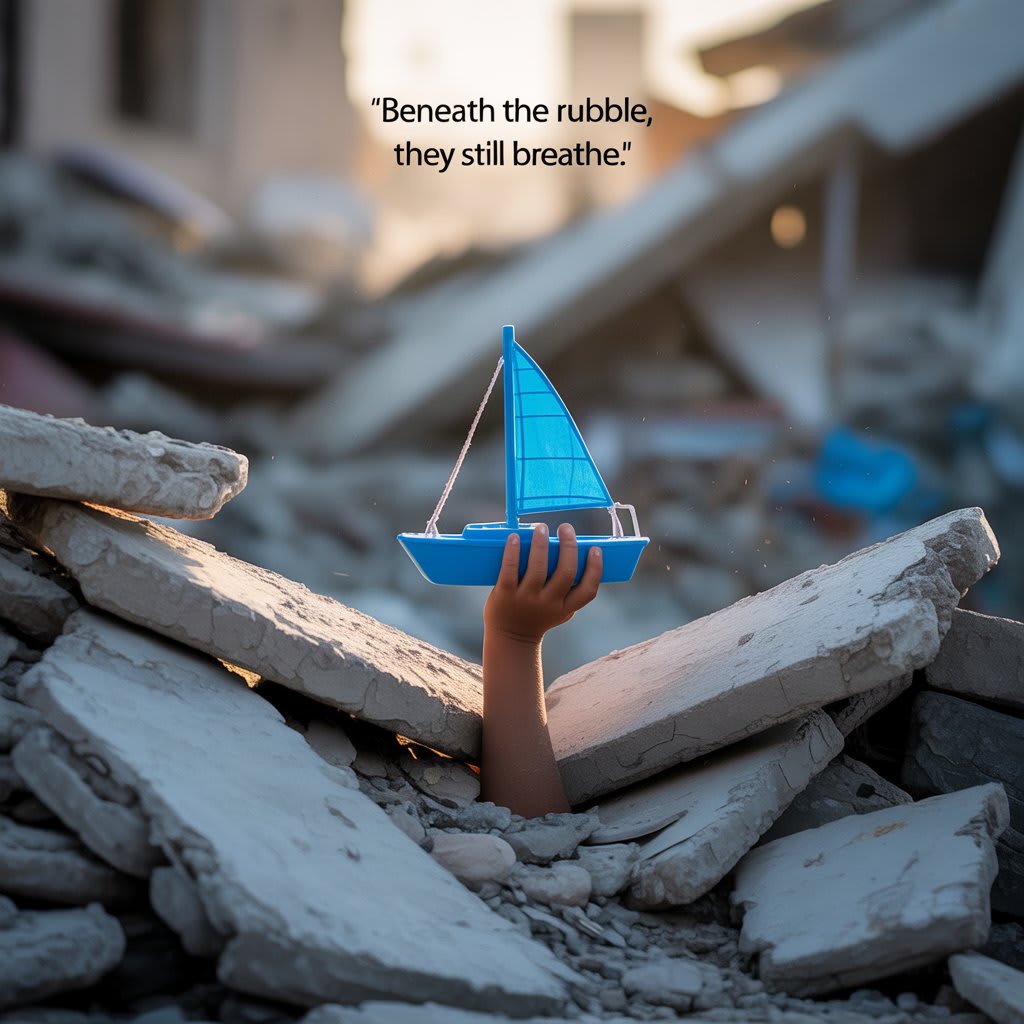
"They told me war is strategy,
But all I saw were children buried beneath strategy.
They called it defense,
But the sky fell on homes, not rockets."
— Anonymous, Gaza resident
It began like many mornings in Gaza do—with the sound of drones circling overhead. You hear it so often, it becomes part of the background. Like traffic in a city, or the ticking of a clock. But this time, it was different.
The humming grew louder.
Then, silence.
Then, the blast.
The earth shook. Windows shattered. The sky turned red, then black.
Another airstrike. Another home gone. Another family broken.
Israel released a statement: “We targeted a terrorist hideout.”
But the bodies pulled from the rubble told another story.
There were no weapons. No tunnels. No fighters.
Just a mother, a father, three children, and a baby whose name the world will never know.
Living Under Siege
For over 17 years, Gaza has lived under a blockade—land, sea, and air. A tiny strip of land fenced in from every direction. Two million people packed into one of the most densely populated places on earth, with nowhere to run and nowhere to hide.
Electricity cuts are daily. Clean water is a luxury. Medical supplies are limited.
And yet, the people go on.
Children play in alleyways. Young couples get married under candlelight. Teachers write lessons on blackboards with broken chalk. There’s resilience here—raw, stubborn, and beautiful.
But when the bombs fall, even resilience has its limits.
The Language of Justification
Israel says it is “defending itself.” That’s the phrase they always use.
But self-defense doesn’t look like this.
It doesn’t look like flattening apartment buildings with families still inside.
It doesn’t look like bombing hospitals and claiming they were being used “as cover.”
It doesn’t look like targeting journalists, medics, and children—and then blaming them for being in the wrong place.
The reality is harsh, but simple:
Gaza is being punished not for what it does, but for what it is—Palestinian.
Who Tells the Story?
The tragedy is not just in the bombs—it’s in the silence that follows.
The global media shows destruction, but rarely context.
They show smoke, but not the years of suffering that came before it.
They call it a “conflict” as if both sides are equal.
But this is not a fight between equals.
This is a military superpower backed by billions in weapons and support—
Versus a besieged population without an army, without freedom of movement, without a voice in most rooms that decide their fate.
And when Palestinians speak, they’re told they’re being “too emotional.”
As if mourning your dead makes you untrustworthy.
As if crying for your children is a political act.
Daily Life in a War Zone
Imagine being a parent in Gaza.
Your child asks, “Will we wake up tomorrow?” And you don’t know what to say.
You try to hide your fear, smile through the sirens, and act like everything is okay—because you don’t have the luxury of falling apart.
A friend in Gaza once said,
"We don’t sleep. We wait. For morning. For a ceasefire. For someone to remember we exist."
Another wrote,
"When the world posts ‘Never Again’ every Holocaust Remembrance Day, I wonder—did they mean us too?"
The Unseen Grief
You won’t hear their names on the news.
The grandmother who died holding a Quran in her lap.
The young boy who lost both his legs and still tried to smile for the camera.
The doctor who refused to leave his post, even when the hospital lost power and missiles fell nearby.
Gaza grieves in silence. There are no memorials. No candlelight vigils in foreign capitals. No UN resolutions that ever really stick.
Just rubble, silence, and the hope that maybe the next airstrike won’t be theirs.
Where Is Accountability?
The world has the power to say “enough”—but it rarely does.
Some governments issue statements of “concern.”
Some citizens protest in the streets for a few days.
Then everything fades—until the next round.
And each time, Israel insists: “We are the victims.”
But victims don’t drop white phosphorus on refugee camps.
Victims don’t bomb UN schools and then call it “collateral damage.”
Victims don’t cut off electricity to hospitals and justify it in press conferences.
At what point does the world admit that what’s happening isn’t self-defense—it’s collective punishment?
Hope Still Lives Here
And yet—despite it all—Gaza still breathes.
Children still laugh, even if only for a moment.
Artists still paint murals on broken walls.
Poets still write verses in the dark.
And every time a baby is born, a mother whispers, “Maybe you’ll live to see freedom.”
They have nothing—and yet they dream.
That’s power. That’s resistance.
Final Words: This Story Isn’t Over
This isn’t just about politics or borders.
It’s about humanity. Dignity. Memory.
Because when you erase a people’s story, you kill them twice.
So remember Gaza. Not just in headlines. Not just during war.
But always.
And when someone says, “Both sides…”
Remind them that only one side lives behind walls.
Only one side controls the skies.
And only one side buries its children by the dozens in the name of someone else’s “security.”
Gaza is not a battlefield. It is a community under siege.
And it deserves more than silence.
One follow is all it takes — miss it now, and you may never find me again.
About the Creator
Zohaib Khan
Words that sing. Ideas that linger.
Exploring life’s highs and heartbreaks—one story at a time.
Your new favorite corner of the internet starts here.
One follow is all it takes — miss it now, and you may never find me again.
Keep reading
More stories from Zohaib Khan and writers in Criminal and other communities.
Are You in Control—or Is Your Tech Controlling You?
It’s 7:00 AM. Your alarm goes off gently. Without lifting a finger, your coffee machine starts brewing. The blinds slide open just enough to let the sunlight ease in. As you walk into the bathroom, your mirror flashes the day’s weather, traffic updates, and your morning meetings.
By Zohaib Khan7 months ago in Education
Living in the Blast Zone: The "House of Skulls" and the Collapse of Ephrata’s Luxury Dream
The Morning the Property Value Died On January 6, 2026, the residents of Washington Avenue didn't just wake up to a crime scene; they woke up in a financial blast zone. While the media trucks have packed up and the hazmat suits are gone, the neighbors are left with a permanent scar. In real estate law, this is called "Stigmatized Property."
By Sunshine Firecrackera day ago in Criminal



Comments
There are no comments for this story
Be the first to respond and start the conversation.