


As a former inmate of the Ohio Department of Rehabilitation and Corrections, I am not only appalled at the rate of incarceration in Ohio but throughout the United States. The information I will share here is available to every citizen, but most are oblivious to its effect on our society or just do not care. When I arrived at the Ohio State Penitentiary in 1984 they were preparing to close the prison for good and at that time there were only 13 prisons in Ohio. During my nine-year and ten-month incarceration, that number grew to 22 and today it is at 27 prisons throughout the state. The chart below from the Prison Policy Initiative shows the steady rise in Ohio's prison incarceration rate.

When I received my number in 1984 the prison population in Ohio was between 25,000 and 30,000, and there were many studies and committees formed to deal with the problem of overcrowding. The government in Ohio chose to address the problem with a billion-dollar prison expansion project which still failed to eliminate the problem of overcrowding. Now there are those who will argue that overcrowding is a result of an increase in crime, however, I will point out that it is the result of an unjust criminal justice system that systematically sentences minorities to longer sentences than their white counterparts. Often for similar crimes. Therefore, if we are to prevent overcrowding in our prisons we must first fix the broken and unjust criminal justice system.
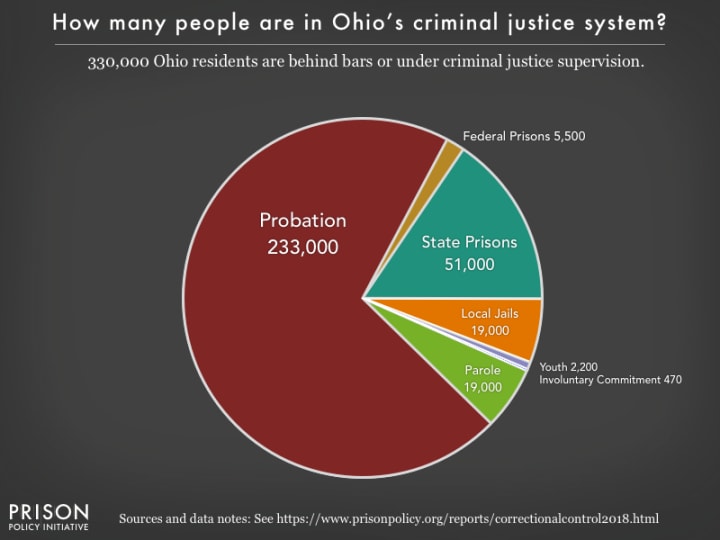
According to the Prison Policy Initiative, there are currently 51,000 people in Ohio prisons; but when you add those in jails, immigration detention, and juvenile facilities that number increases to 79,000. Ohio has an incarceration rate of 679 per 100,000 people. Countries like Cuba and Russia, which we condemn for their incarceration practices; do not have such a high incarceration rate. This increase in the prison population was not due to an increase in crime or recidivism it was by design with the passage of SB199 which enacted mandatory sentencing laws that meant a single prison bed might be occupied for ten years or more by the same inmate. The Prison Policy Initiative indicates the number of people passing through city and county jails may be greater than those reported since annually at least 150,000 people are booked into and released from Ohio jails. According to the chart below, there was a total of 329,700 people under the supervision of the Ohio Department of Rehabilitation and Corrections in 2018.
Although I seem to be singling out Ohio; according to the United States Justice Department data California, Georgia, Pennsylvania, and Texas have higher prison populations. The one thing that each of these states have in common is mandatory minimum sentencing and three strikes you are out laws. High crime rates are present as well, but most notably are the racial disparities. By 2010 there were five times as many African-Americans under the supervision of the Ohio Department of Rehabilitation than there were White Americans and this was greater than the national average.
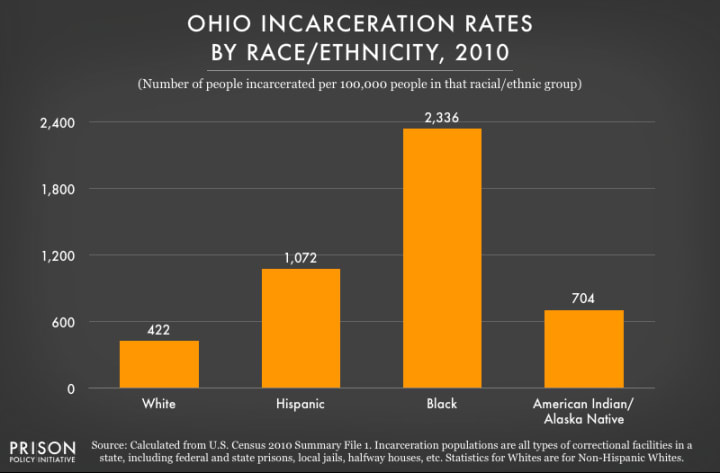
These high incarceration rates and the racial disparities have contributed to the breakdown of the African-American family. Although African-Americans make up only six percent of the general population they are more than fifty percent of the prison population. Studies have shown that many African-American fathers are in prison by their child's fifth birthday. This contributes to many behavioral problems and often leads the child to repeat the cycle with juvenile delinquency and then prison. Therefore, I believe we must ask ourselves: "Is this by design or just a coincidence?" "Is our criminal justice system really about justice or just us?" Meaning white America has created these disparities of injustice as a means to continue the enslavement of African-Americans and other minorities because these incarcerations not only affect the family unit; but also affect society as a whole by impacting where an individual can live and work, or if they can vote.
The map below displays the United States incarceration rate per 100,000 inhabitants and you can see those states which have the highest rates. Of course, if you are concerned enough to check you will find that the majority of those incarcerated are minorities. When you compare this data with high school dropout, college enrollment, voting, and other societal factors in these states you can see the glaring racial disparities.

Although these facts about the United States incarceration rate are uncommon knowledge it is common enough in every community that we should be concerned enough to do something about it. When your state legislator runs on a platform of tough on crime you need to ask yourself, why this platform; because sometimes your voting practices can be an indirect contribution to the problem.
If what you have read thus far does not concern you or motivate you to action because of Nimbyism (It does not happen to you, or Not in My Back Yard so to speak), then examine the following chart; because we outdistance other developed countries with our incarceration rates and yet we claim to be the best country to live in. So it is happening in your backyard. I hope you have been informed and challenged.

Perry AR, Bright M. African American fathers and incarceration: paternal involvement and child outcomes. Soc Work Public Health. 2012;27(1-2):187-203. doi: 10.1080/19371918.2011.629856. PMID: 22239385.
About the Creator
Rodney L. Sutton, Sr.
Preacher, teacher, formerly homeless college educated professional who advocates for the homeless, juvenile delinquents, ex-felons, youth, single mothers, and all other underserved populations. Hobbies include cooking, reading, traveling
Keep reading
More stories from Rodney L. Sutton, Sr. and writers in Criminal and other communities.
Celebrate Family
I was reflecting today as I often do, and while doing so I realized it has been 25 years since my grandmother, Marcella Rush, (Da'Ma, as we affectionally called her) went home to be with the Lord. Upon this realization also came the awareness of how we often take life and all it holds for granted. Almost 30 years ago when I was shot and the doctors performed a surgery that miraculously saved my life I was newly married and awaiting the birth of my first child. Preparing to celebrate a new family. When I contracted the coronavirus I had recently returned from Kentucky and Ohio where I celebrated Thanksgiving with family. So, as one who is currently recovering from the effects of the coronavirus, I can tell you that death is standing right outside the door and can take you unawares. Making the celebration of family that much more important.
By Rodney L. Sutton, Sr.5 years ago in Families
The Charlie Kirk Phenomenon
September 10, 2025, will be etched into the recent history of the United States not as a mere day of campaigning or academic debate, but as the moment when political polarization reached a point of no return. Charlie Kirk, one of the most influential and simultaneously controversial figures of modern conservatism, was the victim of a brutal assassination during a public event at Utah Valley University. This event did not just mark the tragic end of a 31-year-old thought leader; it triggered a wave of reactions that exposed deep social tensions, wild conspiracy theories, and a fierce debate about the limits of hatred in the digital age.
By Teodor Monescu7 days ago in Criminal
Crime Chronicles: Darya Nikolaevna Saltykova
A little while ago, we covered the story of Delphine LaLaurie (1787 - 1849), the New Orleans socialite who tortured and murdered her slaves. We also covered Erzsebet Bathory (1560 - 1614), who did the same thing in Hungary around 200 years before that; I didn't think I'd find another one, but I did - in Russia.
By Greg Seebregtsabout 3 hours ago in Criminal




Comments
There are no comments for this story
Be the first to respond and start the conversation.