
Ukraine's Serial Killer Terror
Anatoly Onoprienko, known as "The Terminator," terrorized Ukraine in the 1980s and 1990s with a brutal killing spree that left 52 victims dead.

Anatoly Onoprienko, infamously known as The Terminator was a Ukrainian serial killer who terrorized the country during the 1980s and 1990s. His gruesome spree of murders, characterized by extreme violence and a lack of discernible pattern, shocked the nation and left investigators baffled. This summary delves into the life crimes, and capture of Anatoly Onoprienko, shedding light on his chilling legacy.Born on July 25, 1959, in the small village of Zhytomyr Oblast, Ukraine Anatoly Onoprienko's early life seemed unremarkable. Raised in a family of limited means, he displayed an affinity for animals and nature. However, beneath this facade lurked a disturbed individual who would eventually become one of Ukraine's most notorious criminals.
Onoprienko's killing spree began in 1989 and continued until his capture in 1996. His modus operandi was marked by extreme brutality and a lack of a discernible pattern, making it difficult for law enforcement to connect the crimes. He targeted families, often killing multiple members at once, and showed no remorse for his heinous acts.The Ukrainian public was gripped by fear as news of the murders spread. Panic escalated leading to rumors of supernatural explanations for the inexplicable violence. The lack of a clear motive or pattern of victim selection baffled both law enforcement and psychological profilers. This aura of mystery only intensified the public's dread.
Anatoly Onoprienko's capture in 1996 marked a turning point in the investigation. His downfall came when he was caught committing a burglary, and his fingerprints were matched to those found at multiple crime scenes. During his interrogation he confessed to 52 murders, although the actual number might be even higher. His testimony revealed chilling details of his crimes, confirming that he had acted alone.During the trial, Onoprienko's defense claimed that he had committed the murders due to a supposed wolf gene which they argued compelled him to kill. This attempt at an insanity defense was met with skepticism, and Onoprienko was ultimately found guilty in 2002. He was sentenced to life in prison for his reign of terror.
The case of Anatoly Onoprienko shed light on several aspects of criminal psychology. His ability to blend in with society, appearing unassuming and even compassionate, highlighted the unsettling truth that monsters can lurk among us unnoticed. The absence of a clear motive challenged the notion that serial killers must have discernible reasons for their actions, showcasing the complexity of human psychology.Onoprienko's case also prompted discussions about the effectiveness of the justice system. Some criticized the lengthy trial process and the lack of closure for the victims' families, while others argued that justice had been served through his imprisonment. The Ukrainian legal system, still relatively new at the time, faced challenges in handling such a high-profile and complex case.
The story of Anatoly Onoprienko has left an indelible mark on Ukraine's history and criminal justice system. His moniker, The Terminator reflects the terror he instilled in the hearts of Ukrainians during his reign of violence. While his motives remain enigmatic and his crimes unforgivable, the case prompted discussions about the importance of understanding and preventing such acts of brutality in the future.In conclusion, Anatoly Onoprienko's life and crimes paint a disturbing portrait of a serial killer who haunted Ukraine for years. His gruesome spree of murders, marked by extreme violence and a lack of discernible motive, shocked the nation and left investigators perplexed. His capture and subsequent trial shed light on the complexities of criminal psychology and the challenges of the justice system. "The Terminator" will forever be remembered as a chilling reminder of the darkness that can exist within seemingly ordinary individuals, and the profound impact of his actions continues to reverberate in the collective memory of Ukraine.
About the Creator
Keep reading
More stories from Kure Garba and writers in Criminal and other communities.
Serial Killer: Metal Fang
Nikolai Dzhumagaliev, also known as Metal Fang was a notorious Soviet serial killer who terrorized Kazakhstan during the late 20th century. Born on April 8, 1952, Dzhumagaliev's childhood was marked by a troubled family background and early exposure to violence.These factors likely contributed to his later criminal behavior. His reign of terror spanned from 1980 to 1983, during which he committed a series of heinous crimes that shocked the nation.Dzhumagaliev's moniker, Metal Fang was derived from his unique and horrifying modus operandi. He would often bite his victims, leaving distinct bite marks that resembled metal edges. This gruesome signature earned him significant media attention and added to the sense of fear that gripped the region. His victims were predominantly women and children, adding to the public's outrage and fear.
By Kure Garba3 years ago in Criminal
The last Alibi
M Mehran In the rain-slick streets of Frankfurt, crime rarely slept — it adapted. Sirens echoed through financial districts, neon lights flickered across wet pavement, and somewhere in the darkness, someone was always watching. But Inspector Daniel Krämer had never seen a case like this. Because this killer never fled. He never hid. And according to every witness… he was never there. The Perfect Crime Scene At 10:42 p.m., emergency calls flooded dispatch from a luxury apartment overlooking the River Main. A prominent investment lawyer, Stefan Krüger, was found dead in his study — a single precise stab wound to the chest. No signs of struggle. No forced entry. No missing valuables. Only a glass of red wine, two chairs facing each other, and soft jazz still playing in the background. Krämer stood in the doorway, scanning the room. “He was expecting someone,” he said. Detective Anika Weiss nodded. “Neighbor saw a guest arrive at 9:58 p.m.” “Did they see him leave?” She shook her head. “No one left.” The Man With the Unbreakable Alibi Security cameras in the lobby clearly captured a visitor entering the building: a well-dressed man in a charcoal coat. Facial recognition identified him immediately. Martin Adler. Business partner. Friend. And now prime suspect. But Adler’s alibi was ironclad. At the estimated time of death, he was seated in a live televised panel discussion across town. The broadcast had no cuts. No delays. Hundreds of viewers watched him speak in real time. Krämer replayed the footage three times. Adler never left the stage. Yet the cameras did not lie. He had entered the building. And he had never exited. A Second Body, Same Ghost Two nights later, another victim surfaced — a private art broker found dead in her office after hours. Same wound. Same precision. Same untouched valuables. Same witness report: a man in a charcoal coat entering. Security footage confirmed it. Martin Adler again. But Adler was speaking at a charity gala across the city, photographed repeatedly by journalists and guests. Two murders. One man. Impossible timing. Krämer rubbed his temples. “Either Adler can teleport… or someone wants us to believe he can.” The Illusion of Presence Forensic teams uncovered a strange detail at both scenes: microscopic adhesive residue near entry doors and elevator panels. Transparent. Industrial grade. And unusual. Meanwhile, a digital analyst noticed something peculiar in the lobby footage. Adler’s reflection did not appear in the glass directory panel as he walked past. Anika froze the frame. “That’s not him,” she whispered. Krämer leaned closer. It looked like Adler. Moved like Adler. But it wasn’t Adler. It was a projection. The Technology Behind the Ghost Investigators uncovered a compact holographic projection system hidden inside a maintenance ceiling panel near the lobby camera. Using synchronized light refraction and motion mapping, the device projected a lifelike moving image — visible from specific angles. To the security camera, the illusion appeared real. To passing witnesses, it was convincing enough. But from the wrong angle, the figure simply vanished. Someone had manufactured a digital ghost. And they wanted police chasing the wrong man. Following the Motive Both victims shared a quiet connection: they were former legal advisors in a corporate fraud case buried years earlier. The case collapsed after key evidence mysteriously disappeared. The primary beneficiary? A development conglomerate that had since become one of Europe’s fastest-growing real estate empires. Krämer studied the archived case file. One junior accountant had attempted to testify before vanishing from public records. Name: Lukas Brenner. Declared missing. Presumed relocated. But financial activity showed he never left the country. The Third Target Surveillance traced Brenner to an abandoned industrial building slated for demolition. Inside, investigators found a workshop filled with projection equipment, acoustic dampening foam, and architectural blueprints. Pinned to a wall were photographs of individuals tied to the old fraud case. Three faces were crossed out. One remained. Helena Vogler — CEO of the conglomerate. Scheduled to attend a press conference the next morning. Krämer grabbed his coat. “He’s finishing what he started.” Truth Revealed in the Light The press hall buzzed with reporters and flashing cameras as Vogler approached the podium. At exactly 11:03 a.m., the lights flickered. A man in a charcoal coat appeared near the rear exit. Gasps rippled through the room. Security rushed toward the figure — only for it to flicker and dissolve into light. Panic erupted. And in the confusion, a real figure emerged beside the stage. Lukas Brenner. Calm. Pale. Determined. “I’m not here to kill,” he said, raising his hands. Security froze. Cameras rolled. “They buried evidence. They buried the truth. They buried lives,” he continued. “I made ghosts so the world would finally look where it refused to see.” Krämer stepped forward. “You committed murder.” Brenner’s eyes darkened. “They destroyed thousands of lives and walked free.” Silence filled the hall. Not the artificial silence of hidden crimes. But the heavy silence of truth exposed. After the Verdict Brenner was arrested without resistance. His projections, illusions, and meticulous planning stunned investigators across Europe. The reopened fraud case uncovered billions in corruption. Executives resigned. Charges were filed. And the public learned how easily reality could be manipulated — not just through technology, but through power. Weeks later, Krämer stood by the river, watching reflections ripple beneath gray skies. Anika joined him. “Do you think he regrets it?” Krämer considered the question. “He made the world see ghosts,” he said. “But what haunted him was real.” The city moved around them — loud, restless, alive. And somewhere within its noise lived truth, deception, justice, and the fragile line between them. Because the most dangerous criminals are not always the ones who hide. Sometimes, they are the ones everyone can see — and no one chooses to believe.
By Muhammad Mehran2 days ago in Criminal
He Confessed to Murder in My DMs: The Dark Side of Going Viral
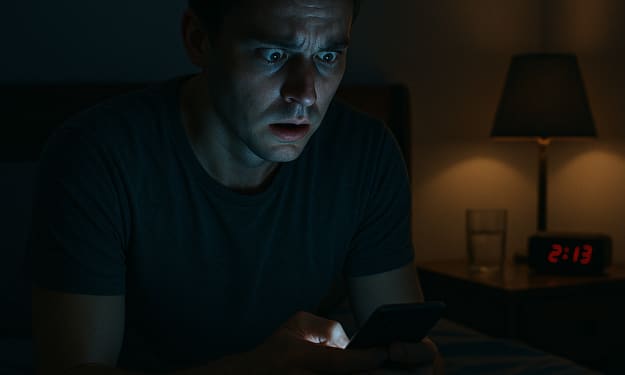
When your most-liked story becomes someone else's confession booth The message came in at 2:13 a.m. I saw the notification glow on my nightstand, that soft blue light that usually means spam, or a heart emoji, or someone asking, “Did this really happen?”
By abualyaanart5 days ago in Criminal
Review of 'Man on the Run'
My wife and I saw Man on the Run, a nearly 2-hour documentary on Amazon Prime, about Wings, Paul McCartney's group that flew around the world from shortly after The Beatles broke up in early 1970 to shortly after John Lennon was murdered at the end of 1980, making a Beatles reunion forever impossible.
By Paul Levinsona day ago in Beat



Comments
There are no comments for this story
Be the first to respond and start the conversation.