
The Twisted Story of A Grown Man’s Impersonation Of A Missing Young Boy
When Nicholas Barclay disappeared, his family could never anticipate who would come knocking...


There is little doubt that Nicholas Barclay’s early life was deeply troubled. Born in San Antonio, Texas, in 1980 to a criminal father and a mother struggling with drug addiction, Nicholas grew up without the guidance and stability he desperately needed.
As a result, he became a rebellious child, frequently clashing with adults, skipping classes, and refusing to conform to societal rules. By the time he reached his early teens, he had already acquired three tattoos—an unusual marker of his troubled upbringing.
Despite his behavioural issues, those who knew Nicholas often described him as a lovable boy with an endearing and charismatic personality.

June 10, 1994, would become a harrowing day for Nicholas Barclay and for those who knew and loved him. That afternoon, the 13-year-old left his home with plans to play basketball with friends, unaware it would be the last time he would be seen by his family.
Later that evening, Nicholas used a payphone to call his mother, Beverly, asking for a ride home. She was asleep at the time, and the call was answered instead by his older brother, Jason. Jason told Nicholas to walk the 1.5 miles back home before hanging up.
Hours passed, but Nicholas never arrived.

Nicholas’s disappearance went unnoticed for three days by his mother and brother, both of whom were struggling with drug addiction. It was not until June 13 that Beverly finally filed a missing persons report for her son.
What followed was a large-scale search of the surrounding area, but tragically, no trace of the young boy was ever found.
With no leads, no confirmed sightings, and no suspects, Nicholas’s story gradually faded from media attention. His name became little more than a memory to strangers—yet for his family, the absence of answers was a form of quiet torture that never eased.

For the next three years, the case remained silent, with no new developments. Then, in 1997, emergency services in Spain received a call from a tourist who claimed to have found a lost child.
Police rushed to the scene, expecting to find a frightened 14-year-old boy. Instead, they were confronted with something entirely unexpected—a peculiar individual who looked far older than his supposed age, more like a grown man than a child. He carried no identification and barely spoke a word.
Confused by the situation, Spanish authorities placed him in a juvenile facility. It was there that he slowly began to open up.
Speaking with a thick French accent, the “child” claimed to be a U.S. citizen who had been trafficked into a child sex ring. He described years of relentless abuse and said that all he wanted now was to return home to his family.
In hindsight, the truth was far more disturbing: the individual was not a missing American teenager at all, but a 23-year-old French man named Frédéric Bourdin.

Born in 1974, Frédéric’s childhood was marked by chronic instability. After running away from home at a young age, he drifted through group homes and temporary placements, never finding a place where he truly belonged.
By his late teenage years, he had perfected the art of manipulation, spinning heartbreaking stories of abuse to elicit sympathy and secure shelter. He would later claim that he craved human connection and only felt safe when he was pretending to be someone else.
In the years that followed, Frédéric impersonated numerous individuals across Europe, repeatedly assuming false identities. These deceptions would eventually earn him the chilling nickname: “The Chameleon.”
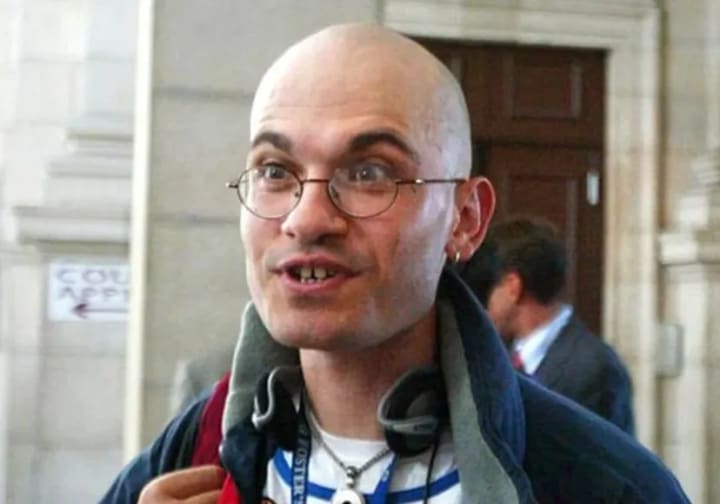
By 1997, Frédéric was actively searching for his next persona.
While in the custody of Spanish authorities, he took a calculated risk. Posing as a Spanish police officer, Frédéric contacted U.S. authorities and claimed to have found an unidentified missing boy.
With thousands of missing children on record and no name to work with, officials had no immediate way of identifying the child. As a result, they referred the case to the National Centre for Missing & Exploited Children, unknowingly setting the stage for one of the most infamous deceptions in modern true-crime history.

The operators methodically worked through countless missing-child cases, unaware that Frédéric was carefully selecting which identity he would assume. In the end, he settled on Nicholas Barclay.
At that point, Frédéric had never even seen a photograph of the boy, and any chance of his deception succeeding seemed almost impossible.
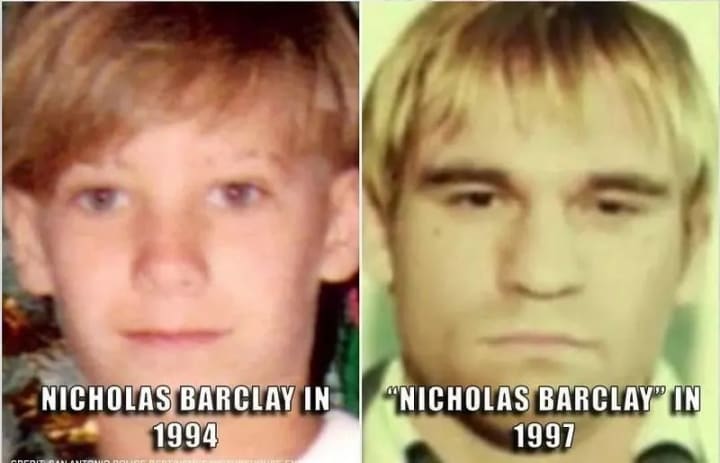
Frédéric did not bear even a passing resemblance to Nicholas Barclay, who would have been only 16 years old at the time. Nicholas had blue eyes, while Frédéric’s were brown. Nicholas spoke with a heavy Texan drawl; Frédéric, with a pronounced French accent.
Nevertheless, Frédéric was unwaveringly committed to playing the role.
He immediately dyed his brown hair blonde, gave himself similar tattoos to that of Nicholas and even used a razor blade to scar himself in the same areas that Nicholas was known to have scars.

U.S. authorities remained skeptical of Frédéric’s story, yet reluctantly agreed to contact the Barclay family. Perhaps driven by a desperate longing for closure, Nicholas’s older sister spoke with Frédéric over the phone and became convinced that it was her brother.
The Barclay family was overwhelmed with joy. It seemed their prayers had finally been answered—“Nicky” was coming home.
In October of that year, Frédéric was placed on a flight to Texas as a camera crew waited for his arrival at the airport. Footage would later capture the emotional reunion between “Nicholas” and his mother, Beverly, who took one look at Frédéric and accepted him without question.


In the months following the “reunion,” Frédéric settled into the Barclay family home. Gradually, he began to rebuild a semblance of a normal life—attending school and spending time with the family, who never questioned his inability to recall family memories, his different eye color, or his foreign accent.
Despite these inconsistencies, the Barclays seemed to cling to him, perhaps desperate to fill the void left by Nicholas’s disappearance and to rewrite the pain of their loss.

Cracks began to appear when private investigator Charlie Parker teamed up with a TV crew documenting Nicholas Barclay’s return.
As Charlie scrutinized childhood photos of Nicholas, he couldn’t ignore the glaring differences—including the shape of the ears. Alarmed, he alerted the FBI, sparking a formal investigation.
By February of the following year, a court order compelled Frédéric to submit his fingerprints for comparison. The results confirmed everyone’s worst fears: this was not Nicholas Barclay.

Frédéric Bourdin was promptly arrested and charged with fraud. By that September, he had pleaded guilty and was sentenced to six years in prison. After serving his sentence, he was deported back to his native France—but his behaviour did not change.
Once home, Frédéric resumed assuming the identities of other missing children, continuing the bizarre lifestyle he had long been accustomed to. While many have expressed sympathy for the conman, claiming he “only wants to feel loved and accepted,” it remains clear that such desires should never come at the expense of vulnerable and heartbroken families.

In the aftermath of losing Nicholas twice, the Barclay family was left reeling from the profound hurt and sense of betrayal caused by Frédéric. What they had desperately hoped would be a happy ending instead reopened deep psychological and emotional wounds.
Adding to the family’s anguish, not long after Frédéric’s arrest, Nicholas’s brother Jason succumbed to his drug addiction. Many believe he never forgave himself for what happened to Nicholas, and the weight of his guilt became too much to bear.
Psychologists have been fascinated by Frédéric Bourdin’s case. It offers insight into how grief can cloud judgment, with experts noting that families of missing persons are particularly emotionally vulnerable—and often more willing to accept any explanation, no matter how improbable, if it offers even a glimmer of hope.

In the three decades since Nicholas disappeared, his fate remains a mystery.
Sadly, as of 2025, the case is considered inactive. If alive today, Nicholas Barclay would be 44 years old.
About the Creator
Matesanz
I write about history, true crime and strange phenomenon from around the world, subscribe for updates! I post daily.
Michigan Synagogue Shooting: Fear, Faith, and Survival
Places of worship are meant to feel safe. People gather there to pray, reflect, and share quiet moments with their community. For many families, a synagogue is more than a building. It is where children learn traditions, where people celebrate holidays, and where comfort is found during difficult times.The michigan synagogue shooting shattered that sense of safety in an instant. What began as an ordinary day quickly turned into confusion and fear. Families inside the building suddenly faced a situation no one expects in a place meant for peace.
By Muqadas khan3 days ago in Criminal
Top tipple tricks
Been thinking a lot about drinking, lately. Not least because of a recent episode of over-indulgence and the inevitable after effects. Some readers may recall the earlier articles I wrote about beating the booze. Here I set out an experiment in techniques for cutting down on my alcohol intake. The experiment was successful, the techniques worked, and I have armed myself with an arsenal of weapons in the war against the demon drink. I have yet to fire the first round however. It's all a question of timing (perhaps procrastination).
By Raymond G. Taylor7 days ago in Psyche


Comments
There are no comments for this story
Be the first to respond and start the conversation.