
“The Sound of Red Ink”
A detective finds out every crime scene has one strange thing in common — a poem written in red ink that predicts the next murder.

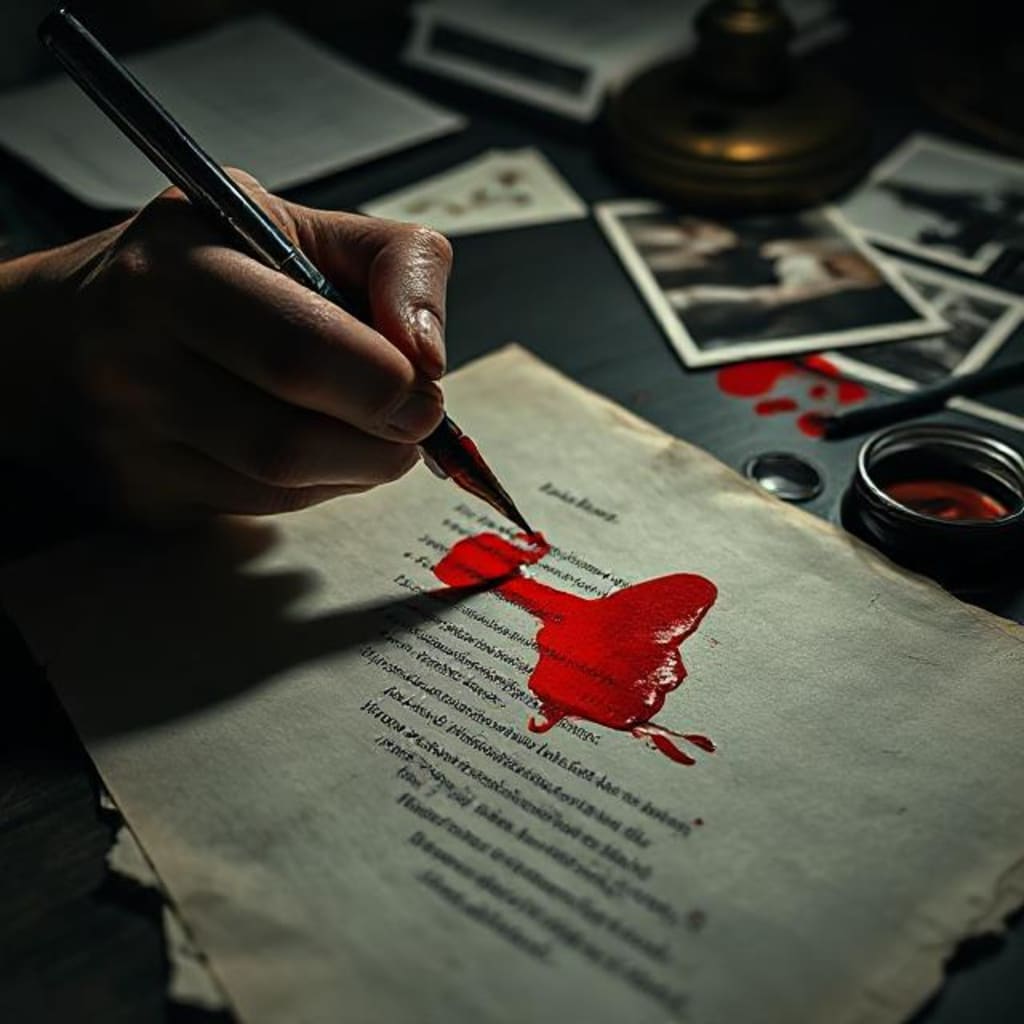
The Sound of Red Ink
By [ALi Rehman]
Detective Mara Ellis had seen her fair share of grisly crime scenes. But nothing about this latest case felt ordinary.
The body was sprawled in a dim alleyway, eyes wide with terror, and a single sheet of paper pinned to the victim’s chest. The paper bore a poem, written meticulously in red ink:
“Beneath the silent moon’s cold light,
A shadow falls, escaping night.
Whispers echo, secrets keep,
Another soul will soon sleep.”
Mara crouched, reading the lines carefully. A poem. At a murder scene. Strange, but not unheard of. Yet what chilled her was the ominous final line. Another soul will soon sleep.
She had seen the killer’s signature before—two previous victims, both found with poems in red ink at their scenes. Each poem eerily predicted the circumstances of the next murder, as if the killer were sending a message.
The police had been baffled for weeks, unable to connect the dots or find a pattern. But Mara was convinced there was a method beneath the madness, a rhythm behind the rhyme.
She spread the three poems out on her desk at headquarters, each in the killer’s sharp, flowing handwriting. The red ink stood out starkly against the white paper, like blood spilled onto parchment.
The first poem had appeared a month ago:
“In the quiet garden where roses bleed,
A final breath, a desperate need.
The thorns will pierce, the petals fall,
Another will answer death’s cold call.”
The victim had been found in a rose garden, stabbed through the heart. The second poem, left at the next crime scene, read:
“The clock strikes twelve, a shadow bends,
A whispered scream the night portends.
In ticking time, the end draws near,
A soul will vanish without a tear.”
That victim had been strangled just before midnight.
Now, the third poem foretold an imminent murder — the fourth in the sequence. Mara knew she had precious little time to stop the killer before the prophecy came true.
Mara called her partner, Detective Jason Keller. “We need to track down the source of these poems,” she said. “They’re clues, not just taunts.”
Jason nodded. “But who writes poetry in red ink? It’s theatrical. Almost like the killer wants to be caught.”
“Or wants to control the narrative,” Mara replied.
They poured over crime scene photos, maps, and witness statements. The victims seemed unrelated at first — no shared acquaintances, no common jobs or hangouts. But something nagged at Mara’s mind.
Then she noticed a subtle detail. Each murder had taken place near public libraries or bookstores.
The next day, Mara and Jason visited the largest library in town. Rows of books towered overhead, the smell of paper thick in the air. She pulled volumes of poetry from the shelves—classic anthologies and modern verse alike.
Suddenly, she found it: a book of obscure poems with notes written in the margins, scrawled in the same distinctive red ink.
Inside the book was a folded note — a cryptic message:
“The pen flows red; the story’s told.
Seek the writer, young and old.
In verse lies the truth you seek,
Before the silence makes you weak.”
Mara’s heart pounded. The killer wasn’t just leaving poems at crime scenes — they were playing a game of riddles, daring her to find them before the next murder.
She scanned the book’s sign-out log. A name appeared repeatedly: Nathan Crowe.
Mara and Jason tracked Nathan down to a small apartment cluttered with paper, pens, and stacks of poetry books. Nathan was a frail man, eyes haunted but sharp.
“I didn’t kill anyone,” he said quickly. “But I wrote the poems. It started as a game — to predict the news stories. Then I found… I was right. My words came true.”
Mara frowned. “You predicted the murders? Were you working with the killer?”
“No!” Nathan’s voice trembled. “I think the killer uses my poems to plan. They’re obsessed with poetry, with control. They want to show that fate is written in ink.”
Mara realized Nathan was both a pawn and a witness — someone whose words were twisted into a weapon.
That night, Mara studied the poems again. There was a hidden pattern: the first letters of each line spelled a name — LUCAS.
A new victim? A clue?
Mara dug into police records and discovered a missing person named Lucas Avery, last seen near the next predicted murder site.
Time was running out.
Mara and Jason raced to the abandoned warehouse on the outskirts of town, the location hinted at in the latest poem. The air was thick with tension.
Inside, they found Lucas, bound but alive. Nearby, the killer emerged — a man obsessed with poetry and power, his eyes gleaming with madness.
“You read my poems,” he said with a twisted smile. “They’re my masterpiece, my legacy.”
Mara didn’t hesitate. “Your legacy ends tonight.”
After a tense confrontation, the killer was subdued and arrested.
Back at headquarters, Mara placed the poems in evidence. The red ink no longer sang a haunting song but stood as a silent reminder of the fine line between art and terror.
She looked out the window, the city lights flickering beneath the quiet hum of night.
The sound of red ink had spoken. And she had listened.
About the Creator
Ali Rehman
please read my articles and share.
Thank you
Keep reading
More stories from Ali Rehman and writers in Criminal and other communities.
Ken Childs and the Shadow Network Behind Celebrity Surveillance
Hollywood is no stranger to intrigue. Behind the red carpets, blockbuster premieres, and glamorous headlines lies a parallel world where privacy is fragile and information can be extremely valuable. Over the years, celebrities have faced stalkers, hackers, and fraud schemes designed to exploit their wealth and visibility. Recently, reports circulating online have drawn attention to a controversial narrative involving private investigator Ken Childs and allegations that place him near the center of a disturbing story about celebrity surveillance.
By Shane Smith5 days ago in Criminal
Murdering the love of Sarah Maguire
January 2022, it was a cold winter in Tulsa, Oklahoma, one that felt colder than most for some of us in the city. If one were to be out in the evening air of the cold, it was bone chilling to the soul. On an evening like this one who wouldn’t enjoy a good home cooked meal by someone who seemed to care about them? Right, Folks?
By Cassie Moore2 days ago in Criminal



Comments
There are no comments for this story
Be the first to respond and start the conversation.