
The Savage Football Hooligans Who Killed for the Love of Their Team
In the 70s and 80s, football stadiums were a place of violence


An epidemic of crime hit Britain in the 70s and 80s. This was football hooliganism. It is hard to explain this to anyone who was not brought up in British sporting history. Football, Soccer to my US friends, is a passion like nothing else in the United Kingdom.
Rivalries between friends and family are common if they support different teams. However, there was a time when this simple rivalry went beyond banter and became violent. Clashes between rival fans became criminal; the country was out of control.
It is essential to appreciate that some of these fans of clubs went purely to the matches for violence. Some may not have even supported the team that they battled for. And battles they were, strategies were drawn up by warlike councils to attack rival fans. One of the biggest rivalries will always be between West Ham and Millwall fans. Both clubs are located in London, some four miles apart, separated by the River Thames.
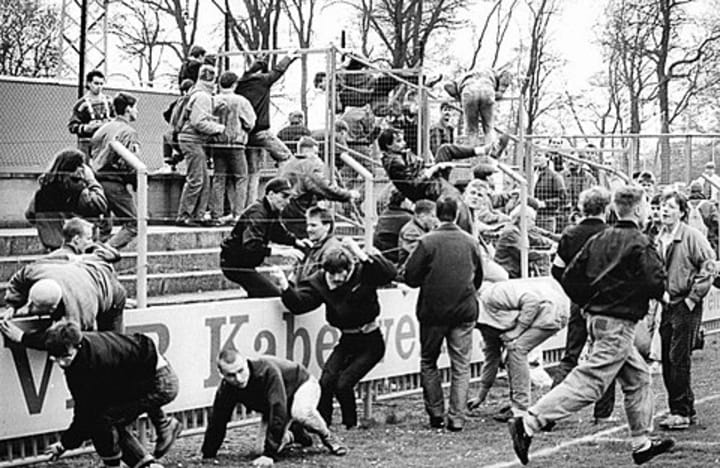
Millwall v West Ham
The conflict started at the very founding of the club in 1885. Millwall was set up by a group of labour workers from canned factory JT Morton. Ten years later, West Ham was set up by a shipping firm called Thames Ironworks. Workers' relations failed between the two when they failed to stand together concerning work relations.
The rivalry was also heightened in the 60s when two of London's gangsters supported different clubs. The Krays were die-hard West Ham fans and The Richardsons Millwall fans.
The worse incident of violence happened in September 1976, when a clash between rival fans ended with tragedy at the local train station. Ian Pratt was an eighteen-year-old Millwall fan who fell under a train during one such battle. Millwall immediately called for a revenge killing, handing out leaflets to incite the violence. This was encouraged further by the chant West Ham made up on the terraces, "We've got brains; we throw Millwall under trains."
The clashes between Millwall and West Ham largely died down as the two rarely met each other in games. West Ham was in a much higher league than Millwall; they rarely played each other. Although the battles never disappeared entirely, in 2009 the violence was still there when the teams met in a cup game.
Five years ago, I attended my local team playing Millwall and was abused by some fans outside the ground. Millwall, it appears, has not moved that far away from its violent past.
Football Violence
These were not the only clubs with a history of rivalry. Rivalries and violence occurred in every city in the United Kingdom between every team. For example, Manchester had two rival clubs, United and City. United hooligans called themselves the red army and initiated some fierce battles.
Celtic and Rangers, in Glasgow, battled regularly; their history goes back to religion, with one club being supported by Catholics and one by Protestants.
Other deaths contributed to football hooliganism. When violence erupted one sunny afternoon in 1978, between Birmingham and Chelsea, twenty-one-year-old Vernon Brown, a factory storekeeper, was crushed to death under the wheels of a double-decker bus.
Organised Crime
Hooligans were well organised, especially when organised crime started infiltrating these gangs. The groups became a professional establishment with group networks, informants and planned operations. War councils operated like the military with tribal loyalty.
Although many members were working class, the leaders were professional people who had exceptional leadership qualities. Their soldiers' weapons ranged from pool balls in a sock to knives and bike chains. Some even carried darts to throw at their opponents. If the police had confiscated weapons, hooligans would use whatever they could get, ripping up steel barriers and using them as clubs.
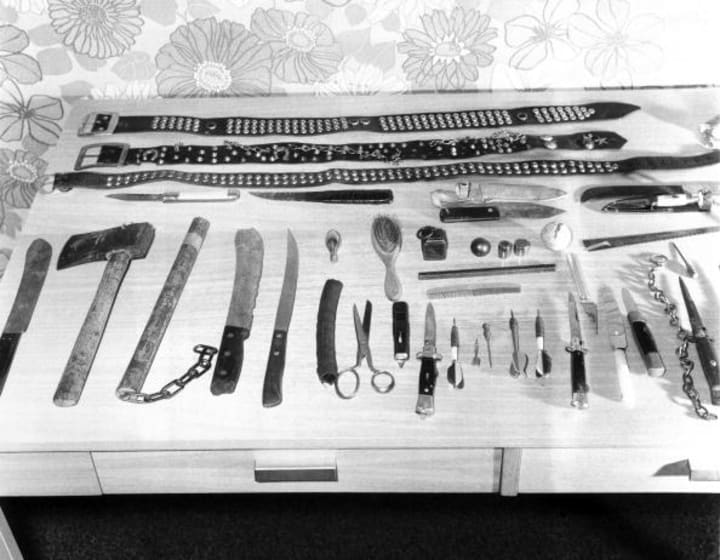
Football clubs tried to stop this violence with a range of methods. First, they would fence off the terraces where the hooligans stood, caging the violence. They would name and shame hooligans in the programs for the match; none of these had much effect.
Government Intervention
The violence became so bad in England and Europe that the government was forced to step in.
Two pieces of government legislation gave powers to the police to restrict the movement of these criminals. First, hooligans were put on a register and not allowed to travel during away games. This was whether it was a club game or international. Some even had their passports confiscated.
Clubs were issued huge fines if they did not make reasonable adjustments to stop the violence. Grounds were segregated with home and away fans sitting in separate areas; they were taken to and from the stadium through different routes. There was also a period where English teams were banned from participating in European matches. It was a dark time for any football fan.
By the 1990s, the level of violence had reduced to a level that English teams were allowed back into European competitions. However, there are still occasions when violence erupts; these are the news reports that make me cringe; I'm ashamed to be British.
Stadiums have now though, become a place to take the family. The violence is being replaced by harmless banter and ridicule if your team loses to a rival.

If you enjoyed this article, please subscribe to my writing, share it and give it a heart. As a writer tips and pledges mean a great deal to me, so a massive thank you if you send one.
About the Creator
Sam H Arnold
Fiction and parenting writer exploring the dynamics of family life, supporting children with additional needs. I also delve into the darker narratives that shape our world, specialising in history and crime.
Keep reading
More stories from Sam H Arnold and writers in Criminal and other communities.
The Horrific Murders That Police Would Not Have Solved Without a Confession
The Boston Strangler was a serial killer that caused panic amongst single women. Responsible for at least eleven murders of women ranging in age. The murders occurred between 1962 and 64; no one has ever been charged for the murders. However, the police believe after forty-nine years, they have identified the Boston Strangler. His premature death means they are unable to charge him.
By Sam H Arnold4 years ago in Criminal
A Mother's Love Lost
It was December 30th, 1988, just two days before the New Year. Jack Dale Walker had convinced a coworker to drive him out to the trailer where his girlfriend lived. Hansel Norton, the co-worker, had known Jack for barely three full weeks. Hansel was trying to be a good friend to this new friend. So, Jack, was young, only 22 years old and appeared to be love sick for the girl who was the mother of his baby.
By Cassie Moore5 days ago in Criminal
Inside the House of Skulls: The Full Timeline of the Jonathan Gerlach Investigation
INVESTIGATION TARGET: JONATHAN C. GERLACH INCIDENT LOCATION: 100 WASHINGTON AVENUE, EPHRATA PA CHARGES: ABUSE OF CORPSE (x100), THEFT, DESECRATION STATUS: INCARCERATED ($1M BAIL) KEYWORDS: #HouseOfSkulls #JonathanGerlach #EphrataCrime #MountMoriah
By Sunshine Firecracker2 days ago in Criminal


Comments
There are no comments for this story
Be the first to respond and start the conversation.