
The Rostov Predator: The True Face of Andrei Chikatilo(part2)
Unraveling the Criminal Mind of Andrei Chikatilo.

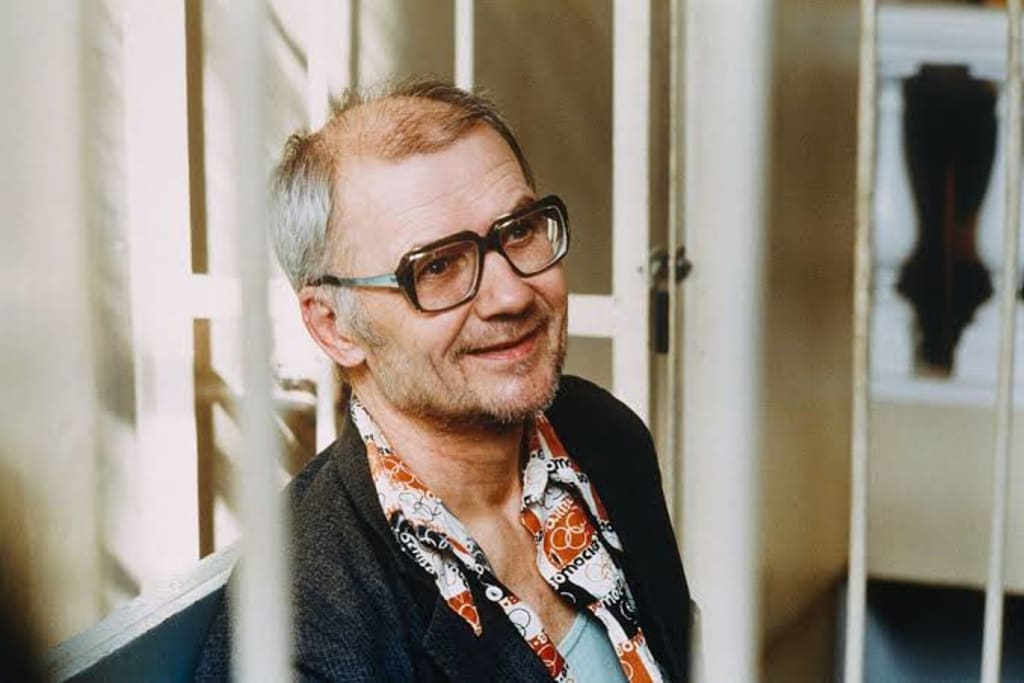
Following Biryuk's murder, Chikatilo no longer attempted to resist his homicidal urges: between July and September 1982, he killed a further five victims between the ages of 9 and 18. He established a pattern of approaching children, runaways, and young vagrants at bus or railway stations, enticing them to a nearby forest or other secluded area, and killing them, usually by stabbing, slashing and eviscerating the victim with a knife; although some victims, in addition to receiving a multitude of knife wounds, were also strangled or battered to death.
Many of the victims' bodies bore evidence of mutilation to the eye sockets. Pathologists concluded these injuries had been caused by a knife, leading investigators to the conclusion the killer had gouged out the eyes of his victims. Chikatilo's adult female victims were often prostitutes or homeless women whom he would lure to secluded areas with promises of alcohol or money. He would typically attempt intercourse with these victims, but he would usually be unable to achieve or maintain an erection; this would send him into a murderous fury, particularly if the woman mocked his impotence. He would achieve orgasm only when he stabbed and slashed the victim to death. Chikatilo's child and adolescent victims were of both sexes; he would lure these victims to secluded areas using a variety of ruses, usually formed in the initial conversation with the victim, such as promising them assistance or company, or offering to show them a shortcut, a chance to view rare stamps, films or coins, or with an offer of food or candy. He would usually overpower these victims once they were alone, often tying their hands behind their backs with a length of rope before stuffing mud or loam into the victims' mouths to silence their screams, and then proceed to kill them. After the killing, Chikatilo would make rudimentary—though seldom serious—efforts to conceal the body before leaving the crime scene.
On 11 December 1982, Chikatilo encountered a 10-year-old girl named Olga Stalmachenok riding a bus to her parents' home in Novoshakhtinsk and persuaded the child to leave the bus with him. She was last seen by a fellow passenger, who reported that a middle-aged man had led the girl away firmly by the hand. Chikatilo lured the girl to a cornfield on the outskirts of the city, stabbed her in excess of fifty times around the head and body, ripped open her chest and excised her lower bowel and uterus
more murders and investigation
By January 1983, four victims thus far killed had been tentatively linked to the same killer. A Moscow police team, headed by Major Mikhail Fetisov, was sent to Rostov to direct the investigation, which gradually became known among investigators as Operation Forest Path. Fetisov established a team of ten investigators based in Rostov, charged with solving all four cases. In March, Fetisov assigned a newly appointed forensic analyst, Viktor Burakov, to head the investigation. The following month, Stalmachenok's body was found. Burakov was summoned to the crime scene, where he examined the numerous knife wounds and eviscerations conducted upon the child and the striations on her eye sockets. Burakov later stated that, as he noted the striations upon Stalmachenok's eye sockets, any doubts about the presence of a serial killer evaporated.
Chikatilo did not kill again until June 1983, when he murdered a 15-year-old Armenian girl named Laura Sarkisyan; her body was found close to an unmarked railway platform near Shakhty. By September, he had killed a further five victims. The accumulation of bodies found and the similarities between the pattern of wounds inflicted on the victims forced the Soviet authorities to acknowledge that a serial killer was on the loose. On 6 September 1983 the public prosecutor of the Soviet Union formally linked six of the murders thus far attributed to the same killer.
Due to the sheer savagery of the murders and the precision of the eviscerations upon the victims' bodies, police theorized that the killings had been conducted by either a group harvesting organs to sell for transplant, the work of a Satanic cult, or a mentally ill individual. Much of the police effort concentrated upon the theory that the killer must be mentally ill, homosexual, or a paedophile, and the alibis of all individuals who had either spent time in psychiatric wards or had been convicted of homosexuality or paedophilia were checked and logged in a card filing system. Registered sex offenders were also investigated and, if their alibi was corroborated, eliminated from the inquiry.
Beginning in September 1983, several young men confessed to the murders, although these individuals were often intellectually disabled youths who admitted to the crimes only under prolonged and often brutal interrogation. Three known homosexuals and a convicted sex offender committed suicide as a result of the investigators' heavy-handed tactics. As a result of the investigation, more than 1,000 unrelated crimes, including ninety-five murders, 140 aggravated assaults, and 245 rapes, were solved.
In January and February 1984, Chikatilo killed two women in Rostov's Park of Aviators. On 24 March, he lured a 10-year-old boy, Dmitry Ptashnikov, away from a stamp kiosk in Novoshakhtinsk. While walking with the boy, Chikatilo was seen by several witnesses who were able to give investigators a detailed description of the killer. When Ptashnikov's body was found three days later, police also found a footprint of the killer and both semen and saliva samples on the victim's clothing. On 25 May, Chikatilo killed a young woman named Tatyana Petrosyan and her 10-year-old daughter, Svetlana, in a wooded area outside Shakhty; Petrosyan had known Chikatilo for several years prior to her murder. By the end of July, he had killed three additional young women between the ages of 19 and 21, and a 13-year-old boy.
In the summer of 1984, Chikatilo was fired from his work as a supply clerk for the theft of two rolls of linoleum. The accusation had been filed against him the previous February, and he had been asked to resign quietly but had refused to do so, as he had denied the charges. Chikatilo found another job as a supply clerk in Rostov on 1 August.
On 2 August, Chikatilo killed a 16-year-old girl, Natalya Golosovskaya, in the Park of Aviators. On 7 August, he lured a 17-year-old girl, Lyudmila Alekseyeva, to the banks of the Don River on the pretense of showing her a shortcut to a bus terminal. Alekseyeva suffered thirty-nine slash wounds to her body before Chikatilo mutilated and disembowelled her, intentionally inflicting wounds he knew would not be immediately fatal. Her body was found the following morning; her excised upper lip inside her mouth.
First arrest and release
On 13 September 1984, Chikatilo was observed by two undercover detectives attempting to talk to young women at a Rostov bus station. The detectives followed him as he wandered through the city, trying to approach women and committing acts of frotteurism in public places. Upon Chikatilo's arrival at the city's central market he was arrested and held. A search of his belongings revealed a knife with a 20-centimetre (7.9 in) blade, several lengths of rope, and a jar of Vaseline. He was also discovered to be under investigation for minor theft at one of his former employers, which gave the investigators the legal right to hold him for a prolonged period of time. Chikatilo's dubious background was uncovered, and his physical description matched the description of the man seen walking alongside Dmitry Ptashnikov prior to the boy's murder. A sample of Chikatilo's blood was taken; the results of which revealed his blood group to be type A, whereas semen samples found upon a total of six victims murdered by the unknown killer throughout the spring and summer of 1984 had been classified by medical examiners to be type AB. Chikatilo's name was added to the card index file used by investigators; however, the results of his blood type analysis largely discounted him as being the unknown killer
Chikatilo was found guilty of theft of property from his previous employer. His membership of the Communist Party was revoked and he was sentenced to one year in prison. He was released from custody on 12 December 1984 after serving three months. On 8 October 1984, the head of the Russian Public Prosecutors Office formally linked twenty-three of Chikatilo's murders into one case and dropped all charges against the mentally disabled youths who had previously confessed to the murders.
Upon his release from prison in December 1984, Chikatilo found new work within the supply department of a locomotive factory in Novocherkassk and kept a low profile. He did not kill again until 1 August 1985 when, on a business trip to Moscow, he encountered an 18-year-old woman, named Natalia Pokhlistova, standing on a railway platform near Domodedovo Airport. Pokhlistova was lured off a train into a thicket of woods close to the village of Vostryakovo where she was bound, stabbed thirty-eight times in her neck and chest, then strangled to death.
Political and public pressure and Snare
On 11 March, the leaders of the investigation, headed by Fetisov, held a meeting to discuss progress made in the manhunt.Fetisov was under intense pressure from the public, the press, and the Soviet Ministry of the Interior to solve the case; both he and Viktor Burakov had devoted extensive time and effort over the previous seven years in their efforts to apprehend the perpetrator.[The intensity of the manhunt in the years up to 1984 had receded to a degree between 1985 and 1987, when Chikatilo had committed only three murders investigators had conclusively linked to the killer—all killed by 1986. However, by March 1990, a further six victims had been linked to the killer. In addition, following the introduction of greater media freedom as a result of glasnost, the Soviet news media was much less repressed than it had been in the early years of the manhunt and accordingly devoted extensive publicity to the case. Fetisov had also noted laxity in some areas of the investigation and warned that people would be fired if the killer was not caught soon.
Chikatilo had killed three further victims by August 1990. On 4 April, he lured a 31-year-old woman, Lyubov Zuyeva, off a train and killed her in woodland near Donleskhoz station. Her body was not found until 24 August. On 28 July, he lured a 13-year-old boy, Viktor Petrov, away from a Rostov railway station and killed him in Rostov's Botanical Gardens; and on 14 August, he killed an 11-year-old boy, Ivan Fomin, in the reeds near Novocherkassk beach.
The discovery of more victims triggered a massive police operation. Since several bodies of victims had been discovered at railroad stations on a rail route through Rostov Oblast, Burakov suggested a plan to saturate all the larger stations in the region with an obvious uniformed police presence that the killer could not fail to notice. The intention was to deter the killer from attempting to strike at any of these locations, and to have undercover officers patrolling smaller, less crowded stations where the killer's activities would be more likely to be noticed. The plan was approved, and both uniformed and undercover officers were instructed to question any adult male in the company of a young woman or child, and take down his name and passport number. Police deployed 360 men to all stations in Rostov Oblast, but undercover officers were only assigned to the three smaller stations on the route through the Oblast where the killer had struck most frequently - Kundryucha, Donleskhoz and Lesostep - in an effort to force the killer to strike at one of those three stations. The operation was implemented on October 27, 1990.
On October 30, police found the body of a 16-year-old boy, Vadim Gromov, at Donleskhoz station. The injuries on Gromov's body immediately linked him to the manhunt: the young man had been strangled, stabbed twenty-seven times and castrated, with the tip of his tongue cut off and his left eye stabbed out. Gromov had been killed on October 17, ten days before the start of the initiative. On the same day Gromov's body was found, Chikatilo lured another 16-year-old, Viktor Tishchenko, from a train at Kirpichnaya station and killed him in a nearby forest. Tishchenko's body, with forty separate knife wounds, was found on November 3.
second arrest
Police placed Chikatilo under surveillance on November 14. On several occasions, especially on trains or buses, he was observed approaching young women or lonely children and engaging them in conversation. If the woman or child interrupted the conversation, Chikatilo would wait a few minutes and then look for another interlocutor. On November 20, after six days of surveillance, Chikatilo left his home with a large flask, which he had filled with beer at a kiosk in a local park, before wandering around Novocherkassk, trying to contact children he met on his way. Upon leaving a cafe, Chikatilo was arrested by four plainclothes police officers. He offered no resistance as he was handcuffed and placed inside an unmarked police car.
Upon his arrest, Chikatilo claimed that the police were wrong and complained that he had also been arrested in 1984 for the same series of murders. A search of the suspect revealed another piece of evidence: one of Chikatilo's fingers had a deep flesh wound that he himself had treated with iodine. Medical examiners concluded that the wound was from a human bite. Chikatilo's penultimate victim, Viktor Tishchenko, was a physically strong young man. At the crime scene, police found numerous signs of a fierce physical struggle between the victim and his killer. Although it was later discovered that a bone in his finger was broken and a fingernail had been torn off, Chikatilo never sought medical treatment for this injury.
A search of Chikatilo's belongings revealed that he was in possession of a folding knife and two pieces of rope. A sample of his blood was taken, and he was placed in a cell inside KGB headquarters in Rostov with a police informant, who was instructed to engage Chikatilo in conversation and obtain any information he could from him. The next day, November 21, the formal interrogation of Chikatilo began, conducted by Issa Kostoyev. The strategy chosen by the police to obtain a confession was to make Chikatilo believe that he was a very sick person in need of medical help. The intention was to give Chikatilo hope that if he confessed, he would not be prosecuted by reason of insanity. The police knew that their case against Chikatilo was largely circumstantial, and under Soviet law, they had ten days in which they could legally hold a suspect before charging or releasing him.
About the Creator
diego michel
I am a writer and I love writing
Keep reading
More stories from diego michel and writers in Criminal and other communities.
The Rostov Predator: The True Face of Andrei Chikatilo(part1)
Andrei Romanovich Chikatilo, better known as "the Butcher of Rostov", "the Red Ripper" and "the Rostov Ripper", murdered, disemboweled and in some cases raped 56 women and children in the former Soviet Union and was executed at the age of 57 after being tried for 53 of these crimes.
By diego michel2 years ago in Criminal
Multinational Crisis
Part One: Nigeria You have all heard about Nigerians, Nigeria in general. The infamous scammer country. But let’s have a real conversation. Let me give you some extremely boring stats, so we are on a level playing field, on my thoughts. I’ll be as brief as possible considering, no one wants an hour long dissertation on economic issues.
By Alexandra Granta day ago in Criminal
Oklahoma Murder for Hire
Murder for hire in 1988 must have been a real monster of a time to find for a woman who was bored, and just lazy. A woman that claimed she was abused, knew how to work a young man up, back in those days it was much easier to find “a knight in shining armor”. Men all over wanted to be one, no man how scuzzy they really were.
By Cassie Moore3 days ago in Criminal



Comments
There are no comments for this story
Be the first to respond and start the conversation.