
The Reagan Mask & The Million-Dollar Vanish: Inside the Mind of the Hollywood Bandit
"Every story, though similar, is not quite like the one I tell you with a mythological flourish."

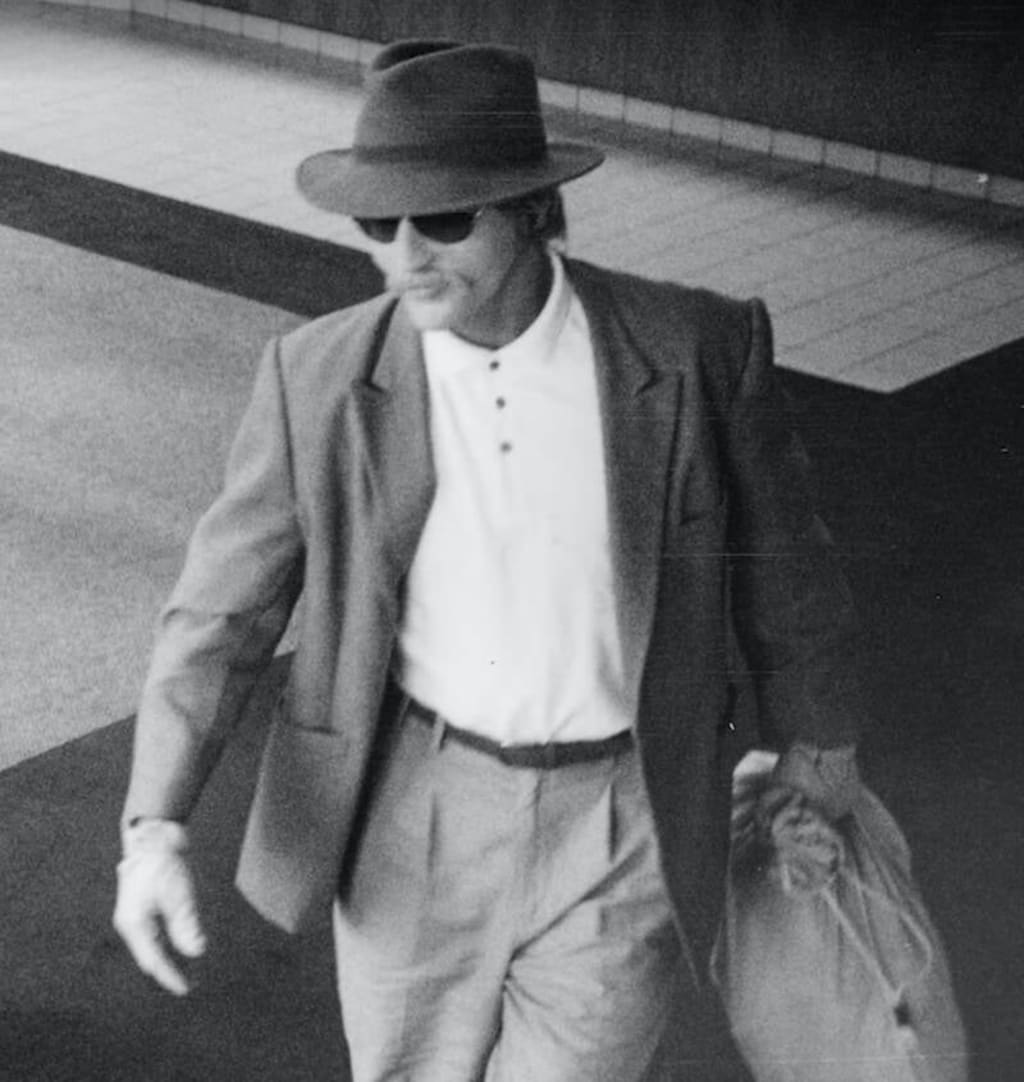
William Scott Scurlock was the antithesis of the typical violent criminal. In the early 1990s, the quiet life of the Pacific Northwest was disrupted not by a desperate thug, but by a mastermind whose genius lay in performance art. Scurlock viewed bank robbery as a meticulously directed theatrical production, drawing his primary inspiration from action films like Point Break. His obsession with elaborate prosthetics, wigs, and makeup soon earned him the enduring moniker: The Hollywood Bandit.
The bandit's debut show, which set the bizarre standard for his future, took place at the Seafirst Bank in Seattle's upscale Madison Park neighborhood. On this first job, Scurlock entered the bank completely transformed, wearing layers of professional theatrical makeup and a heavy prosthetic nose. His accomplice, Mark Biggins, wore a surreal and chilling plastic Ronald Reagan mask. This instantly elevated the crime, framing it not as simple theft, but as an oddly sophisticated, almost political, spectacle.
The operation was silent, intimidating, and ruthlessly efficient. The crew quickly took control of the room, secured approximately $20,000, and vanished without firing a shot or harming a soul. For Scurlock, the rush was profound and instantly addictive. The cash was merely the box office receipt; the true prize was the flawless performance and the complete evasion of capture.
II. The Director’s Vision: The Art of Evasion (1992–1996)
The single successful heist of 1992 quickly escalated into a four-year crime spree. Between 1992 and 1996, Scurlock and his rotating cast of accomplices would rob almost 20 banks across the Seattle area, accumulating an astonishing total of $2.3 million.
Scurlock’s defining genius was his unwavering commitment to his craft of disguise. The FBI was baffled, initially labeling him the "Take Charge Robber" for his domineering demeanor. But they soon realized the true challenge: he never repeated a disguise. He might appear as a middle-aged dentist one day, a casually dressed hippie the next, or even an elderly man with a cane. His technique was so impeccable that he reportedly stood in line at the same banks he had robbed days earlier, unseen and unsuspected.
His preparation was obsessive and cinematic. Investigators later discovered a secret underground bunker on his property—a hidden, climate-controlled armory where he stored his costumes, weapons, and tools. This allowed him to maintain a facade of normalcy on the surface while secretly living the life of a theatrical criminal legend beneath. His heists grew in audacity, culminating in a robbery where he convinced a teller to open a lower-level vault drawer, enabling him to walk away with over $1 million—one of the largest single bank heists in U.S. history at the time. The FBI, forced to admire his skill, declared him the best bank robber they had ever encountered.
III. The Tragic Climax: The Final Act (November 1996)
The Hollywood Bandit’s spectacular run came to a tragic, abrupt end on Wednesday, November 27, 1996, just before Thanksgiving. A tracking device hidden within the stolen money during his final robbery immediately alerted the police.
What ensued was a dramatic, high-speed chase that descended into a violent gun battle. Law enforcement managed to wound and capture two of Scurlock’s accomplices, but the master of disguise—the director himself—vanished on foot into the suburban darkness of South Seattle.
The FBI and local police launched a massive, intensive manhunt. Scurlock, however, was already hidden just blocks away, tucked inside an old, deactivated camper in the backyard of a nearby residence.
The next day, Thanksgiving, the property owners discovered the fugitive and called 911. Police immediately surrounded the structure. As an officer approached the door, a single gunshot rang out from inside. After securing the area, SWAT officers forced the camper door open and found Scurlock dead from a self-inflicted gunshot wound to the head.
The puzzle of William Scott Scurlock—how a well-mannered, creative man transformed into the most infamous bank robber in Washington history—was closed by this final, solitary act. His story remains a landmark in true crime, a chilling reminder of how obsession, performance, and the search for adrenaline can elevate a criminal endeavor into a disturbing global .
Final Takeaway: The Ultimate Price
The tragic saga of the Hollywood Bandit serves as a stark reminder that even the most elaborate performance cannot outrun its inevitable conclusion. Scurlock's undeniable genius was tragically misplaced, proving that no thrill is worth the irreversible price of crime.
We invite you to join the conversation:
Did Scurlock’s theatrical approach fascinate or repel you? Share your thoughts below on this uniquely complex true crime story.
About the Creator
Keep reading
More stories from Alexander Reeve and writers in Criminal and other communities.
The Leap into the Void: The Air Escape Legend That Shook America
On the afternoon of November 24, 1971, the day before Thanksgiving, a man calling himself Dan Cooper approached the Northwest Orient Airlines counter in Portland, Oregon. Cooper was a completely nondescript individual: a calm, middle-aged man in a dark business suit, a crisp white shirt, and a black clip-on tie. Using cash, he bought a one-way ticket for Flight 305, a short, routine hop to Seattle, Washington.
By Alexander Reeve3 months ago in Criminal
The Mayor’s Silence: Thomas Reinhold, Jonathan Gerlach, and Ephrata's 'House of Skulls'
The Promotion to Failure Thomas G. Reinhold isn’t a newcomer to Ephrata’s power structure; he is its architect. After spending over a decade (2012–2025) as Council President—rubber-stamping police budgets and prioritizing quick, unanimous meetings over deep scrutiny—Reinhold finally ascended to the Mayor’s office in January 2026.
By Sunshine Firecracker4 days ago in Criminal
The $1 Deed: Did Jonathan Gerlach Transfer His Ephrata Property to Hide Assets?
The Paper Trail While the investigation into the Mount Moriah Cemetery grave robberies was quietly building, Jonathan Gerlach was already making moves to separate himself from his most valuable asset.
By Sunshine Firecracker5 days ago in Criminal



Comments
There are no comments for this story
Be the first to respond and start the conversation.