


“He was always quiet, polite, and dependable.”
That’s how most people described Charles Cullen, a nurse who spent 16 years in the healthcare system, working at multiple hospitals across New Jersey and Pennsylvania. But behind the calm smile and professional appearance hid one of the most prolific serial killers in modern American history.
The Beginning of a Nightmare
Charles Cullen began his nursing career in 1987 at Saint Barnabas Medical Center in Livingston, New Jersey. At first, no one suspected anything. He seemed like a hardworking, if slightly awkward, professional. Patients came and went. Some died. But in a hospital, death isn’t always questioned—especially when it’s an elderly patient with a serious condition.
But in the background, Cullen was testing his power. He started administering lethal doses of insulin and digoxin, drugs that, in certain amounts, could cause sudden cardiac arrest or a painless death. Most of the time, the deaths were chalked up to natural causes.
And Charles Cullen kept going to work.
⚠️ A Pattern in the Shadows
Over the years, Cullen worked at ten different hospitals. Every time suspicions started to rise—due to sudden spikes in patient deaths or unusual prescription patterns—he resigned or was let go quietly. Hospitals feared lawsuits or bad publicity more than digging deeper.
Still, colleagues started noticing odd behavior:
He was often around when patients unexpectedly died.
He logged in to medical records of patients not assigned to him.
He volunteered for extra shifts in the ICU—where the sickest and most vulnerable patients lay.
Yet, without hard proof and in a system that lacked proper reporting protocols, he always walked away untouched.
🧪 The Smoking Gun
It wasn’t until Cullen joined Somerset Medical Center in 2002 that things began to unravel.
Pharmacy staff and nurses noticed Cullen accessing drugs that didn’t match patient needs. Some drugs started disappearing from the inventory. A few patients who were recovering suddenly went into cardiac arrest and died.
One nurse finally reported suspicions. She believed Cullen might be harming patients. The hospital launched an internal investigation but hesitated to involve law enforcement.
It was only after two more suspicious deaths and continued pressure from staff that the New Jersey Poison Control Center was contacted. Toxicology tests revealed lethal levels of digoxin and insulin in the bodies of patients who should have lived.
The trail now pointed to one person: Charles Cullen.
👮 Arrest and Confession
On December 12, 2003, Charles Cullen was arrested at his home. He initially denied everything, but soon cracked under interrogation.
In a chilling confession, Cullen admitted to killing at least 40 patients over 16 years—but investigators believe the number could be over 400.
His reasoning? He claimed he wanted to "ease suffering" and "put people out of their misery." But many of his victims weren’t terminal. Some were recovering. Some were even young.
His actions weren’t mercy. They were murder.
⚖️ The Trial
Rather than go through a full trial, Cullen accepted a plea deal. In exchange for cooperating and identifying more victims, he avoided the death penalty. He was sentenced to multiple life sentences without the possibility of parole.
During court proceedings, victims’ families confronted him, demanding answers. Cullen, cold and unemotional, sat silently. He offered no apologies. No explanations.
He will spend the rest of his life in New Jersey State Prison.
📉 How He Got Away for So Long
Charles Cullen’s case exposed serious flaws in the U.S. healthcare system:
Hospitals failed to share suspicions when he transferred jobs.
Reporting systems for healthcare malpractice were outdated.
A “don’t ask, don’t tell” culture existed around unusual patient deaths.
In many ways, hospitals were afraid to accuse one of their own—and patients paid the ultimate price.
🛡️ The Aftermath: Change and Reform
The horror of the Cullen case led to:
"Cullen Laws" passed in New Jersey and Pennsylvania, requiring hospitals to report suspicious deaths and employee misconduct to state authorities.
Stricter background checks and better tracking of medical licenses.
A cultural shift in hospitals to encourage reporting and protect whistleblowers.
It also inspired the book "The Good Nurse" by Charles Graeber, and later a Netflix documentary and film, bringing global attention to this terrifying chapter in modern medicine.
🧠 Psychological Profile: Who Was Charles Cullen?
Experts later diagnosed Cullen with major depression and personality disorders. His childhood was filled with trauma—an absent father, a mentally ill mother who died in a car accident, and early suicide attempts. But none of that excused what he did.
Instead of healing others, he used his role as a nurse to play God, deciding who lived and who died.
He was a man hidden in plain sight, wearing scrubs instead of a mask, using syringes instead of weapons.
🧾 Final Thoughts
Charles Cullen wasn’t the kind of killer we expect. He didn’t hunt at night or leave a trail of blood. He used trust, silence, and institutional weakness to hide his crimes for almost two decades.
This case is a haunting reminder that evil doesn’t always scream. Sometimes, it whispers in the most trusted places.
About the Creator
Farzad
I write A best history story for read it see and read my story in injoy it .
Under the Bridge: The Senseless Killing of Jocelyn Nungaray
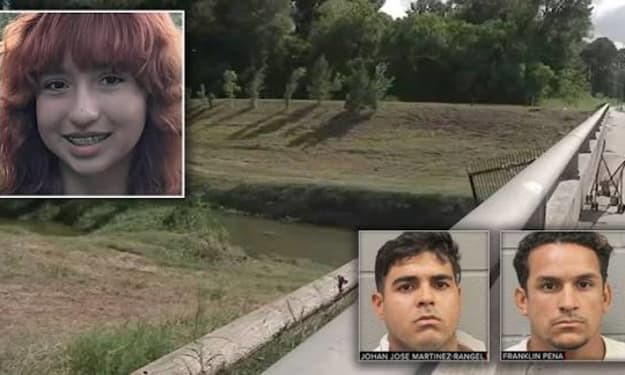
The tragic case of 12-year-old Jocelyn Nungaray sent shockwaves through Houston Texasband beyond highlighting issues of child safety vulnerability and the justice systems response to heinous crimes. On the night of Sunday June 16 2024 Jocelyn sneaked out of her home in north Houston to visit a nearby convenience store. What should have been a short innocent errand turned into a nightmare when she encountered two men who appeared lost and in need of directions.According to investigators the men—later identified as 26-year-old Franklin Jose Pena Ramos and 22-year-old Johan Jose Martínez-Rangel, both Venezuelan nationals who had entered the United States illegally—followed the young girl. Surveillance footage captured the trio together showing them walking in the area. The men allegedly lured Jocelyn to a secluded spot under a bridge near West Rankin Road not far from her residence. There she was subjected to brutal violence including sexual assault before being strangled to death.
By Kure Garba2 days ago in Criminal
Guard Your Battery
Why are some people so attractive just by standing there? It’s not because they are "likable," but because they don’t need everyone to like them. I realized later that truly charismatic people allow themselves to be criticized, but they never criticize themselves. They never try to please the world; instead, the world stops to watch them.
By Emily Chan - Life and love sharing2 days ago in Poets


Comments
There are no comments for this story
Be the first to respond and start the conversation.