

Whilst he was alive, Claudio Bravo never became acquainted with Jules, but through a series of fortunate misfortunes, Jules would soon become rather intimately acquainted with the late Claudio Bravo. Like most people, Jules could use a bit of extra cash, but if he knew the strings attached to what was about to fall from the sky he might have chosen to carry on walking.
Jules is climbing up the gritty gravel road carved out of the side of the cliff when he suddenly hears a strange flapping sound and then a sharp smack. He whips round in time to see a cloud of dust rise from where a small object hit the ground. He thinks for a moment that a bird has fallen out of the sky, but as he approaches, he realises it is a black notebook. He takes off his heavy pack, picks it up curiously, and brushes off the cover. The powder fine dust smears against the supple finish.
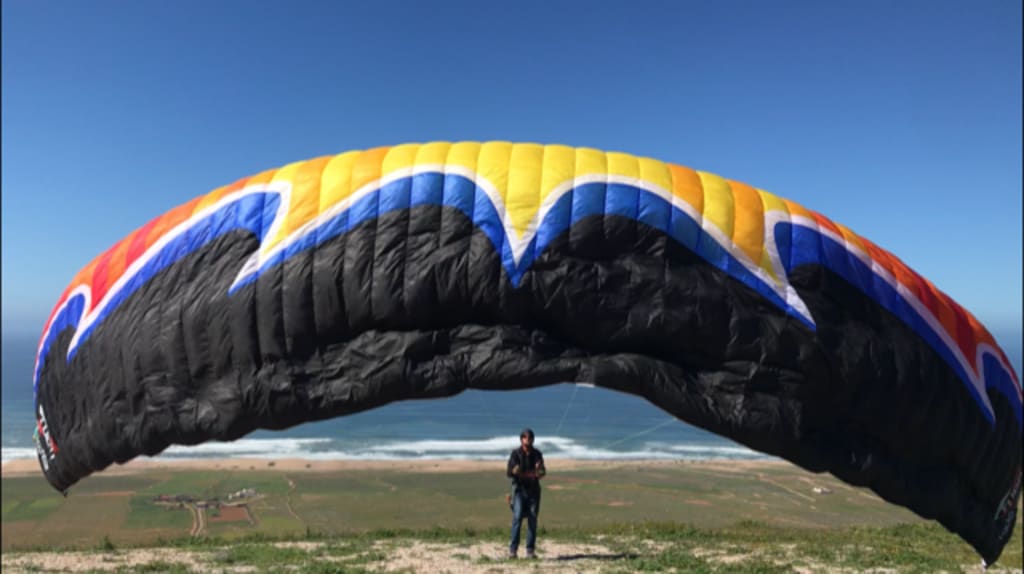
Looking up, he sees a paraglider hanging from a dark red emergency chute with black scallops, the normal wing of the glider floating listlessly in the air 100 metres above.
The pilot sees him and waves but it’s no use. Once a paraglider opens the emergency chute there is only one way to go – down. You no longer have proper lift or control. Jules knows this because he is a world champion paraglider himself, ex-military special services and currently training to do the longest possible solo flight: the entire length of The Rockies.
As Jules rounds the final curve of the road which hooks up over the side of the cliff, there is a sign pointing left to Nigel’s Place, and another pointing right to Le Nid d’Aigle, (The Eagles Nest). Nigel is a Brit, and a bit of a salty dog, having spent most of his life paragliding by the sea just north of the fishing village of Mirleft in Southern Morocco. In addition to one large slobbery dog and one little puffball, Nigel has a pet parrot, with whom he shares not only a dwelling, but also a similar countenance and tone of voice.
Nigel’s Place is a patch of land with a windsock, a few spartan dwellings, and a dusty gravel area slanting down to where paragliders can take off into the wind on the edge of the cliff. On the other side of the road is The Eagle’s Nest, owned by a Belgian couple and appealing more to the French paragliding crowd. It is much more commercial, with a few rooms, a restaurant and a bar.
Jules takes the book to Nigel, and asks him if he knows the paraglider that just went down.
“That bastard nearly clipped one of my friends in the side just now, but no, never seen him before. He took off from next door.”
Nigel takes the book and with no regard for privacy, starts reading.
Nigel sees the book is in Spanish, which he doesn’t speak and tosses it to Jules. The handwritten contents involve mostly names and dates, a few of which he recognises as prominent politicians and celebrities. On the inside of the front cover there is a label which reads ‘Propriete de le Musee Palais Claudio Bravo’, followed by the address in Taroudant and a phone number.
Jules calls the number in the front of the book.
Within thirty seconds a man comes on the line introducing himself as Kidab, the curator of the museum. He explains that the book has been stolen from the museum and they are desperate for its safe return, offering a reward of $5,000.
Jules tells Kidab that the police have caught the thief at gunpoint and are on their way up the hill, and he will hand it to them personally. Kidab implores him not to do so and begs him to bring the notebook directly back to the museum himself. He explains that the notebook is the secret personal diary of Claudio Bravo – famous artist and semi-closeted homosexual who lived his later life in Morocco and built a palatial estate just outside Taroudant which was left to his chauffeur in his will, and is now a museum and hotel.
Invaluable, yet disastrous in the wrong hands, the diary contains intimate details of a variety of liaisons, some of which incriminate the local police chief himself. The police have no intention of returning the book to the museum and intend to destroy it immediately. In desperation, Kidab raises the reward to $20,000 in cash if Jules is able to return it forthwith, without involving the police. Not being a fan of art nor realising that Claudio Bravo’s paintings sell for more than $1 million each, Jules is under the impression that this is quite a lot of money.
He thinks for a moment; $20,000 would fund his entire project. Then without hesitation, straps on his pack, lays out his wing, catches the air and begins a slow jog toward the cliff leaning forward, taking off straight into the wind. Nigel yells at him in surprise, but he cannot hear anymore and is already passed the point of no return.
Jules rides the current of air forced upward where the ocean breeze becomes trapped by the side of the cliff. A good pilot can use the lift provided by the ridgeline to travel for miles, but it eventually ends where the road turns inland to the desert about 10 miles north of his present location. The police would have to assume that this is as far as any skilled pilot could get and most wouldn’t even make it that far.
However, Jules knows a lot more about air currents than most people, even most paragliders. What the police fail to understand is the concept of katabatic and anabatic wind. Currently Jules is riding the anabatic wind being pushed up the face of the cliff, but as evening approaches and the inland valleys begin to cool there is an opposite effect called katabatic wind, where the cold air currents flow down the mountain into the valleys and can easily result in a pilot being forced to land prematurely. In certain valleys where two ranges of mountains are close together, this downward current of air from both sides meets in the middle, so that the opposing airflows force the air upwards with such power that a good pilot can circle just inside and gain elevation. This works particularly well over thin manmade lakes that have been created by damming a river valley, and Jules knows just the spot. In fact, the road that the police are now taking reaches its dead end at the dam, with no outlet to the other side of the lake. No outlet except up and over.
So instead of following the ridgeline north to its end, Jules pulls a few spirals in the updraft to get a final boost of lift and then turns inland over the ridge. He figures that if he turns where the dirt road is winding, the police will struggle to keep pace. They will know the road is a dead end and for a paraglider so is the route that Jules has taken. He will be forced to land and will be captured.
The sun hangs just over the ocean but has already set for Jules as he crosses the ridgeline and begins his inevitable descent into the valley. The air has already begun to cool, and he is sucked down the mountainside with force. He angles sideways to take advantage of this speed and get more lift, then breaks away from the mountainside towards the centre of the lake, hoping that he has enough speed to make it to the middle where the currents meet and will force him back up. If this doesn’t work, he will land in the water and likely suffocate under the Skytex fabric, or best case scenario end up in a Moroccan jail.
The police convoy comes through the pass just in time to see Jules careening towards the lake. They screech to a halt at the shoreline and wait, confident that they’ve got their man. But just as his feet almost brush the water, the wing flares and catches the current, pulling Jules back up into the air. He skilfully spirals upward in the flow, gaining elevation with every turn. The police stare in wonder. From Jules’ perspective they become smaller and smaller as he ascends, until they are nothing more than specks on the ground.
He gains enough elevation to climb over the opposite ridgeline and descends rapidly into the next valley. This valley he judges, is too wide to provide the same effect and he knows that he must come down. A highway runs up the length of it in the direction of Taroudant, Jules spots a lorry travelling in the right direction, with a nice flat top and going slowly enough for him to land. He is losing light quickly and knows that it is now or never, so pulls in both sides of the wing to speed the descent and match the speed of the lorry.
Jules touches down without a sound and releases the wing, saying a brief mental goodbye to a good friend that has accompanied him on many a journey, but then again, $20,000 buys an awful lot of wings.
Jules stays hidden on the roof of the lorry until it comes to a stop about an hour later near Tiznit.
He sneaks down and covertly makes his way to the local taxi rank, gets into the first taxi and after a bit of bargaining persuades the driver, on production of $100 upfront and $100 on arrival to take him to Taroudant, wait for him there and then take him back to Mirleft.
As they pull out of the taxi rank a series of police cars stream by with lights on, Jules ducks down to avoid being seen. The driver’s eyes in the rear-view mirror reveal his apprehension to move, so Jules gives him the other $100 and puts one finger to his lips. The driver nods and floors the accelerator.
Jules isn’t surprised that there are numerous police at the museum entrance as the taxi cautiously approaches. Kidab had warned him of this so he pulls out his phone and calls the cell number he has been given. There is a staff entrance around the side where they take deliveries and Kidab says he will meet him there with the diary to collect the cash. He assures him that once the diary is returned and locked in the museum the police will have no choice but to abandon the hunt. Kidab assures him that he has friends in high places as well, but that protection only extends to the walls of the Palais.
Jules makes the trade - which is uneventful and returns to the taxi for the ride back to Mirleft rather happy with himself.
Kidab shuts the side door to the museum and breathes a sigh of relief. He tucks the diary into his inside pocket, dons his chef’s hat, picks up a box of tomatoes that had been delivered earlier in the day and walks towards the kitchen. On his way, Kidab passes the real curator in the hall, who asks him what he was doing. Just a delivery for tonight’s supper for the two guest in the hotel, Kidab explains.
Neither Kidab nor the notebook were ever seen again.
Jules used the rest of the cash to buy a new wing and make all of the arrangements for his trip in the Rockies. He went on to film the journey and eventually sold the film to the Discovery Channel for over $1million or as some might argue, the price of a painting by Claudio Bravo. Not a bad result from a little black book that fell from the sky, the whereabouts of which are currently unknown.
About the Creator
Dan de Garre
Travelling is the best way to walk a mile in someone else's shoes, the second best is reading! I hope you enjoy reading my work.
Keep reading
More stories from writers in Criminal and other communities.
The Fall of "El Jefe": From Olympic Athlete to FBI Most Wanted
The man in custody before you is the subject of today’s most viral story! Ryan Wedding, 44, was one of the FBI's Top Ten Most Wanted fugitives. After a 15-year manhunt and a $15 million reward on his head, he has finally been apprehended.
By Hossam Gamalabout 18 hours ago in Criminal
Multinational Crisis Part 5
If you had no idea there were people trying to defraud women and men online, you probably have been on a long staycation in the jungles of the Amazon, or you live under a rock. This is happening everyday and hundreds and thousands of times a day to as many people.
By Alexandra Grant4 days ago in Criminal



Comments
There are no comments for this story
Be the first to respond and start the conversation.