
The Criminal Saga of Donald Neilson: The Black Panther's Reign of Terror
From Burglaries to Kidnapping, Unveiling the Twisted Path of a Notorious Serial Killer


Donald Neilson was born on August 1, 1936, as Donald Nappey. He seemed to have a normal, crime-free childhood, marred only by teasing due to his surname.
After serving in the military, he got married in 1955. The birth of his daughter Kathryn in 1960 prompted him to legally change his name to Neilson to prevent her from becoming a victim of bullying. Neilson was convinced by his wife to abandon a career in the armed forces. They settled in Bradford, where he worked in various professions, including construction and security services.
BEGINNING OF A CRIMINAL CAREER
Financial success eluded him. Therefore, from 1965 onwards, Neilson began regularly breaking into houses to supplement his income. Despite committing hundreds of burglaries, his new "profession" did not bring in the expected earnings. Consequently, from 1967 onwards, he turned to armed robberies of post offices, committing at least 19 of them over a period of seven years. In 1972, one of these raids resulted in the non-fatal injury of a post office manager who resisted. Neilson's practice of wearing a dark balaclava during his robberies earned him the nickname "The Black Panther" in the media.
THE MURDER SPREE BEGINS
On February 15, 1974, during a robbery at a post office in Harrogate, Neilson shot and killed the postmaster, Donald Skepper. After keeping a low profile following the first murder and the subsequent manhunt, he struck again seven months later. During another robbery, he once again shot and killed a post office manager.
The police quickly concluded that they were searching for the same murderer in both cases. Only nine weeks later, a third postmaster, Sidney Grayland, was shot and killed during a robbery in the West Midlands. Forensic evidence at the crime scene linked this death to the first two. Despite the three murders, the media showed little interest in the attacks.
KIDNAPPING AS A SOURCE OF MONEY?
Neilson was still looking for a way to quickly acquire money. He decided to kidnap 17-year-old Lesley Whittle, an heiress to a large fortune. He gathered as much information as he could about the teenager and made elaborate plans for the abduction and ransom handover.
On January 14, 1975, Neilson broke into the Whittle family's Shropshire estate. He successfully abducted Lesley from her bedroom and left a ransom demand of £50,000, along with detailed instructions for the money exchange by her brother, warning them not to involve the police.
Lesley Whittle was held captive in a drainage shaft beneath Bathpool Park in Staffordshire. The Whittle family chose to disregard the ransom letter and informed both the local police and Scotland Yard. Poor communication between the various police factions resulted in a media leak that convinced the police that the kidnapper had been deterred by media attention. However, this was not the case.
When Neilson called the designated phone booth according to his instructions, Lesley's brother Ronald Whittle was not present to answer the call. As a result, two more ransom drop attempts over the next 72 hours were botched, both due to poor police coordination and bad luck. At least it seemed certain that Lesley was still alive since the Whittles received a recording of her voice with instructions for another ransom attempt.
It is claimed that during the second ransom drop attempt scheduled to take place in Bathpool Park, Neilson spotted a police vehicle in the area and decided to abandon the ransom drop to avoid a police trap.
ACTS OF DESPERATION
Angry that his instructions were not followed, Neilson waited nearby for Ronald Whittle and the police to leave the park before entering the drainage shaft and killing Lesley Whittle. If the police had conducted a thorough search before concluding the operation, they would likely have found Lesley alive.
On the same evening, Neilson was involved in a robbery at a freight terminal at the train station, where a guard was seriously injured. Forensic evidence led to the conclusion that the perpetrator was the same person responsible for the "Black Panther" robberies. However, at that time, a connection to the kidnapping of Lesley Whittle could not be established.
It took over a week for the police to discover Neilson's stolen getaway vehicle, which he had left near the freight terminal. Inside the car, officers found tape recordings of Lesley Whittle's voice and instructions for the ransom exchange.
After ten days without any contact from Lesley's kidnapper, a search of Bathpool Park was initiated. A televised interview with Ronald Whittle and a public appeal led to the discovery of Lesley Whittle's body almost two months later on March 7, 1975.
THE ARREST
Despite the discovery of Lesley Whittle's body, the police made little progress in their search for the "Black Panther." It wasn't until nine months later, on December 11, 1975, that he was apprehended. After returning to post office robberies following the failure of his kidnapping attempt, Neilson was finally arrested by two police officers near Nottingham for behaving suspiciously near a local post office. Several balaclavas were found during a thorough search of his house. During an extensive interrogation, Neilson confessed to being the "Black Panther." However, he claimed that Lesley Whittle's death was an accident, stating that she had accidentally slipped off the edge of the drainage shaft.
THE TRIAL AND CONVICTION
Neilson's trial began on June 14, 1976, amid a media frenzy, at the Oxford Crown Court. He was charged with four counts of murder as well as various other charges of attempted murder, robbery, kidnapping, and possession of firearms.
On July 1, 1976, Neilson was convicted on all charges except two counts of attempted murder. He was sentenced to life imprisonment, with the judge insisting on excluding the possibility of parole.
Neilson died on December 18, 2011, after being hospitalized for breathing difficulties while in prison.
About the Creator
Emma
I'm a passionate storyteller.With every word I put to paper, I aim to evoke emotions, stimulate thoughts, and take readers on a journey they won't soon forget. Stories have the power to connect people and offer them an escape from reality
Inside The Br@ tal Methods Of N@ zi Secret Police GESTAPO
They worked deep undercover with a name feared as words moved across Nazi occupied Europe. Gestapo: short form of Geheime Staatspolizel, or Secret State Police: the steel fist of Hitler and his machine of terror, entrusted with the job of tracking down foes of the Reich. However their actions behind the scenes were more terrible than many would ever imagine. In contrast to ordinary police, Gestapo never faced any supervision, did not present any warrant, and acted freely. Their methods was cruel: they could arrest a person because somebody whispered something, because a neighbour pointed an accusing finger, even because he shared a joke. Upon arrest individuals just vanished off the face of the earth with some never being heard of once again... (more)
By Live World Storiesa day ago in Criminal
Inside the House of Skulls: The Full Timeline of the Jonathan Gerlach Investigation
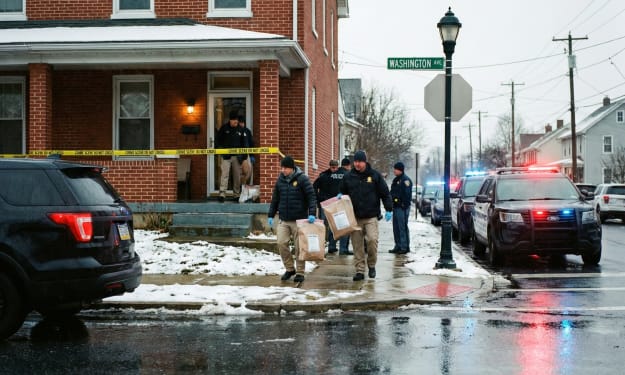
INVESTIGATION TARGET: JONATHAN C. GERLACH INCIDENT LOCATION: 100 WASHINGTON AVENUE, EPHRATA PA CHARGES: ABUSE OF CORPSE (x100), THEFT, DESECRATION STATUS: INCARCERATED ($1M BAIL) KEYWORDS: #HouseOfSkulls #JonathanGerlach #EphrataCrime #MountMoriah
By Sunshine Firecracker5 days ago in Criminal



Comments
There are no comments for this story
Be the first to respond and start the conversation.