
The Cocaine Broker: Inside the Empire of Roberto Pannunzi
How One Italian Man Built the Bridge Between Colombia and the Mafia
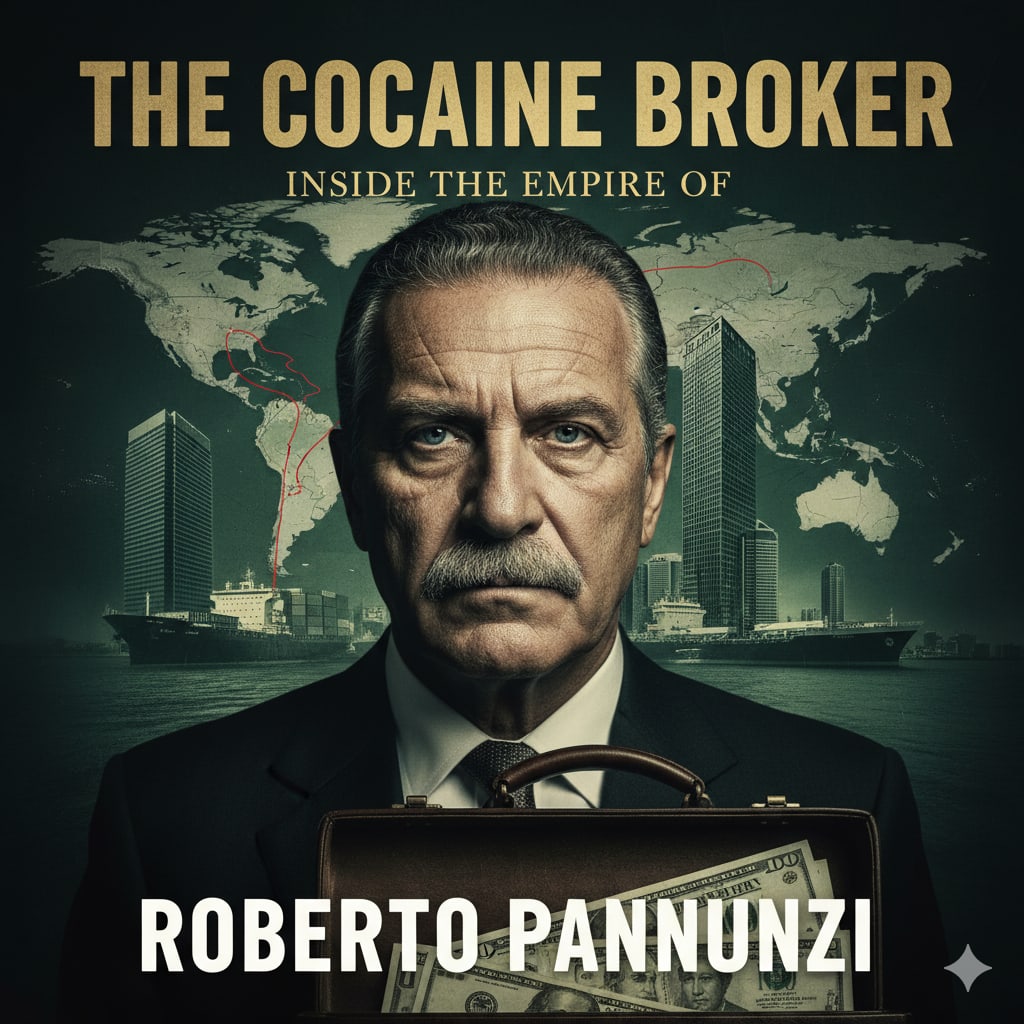
In the murky world of international drug trafficking, few names carry as much weight — or mystery — as Roberto Pannunzi. For decades, he was the invisible thread connecting Colombia’s cocaine cartels with Europe’s most powerful mafia networks. To law enforcement, he was a ghost; to criminals, a legend. Interpol once called him “Europe’s most wanted drug trafficker.” To his enemies, he was simply “the broker.”
Born in the 1940s in Rome, Pannunzi grew up in a world where the Italian mafia was part of everyday life. His father ran a small business, but young Roberto was more fascinated by the underworld’s glamour — sharp suits, expensive cars, and whispered power. He began his career in petty crime, smuggling contraband cigarettes, but his intelligence and calm demeanor soon caught the attention of bigger players.
By the 1970s, Roberto had formed connections with the ’Ndrangheta, Calabria’s powerful mafia syndicate. Unlike the Sicilian Cosa Nostra, which focused on traditional rackets like extortion and political control, the ’Ndrangheta saw an opportunity in cocaine — the new gold of the underworld. But they needed someone who could connect them to the suppliers in South America.
That man was Roberto Pannunzi.
Fluent in Spanish and English, charming in conversation, and cautious to the point of paranoia, Pannunzi had the rare ability to build trust across cultures. In the late 1970s and early 1980s, he began traveling to Colombia, meeting with members of the Medellín and Cali cartels. His mission was clear: establish a direct supply line between Latin America’s cocaine producers and Europe’s mafia distributors.
And he succeeded — spectacularly.
Pannunzi wasn’t a violent man. He didn’t run street gangs or order hits. His genius was logistics and negotiation. He acted as a broker, buying massive quantities of cocaine directly from the cartels and selling them wholesale to the ’Ndrangheta, the Sicilian Mafia, and other European syndicates. By cutting out intermediaries, he made himself indispensable — and unimaginably rich.
For years, his operations flooded Europe with cocaine. It’s estimated that at the height of his career, Pannunzi was responsible for half of the cocaine imported into Europe. His network reached from Bogotá to Milan, from Madrid to New York.
Law enforcement agencies on three continents tried to catch him, but Pannunzi was always one step ahead. He changed identities, countries, and phone numbers with ease. He operated through shell companies, front businesses, and coded messages. To the average person, he was just another Italian businessman traveling for “import and export.”
But no empire lasts forever.
In 1994, after years of surveillance, Roberto Pannunzi was finally arrested in Colombia. His capture made headlines — but his legend grew even larger when he escaped from prison. He vanished into thin air, aided by corrupt officials and his vast criminal connections.
Authorities were stunned. For nearly a decade, Pannunzi lived under new identities in Spain, Venezuela, and Italy, continuing to manage parts of his empire remotely. He was eventually caught again in 2004 — but once again, he escaped custody. Each time, he vanished like smoke.
His final arrest came in 2013 in Bogotá, Colombia, in a luxury shopping mall. The man Interpol had hunted for years was casually buying clothes when police surrounded him. This time, there would be no escape. He was extradited to Italy and sentenced to prison for drug trafficking. Yet, even behind bars, his legend persisted.
Pannunzi’s legacy lies not in violence but in innovation. He turned drug trafficking into a global business model, creating a system that outlived him. The ’Ndrangheta — now considered the most powerful criminal organization in Europe — still uses the routes and networks he built.
To this day, investigators say that his “blueprint” for smuggling, money laundering, and offshore banking remains the foundation of modern organized crime. Some of his associates became billionaires; others vanished or were killed. But Roberto Pannunzi survived it all — calm, composed, and calculating.
He is often compared to Pablo Escobar, but in truth, Pannunzi was different. Escobar ruled through fear; Pannunzi ruled through trust and intelligence. He proved that the deadliest weapon in the underworld isn’t a gun — it’s a handshake.
Even now, in his twilight years, Roberto Pannunzi’s name still sends ripples through law enforcement circles. For many, he represents a turning point — the man who turned cocaine from a Latin American problem into a global commodity.
And perhaps the most chilling part?
He never saw himself as a criminal. “I am just a businessman,” he once reportedly said. “I move products. Others decide what to do with them.”
About the Creator
shakir hamid
A passionate writer sharing well-researched true stories, real-life events, and thought-provoking content. My work focuses on clarity, depth, and storytelling that keeps readers informed and engaged.
Keep reading
More stories from shakir hamid and writers in Criminal and other communities.
The Ghost of Medellín
In the late 1970s, deep within the misty mountains of Colombia, a man began building an empire that would terrify the world. His name was Pablo Emilio Escobar Gaviria, a man born into poverty who would one day command more power, money, and fear than many governments combined.
By shakir hamid4 months ago in Criminal
The Second Crime Scene: The 8 Bodies Found in the Ephrata Storage Locker
DOSSIER ENTRY: THE SECOND CRIME SCENE TARGET LOCATION: EPHRATA SELF STORAGE (FACILITY NAME REDACTED) SEARCH DATE: WEDNESDAY, JANUARY 7, 2026 EVIDENCE RECOVERED: 8 INTACT HUMAN CORPSES / SKELETAL REMAINS THEORY: "FINISHED GOODS WAREHOUSE" STATUS: VERIFIED (AFFIDAVIT OF PROBABLE CAUSE)
By Sunshine Firecracker5 days ago in Criminal
The Facebook Marketplace of Horrors: Inside the groups where bones are traded like baseball cards.
It Wasn't the Dark Web When we hear about the illegal sale of human body parts, we imagine the "Dark Web"—encrypted Tor browsers, Bitcoin wallets, and shadowy Russian servers. The terrifying reality of the Jonathan Gerlach case is that he wasn't hiding in the digital shadows. He was hiding in plain sight.
By Sunshine Firecracker4 days ago in Criminal
How to Succeed at the Benson Directory®
Congratulations and welcome to the Benson Directory® employee #22391! As our newest call handler, you will have the privilege of speaking with dozens of unique and interesting people on a daily basis as well as the opportunity to earn bonuses for high performance. Contained within this handbook you will find a set of ease to follow instructions designed to help you settle in to your new role and begin paving the way to success.
By S. A. Crawford3 days ago in Fiction



Comments
There are no comments for this story
Be the first to respond and start the conversation.