
The Case of Nellie May Madison
and the Battered-Woman Defence

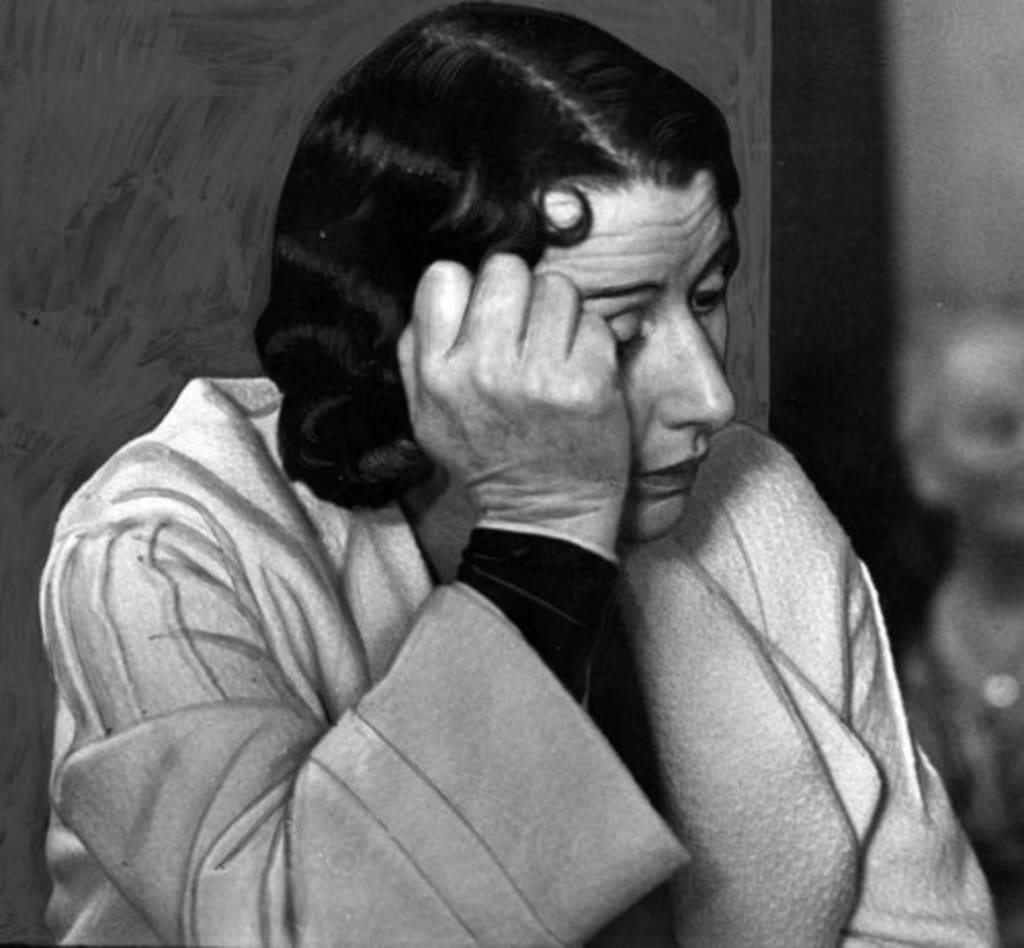
Nellie May Madison was the first woman sentenced to death in California. Her case was a stepping stone on the road to credibility for the abuse defence. At the time, the idea of a woman pointing to the spousal abuse she had suffered as the reason for her crime was unheard of. Nellie was born Nellie May Mooney, on the 5th April 1895 in Red Rock, Montana, to Edward Mooney and Catherine Doherty Mooney. Her parents had emigrated from Ireland to the USA a few years before she was born, and had their children - four including Nellie - in the US. They raised Nellie in Dillon, Montana; and she was trained to be a survivalist of the mountains.
When she was thirteen, Nellie married a twenty-four-year-old cowboy and ex-convict called Ralph Brothers. They eloped to Ogden, Utah in 1908. Her parents brought Nellie back home, and she went on to marry three different men. After her third divorce, she moved to Palm Springs where she met Eric Madison in 1933. The two of them dated for a short while, and when Nellie inherited one-thousand-dollars Eric proposed. They married in July of 1933 in Salt Lake City, Utah.
A few months later they returned to California, getting jobs in the commissary of Warner Brothers Studios in Burbank, and moved into an apartment together. Eric lasted at his job for two weeks until he overcharged director Albert Green for a box of cigars. This led to an altercation, which culminated in Eric Madison shouting and shoving the director, ultimately getting himself sacked. Nellie later reported that he was abusive for all of this time.
At some point in March 1934, Nellie came home earlier than she had expected to from seeing a film. Upon entering their apartment, she found Eric in bed with a 16-year-old girl. The girl screamed and ran, leaving Eric to beat Nellie. The beating lasted for six days, during which Eric boasted that he’d tricked Nellie into a fake marriage for her money and forced her to sign a note saying that they weren’t married.
Nellie went out and bought a 32-20 calibre Spanish revolver from a second-hand dealer on the 23rd March, saying when asked that she and her husband were going on a trip and needed one for safety. She later said to an unknown person that she intended to use it to scare her husband, and to get the note back. Nellie signed and paid for the gun, arranging to return the next day to pick it up.
The next day she took the gun to a local hardware store in order to buy some shells. The assistant told her that the gun was broken, and would need repairing before she could fire it. She then bought a 32-20 calibre Colt revolver and shells. She told the clerk she couldn’t wait the usual twenty-four hours, because she and her husband wanted it for target practice on a weekend trip to the local Frazier Mountain Park. When she was at the store, she called the local police department and asked for two people by name. They were both unavailable. She went upstairs in the store, and when she came down again said that “Lew” had authorized her to take the gun. Nellie left the Spanish gun shells at the store and left with both guns, and shells for the Colt revolver.
On March 24th 1934 at 8pm, Nellie arrived back at the apartment complex. She sat in the lobby and had a conversation with the building caretaker. The caretaker asked where her husband was. Nellie responded that he might be home at 10 or 12, or 1 or 2, or not at all. The caretaker made a poorly timed joke, asking “What, another woman?” to which Nellie replied: “Yes, another woman.” About ten minutes later, Eric entered the lobby from outside. He spoke briefly to the caretaker, and without a word to Nellie walked straight into their apartment. Nellie followed him. The caretaker was the last person to see Eric Madison alive.
We don’t know much else about what happened that night, until midnight, when Eric Madison was in bed arguing with Nellie. Nellie showed him her gun, perhaps as an attempt to warn him that she wasn’t going to stand for his abuse any longer. Eric reached under the bed and pulled out a butchers knife from the box he kept under his bed, threatening to cut out Nellie’s heart. He threw two knives at her, both of which narrowly missed. As he reached under the bed for another knife, Nellie lifted her gun and shot Eric in the back five times, killing him.
Neighbours were quickly woken by the sound of gunshots and gathered in the hallway to discuss the location of the shots. The building manager actually came and knocked on the door to Eric and Nellie’s apartment, asking if they were okay. Nellie opened the door, she said she’d heard the shooting but was fine. She claimed to have heard the noise from the floor below and joined the other residents in the hall. She appeared calm. A neighbour asked if she was afraid; Nellie said no, her husband would be home in about ten minutes. After a while, one of the men in the hallway suggested that the noise could have come from the Warner Bros. Studio opposite, which was filming the film ‘Midnight Alibi’ and they returned to their rooms.
The next morning, Nellie left her building at approximately eight-thirty, dressed and carrying a paper-wrapped parcel. She left a sign hanging on the door that read: “Please do not disturb, I will get my laundry later.” Nobody else was seen entering or leaving her apartment until about four that afternoon. Two people carrying a suitcase called on the apartment manager’s house and said that Nellie had arranged to reserve an apartment for one of them. The manager saw the sign, knocked on their door, and entered when he did not get a response. Upon entering, he found Eric’s body on the apartment floor.
It was clear Eric had been dead for over twelve hours.
The Burbank police received a tip and arrested her on March 26th, she was at the Cuddy Ranch, with Cuddy, whom Nellie had told she had “a little trouble,” some reports say she was found by police hiding under a blanket in the closet. Some say she was in there changing her shoes.
Dozens of reporters attended her interrogation at the Burbank police station. She denied killing her husband and was forced to tell police about her previous husbands. Nellie was charged with first-degree murder. There were five daily newspapers in Los Angeles, and they all fixated on Nellie and her crime, writing about her often. She was compared to the Femme Fatales featured in pulp fiction novels and crime noir. Artists edited photographs of her to make her look more sinister, calling her an “Iron Woman,” because she did not flirt, or cry, or beg for sympathy.
On the 6th of June, 1934, before even knowing the facts of the case, the LA Country District Attorney sought the death penalty. The trial began the following day, and caused an uproar - no woman had been executed by the state of California. Her lawyers advised that she not mention the spousal abuse, and instead to claim she was not at the scene of the murder. The trial was insanity. The crowds were overflowing, and a so-called “hanging judge,” who was known for favouring prosecutors, exhibits included the “death bed” complete with bloody sheets. Nellie perjured her testimony - saying that the dead man on her apartment floor was not Eric, but a stranger (all on advice from her lawyer), and alienated her from everyone.
Nellie’s testimony was obviously untrue, so a jury of eight men and four women found her guilty. She was sentenced to death by hanging. Nellie was the first woman in the state of California to be sentenced to death, on the 23rd July 1934. On July 13th she was driven to The California Institution for Women, Tehachapi, where she was put in a specially built death row to wait for her execution date.
Upon Nellie’s first appeal, the California Supreme Court upheld the conviction. One of her ex-husbands, with whom she was still friends, told her to make public the abuse that she suffered at Eric’s hands. Nellie fired her trial attorney and hired someone new, who supported her claims. On June 21st, 1935, she confessed to the murder, but also revealed her history of mental and physical abuse at the hands of Eric. She pled her case to the judge, who refused to reduce the sentence and did not believe her story at all - calling it “ridiculous.” Luckily, one of Eric’s ex-wives, Georgia Madison, came forward with a similar abuse story. Journalists quickly changed their tune and instead painted Nellie as a victim - a far cry from the Femme Fatale figure they were talking about previously. The public supported Nellie, including a well-known journalist called “Aggie” Underwood.
Underwood found out that Eric Madison had beaten Nellie and his ex-wife into signing confessions stating that they had been unfaithful in their marriage when actually it was Eric who had cheated. Not only had he been sleeping with other women, but he had also been sleeping with underaged girls. Every single juror who had convicted Madison petitioned Governor Frank Merriam to commute the sentence. Sixteen days before Nellie was scheduled to hang, on September 16th 1935, he commuted her sentence to life in prison. From her prison cell, Nellie began a letter-writing campaign from prison to reduce this. Governor Culbert Olson had Nellie freed on March 27th 1943. It was nine years and three days after the murder.
The same year as she was released from prison, she settled down in San Bernardino, where she married her sixth husband, John Wagner. Nellie died there on 8th July 1953, after suffering a stroke.
Now, in 2020, the abuse defence is fairly widely used in court, but a lot of people are still sceptical of it. Throughout Nellie’s case, the media behaved in unthinkable ways. They manipulated Nellie’s gender and appearance first in her disfavour, then to her advantage, changing their opinions based on anything but fact. Media outlets still behave like this now, treating both perpetrators and victims badly, publishing articles full of assumptions. There’s not really anything in place at the moment that can prevent this kind of behaviour, but hopefully, in the future, some kind of legislation can be introduced to prevent people like Nellie being maltreated in the future.
About the Creator
Keep reading
More stories from Molly Kent and writers in Criminal and other communities.
The Disappearance of Jennifer Kesse
Jennifer Kesse was born in New Jersey on May 20, 1981. She attended the University of Central Florida in Orlando and graduated with a degree in finance in 2003. Shortly after graduating she bought a condo in Orlando and started work as a finance manager at Central Florida Investments Timeshare Company. She had just returned from a holiday to The Virgin Islands with her boyfriend, Rob, and they were looking forward to taking the next step in their relationship. Then, on January 23/24 of 2006, she disappeared.
By Molly Kent8 years ago in Criminal
Push To Prevent Catapults Being Bought By Children
MP’s have been warned to put new legislation in place that will help to close a loophole in the law which allows people including children to legally buy weapons which is capable of killing wildlife. The alert was issued during a briefing in parliament which set out growing evidence that catapults were being misused against animals and to damage other people’s private property. The Naturewatch Foundation who hosted the session expanded on their message that at the moment there is a completely unregulated system where people of any age can buy weapons and there are no meaningful controls on sale or power.
By Ashish Prabhu6 days ago in Criminal
A Transparent Look at Vocal Challenges and Top Stories
Almost three years ago, we shared a resource article that served as a place for people to suggest new challenge prompts. We thought it would be a good idea to refresh that thread, and take the opportunity to answer a few common questions about top stories, how challenges are judged and how submissions are reviewed.
By Vocal Curation Team4 days ago in Resources


Comments
There are no comments for this story
Be the first to respond and start the conversation.