
The Bloody Inn: Diabolical True Crime & Tabletop Talk
Bloody table talk.

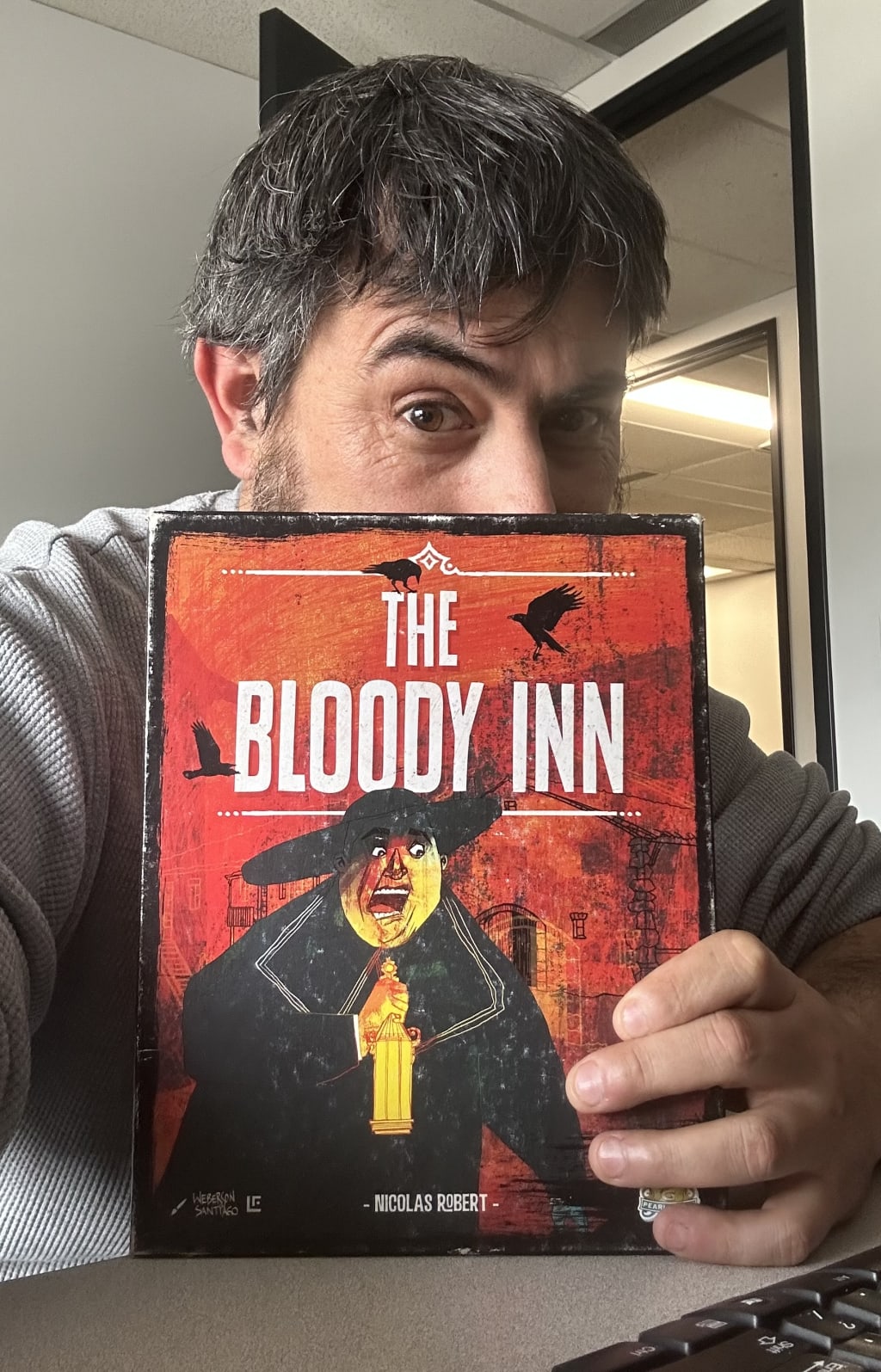
There’s something oddly delightful about dealing in death… at least when it’s made of cardboard.
One of my favorite board games of all time is ‘The Bloody Inn’ by Pearl Games. Set in rural 1830s France, you and your fellow players are the proprietors of a remote inn with a morbid twist—you’re not in it just to host guests, but to murder the wealthy ones and bury their bodies under the floorboards before the authorities catch on. It’s tongue-in-cheek. It’s tactically clever. And yes—it’s wickedly fun.
But the strangest part? It’s inspired by a real and rather horrifying series of events.
The “Real” Bloody Inn
Long before the board game or its comical namesake film adaptation in 1951, ‘L’Auberge Rouge’ (The Red Inn) was a real roadside stop near Peyrebeille in the Ardèche region of France. Run by Ultra Royalists of the former king, Pierre and Marie Martin, the inn reportedly became the scene of numerous disappearances and deaths over the course of two decades in the early 1800s.
The couple, along with their servant Jean Rochette, were arrested in 1831 after the mysterious disappearance of a horse dealer named Antoine Enjolras. His body was discovered near the Allier River, and had suspicious final whereabouts at this inn. Whispers and rumors from peasants in the area exploded into public outcry, and eventually, the trio was accused of rape, cannibalism, and over 50 murders. Yet, only convicted of one. However, that was more than enough to justify their execution right in front of their storied inn.
The inn remains today and is now a grim roadside attraction and museum, drawing morbid curiosity and dark history lovers alike. The legend has taken on a life of its own—fueled by folklore, dramatizations, and reinterpretations that lean less on evidence and more on eerie atmosphere and tabloid-like scandal.
Did this family commit these atrocities? All of the evidence brought against them was hearsay, second hand, and/or completely unsubstantiated lies. Such was the Napoleanic Code of the time. Especially against controversial political rivals. All testimony from the 100 “witnesses” were admissible in court. Their fate was sealed.
Morality and Macabre Laughter
So what makes this the perfect setting for a board game?
The Bloody Inn invites players to revel in the audacity of playing scheming killers taking guests for the money in their pockets. The art is dour, rough, and deadpan. Begging you to give life to it. The strategy is tight and methodical. And the laughs come easy as someone smirks, “Do I really have the right accomplices to build a crypt for more bodies AND pay off the priest this turn? How much money is that guest worth?”
It’s a masterclass in macabre comedy, and yet, every time I play it, a subtle chill remains beneath the surface. Because this is based on something real. People died. A family was beheaded in front of their home to the blood thirsty vitriol of a crowd of townsfolk. But we still play.
We still laugh.
From Tragedy to Tabletop
The same story has echoed through centuries of entertainment. The 1951 French film L’Auberge Rouge played the legend as farce, and Pearl Games transformed the tale into a darkly comic Eurogame. And now, I find myself even adapting this setting into a full tabletop roleplaying game inspired by the same events.
The question that haunts me most isn’t whether this is in bad taste—it’s why we do it.
Why are we so drawn to these morbid tales? What makes tragedy easier to handle when it’s wrapped in humor, or abstracted into mechanics? Why do games that simulate fictional murder become dinner party staples? And what does it say about us that we are most comfortable confronting death when we can giggle while doing it?
I don’t have the answer. But I do have a copy of the hilarious 1951 macabre French film L’Auberge Rouge and The Bloody Inn boardgame on my shelf—and a frequent table of players laughing as they dig another shallow grave. I also am writing a grimdark survival horror roleplaying game inspired by the diabolical table talk of this very game. (Pssst! Keep up with my progress and playtesting via www.ariesbrood.com!)
What is wrong with me?
And perhaps that important introspection, in itself, says more than enough and what we’re really trying to understand.
About the Creator
Lucas Diercouff
Filmmaker, writer, and avid roleplaying gamemaster. I look forward to writing more about my tabletop adventures around Colorado.
Get creative with me at www.ariesbrood.com!
Keep reading
More stories from Lucas Diercouff and writers in Criminal and other communities.
The Crane Catalyst
Under moonlight, The Cranes gathered. The "impenetrable" Le Marquis Bank in sight. Our insider, "Morris", propped the emergency exit, now entrance. Sal, always the charmer, even got the guard's phone number. VOLTaire killed the power as Bella slithered to the vault, locked by a biometric that will cost the CEO their job. Bella held her breath and placed her amino synthesized glove. The vault gave up a final gasp. Ours. Finally. Shimmering like a diamond of untold worth. They packed swiftly, leaving only a rainbow origami crane behind. The world would never be the same. Together, The Cranes lift all.
By Lucas Diercouff3 years ago in Fiction
Inside the House of Skulls: The Full Timeline of the Jonathan Gerlach Investigation
INVESTIGATION TARGET: JONATHAN C. GERLACH INCIDENT LOCATION: 100 WASHINGTON AVENUE, EPHRATA PA CHARGES: ABUSE OF CORPSE (x100), THEFT, DESECRATION STATUS: INCARCERATED ($1M BAIL) KEYWORDS: #HouseOfSkulls #JonathanGerlach #EphrataCrime #MountMoriah
By Sunshine Firecracker8 minutes ago in Criminal
The $23,000-a-Day Question: Ephrata spends $8.5 million a year for police. What are we actually buying?
The Invoice Arrives Every year, Ephrata property owners receive a tax bill. A massive chunk of that bill goes to one place: The Police Department. We are told this is the price of safety. We are told that we have a "Gold Standard" department that warrants premium funding.
By Sunshine Firecrackera day ago in Criminal
Wild Card Weekend Recap: What Happens Now?
I think I figured out why I love Wild Card Weekend so much. It's because it's the first playoff anything of the calendar year. The NFL season starts in the fall, and once upon a time, the champion was crowned either on or slightly before New Year's. The evolution of the NFL schedule has resulted in the playoffs starting just into the New Year, and currently, the final week of the season falls on the first weekend of the New Year, with Wild Card Weekend coming a week after that. So yes, chronologically, the NFL's Wild Card Weekend serves as the first playoff anything of the calendar year.
By Clyde E. Dawkins5 days ago in Unbalanced



Comments (1)
That board game sounds wild! Didn't know it was inspired by a real, creepy inn.