
The 11 Most Horrifying Crimes of the 1990s
Historical crimes broken down by decade: 1990–1999

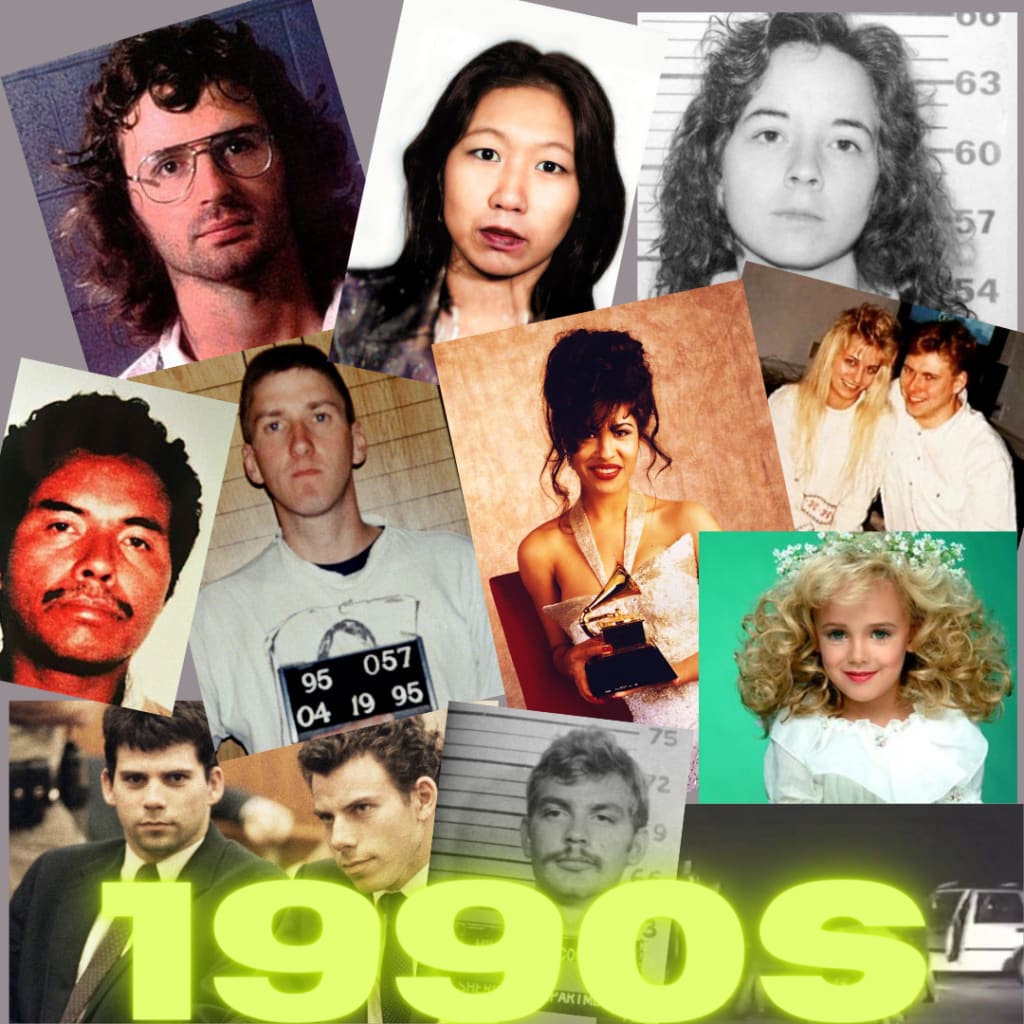
The 90s are typically remembered as a decade of peace and prosperity. The Cold War ended with the fall of the Soviet Union. The rise of the internet changed the way we communicate and opened up a whole new world.
However, the 90s were no different than any other time in human history when it came to crime. Terrible people did terrible things that we’d love to forget.
Some crimes will always remain in the back of our minds because of just how truly disturbing they were or what they symbolized.
The following are, in my opinion, the most disturbing and gruesome crimes that occurred during the 1990s decade.
The Menendez Brothers: Disturbed Siblings
While the crime itself happened in August of 1989, the highly publicized arrests and trials didn’t take place until 1992 through 1996. The two brothers were arrested and charged with the brutal murders of their parents, Jose and Kitty Menendez. While sitting in their living room, Jose was shot six times and Kitty was shot 10 times by their sons. Their injuries were so severe that it left them unrecognizable.
This case quickly became a national sensation not only because of the brutal nature in which these men assassinated their own parents but because their trial was the case that cemented Court TV as a theatric pastime.
The first trial ended in a deadlocked jury after the brothers attempted to blame their actions on emotional, physical, and sexual abuse. The retrial found both brothers guilty when the jury saw through their lies and realized they murdered their mother and father in cold blood simply for financial gain.
Jon Benet Ramsey: The Unsolved Murder of a Pageant Princess
The death of this beautiful 6-year-old little girl on December 26, 1996, quickly caught the nation’s attention. How could a child be murdered in her own home during Christmas and the police have zero leads? Her extensive beauty pageant career generated that much more interest in the case.
How Jon Benet was discovered, the infamous “ransom note”, the barbaric way she was killed, and a phantom pineapple meal just kept raising questions that to this day have not been answered.
Shotty police work, false confessions, improbable theories, and defamation lawsuits have kept this case in the spotlight for 27 years and yet we seem no closer to a resolution than we were then. The loss of a child is unimaginable, but to never know who took them from this world adds another level of grief to her family.
Selena Quintanilla-Pérez: Queen of Tejano Music
The murder of Selena Quintanilla-Pérez, professionally known as “Selena” was very much a “shot heard around the world.” Famous for her contributions to the music and fashion industries. She was one of the most celebrated Mexican American entertainers of the late 20th century and one of Billboard magazine’s “Greatest Latino Artists of All Time.”
She was young, beautiful, famous, ambitious, and loved by her family and fans across the world. She seemed to have a presence that reached out to everyone across the globe. Partly because she remained humble after rising from a family that had to declare bankruptcy and be evicted from their home to one of the biggest musical superstars of all time.
On March 31, 1995, Selena was shot by friend and business associate Yolanda Saldívar after Saldivar was confronted about embezzling money from Selena’s businesses. The loss of such a beautiful and talented soul was heartbreaking for her fans, but the anger over such a betrayal was what really made her murder that much more devastating.
Susan Smith: Murderous Mother
Susan Smith appeared on television screens across America pleading for her children to be returned to their family.
On October 25, 1994, Susan reported that her 3-year-old son Michael, and 14-month-old son Alex were kidnapped after she was carjacked by a black man while stopped at a red light. She continued the charade for nine days until investigators began to see through her lies and she confessed.
The entire nation, especially Susan’s family was absolutely devasted when the news of what really transpired broke.
Susan allowed her car to roll into the nearby John D. Long Lake, with both of her sleeping children buckled inside. She claims that she had intentions of killing herself as well, but her body “willed itself” from the vehicle before it reached the water.
Her defense claimed that she wasn’t responsible for the murder of her two precious little boys due to depression. However, the prosecution dropped a bombshell when they revealed that she had been having an affair with a man who broke off their relationship because he didn’t want children.
She was convicted of two counts of murder and sentenced to life in prison.
Paul Bernardo & Karla Homolka: The Ken & Barbie Killers
This marriage wasn’t a fairy tale. It was a horror story.
Paul Bernardo and Karla Homolka appeared to be like any other young, good-looking couple from the outside. However, unbeknownst to anyone, Paul already had quite the history of raping and abusing women. Karla, only 17 when they met, not only submitted to his deviant sexual behavior but encouraged it.
In 1990, Paul became obsessed with Karla’s 15-year-old sister Tammy. Karla was determined to “give her sister’s virginity to Paul for Christmas”.
They spiked Tammy’s drink with sleeping pills and when she fell unconscious, Paul raped her while Karla held a cloth soaked in the anesthetic Halothane over her mouth and nose. Her death was ruled accidental until the couple was tried for other murders.
They were eventually arrested and tried for the rape and murder of three women, including Tammy. Paul was found guilty and was sentenced to life in prison with the possibility of parole after 25 years. Karla however, took a plea deal. In exchange for her testimony against Paul, she only received a 12-year sentence for manslaughter.
Rodney King: A Symbol for Civil Rights
Rodney King was a black man that became the victim of police brutality on March 3, 1991. He was arrested after leading officers on a vehicle pursuit while driving intoxicated. What ensued during the arrest is what perpetuated the name Rodney King to become as associated with civil rights as Rosa Parks and Martin Luther King, Jr.
A bystander recorded four LAPD police officers beating King while he lay unarmed on the ground. The footage was sent to a local news station where it circulated very quickly, resulting in an uproar from the public.
The four officers involved were tried on charges of using excessive force, however, three of them were acquitted, while the jury for the fourth was unable to reach a verdict. As the news broke, so did the patience of minorities that were outraged by the lack of justice.
This sparked the 1992 Los Angeles riots, which lasted six days. During that time six people were killed and 2,383 were injured. It only ended after the California National Guard, the Army, and the Marine Corps sent reinforcements to regain control of the city.
Afterward, the federal government brought its own charges against the officers on the grounds of violation of King’s civil rights. Two officers were found guilty, while two were still acquitted. In 1994, a civil lawsuit was filed against the City of Los Angeles, which was held liable and ordered to pay King $3.8 in damages.
Waco Massacre: The Branch Davidian Compound
When a postman who was asked for directions by a news reporter turned out to be the brother-in-law of Branch Davidian cult leader, David Koresh, the ATF’s element of surprise was ruined.
Their attempt to reduce the risk to innocent people on the compound while conducting their search and arrest warrants failed.
Gunfire met gunfire as the Davidians used their cache of weapons to fire upon the ATF agents. At the end of this two-hour encounter, four ATF agents and six Branch Davidians were dead. But that was just the beginning.
Koresh claimed to be a prophet of God and threatened violence against anyone who tried to attack him and his “family” or interfere with their beliefs.
As 900 law enforcement officials surrounded the compound, a 51-day siege followed. The incident took center stage in the media as Koresh stated that he and his followers would come out when he finished his writing his messages from God.
Finally, the Attorney General approved a plan for officials to use special tanks to penetrate the compound and set off 400 containers of CS gas inside. Afterward, fires broke out inside the compound. The sounds of gunfire prevented firefighters from entering.
76 Branch Davidians, including Koresh, and 25 children died. Some had gunshot wounds, indicating suicide or murder-suicide.
A storm of resentment over the way the government and law enforcement officials handled the situation spread quickly. It was an example of the intrusion of the government into people’s private lives and is felt to be partly responsible for homegrown militias.
Ángel Maturino Reséndiz: The Railroad Killer
Angel Resendiz was a Mexican serial killer suspected of killing at least 23 people in Mexico and the US over the course of a decade. He was given the name “The Railroad Killer” since most of his murders occurred near railroads.
What was so terrifying about Resendiz is not only did he not have a victim “type”, but he also broke into their homes, which are usually considered our safe space. His weapons were usually his own hands or items that were already at the scene.
He shot, strangled, and beat his victims to death. He used bricks, a pickaxe, plywood, an antique fire iron, a tire rim, a statue, and even a railcar air brake hose coupling.
After each heinous murder, he would often hang around the home. Eating, looking at the victims’ driver’s licenses, and taking sentimental items that he would later give to his wife and mother as gifts were common.
Resendiz was sentenced to death for his crimes and executed via lethal injection on June 27, 2006.
Jeffrey Dahmer: The Milwaukee Cannibal
Dahmer is one of the most infamous serial killers in the world. The details of his murders disturbed even the most seasoned investigators, let alone the public.
He is responsible for the murders of 17 men and boys between 1978 and 1991. After he murdered them, he dismembered their bodies and often engaged in necrophilia, preservation of body parts, and cannibalism.
He initially gave his sexual partners sleeping pills to sedate them, because it frustrated him when they moved during sex. After “unintentionally” killing 25-year-old Steven Tuomi by beating him to death, he stopped trying to control his compulsions.
While considered a necrophiliac, Dahmer admitted that he preferred comatose partners to dead ones “75 percent of the time.” This is why he began injecting the brains of his live victims with hydrochloric acid, hoping to put them in a permanent zombie-like state. This often resulted in their immediate death; if not Dahmer would strangle them when it was evident his plan didn’t work.
He was convicted in 1992 and sentenced to life in prison. Dahmer was beaten to death by a fellow inmate at the Columbia Correctional Institution in Wisconsin.
Fan Man-Yee: The Hello Kitty Murder
Fan Man-Yee was a 23-year-old nightclub hostess and single mother trying to make ends meet. One night, she stole the wallet of a regular client, Chan Man-Lok. He demanded that Fan return the money, along with a fee.
Fan returned the money, but didn’t have the money for the fee. In retaliation, Chan kidnapped her and planned on pimping her out to other men to “pay off her debt.”
Fan was imprisoned, tortured, and raped by three men — Chan Man-Lok, Leung Shing-Cho, Leung Wai-Lun, and a minor girl for a month. She suffered immensely at the hands of her kidnappers and later died from her injuries.
Fan was beaten with metal bars, forced to eat human feces, burned with dripping melted plastic, strung up by her hands with electrical wire, and had chili oil poured into her wounds.
After her death, the perpetrators dismembered her body, boiled her body parts, and then threw them out with the trash. Her skull was put inside of a Hello Kitty mermaid doll.
The three men were arrested after the minor girl went to the police. Due to the lack of a body to determine the cause of death, they were only convicted of manslaughter, false imprisonment, and preventing lawful burial. All three were sentenced to life in prison, but Leung appealed his conviction and was only sentenced to 18 years.
Leung was released in 2011.
Alfred P. Murrah Federal Building: The Oklahoma City Bombing
The bombing of the Alfred P. Murrah Federal Building in Oklahoma City, Oklahoma remains the deadliest act of homegrown terrorism in US history.
On the morning of April 19, 1995, a Ryder truck carrying 5,000 pounds of explosives was detonated in front of the nine-story building.
168 people lost their lives that morning, 19 of them children who were in the building’s daycare center. The youngest victim was only 4 months old and over 850 people were injured.
A third of the building was decimated in seconds, over 300 nearby buildings were damaged, and the blast was felt over five miles away. It was the worst terrorist act the country had ever seen until the World Trade Center attacks on September 11, 2001.
This attack occurred on the second anniversary of the Waco Siege, and it wasn’t a coincidence. Evidence located at the scene led government officials to two anti-government white supremacists — Timothy McVeigh and Terry Nichols.
McVeigh, Nichols, and two other conspirators were motivated by their disdain for the federal government and disapproval of the way the Ruby Ridge Incident and the Waco Siege were handled. They felt that the more people that were killed, the more powerful their “message” would be.
On June 2, 1997, Timothy McVeigh was found guilty of 11 counts of murder and conspiracy and sentenced to death. He was executed by lethal injection on June 11, 2001.
Terry Nicols was also found guilty and sentenced to 161 consecutive life terms without the possibility of parole.
Accomplices Michael and Lori Fortier agreed to testify against McVeigh and Nichols in exchange for a lighter sentence and immunity for his wife. Michael was sentenced to 12 years in prison and was released in January 2006.
Obviously, there were many more well-known crimes that occurred during the 90s. The O.J. Simpson trial, the murders of Tupac and Biggie, Pablo Escobar, and the I-95 Killer, just to name a few, were major headliners. I feel that the 11 crimes listed above however shaped our world in a way that only the most horrifying can.
About the Creator
Kassondra O'Hara
Working mom who uses her curiosity to fuel the curiosities of others ~ Writes mostly history and true crime
Keep reading
More stories from Kassondra O'Hara and writers in Criminal and other communities.
Sherry Lynn Marler Simply Vanished from a Small Alabama Town
Sherry Marler was known as “Little Farmer” by the people who knew her in Greenville, Alabama. It was obvious why this was her nickname, as she was described as a tomboy who loved anything to do with farming.
By Kassondra O'Haraabout a year ago in Criminal
Murdering the love of Sarah Maguire
January 2022, it was a cold winter in Tulsa, Oklahoma, one that felt colder than most for some of us in the city. If one were to be out in the evening air of the cold, it was bone chilling to the soul. On an evening like this one who wouldn’t enjoy a good home cooked meal by someone who seemed to care about them? Right, Folks?
By Cassie Moore4 days ago in Criminal
Nuclear Firestorm
When a modern nuclear weapon explodes, the world inside its blast zone changes in a matter of seconds. The moment the weapon detonates, a blinding flash of light brighter than the sun fills the sky. Temperatures at the center of the explosion can reach millions of degrees, hotter than the surface of the sun. Everything close to the explosion—buildings, trees, vehicles, and living creatures—is instantly vaporized.
By imtiazalam2 days ago in Criminal


Comments (1)
The 90s had some truly messed up crimes. The Menendez brothers' case was crazy, and Jon Benet Ramsey's murder is still so mysterious. It's hard to forget these.