
Terrorism Across the Globe: Understanding Its Impact and How to Tackle It
"Preventing Terrorism: Global Strategies and Local Solutions"

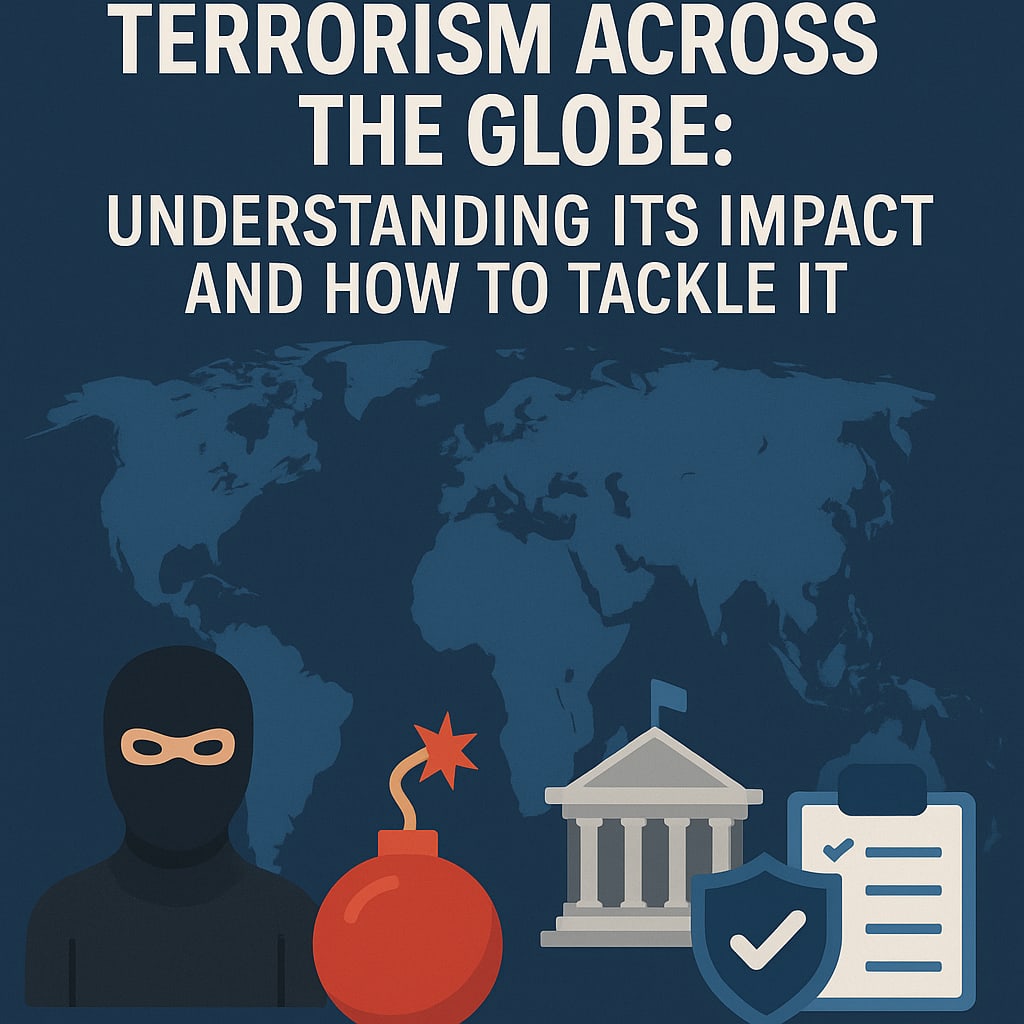
Terrorism is one of the most alarming global challenges of the 21st century. It affects countries across continents, regardless of their political system, religion, or economic status. From the 9/11 attacks in the United States to the ongoing threats in the Middle East, South Asia, and parts of Africa and Europe, terrorism has reshaped national security policies, impacted economies, and changed the lives of millions. This article explores what terrorism is, why it continues to grow, how it affects people and nations, and what measures can be taken to combat it effectively.
What Is Terrorism?
Terrorism refers to the use of violence, threats, or intimidation—usually against civilians—to achieve political, religious, or ideological goals. These acts are often designed to instill fear and create chaos. Terrorist groups may use bombings, shootings, cyberattacks, or biological weapons to spread fear and gain attention. Unlike traditional warfare, terrorism targets ordinary people and aims to disrupt normal life.
Global Spread of Terrorism
Terrorism is not limited to one region. It exists in various forms around the world:
In the Middle East, groups like ISIS and Al-Qaeda have carried out brutal attacks and controlled territories, spreading fear and radical ideologies.
In South Asia, countries like Pakistan, Afghanistan, and India have faced frequent terrorist attacks, especially along border areas.
In Africa, Boko Haram in Nigeria and Al-Shabaab in Somalia have committed mass killings, kidnappings, and bombings.
In Europe and North America, lone-wolf attackers inspired by extremist ideologies have targeted public places, schools, and religious institutions.
The rise of global communication, social media, and easy access to weapons and explosives have made it easier for terrorist ideologies to spread and operate across borders.
Causes of Terrorism
Understanding the root causes of terrorism is key to preventing it. These causes include:
Political instability and oppression: Lack of justice and freedom may lead some individuals to join extremist groups.
Religious extremism: Some groups use religion to justify violence and gain followers.
Poverty and unemployment: In poor regions, terrorist groups often recruit youth who have few opportunities.
Foreign interference: Wars and military occupations can fuel resentment and give rise to terrorist movements.
Lack of education: Misinformation and lack of critical thinking make it easier for people to be radicalized.
Impact of Terrorism
The effects of terrorism are devastating:
Loss of Lives: Innocent civilians, soldiers, and even children are killed or injured.
Economic Damage: Businesses shut down, tourism declines, and countries spend billions on security.
Fear and Mental Health: Continuous threats create anxiety, depression, and trauma among people.
Displacement: In war-torn areas, millions are forced to flee their homes, becoming refugees.
Division in Society: Terrorist acts can create hatred between communities, fueling racism and discrimination.
Preventing Terrorism: Global Strategies and Local Solutions
To tackle terrorism, a joint effort is needed from governments, international organizations, and local communities. Here are some important strategies:
Strong Intelligence and Surveillance: Tracking terrorist activities through data collection, internet monitoring, and intelligence sharing between countries helps prevent attacks before they happen.
International Cooperation: Countries must work together through organizations like the United Nations, Interpol, and NATO to share information and coordinate actions against terrorist networks.
Community Policing and Local Involvement: Police and local leaders can help identify early signs of radicalization and take preventive steps.
Education and Awareness: Promoting critical thinking, tolerance, and accurate information can reduce the influence of extremist ideologies.
Countering Online Propaganda: Governments and tech companies must work together to take down harmful content and provide positive alternatives online.
Addressing Root Causes: Long-term peace can only be achieved by addressing poverty, injustice, lack of education, and human rights violations that push people toward extremism.
Final Thoughts
The fight against terrorism is not just a battle of weapons and security—it is a fight for the hearts and minds of people. By promoting education, justice, unity, and dialogue, we can remove the foundations on which terrorism thrives. Every country, every community, and every individual has a role to play in building a world where peace prevails over fear. Let us raise our voices for harmony, stand together against hate, and work for a safer, more compassionate world for future generations.
About the Creator
Keep reading
More stories from Sharjeel Muhammad and writers in Criminal and other communities.
"The Sun: The Lifeline and Powerhouse of the Universe"
By Sharjeel Norani The Sun is not just a bright ball of fire in the sky—it is the beating heart of our solar system, the ultimate source of energy, and a life-sustaining force without which life as we know it could not exist. It is the anchor that keeps the planets in orbit, the engine that powers Earth's climate and weather, and the reason living organisms flourish. This article explores the importance of the Sun in both scientific and philosophical terms, shedding light on how it truly is the lifeline and powerhouse of the universe.
By Sharjeel Muhammad11 months ago in Education
The Middle East at a Crossroads
The Middle East at a Crossroads The Middle East has once again become the center of global attention as tensions rise between several powerful countries and regional actors. Conflicts, political rivalries, and military movements have created an atmosphere of uncertainty that many analysts believe could reshape global politics in the coming years. Although wars and crises have occurred in this region for decades, the current situation feels more fragile and dangerous because multiple global powers are indirectly involved.
By Wings of Time a day ago in Criminal
The Man Who Stole Silence
M Mehran The city of Karachi never truly sleeps. Even at 3 a.m., when the street vendors have packed their carts and the traffic thins into an occasional growl, there is a pulse beneath the silence. It’s the hum of secrets. And in that hum lived a criminal no one could catch. His name was Farhan Qureshi, though the newspapers would later call him The Whisper Thief. Farhan didn’t carry a gun. He didn’t break locks. He didn’t leave fingerprints. What he stole was far more valuable than gold—he stole silence. For two years, the wealthiest neighborhoods of Karachi reported strange incidents. No jewelry missing. No cash gone. Yet every victim insisted something had been taken. A private conversation. A hidden confession. A secret buried in the dark. The police were baffled. Inspector Danish Malik, a decorated officer known for dismantling organized crime rings, was assigned the case. At first, he dismissed it as paranoia. “People lose money and invent drama,” he told his team. But then he listened to the recordings. Each victim had received a single audio file. In it, their most private moment—an argument with a spouse, a confession of bribery, a hidden affair—played back in chilling clarity. Attached was a simple message: “Pay for your silence.” This wasn’t theft. It was psychological warfare. It was criminal extortion crafted with surgical precision. And Farhan was brilliant. A Criminal Mind Built on Observation Farhan had once studied sound engineering at a local university. He was gifted—top of his class. Professors predicted he would work in film or music production. But talent doesn’t always walk the straight path. After his father’s sudden death, debts swallowed his family. Scholarships vanished. Dreams collapsed. Bitterness replaced ambition. Farhan discovered something during his final semester: people reveal everything when they believe no one is listening. From rooftops, parked cars, and disguised maintenance visits, he planted tiny listening devices in homes of influential businessmen, politicians, and social elites. He never targeted the poor. He chose people with reputations to protect. He didn’t rush. He collected months of conversations before making a move. He built profiles. Studied behavior patterns. Understood their fears. Unlike typical criminals driven by impulse or greed, Farhan thrived on control. And control is addictive. The First Crack in the Perfect Crime Inspector Danish noticed something others ignored. None of the devices were ever found. “Not one?” he asked his forensic team. “Not one,” they confirmed. That meant the criminal wasn’t breaking in repeatedly. He was installing something permanent—or something invisible. Danish reviewed architectural plans of the targeted houses. He discovered a pattern: all the homes had recently installed high-end smart sound systems from the same supplier. The company? EchoWave Solutions. Danish paid them a visit. The office was small, modern, and surprisingly minimal. Only three employees were listed. One of them—Farhan Qureshi. Clean record. No prior arrests. Soft-spoken. Intelligent eyes. When Danish shook his hand, he felt it—the calm confidence of a man who believed he was untouchable. Psychological Cat and Mouse Danish didn’t arrest him immediately. There was no direct evidence. Instead, he started surveillance. Farhan, however, sensed it. Criminal psychology often reveals a dangerous truth: the smartest criminals are hyper-aware. Farhan noticed the unmarked car parked across his apartment. He noticed the unfamiliar number calling and hanging up. So he escalated. Instead of extorting quietly, he released a politician’s secret recording publicly. It exploded across social media. News channels debated ethics, privacy, and corruption. The city panicked. Was he a villain—or a vigilante exposing hypocrisy? That moral confusion protected him. Some citizens secretly admired him. “He only targets the corrupt,” online forums argued. But Danish knew better. A criminal who justifies his actions is still a criminal. The Mistake Every Criminal Makes Arrogance. Farhan believed he understood fear better than anyone. But he underestimated something—human unpredictability. One of his victims refused to pay. Instead, she invited him to release everything. Her name was Samina Rahman, a school principal with nothing to hide. Farhan sent the audio. It was harmless—her crying over financial struggles, her doubts about leadership. Instead of shame, she received sympathy. The public response shifted. If he could invade her privacy, he could invade anyone’s. Now fear replaced fascination. Danish used that moment. He publicly announced a digital trace had been found—bluffing. He described a fictional encryption flaw in the criminal’s system. Farhan panicked. Not outwardly—but digitally. He logged into his secure server from a backup connection he believed was untraceable. It wasn’t. Cybercrime units tracked the IP to a warehouse near the port. Inside, they found walls lined with monitors. Audio feeds labeled with names. Dates. Addresses. And Farhan. He didn’t run. He simply removed his headphones and said, “You’re late.” Inside the Criminal’s Mind During interrogation, Farhan remained composed. “Why?” Danish asked. Farhan’s answer was chilling. “Because silence is power. The wealthy use it to hide corruption. I just borrowed it.” “But you sold it,” Danish replied. Farhan smiled faintly. “Everyone sells something.” Psychologists later analyzed him as highly intelligent, emotionally detached, and morally rationalizing—traits common in non-violent white-collar criminals. Yet what made him truly dangerous wasn’t cruelty. It was patience. The Aftermath The case became one of Karachi’s most discussed criminal investigations. It reshaped conversations about digital privacy, surveillance, and smart home vulnerabilities. EchoWave Solutions shut down. New cybersecurity laws were proposed. And Farhan Qureshi was sentenced to twelve years in prison for extortion, illegal surveillance, and cybercrime. But even behind bars, rumors circulate. Some say he’s writing a book. Some say he’s helping authorities understand criminal behavior. Others whisper that he left hidden recordings no one has found. Because the scariest criminals don’t always steal money. They steal peace of mind.
By Muhammad Mehran7 days ago in Criminal



Comments (1)
This was a great article. We must raise awareness about this topic especially in these times.