
"Terror’s Architect: The Rise and Fall of Usama bin Laden"
Tracing the Footsteps of a Jihadist Who Changed History Forever

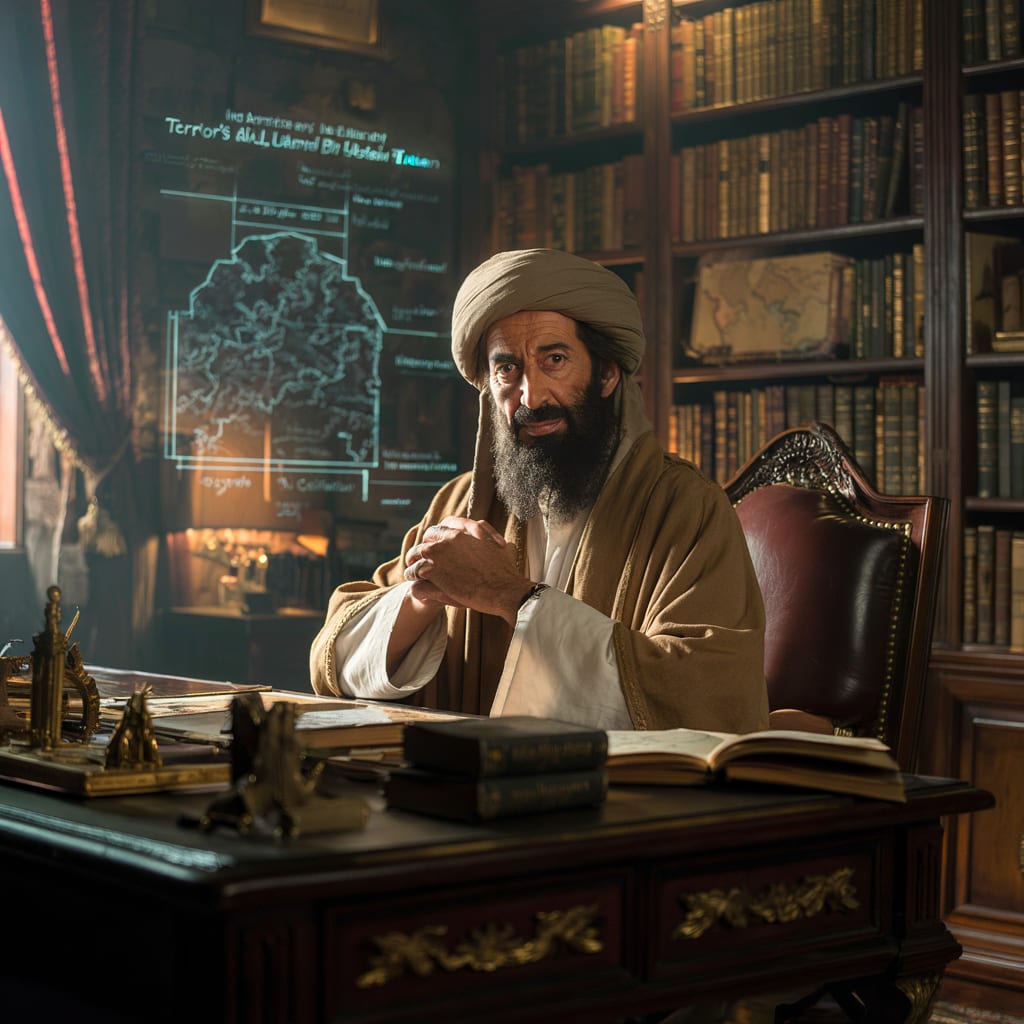
Usama bin Laden was born into privilege, but he died in secrecy—buried at sea after becoming the most wanted man on Earth. His life story is a chilling chronicle of ideology, violence, and global warfare.
Born in 1957 in Riyadh, Saudi Arabia, bin Laden was the 17th of over 50 children in the wealthy bin Laden family. His father, Mohammed bin Laden, had amassed a fortune through construction contracts tied closely to the Saudi royal family. Usama was raised in a world of luxury, but also strict religious values. As a young man, he studied business and Islamic law, developing a deep and rigid interpretation of Islam.
The Soviet invasion of Afghanistan in 1979 marked the first major turning point in bin Laden’s life. He left the comforts of Saudi Arabia to join the Afghan resistance, known as the mujahideen. He wasn’t just a fighter; he became a financier and recruiter, using his wealth to build networks and training camps. This experience in Afghanistan not only gave bin Laden combat experience but also exposed him to the idea of uniting Muslims globally in armed jihad.
In 1988, bin Laden founded al-Qaeda—Arabic for “The Base.” It was meant to be a global network of Islamic fighters focused on resisting non-Muslim influence in Muslim lands. But its mission quickly escalated. The 1990s saw al-Qaeda expand its reach through bombings, assassinations, and propaganda. In 1996, bin Laden issued a fatwa declaring war against the United States, accusing it of occupying Islamic holy lands and exploiting Muslim nations.
The world began to feel the full force of bin Laden’s ideology in 1998 when al-Qaeda bombed U.S. embassies in Kenya and Tanzania, killing over 200 people. In 2000, the USS Cole was attacked in Yemen, leaving 17 American sailors dead. But it was the events of September 11, 2001, that would mark bin Laden forever in the pages of history.
On that morning, four planes were hijacked by al-Qaeda operatives. Two crashed into the World Trade Center towers in New York City, one hit the Pentagon, and the fourth was brought down in Pennsylvania by brave passengers. Nearly 3,000 people were killed. Bin Laden became the face of terror. His message was clear: America and its allies were targets, and no one was beyond reach.
In the aftermath, the U.S. launched the War on Terror. Afghanistan’s Taliban regime, which had sheltered bin Laden, was toppled. Bin Laden, however, vanished into the mountains of Tora Bora and for years eluded capture. He became a ghost—issuing video messages, mocking the West, and inciting more violence.
Despite years of searching, leads went cold. Rumors suggested he was hiding in remote caves, protected by tribal loyalty and terrain. But in 2010, U.S. intelligence tracked a trusted courier to a compound in Abbottabad, Pakistan. The high-walled compound raised suspicions—it had no internet or phone lines and burned its trash. Months of surveillance followed. Then, on May 2, 2011, a team of U.S. Navy SEALs launched Operation Neptune Spear.

In a daring night raid, the SEALs stormed the compound. After a brief firefight, Usama bin Laden was killed with a shot to the head. His body was quickly identified, then buried at sea to prevent a burial site from becoming a shrine. The mission ended a decade-long manhunt and brought a sense of closure to millions affected by his reign of terror.
Bin Laden’s death was a symbolic victory, but not the end of terrorism. Al-Qaeda splintered and gave rise to even more brutal groups like ISIS. His ideology lived on, passed through digital propaganda and lone wolf attacks worldwide.
The story of Usama bin Laden is a lesson in how one man’s extremist beliefs, backed by wealth, global connections, and unwavering conviction, can reshape history. He rose from privilege to infamy, hiding behind faith to justify murder. And in the end, he fell—not as a martyr or leader, but as a fugitive brought to justice in the dead of night.
His life reminds us that terror doesn't grow in the dark alone—it feeds off politics, war, and belief. And while bin Laden is gone, the forces he unleashed remain a challenge for generations to come.
About the Creator
Haroon Afridi
Uncovering the innocent, exposing the guilty, and diving deep into the dark corners of justice. From twisted minds to courtroom drama—Criminal brings you the raw, the real, and the ruthless.
Keep reading
More stories from writers in Criminal and other communities.
Inside The Br@ tal Methods Of N@ zi Secret Police GESTAPO
They worked deep undercover with a name feared as words moved across Nazi occupied Europe. Gestapo: short form of Geheime Staatspolizel, or Secret State Police: the steel fist of Hitler and his machine of terror, entrusted with the job of tracking down foes of the Reich. However their actions behind the scenes were more terrible than many would ever imagine. In contrast to ordinary police, Gestapo never faced any supervision, did not present any warrant, and acted freely. Their methods was cruel: they could arrest a person because somebody whispered something, because a neighbour pointed an accusing finger, even because he shared a joke. Upon arrest individuals just vanished off the face of the earth with some never being heard of once again... (more)
By Live World Stories7 days ago in Criminal
How to Beat Ephrata Borough's Secrecy: A Citizen's Guide
(This is Chapter 21 of the complete Jonathan Gerlach investigation.) The Information War Filing a request under the Pennsylvania Right-to-Know Law (RTKL) in Ephrata Borough is the only legal tool citizens have to pierce the "Wall of Silence" surrounding the Jonathan Gerlach case. While the Mayor ignores emails and the Borough Manager deflects questions about the Associated Building Inspections (ABI) contract, the law is on your side.
By Sunshine Firecrackera day ago in Criminal



Comments
There are no comments for this story
Be the first to respond and start the conversation.