
Rise of Adolf Hitler
From Failed Artist to Dictator: How Adolf Hitler Seized Power and Changed History Forever


The rise of Adolf Hitler from a failed art student to one of the most notorious dictators in human history remains one of the most unsettling and cautionary tales of the 20th century. His ascent to power was not merely the result of personal ambition, but a complex interplay of social unrest, economic collapse, political instability, and persuasive propaganda. By examining the circumstances that enabled Hitler’s rise, we not only understand the fragility of democracy but also the devastating consequences of unchecked authoritarianism.
---
Early Life and World War I Experience
Born on April 20, 1889, in Braunau am Inn, Austria-Hungary, Adolf Hitler was the fourth of six children. After a turbulent childhood marked by a stern father and a deep interest in German nationalism, Hitler moved to Vienna in hopes of becoming an artist. However, his dreams were shattered after being rejected twice by the Academy of Fine Arts Vienna. During this time, Hitler developed many of the antisemitic and nationalist ideologies that would later form the foundation of his political beliefs.
When World War I erupted in 1914, Hitler enlisted in the German Army. Though he only rose to the rank of corporal, he was wounded and decorated for bravery. The war deeply impacted Hitler, and Germany’s defeat in 1918 left him embittered. Like many Germans, he believed the nation had been betrayed by corrupt politicians and communists — a narrative that would be central to his future propaganda.
---
The Political Chaos of the Weimar Republic
After Germany’s defeat in World War I, the Treaty of Versailles in 1919 placed the nation in a humiliating position. Harsh reparations, loss of territory, and economic penalties led to soaring inflation, mass unemployment, and widespread discontent. The newly formed Weimar Republic was democratic in theory, but in practice, it was unstable and plagued with infighting between communists, monarchists, and various nationalist factions.
This environment proved fertile ground for radical ideologies. Germans longed for a return to stability, pride, and order — and Adolf Hitler emerged as a voice that promised all three.
---
Hitler and the Nazi Party
In 1919, Hitler joined the German Workers’ Party, a small nationalist group. He quickly rose through its ranks and transformed it into the National Socialist German Workers’ Party (NSDAP), commonly known as the Nazi Party. Hitler’s oratory skills were magnetic; he captivated audiences with impassioned speeches filled with promises to restore Germany’s greatness and eliminate perceived internal threats such as Jews, Marxists, and foreign powers.
In 1923, Hitler attempted a coup known as the Beer Hall Putsch in Munich, which failed miserably and led to his imprisonment. But even this setback became a stepping stone — during his time in prison, he authored "Mein Kampf" ("My Struggle"), a manifesto outlining his vision for Germany’s future, based on nationalism, racism, and authoritarianism.
---
Economic Collapse and Political Opportunity
The global Great Depression of 1929 proved to be the turning point in Hitler’s political fortunes. As Germany’s economy collapsed, unemployment soared, and hunger spread, the Nazi Party gained traction. Many saw Hitler as a strong leader who could bring order and rebuild Germany.
By exploiting fear, anger, and despair, Hitler expanded the Nazi Party’s influence. His propaganda, orchestrated by Joseph Goebbels, painted Jews and communists as scapegoats for Germany’s woes, while promoting Hitler as the nation’s savior.
In 1932, the Nazi Party became the largest in the Reichstag (German parliament), although they didn’t hold a majority. Political chaos ensued, and conservative elites, believing they could control Hitler, persuaded President Paul von Hindenburg to appoint him as Chancellor of Germany on January 30, 1933.
---
The Road to Total Dictatorship
Once in power, Hitler moved quickly to dismantle the democratic structures of the Weimar Republic. Following the Reichstag Fire in February 1933, Hitler pushed the Reichstag Fire Decree, which suspended civil liberties and allowed mass arrests of political opponents. The Enabling Act, passed in March 1933, gave Hitler the power to enact laws without parliamentary consent.
By 1934, Hitler had eliminated all political opposition. After the death of President Hindenburg in August 1934, Hitler merged the roles of Chancellor and President, becoming Führer — the absolute leader of Germany.
---
Conclusion: The Rise and Its Lessons
Adolf Hitler’s rise was not an accident, nor the work of a single man’s will. It was the result of a nation’s vulnerability, a broken political system, and the seductive appeal of authoritarian solutions during times of crisis. His path from an unknown artist to a dictator who led the world into the deadliest war in history serves as a grave reminder.
The horrors that followed — from the Holocaust to World War II — make it essential that societies remain vigilant against hate, extremism, and the slow erosion of democratic institutions. The world must remember how Hitler rose to power, so it never happens again.
About the Creator
Mati Henry
Storyteller. Dream weaver. Truth seeker. I write to explore worlds both real and imagined—capturing emotion, sparking thought, and inspiring change. Follow me for stories that stay with you long after the last word.
Keep reading
More stories from Mati Henry and writers in Criminal and other communities.
Destruction in Gaza
Gaza, once a densely populated strip of land teeming with life, laughter, and resilience, now echoes with the sounds of falling bombs, cries for help, and the silence of lives lost too soon. The ongoing Israeli military offensive has turned entire neighborhoods into graveyards of shattered buildings and dreams. While global leaders trade statements and political debates rage on, the real cost is being paid by the innocent—women, children, and families who had no role in the politics of war but bear its cruelest consequences.
By Mati Henry 7 months ago in Criminal
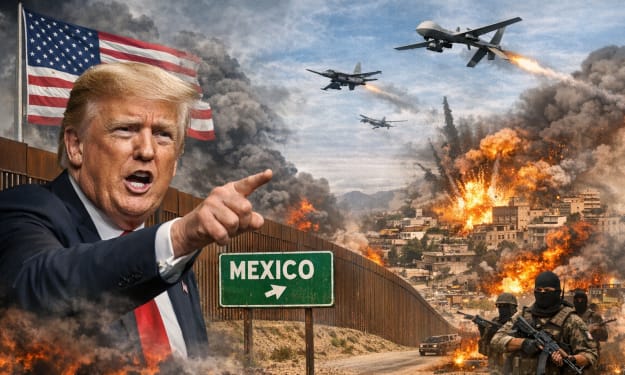
Donald Trump Threatens to Strike Mexico: A New Escalation in Political Rhetoric
Donald Trump Threatens to Strike Mexico: A New Escalation in Political Rhetoric Recent statements attributed to former US President Donald Trump have sparked widespread debate after he suggested the possibility of military action against Mexico. The comments, framed around combating drug cartels and cross-border crime, immediately drew attention from media outlets, political analysts, and the public. While such remarks are not entirely new in Trump’s political style, the idea of striking a neighboring sovereign nation has raised serious concerns about diplomacy, international law, and regional stability.
By America today 7 days ago in Criminal


Comments (1)
Hitler's rise is a chilling example of how bad times can let dictators take over. It shows how important a strong democracy is. The Weimar Republic's chaos was a big factor. Unrest and economic collapse made it easy for Hitler to gain power.