
Ötzi the Iceman: A Copper Age Murder Mystery
The real story of a murdered man frozen for 5300 years...


A frozen body protruding from the ice, copper age equipment and fatal wounds to the back - read on for the tale of Ötzi the Iceman, featuring:
- A Grim Discovery
- Ötzi's Autopsy
- Ötzi's Equipment
- How Did Ötzi Die?
A Grim Discovery
In 1991 a pair of German tourists had their holiday take a dark turn when they discovered a frozen human body protruding from the ice of the Ötztal Alps, between Austria and Italy.
Authorities assumed that the body was that of an unfortunate hiker, begging the usual recovery efforts one would expect in that situation. Several attempts were made to retrieve the body, but had to be abandoned thanks to the weather and then the lack of a helicopter for transport.
By this point, several items of equipment recovered from the body had raised eyebrows. He had an axe, a dagger and a stick (identified as a partially constructed bow) alongside some birch-bark containers - which isn't really what you expect for a modern mountain hiker.
The body was finally chipped freed using ice-axes and transported to the Institute of Forensic Medicine in Innsbruck under the eyes of a forensic scientist. An expert soon identified the body as being at least 4,000 years old - and it was placed in an ice-cold room to arrest any further decomposition as it thawed out.

Ötzi's Autopsy
Despite his age (the body dates back around 5300 years) Ötzi was very well preserved by his icy environment. The freezing cold temperatures turned him into an ice mummy, removing the water from his body like we freeze-dry food or freeze-distill alcohol. As a natural mummy, Ötzi was much more intact than a prepared Egyptian specimen - meaning that researchers were able to conduct autopsies of his body.
Ötzi was around 46, had an athletic build and bore signs of stress, fleas, whipworm and Lyme disease. He had suffered several broken bones during his lifetime and lacked a 12th pair of ribs (that's not incredibly uncommon - more than one in twenty modern humans have the same variation.)
Ötzi also had soot in his lungs (from frequent proximity to open fires) and a mixture of game meat (venison and ibex) plants and grains in his stomach. He was lactose intolerant (again, not uncommon for the time) with a predisposition for cardiovascular disease and a blood type of O positive.
He also had battle wounds that were a few days old, a severe head injury and an arrowhead embedded in his left shoulder!
Ötzi's Equipment
It wasn't just Ötzi that was preserved by the ice - though admittedly, his body seems in better condition than his gear.
He was clad in a loincloth, leggings, belt (with a stitched on pouch loaded with fire-starting supplies) and shoes, each put together from leather and hide stitched with plant fiber and animal sinew. The shoes were surprisingly complicated, featuring a mesh of bark fiber holding grass in place as padding, all contained within a leather upper shell and sole.
He also had a mat of woven grass, which may have been part of a backpack or simply used as a shelter against the rain. A cap of bearskin held on with a chinstrap completed his ensemble.
The real prize for an attacker should have been Ötzi's copper axe. This luxury item was the province of the rich and high-ranking around 3000BCE, suggesting that Ötzi may have been a figure of importance. The axe feature a blade of nearly pure imported copper - and it would have served as an effective tool and potent weapon.
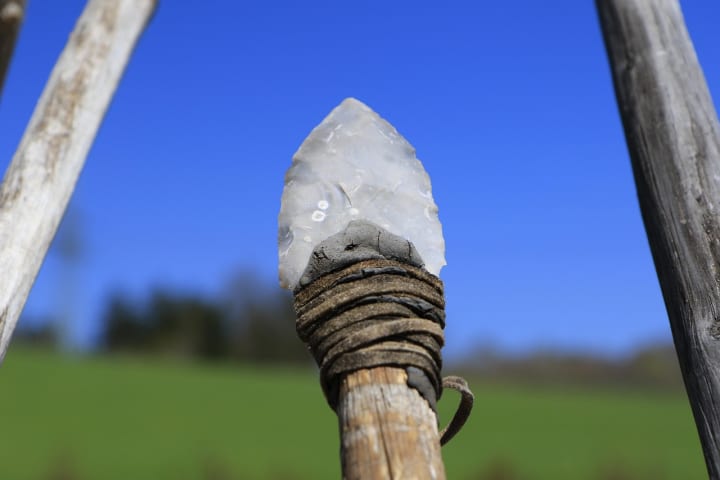
Ötzi also had a partially finished bow and several arrows, along with a practical flint knife. He had a wood-and-antler tool for resharpening flint items, containers made of stitched together birch-bark, the remains of a backpack and belt attachment designed to carry dead birds.
Ötzi carried one final item that might have offered the wounded man a glimmer of hope - bits of birch polypore on strips of hide. These fungi have antibiotic and styptic (i.e. can help staunch bleeding) properties that may have helped him survive a wound. It's been suggested that the strange posture Ötzi's was found in was due to applying pressure to the wound.
How Did Ötzi Die?
It was probably the arrow wound that killed our copper-age friend. The flint head had punched through his back and severed the subclavian artery, which would have caused him to bleed to death.
Researchers actually discovered fibrin around the arrowhead - this protein is used by the body to clot blood and start knitting a wound. Fibrin is rapidly replaced as healing continues, meaning that Ötzi probably died within half an hour or so of being shot. Curiously, the shaft of the arrow is missing... suggesting that either Ötzi or his killer broke the shaft off, perhaps in an attempt to remove the arrow.
It's not clear where the head wound came from. Perhaps it was the strike of an ambushing pursuer, the result of Ötzi falling after the arrow hit or even a final blow from his killer.
Given that he had been in hand-to-hand combat a few days previously and fled into the Alps before being shot, it seems likely that he was hunted down and murdered by a vengeful enemy. The fact that his valuable axe and dagger were left suggests that theft wasn't the motive of the killing... or that Ötzi managed to escape his killer before succumbing to his wounds.
Thanks for reading - for more grim discoveries, try...
- 8 Bizarre Kinds of Mummification (Including Smoked, Soap & Self-Made!)
- 8 Unbelievable Ways to Die
- Shackled Skeletons & Mummified “Alien” Remains: Unearth These 7 Bizarre Burials
Sources and Further Info:
About the Creator
Bob
The author obtained an MSc in Evolution and Behavior - and an overgrown sense of curiosity!
Hopefully you'll find something interesting in this digital cabinet of curiosities - I also post on Really Weird Real World at Blogspot
Oklahoma Murder for Hire
Murder for hire in 1988 must have been a real monster of a time to find for a woman who was bored, and just lazy. A woman that claimed she was abused, knew how to work a young man up, back in those days it was much easier to find “a knight in shining armor”. Men all over wanted to be one, no man how scuzzy they really were.
By Cassie Mooreabout 14 hours ago in Criminal
Donald Trump and the Iranian File: Policies, Tensions, and Public Questions
Donald Trump and the Iranian File: Policies, Tensions, and Public Questions Donald Trump’s approach to the Iranian file marked one of the most controversial chapters in modern US foreign policy. During his presidency, relations between the United States and Iran shifted dramatically, moving away from diplomacy toward pressure and confrontation. Trump’s decisions reshaped the Middle East landscape, affected global energy markets, and sparked intense debate both inside and outside the United States. Understanding Trump and the Iranian file requires examining his strategy, its consequences, and the questions people most frequently ask.
By America today 3 days ago in Criminal




Comments
There are no comments for this story
Be the first to respond and start the conversation.