

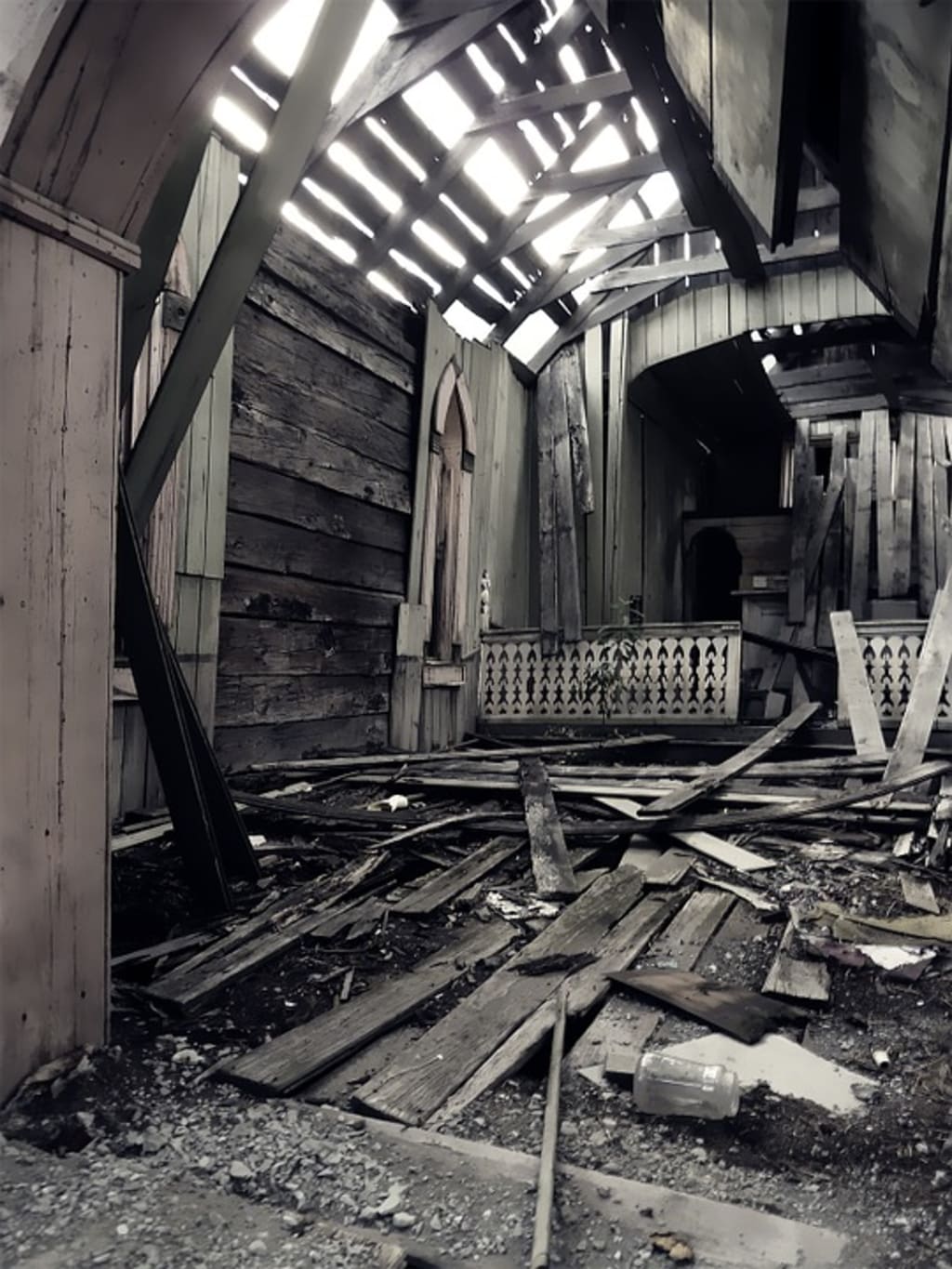
NOWHERE HERE BUT OUTSIDE.
The words were scribbled in bold, large letters on the church wall, sprayed in black paint. Some dead animal’s blood had been smeared beneath it. The stench of putrid, raw meat told the hours since the Calvari had visited the holy site.
Seven days.
A crucifix dangled sideways, in midair; a precarious omen. Detective Xea Geller of the Southern Wales Police Department fixed her eyes upon the sway of its dangerous rhythm. She was unperturbed by the sight of the disemboweled body nailed to the cross. She’d seen the work of the Calvari before.
“Jesus!”
Geller didn’t turn around when Baron entered the wide double doors of the church. She let her colleague’s eyes adjust to the carnage. The sound of retching echoed along the walls.
“Try to be more respectful next time,” the Leporida femme warned. “This is still a church.”
Cotton Baron was as tender a cop as a Bovid femme could be. She even wore garlands on her bull horns at Christmas. It didn’t make her a bad cop, just a queasy one. She was also new to the atrocities of the extremist group terrorizing Christianity. But she wasn’t a Christian herself—a Buddhist, if she could recall correctly—and she often forgot that Geller was.
Geller wasn’t a stranger to the case of the weak stomach, but she had been working these cases for the last three years. She was already used to the many smells and sights that came with being assigned to one of the most important cases in religious and police history in fifty years. The media called them Satanists; the public, witches; but she knew better. The Calvari were not tied to religion, even if they were a cult. Their purpose was to destroy all belief.
“You know, I’d heard of the Easter Massacre,” Baron wiped her mouth as she approached her co-worker. “But this…”
The bodies had been left on the pews, their throats split, their clothes stained with death, a crown of thorns wedged on their heads. No age had been spared. The counter on the wall marked one-hundred-and-one attendees.
No, the Easter Massacre had been nothing compared to this.
The wrath of the Calvari was unleashed on March 28, 2032. What seemed almost like a tender crime, they slaughtered thousands of rabbits and hares and hung them on the window sill of each house adorned with an Easter motif.
The second bloodbath took place that same year, on December 24th. Reports of missing family men were heard across the country before they were found stuffed in their chimneys, dressed in Santa suits and dismembered. A bag of presents waited by the open fire. The stench of burning flesh filled towns and cities alike for weeks, but no one ever forgot it.
The next year, on All Hollow’s Eve, a collective scream was heard as the San Francisco Bridge wore the grizzly sight of hung bodies. The women wore witch’s clothes. The men had carved pumpkin heads.
Never before had they touched the children. Until now.
“Xea,” Baron called as she examined one of the bodies. “Take a look at this.”
Geller walked to the front pew, her eyes finding what her colleague had noticed. Trapped in the joined hands of a brother and sister was a single orchid bloom. “What do you make of it?” Baron asked her. Geller snatched the flower in ire with one hand, and closed the children’s cold staring eyes with the other. “The Calvari regard orchids as a symbol of power and new beginnings. Something big is coming, Baron. Something dark.”
“Darker than this?” the other woman stretched out her arms.
Geller stood. She lifted the orchid to the light seeping in from the broken cupula. “'Nowhere here but outside',” she recited the words on the wall. “It means there’s no such thing as happy endings. And the Calvari are trying to prove it.”
About the Creator
Keep reading
More stories from Karilin Berrios and writers in Criminal and other communities.
The Draw
It happens every year. You switch, you feel, you change, you make. You never really know what you’re going to get—or who. Last year, I got Gertrude Silverback. She was motherly, soft, and generous. I made seventeen patched blankets that year and sold them for half a silver coin. The year before, it was Mr. William Woodchuck. I became very strict and formal and made my best money doing sales. Thirteen silver coins that year.
By Karilin Berrios5 years ago in Fiction
The $1 Deed: Did Jonathan Gerlach Transfer His Ephrata Property to Hide Assets?
The Paper Trail While the investigation into the Mount Moriah Cemetery grave robberies was quietly building, Jonathan Gerlach was already making moves to separate himself from his most valuable asset.
By Sunshine Firecrackerabout 10 hours ago in Criminal
A Horror Movie Come to Life: Inside the Nightmare at 100 Washington Avenue
The Raid on Washington Avenue On the morning of January 6, 2026, the residents of Washington Avenue woke up to a swarm of law enforcement vehicles. But this wasn't a standard drug bust. The officers entering 100 Washington Avenue were wearing hazmat gear and respirators.
By Sunshine Firecrackerabout 18 hours ago in Criminal


Comments
There are no comments for this story
Be the first to respond and start the conversation.