
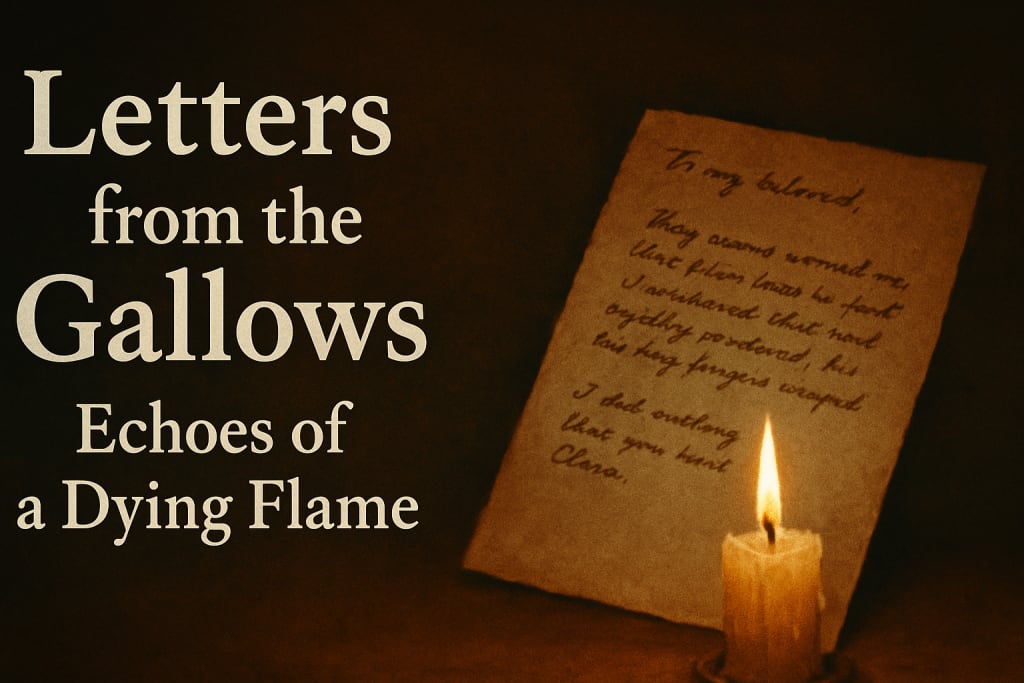
Newgate Prison, 1783
They say a man reveals his truth when the noose waits for him. For Thomas Everly, condemned for treason against the Crown, truth was all he had left—and letters were the only way he could offer it.
Each evening in his final week, he dipped the jailer's stub of a quill into cheap ink and poured pieces of his soul onto scraps of parchment. They would not save him. But perhaps, they could explain him.
To my sister, Mary,
You always warned me that fire lives in my bones. I mocked you for it. Said I was bold, not reckless. But you were right, dear sister. I see that now. My fire burned too hot—against injustice, against cruelty, and, yes, against the King.
Do you remember how Father’s body was dragged from the debtor’s cell, stiff and thin as cordwood? They said he deserved it—for owing coin to the very man who underpaid him. That was the first match struck in me. The second came when our mother begged bread from the magistrate and was spat upon for her trouble.
I swore then I would never kneel to such men. And I kept that oath.
I joined the movement not for glory, but for hope. We wrote pamphlets. We spoke in alleys and basements. We printed truth on stolen presses. And yes—we plotted to burn the tax records that bled our people dry.
I did not throw the torch. But I held the map. And for that, they will hang me.
To my beloved, Clara,
They would not let me write you first. The jailor said letters of the heart should wait, lest they soften a man’s resolve. Fools. They think a man is strongest in anger. They have never known the power of love.
Do you remember that night in the garden, with the lanterns swaying in the rain? You whispered that the world was wicked, but you would brave it if I walked beside you. I carry that night with me, Clara. It is stitched into every breath I draw behind these iron bars.
They offered me a bargain, love. Name names, and I would live. You would have me back. But I could not—will not—be the man who sends others to the rope to save his own neck. I hope you forgive me for that. I could not betray them, or myself.
I want you to live, Clara. To love again. To find joy in the things we once dreamed of—roses, poetry, a child’s laughter. Do not let this grief root itself in you. Burn these words if they hurt too much. But if you keep them, know that they carry every heartbeat I have left.
---
To my son, James,
You are only three. Too young to know the meaning of a rope, or a scaffold. I pray someone reads this to you one day, when you are old enough to ask why other children have fathers and you do not.
They will call me a traitor. But I was loyal—to the hungry, to the broken, to the silenced. I spoke when others whispered. I fought when others fled. I hope you will grow strong, not in defiance alone, but in compassion. Strength is not in fists or fire, but in knowing when to use them—and when not to.
Look after your mother. She will teach you kindness and truth. She is braver than any soldier. She stood by me when I had nothing but ink and conviction. She believed in me. I hope you do too.
By the final day, the jailor no longer mocked him. He waited silently as Thomas sealed the letters. No wax, just folds and string. The gallows were being built across the square. The hammering echoed through stone walls.
When the sun rose, Thomas was led from his cell, his boots worn thin, his wrists bound with rough cord. The street was lined with faces—some jeering, some weeping. A priest whispered last rites, but Thomas only looked skyward. The clouds were red at the edges, as if the heavens mourned at dawn.
“Any final words?” the sheriff asked.
Thomas’s eyes found Clara in the crowd. Her hand was pressed to her mouth. Behind her, Mary stood tall, clutching James close.
He smiled—not for forgiveness, but for love.
“I have nothing more to say,” he said. “My letters carry my voice.”
The hangman nodded. The rope creaked as it was drawn taut.
And then, silence.
The letters were delivered in the days that followed. Mary read hers in the chapel, tears streaking down a face that had always been unshakable. Clara read hers by candlelight, the words lighting a fire that would never go out. And little James—he would not understand his father’s letter until years later, but when he did, he wept like the world was ending and swore to build a better one.
Thomas Everly was buried in an unmarked grave, but his letters survived—in pockets, in hearts, in the whispered stories of those who dared dream of justice. They were words from the gallows, but they echoed like thunder in the souls of the living.
About the Creator
Keep reading
More stories from Said Hameed and writers in Criminal and other communities.
A Fifth Autopsy
Dr. Elara Morrow washed her hands slowly, as if scrubbing away the dread that had taken root under her skin. She’d done four autopsies in as many days, each more bizarre than the last. Each body arrived with the same signs: no external wounds, organs appearing pristine, but a blank expression frozen in wide-eyed terror.
By Said Hameed8 months ago in Criminal
Casting Stones from Crystal Walls: Tracing the 'Corrupt Crusade' Against Kiernan Major
Ever since the dubious arrest of upstate New York native Kiernan Major, an unforgiving odor has lingered among his close associates, friends and supporters—an odor that calls into question nearly everything that has lead up to and followed his incarceration. More than two years prior to his arrest, Major had founded a private intelligence and security consulting firm based in San Francisco's financial district. Stacked with ex-military and intelligence personnel. The founding members spent years methodically scanning military, academic, and intelligence networks for their shared antipathy toward the so-called "military-industrial complex."
By Charlie A. Miller6 days ago in Criminal
Killer Mike, Young Thug and others petition Supreme Court in death sentence of man who had rap lyrics used against him in court
The usage of lyrics to condemn a man to death is wrong. Rappers like Killer Mike who articulates the nature of the game well showed his prowess with the legal documents.
By Skyler Saundersabout 19 hours ago in Criminal


Comments
There are no comments for this story
Be the first to respond and start the conversation.