
Justice is Due: The Atul Subhash Story — A Tragedy Buried Under Paperwork
A 34-year-old AI engineer’s chilling final message exposes the dark reality of India's legal system

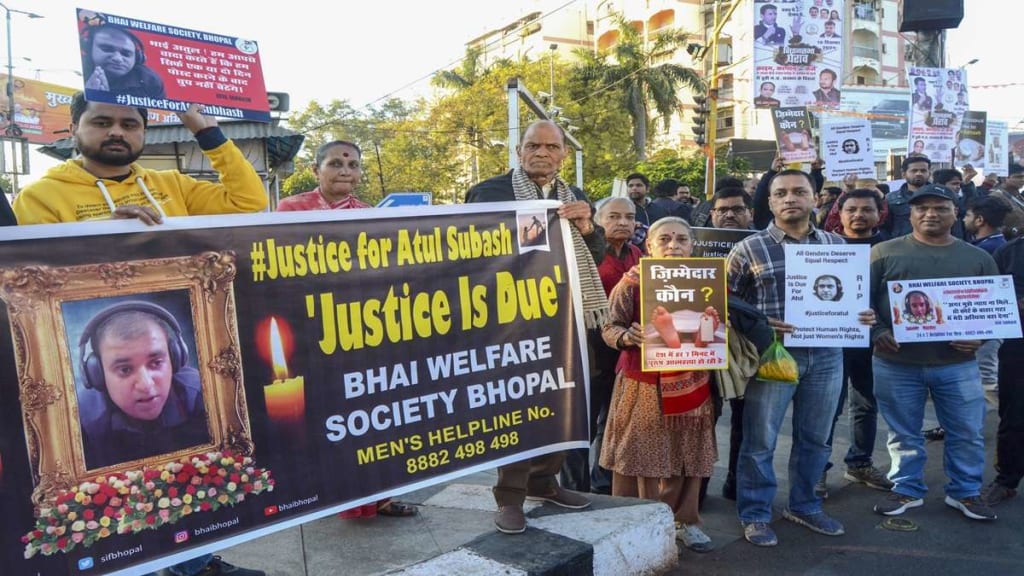
About a month ago, on 9th December, Atul Subhash died of su****e Bengaluru.
His body was found in his apartment in Munnekolalu, Bengaluru. He had an A4 sheet on his chest that read, Justice is due.
He even recorded a 1.5-hour video. "Hello world. My name is Atul Subhash." "I am 34 years old. I live in Bangalore."
"Today, I am going to commit su****e." And a 24-page note.
In his video and note, Atul Subhash blamed five people.
His wife, Nikita Singhania, the principal family court judge of Jaunpur,
his mother-in-law, brother-in-law, and wife's uncle. Before taking such a step, he made a detailed to-do list for himself.
What all he had to do before this extreme step. All this shows that the steps Atul took were deliberate and well-planned.
But why? In this story, I'll talk about this case in detail which exposes our legal system.
For this story, my team spoke to Save Indian Family Foundation's Sumedh Bhosker and Deepika Bhardwaj, a men's rights activist and documentary filmmaker.
To write this story, I looked at Atul's letters, note, and video to find out his version.
And Nikita's version was taken from the news reports published after the police questioning.
I'm going to beep some words from this video.
Atul and Nikita met on Shaadi.com and got married in April 2019.
Nikita is from Jaunpur and has an impressive background. She has a B.Tech in Computer Science and an MBA in Finance.
After that, she worked in the IT industry with Codex Info Solution and HDB Financial Services Ltd.
Atul belongs to Samastipur, Bihar. He works as an AI engineer for Mahindra in Mahindra in Bengaluru.
Before marriage, when Atul talks to Nikita on the phone, he realizes that Nikita is mature
and the kind of girl he wants to spend his life with. But the decision to get married is taken too soon.
There's a reason for this. Nikita's father's health deteriorates and according to doctors,
he has very little time left. That's why he prepones his wedding so that Nikita's father could attend the wedding.
After marriage, Atul and Nikita go to Mauritius for their honeymoon. During the honeymoon, Atul learns a lot about Nikita.
First of all, Nikita didn't want to marry Atul. She was under family pressure, especially because of her father's health.
Because of this, she said yes. During the honeymoon, they have a lot of arguments. But after coming back from the honeymoon,
Atul decides that he would somehow try to maintain the marriage.
He plays the role of a supportive husband. He would drop Nikita to work, love her,
and do all the things that are expected from a responsible partner. Now, the situation between them was better.
In fact, Nikita gets pregnant. As if everything was going well. Then one day, an incident happened.
On August 2019, a few months after their marriage, Nikita's father passed away.
After losing his father, Nikita's behavior changes. Her behavior changes and due to some disciplinary issues,
she loses her job. She would either spend hours on the phone with her mother, or binge-watch Korean romantic dramas.
One day, Nikita tells Atul, I want you to be like the male characters in these dramas.
After losing her father, the distance between Atul and Nikita grows. Remember, Nikita is pregnant.
Atul and his mother try to support Nikita during this time. But the situation at home is not good.
Nikita behaves rudely with Atul's mother. Sometimes, she doesn't discard chicken bones, despite the fact that
her mother-in-law is a vegetarian. In 2020, she has a son. A month later, a ceremony is held in Bengaluru to celebrate her son's birth.
These celebrations are organized by Atul and his mother. But when Nikita's mother and her brother go there, they are not happy.
Because they feel that Atul and his family didn't work hard for this celebration. A dispute arises between them.
And Nikita's family leaves the celebration. Two days later, the first lockdown is imposed in the country.
"The entire country will be in lockdown from midnight today."
Because there is no domestic help during COVID-19, Atul starts taking on household responsibilities.
He has to sweep, mop, wash utensils, clean the bathroom, and take care of the child.
Nikita doesn't help him much because she is still frustrated with her job.
To support her carrier, Atul teaches her programming and AI, refines her resume, and helps her with interviews.
Finally, in April 2021, Nikita gets a job at Accenture. At this time, the entire country is going through a scary second wave of COVID-19.
Many people are dying and their businesses are going bankrupt. This is what happened to Nikita's mother's business.
Nikita's family is not doing well financially. That's why they ask Atul for help.
In 2021, Nikita's family asked Atul for Rs. 15 lakh
to buy Nikita's mother's business inventory. In March, Atul sent Rs. 9 lakh and in April, Rs. 4 lakh.
But according to Atul, this money wasn't used for the mother's business. It was used to buy a house worth Rs. 1 crore.
Apart from this, Atul was asked for Rs. 50 lakh more. When Atul finds out, he asks for his money back.
Out of Rs. 13 lakh, he only gets back 1.5 lakh. Nikita pretends that she had COVID-19
so that she could call her mother to Bengaluru. This became a pattern. Nikita and her mother pressurize Atul for money and other demands.
Nikita's brother Anurag demands that they want to shift to Bengaluru
and start a cloud kitchen business with Atul's support. Atul is against this.
By May 2021, the situation became serious. Nikita's COVID-19 result is negative.
Despite this, Atul brings medicines for Nikita but Nikita refuses to take them.
After this, they have a big fight. On May 16, 2021, Nikita and her mother left Bengaluru and went to Jaunpur
with Atul's son and his family's jewelry. From Jaunpur, Nikita's family started pressurizing Atul.
They accuse him of physical abuse and harassment. Nikita's mother spreads rumors among Atul's relatives
that Atul was mentally and physically torturing them. Demands escalate to the point that Nikita's family tells Atul
that he should come to Jaunpur and apologize to everyone. But Atul has a different plan.
He agrees to come to Jaunpur but instead of apologizing in front of everyone, he wants to expose that the family has been trying to extort money from him.
After this threat, Nikita stops all communication between Atul and his son.
After this, the situation gets worse. Nikita's family demands Rs. 1 crore to settle the case.
But if this demand wasn't fulfilled, they'd file more legal cases against Atul.
Atul thinks that he and his family are educated and have evidence so they wouldn't be able to harass him.
But he is proved wrong. In January 2022, the first case against Atul is filed in the lower court of Jaunpur.
Remember, this case was filed in Jaunpur. We'll talk about this later.
The case claims that in 2019, Atul demanded a dowry of Rs. 10 lakh
from Nikita's father. This increased his stress to the point that her father died.
Three months later, the case is withdrawn. In 2023, Nikita admits during a cross-examination
that her father wasn't stressed by the dowry but his illness. Her father had been suffering from heart disease and diabetes for years
and was taking a blood-thinning medication. The second case is a maintenance case filed in the court of Judge Reeta Kaushik
in Jaunpur. Nikita demands Rs. 2 lakh per month from Atul for maintenance.
Rs. 1 lakh for herself and Rs. 1 lakh for her son. The third case is a divorce petition filed in the Hindu Marriage Act
under Section 13 in Jaunpur. Atul claims that six months after filing the divorce case,
Nikita tries to withdraw it and claims that her lawyer filed the case without her knowledge.
The fourth case is a domestic violence case against Atul's parents and brother.
This case is filed in 2022. But neither Nikita nor her lawyer pursue the case for the next two years.
In 2024, the court dismisses the case. With the same pattern, many other cases are filed against Atul.
Another FIR is filed under many sections of the IPC and under the Dowry Prohibition Act.
Two petitions are filed in the High Court in the case of Fast-Track Maintenance and Dowry.
In September 2024, another domestic violence case is filed. Meanwhile, a court orders Atul to pay Rs. 80,000 per month for maintenance.
Nikita finds this amount insufficient. So she demands Rs. 3 crore from Atul in the High Court.
Atul doesn't want to accept this demand so he files his objection in the High Court. But there is a saying in the Indian legal system: Process is the punishment.
Forget about the decision of the case. You'll be tortured during the hearing. And that's what happens in this case.
Atul claims that according to the legal provision, the cases should've been filed in Bengaluru, where he lives.
But the cases were filed in Jaunpur and Lucknow, where Nikita lives. But the court rejects all these objections
and says that you have to pay for the maintenance. Nikita files 9 cases against Atul and Atul files 1 against Nikita.
During the last 2.5 years, there were 120 court hearings and Atul travelled 40 times between Bengaluru and Jaunpur.
He had to spend 2 days travelling. Since he only got 23 paid leaves per year,
it was difficult to manage the process. Atul said that many hearings were a waste.
Atul would travel and realize that the hearing was cancelled. Sometimes the judges are on leave, sometimes the lawyers are on strike,
and sometimes the hearings get delayed. Even after the court hearing, the proper procedure wasn't followed.
Before an accused's cross-examination, if there's any evidence, whether it's a document or physical evidence,
it's shared with the opposing lawyer. And only after that, the evidence can be used for cross-examination.
But this didn't happen in Atul's case. Atul also said that there's a lot of corruption in the court. Madhav, a clerk, told Atul that if Atul gave him Rs. 3 lakhs,
he could get a good maintenance order passed. Atul said that Judge Reeta Kaushik also asked
a bribe of Rs. 5 lakh to settle the case. Otherwise, he would've spent his entire life going back and forth the court.
As the case went on, the harassment on Atul increased. He said that Nikita and her mother even made fun of him
saying that he should commit su****e. On 21st March 2024, during a court hearing, even the judge didn't listen to Atul.
Nikita said, why don't you commit su****e. A few weeks later, 10th April 2024, Nikita's mother made fun of Atul again.
She said, I thought we'd hear about your su****e today. You had talked about it in the court.
Despite giving maintenance, Atul wasn't given permission to meet his son for 3 years.
Atul's father told the media that even on his son's birthday, Atul wasn't allowed to meet him.
Atul said, he only had 3 options left. Either he fights his case honestly
but takes the risk of manipulation and harassment. Staying alienated from his son and constantly face harassment.
Or he should commit su****e, which Nikita and her mother keep talking about.
Atul chose the third option. He said, this was the best option for him. Because of this, his harassment would stop
and the corruption of the legal system would be exposed. He asked several hard-hitting questions.
How can a judge allow the instigation of su****e in her chamber?
Why is there no accountability for filing false cases? Why is our society giving judges so much salary
when the court hearing doesn't do anything? He wrote a message to his son and his last wish.
Don't immerse my ashes until my harassers are punished. If the court decides that they're not guilty,
then throw my ashes in a gutter outside the court. Before taking this step, Atul did one last thing.
At 2 a.m. on 9th December, he writes an email to the Save Indian Family Foundation, an NGO that advocates for the Indian men who are facing domestic violence.
Please help my family. Thank you for your kindness so far. Atul included a link to an online folder in his email
containing all the documents and videos recorded by Atul. In this folder, there's a link to a video,
su****e note, a poem titled Death Holds No Fear,
a letter addressed to our President, a letter addressed to My Lords,
which criticizes our country's justice system, and a declaration in which Atul states that the accusations made by his wife are wrong.
And there's a folder containing his personal photos. As soon as the NGO receives this email, they alert the police.
But as soon as the police break the door of Atul's house, it's too late.
An A4 sheet is stuck on his chest which reads, Justice is due.
As soon as this incident happens, there's a ruckus on social media. #JusticeForAtulSubhash.
#MeToo. There are protests all over the country and candlelight marches.
On 11th December, Bikas Kumar, Atul's brother, files an abettment of su****e FIR in Bengaluru against Atul's wife,
mother-in-law, Nikita's brother, and uncle. Immediately after filing the FIR, Nikita's uncle rejects all the allegations.
"All the allegations are baseless." He also says that Nikita has all the answers. "Nikita is out of station right now."
"Once, she returns she will respond to all the allegations."
"She has an excuse for everything." He applies for anticipatory bail and is given bail by the court.
After which the search begins for the other accused, Nikita and her family.
After the FIR, it's found that they're at their house in Jaunpur. The police sticks a notice outside their house,
saying they have to to come to the police station in 3 days. After which the police form a team and monitor his family's movements.
After this, Nikita shifts to Gurugram from Jaunpur, while her mother and brother move to Prayagraj.
All this time, they talk on WhatsApp so that the police can't trace them. But by mistake, Nikita makes a normal call to one of her relatives.
The police get to know from the tower location that she's in the PG of Gurugram. "Actually, Nikita made a phone call."
"The Bengaluru police traced this to Gurugram and held her."
She's detained on 14th December. And her mother makes the same mistake that Nikita did.
She receives a normal call and the police track her and her brother's location.
All three of them are taken to Bengaluru on a late-night flight
so that there's no commotion at the airport. When they're taken to Bengaluru, their statements are recorded
and that's how we get to know Nikita's version of the story.
Before discussing Nikita's version, let's set the context. Let's go back to 2 years ago when Nikita filed allegations against Atul.
In January 2022, Nikita Singhania was the first to file for divorce and alimony in a family court in Jaunpur, Uttar Pradesh.
Four months later, she filed an FIR in Jaunpur against Atul and his family
where she claimed that her husband, his parents, and his brother were violent and mentally abusive.
She claimed that Atul treated their husband-wife relationship like a beast
and beat her up regularly. She said that when she tried to seek help from her family,
her parents told her to keep quiet and bear it. According to the complaint, Atul's behavior was so bad
that he mentally and physically tortured her. Atul took full control of her finances.
Atul also gave an answer to these allegations in his video where he said that he didn't take Nikita's salary.
Instead, Nikita gave a part of her salary to him for investment.
He said that when Nikita earned a few lakhs, she invested it in Atul's financial portfolio.
They agreed to that Atul will manage their investments. Atul also said that when Nikita withdrew the money,
she withdrew the principal amount along with the interest. Atul wanted to show that Nikita had full control
over how much she withdrew and how much she deposited. In fact, Atul said that he had chat messages showing Nikita sharing the OTPs.
Let's talk about the police questioning of Nikita. She denies all the allegations and levels four allegations against Atul.
She says that she had been away from Atul for 3 years. If she wanted to harass Atul, why would she stay away from him?
That's what she claims. She also says that Atul and his family demanded a dowry of ₹10 lakh
when they got married in June 2019. She says that two months after their marriage, her father died of cardiac arrest.
Despite the paretns, Atul's parents came to Nikita to threaten her that they'd call off the wedding if she didn't give them the dowry.
Finally, she says that even after her father's death and her child's birth in February 2020,
Atul physically and mentally assaulted her and demanded unnatural sex when drunk.
After being arrested, Nikita, her mother, and her brother applied for bail in Bengaluru's Sessions Court.
On January 4, Bengaluru's Civil Court approved their bail reasoning that the police didn't explain why they had been arrested.
Nikita also filed a petition demanding that the charges against them be cancelled.
Her lawyer argued that there's no detail in the complaint to justify that she should be held for an abetment to su****e FIR.
But the Karnataka High Court refused to do so. They said that there's a lot of detail in the FIR
and that they'd pursue the case. The court asked Nikita why she didn't want the investigation to proceed.
On the other hand, Atul's family filed an appeal against their bail.
In addition, they filed a case in the Supreme Court for custody of Atul's 4-year-old son.
But the Supreme Court didn't listen to Atul's family and asked how Atul's mother could take custody of the child.
Because the last time she saw the child, he was 2.5 years old. So Atul's mother is a stranger to the boy.
The court also said that in such cases, where the mother is still alive, the custody of the child will naturally go to the mother.
Despite this order, Atul's mother can apply for guardianship of the child. At this point, many of you will drop off.
I've seen this in my previous videos as well. Because people are interested in the drama of crime. But very few people are interested in the underlying problem.
You can see from the retention graphs of the Kolkata video that people stop watching the video when the discussion of crime ends
and I start talking about the root cause of the problem. If you want to solve this problem, the next part is for you.
Why? Why do we get to see such cases in our country? Because Atul Subhash's case is not a single case.
And whenever you read about such cases, you'll find one word there. Section 498A
In 2014, 38-year-old Akhtar Makhdoom committed su****e in Bengaluru. In his note, he said that his wife tortured him.
His wife left home with his 5-year-old son. And she filed Section 498A against him and his family.
She filed for a divorce. And asked for Rs. 10 lakh in alimony. Alimony is basically financial support that a spouse has to give to another spouse,
depending on who is earning money in the family. If someone is found guilty under Section 498A,
they can face a 3-year jail term and have to pay a fine. Why is Section 498A special?
Because it's cognizable and non-bailable. And because of these two things, this law is very powerful.
Cognizable means that the police can arrest an accused without a warrant.
And non-bailable means that you won't get an automatic bail. You'll have to go to the judge.
And if the judge agrees, you'll get the bail. "When the law was enacted, it was done with a very specific purpose."
"And the purpose was because there were a lot of these dowry deaths that were happening." "There were a lot of these demands which were made by the in-laws."
"And as a result of which the woman was tortured or she was thrown out of the house." So let's understand the context of why Section 498A was introduced.
The year is 1979. Shashi Bala was only 20 years old when he married Subhash Chandra,
who was a manager at Bata. 10 months later, he finds out that he's pregnant with a 6-month-old baby.
And then what happens? She is found dead. The husband's family says that the kerosene stove on which she was cooking food, exploded.
The same year, there's another incident in Delhi's Model Town. A 24-year-old Tarvinder Kaur is watching TV at home.
After a short while, her 28-year-old husband hears her screams. He finds out that his wife has been burned.
She's taken to the hospital. And a few days later, she dies. He finds out that his mother-in-law and her husband's other relatives had burned her.
But what's registered in the police case? Case of su****e. Due to such incidents, many women's rights activists start protesting.
Because there are murders in the country because of dowry. But nothing happens to the accused. Because our law is very weak.
In Shashi Bala's case, her husband had asked for a scooter in dowry. But he asked for it after marriage.
And according to the law, if someone asks for something after marriage, it's not considered dowry.
That's why her husband couldn't be arrested for dowry. That's why Shashi Bala's mother took the case to the Supreme Court.
So that she could get justice for her daughter. But the court said, our hands are tied. The law is so weak.
What can we do? That's why many women's rights organizations took to the streets
and demanded a strict law. Because of their hard work, in 1983, the government decided
to make the law stricter. And they introduced Section 498A.
According to this law, if a married woman's husband or husband's relatives commit cruelty against her for dowry,
it's a criminal offence. And they'll have to face imprisonment and fine. But the problem with this law is execution.
"The laws that are made to protect women are used very recklessly."
"It's not a matter of 2-3 years ago." "The misuse has been going on for 2 decades."
Deepika isn't the only one who claims this. 20 years ago, the Supreme Court said the same thing. "In 2005, the Supreme Court in a landmark judgment, Sushil Kumar v. Union of India,
said that Section 498A is being used like a weapon."
"This was supposed to be a shield and not a weapon." The Supreme Court said this in 2005.
20 years ago. It's been 20 years, but nothing has changed. Recently, in Telangana, a woman filed Section 498A
against her husband and his family. Now, there's no evidence in the woman's complaint. The Supreme Court also said that
in such cases, just naming family members won't do anything. They need solid evidence.
The Supreme Court said that this law was made to protect married women. But many women are misusing this law.
"Apart from the husband and the mother-in-law, father-in-law, they would write 7, 10, or 6 other names."
"And during investigation, invariably, it has been found that their names have been unnecessarily dragged into the matter."
"Whereas, they were not involved in the matter." The Supreme Court said that this law was made for genuine cases.
But if women misuse this law, what will happen to society? In fact, according to the National Crime Record Bureau data of 2022,
in Section 498A, 85% of the cases, the police file a charge sheet.
But only 15% of the cases get a conviction. This is one of the lowest conviction rates in all the crime categories.
The point is, on average, our society is against women. And to hide the failure of the courts, the government, and the police,
we've made laws against men. In the time of the British, the cobra snakes were the problem in Delhi.
The British thought, to solve this problem, why not give money to every dead snake?
Initially, this strategy was successful. In Delhi, the number of snakes started decreasing.
But after a while, the British realized that a crowd had gathered outside their offices to claim the money.
Because some people have started raising snakes to earn money. And the government did the same with the dowry issue.
On average, I repeat, our society is against women. According to the National Family Health Survey of 2021,
about half of the men and women believe that a man can beat up his wife.
90% of the people believe that a wife should listen to her husband.
80% of women still need their husbands' permission before going to the doctor.
But to solve this problem, we've made bias laws. This is Sumedh Bhoskar from the Save Indian Family Foundation.
While talking about Atul's case, he tells us that if a wife is abused,
she can file a case of cruelty against her husband and his family. This is a criminal case.
But if a husband tries to do the same, it becomes a civil case, not a criminal case.
And it leads to a marital dispute.
A civil case for the women and a criminal case for the men?
The issue is that we're not addressing the root cause of the problem. There are two root causes. The first root is gender attitudes, whether it's against men or against women.
For a solution, we should tell both men and women that women are as independent and capable as men are.
This is what the Breakthrough Foundation is doing with their Taaro ki Toli initiative. And we should teach men about mental health and their emotional maturity.
Almost half of the men don't talk to anyone about their issues because they're not told about their mental health.
The second issue is the legal system's 'process is the punishment' nature, which we saw in Atul's case.
Let me give you another example from Andhra Pradesh. An immigrant worker from Kuwait came to Andhra Pradesh to kill a 60-year-old man.
Why? Because the man assaulted his daughter. But when the police received the complaint, they didn't do anything.
What kind of legal system is this? According to the United Nations, there should be 222 police officers for every lakh people.
In our country, this number is 150. According to the Law Commission, there should be 50 judges for every 10 lakh people.
In our country, this number is 21. And look at the state of our country. On one hand, there's unemployment and no judges in our courts.
And on the other hand, there are vacancies in the same high courts. What happens because of this? People like Atul have to take leave from their companies
and go to Jaunpur from Bengaluru, where they find out that the court proceedings have been cancelled.
Instead of addressing this issue, our government is creating biased laws. But such things make our society more extreme.
Boys run after Andrew Tate and start believing that all girls are useless. "Females are barely sentient."
And girls start believing the same. Because of this frustration, many views of Atul are also very extreme.
He writes in his note how the women empowerment has grown rotten and that men should not support this movement.
At one point, he writes that India has become a country of baby killers where many irresponsible women are aborting their children.
Because of his life experiences, he stereotypes all women. But our society shouldn't commit the same mistake.
And for this, we should solve the root problem because of which Atul and other men have suffered in their lives.
About the Creator
🕵️♂️ True Crime Enthusiast | Storyteller of the Dark Side 🔍
🕵️♂️ True Crime Enthusiast | Storyteller of the Dark Side 🔍
Dive into gripping tales inspired by real-life crime cases, mysteries, and moments that challenge justice. Follow for suspense-filled stories that keep you on the edge!
Keep reading
More stories from 🕵️♂️ True Crime Enthusiast | Storyteller of the Dark Side 🔍 and writers in Criminal and other communities.
Humaira Asghar Ali Miserable Last Journey | Who is Responsible
Humaira Asghar was a young, talented model and theatre artist. A graduate of the prestigious National College of Arts in Lahore, she held a degree in Theatre and Sculpture and worked with respected names like Rafi Peer. She wasn’t an overnight sensation — she was trained, passionate, and determined to succeed on her own terms.
By 🕵️♂️ True Crime Enthusiast | Storyteller of the Dark Side 🔍6 months ago in Criminal
Two Teens, One Bus, and a Nation Watching
Hello, and welcome to “The True Crime Reader,” where we dig beneath the headlines to unravel the stories that shape our understanding of crime, justice, and society. Today’s episode takes us to Oakland, California, for the story behind Dashka Slater’s powerful nonfiction book, “The 57 Bus”—a case that stunned the Bay Area and reverberated across the country.
By Kristen Barenthaler3 days ago in Criminal
A Real Story: The Day Ameneh Bahrami Lost Her Sight
In 2005, Tehran woke up to what seemed like an ordinary morning. Buses were running, offices were opening, and students were heading to their universities. The city was moving through its usual routine. No one knew that, in one small part of the city, a tragedy was about to occur—one that would later shock the entire world.
By shakir hamid3 days ago in Criminal




Comments
There are no comments for this story
Be the first to respond and start the conversation.